

Rapport-Building Terms: Interactive Dictionary & Role-Play Examples
Rapport in medical administration is the working trust that helps patients share accurate information, ask questions, tolerate delays, and follow through on next steps. It combines effective patient communication, empathy in healthcare administration, active listening, and dependable follow-up. When that trust weakens, routine interactions can turn into patient complaints, incomplete intake records, scheduling disputes, or privacy concerns. This guide provides a practical dictionary, scripts, role-play exercises, and coaching methods for building rapport under real front-desk pressure.
1. Why Rapport-Building Is a Core Medical Administrative Skill
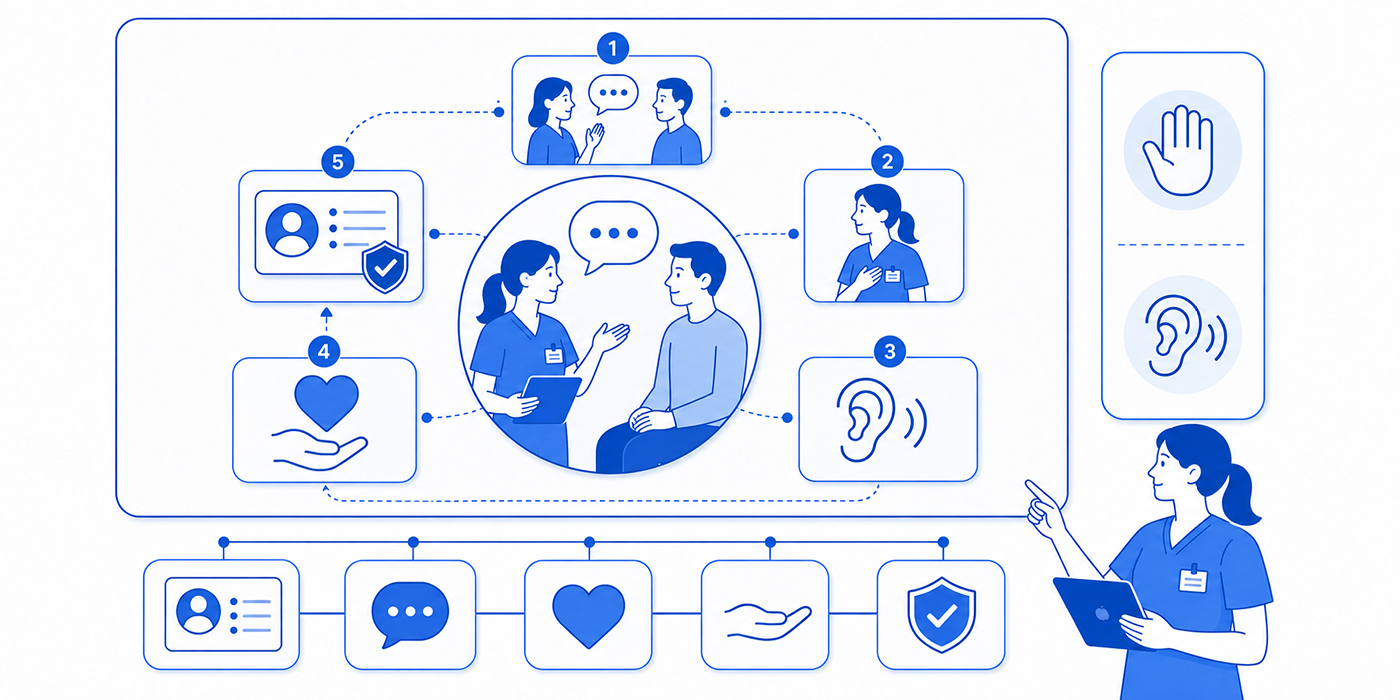
Rapport is the patient’s sense that the person assisting them is attentive, competent, respectful, and dependable. It begins during the first few seconds of an interaction, often before a detailed conversation occurs. A patient notices whether the staff member acknowledges them, protects their information, explains the process, and follows through on promises. These behaviors connect directly with front-desk operations, patient intake procedures, patient confidentiality, and medical administrative workflow.
Strong rapport improves the quality of information staff receive. Patients are more likely to clarify medication names, insurance changes, contact details, symptoms, accessibility needs, and scheduling limitations when they feel safe from embarrassment or dismissal. That information supports cleaner patient record updates, more accurate insurance verification, better appointment scheduling, and safer medical office triage.
Rapport also determines how patients interpret an unavoidable inconvenience. A delayed appointment may feel manageable when the patient receives an honest update, a specific estimate, and realistic options. The same delay can feel disrespectful when the patient receives vague answers or has to ask repeatedly. Staff who understand scheduling conflict management, difficult patient conversations, de-escalation techniques, and crisis communication can preserve trust while still enforcing policy.
The operational value extends beyond courtesy. Rapport supports patient retention, reduces repetitive calls, improves cooperation during registration, and helps staff identify concerns before they become formal complaints. It influences patient satisfaction metrics, the quality of patient portal management, compliance with patient privacy communication, and the effectiveness of patient education.
| # | Rapport-Building Term | Practical Definition | What It Sounds Like | Risk When Missed |
|---|---|---|---|---|
| 1 | Active listening | Giving focused attention, checking meaning, and responding to the patient’s actual concern. | “Let me make sure I understood what changed.” | The staff member solves the wrong problem or misses a safety-relevant detail. |
| 2 | Empathic acknowledgment | Recognizing the patient’s difficulty without claiming to know exactly how they feel. | “I can hear how stressful this delay has been.” | The patient feels dismissed and repeats the complaint more forcefully. |
| 3 | Open-ended question | A question that invites context instead of limiting the patient to a one-word response. | “What happened when you tried to use the portal?” | Important context stays hidden behind a premature yes-or-no answer. |
| 4 | Closed-ended question | A focused question used to confirm a specific fact after sufficient context has been gathered. | “Is 555-0134 still your preferred number?” | Overuse can make the interaction feel rushed or interrogative. |
| 5 | Reflective statement | A concise restatement of the patient’s concern that demonstrates accurate understanding. | “The main issue is that the new appointment conflicts with work.” | The patient must repeatedly correct the staff member. |
| 6 | Paraphrasing | Expressing the patient’s message in clearer language while preserving its meaning. | “You received approval, but the pharmacy still shows the request as pending.” | Details become distorted as the issue moves between departments. |
| 7 | Clarifying question | A question used to resolve ambiguity before entering, routing, or acting on information. | “When you say the claim was rejected, was that message from the insurer or the pharmacy?” | The concern is routed incorrectly and resolution takes longer. |
| 8 | Validation | Confirming that a patient’s concern is understandable or worth examining. | “It makes sense that you want the charge explained before paying it.” | The patient interprets the response as blame or avoidance. |
| 9 | Emotional labeling | Naming an observable emotional state carefully and without exaggeration. | “It sounds like the uncertainty is the most frustrating part.” | Escalation continues because the emotional concern remains unaddressed. |
| 10 | Warm opening | A respectful greeting that identifies the staff member and creates immediate orientation. | “Good morning, I’m Maya at the front desk. How may I help?” | The interaction begins with confusion, distance, or defensiveness. |
| 11 | Name preference | Using the patient’s preferred name and pronunciation after verifying it appropriately. | “How would you like me to address you?” | The patient may feel unseen, misidentified, or disrespected. |
| 12 | Cultural humility | Approaching differences with curiosity, self-awareness, and willingness to learn. | “Are there any communication or care preferences you would like us to note?” | Assumptions replace patient-specific information. |
| 13 | Language access | Providing qualified communication support when language differences affect understanding. | “I can arrange a qualified interpreter for this conversation.” | Consent, instructions, or registration details may be misunderstood. |
| 14 | Plain-language explanation | Replacing administrative jargon with wording the patient can act upon. | “The insurer needs more information before deciding whether it will cover the service.” | The patient leaves without understanding the next step. |
| 15 | Expectation setting | Explaining the process, timing, limits, and next contact point early. | “The review usually takes three business days, and we will message you through the portal.” | Silence is interpreted as neglect or failure. |
| 16 | Transparency | Sharing accurate operational information without overpromising or assigning blame. | “The provider is running about 25 minutes behind.” | Repeated vague updates damage credibility. |
| 17 | Choice architecture | Presenting realistic options in a simple order so the patient can decide efficiently. | “You can wait, reschedule, or switch to the available telehealth slot.” | The patient feels trapped or overwhelmed. |
| 18 | Boundary statement | A respectful explanation of what staff can do, cannot do, and what alternative is available. | “I cannot release that record without authorization. I can help you complete the request.” | Staff may create privacy, legal, or safety exposure. |
| 19 | Privacy cue | A phrase or action that signals protection of sensitive information. | “Let’s move to a private area before discussing those details.” | Patients may withhold information or lose confidence in the practice. |
| 20 | Teach-back | Checking understanding by asking the patient to explain the next step in their own words. | “To make sure I explained it clearly, what will you do after you receive the message?” | Staff assume understanding that has never been confirmed. |
| 21 | Process ownership | Taking responsibility for guiding the issue to the correct next point. | “I will send this to referrals and document that you called today.” | The patient gets transferred repeatedly without a clear owner. |
| 22 | Closed-loop communication | Confirming that a request was received, acted upon, and communicated back. | “The message was sent, and you will receive an update by tomorrow afternoon.” | Tasks remain open while each party assumes someone else responded. |
| 23 | Service recovery | A structured response that acknowledges a failure and creates a credible correction plan. | “We entered the wrong number. I have corrected it and asked the team to call your mobile today.” | A fix without acknowledgment can feel evasive. |
| 24 | Nondefensive response | Addressing the concern without arguing, blaming, or protecting personal pride. | “Thank you for pointing that out. Let me review what happened.” | The conversation becomes a contest over who is right. |
| 25 | De-escalation | Reducing emotional intensity through calm pacing, acknowledgment, boundaries, and options. | “I want to help. Let’s take this one step at a time.” | Volume, threats, and unsafe behavior may intensify. |
| 26 | Appropriate escalation | Involving a supervisor, clinician, security resource, or specialist when the issue exceeds the staff member’s authority. | “This needs review by our office manager, and I will contact them now.” | Staff may delay action on a clinical, legal, financial, or safety concern. |
| 27 | Follow-up commitment | A specific promise containing an action, owner, method, and time. | “I will call you by 3 p.m. after checking with billing.” | Vague promises create more calls and deeper distrust. |
| 28 | Neutral documentation | Recording observable facts, requests, actions, and outcomes without judgmental labels. | “Patient requested supervisor review and was advised of the response timeframe.” | Biased notes can affect later handling and increase compliance risk. |
| 29 | Relational continuity | Using prior documented context to prevent the patient from restarting the story at every contact. | “I reviewed yesterday’s note, so you do not need to repeat everything.” | Repeated retelling increases frustration and reduces confidence. |
| 30 | Respectful closure | Ending with a summary, verified next step, timeframe, and final opportunity for questions. | “We updated your number, sent the request, and will call tomorrow. What else should we address today?” | The patient leaves unsure whether anything was completed. |
2. Interactive Dictionary: How Rapport-Building Terms Work Together
The terms in the table become more useful when grouped by function. The first group gathers accurate information. It includes active listening, open-ended questions, clarifying questions, paraphrasing, and reflective statements. These skills reduce the risk of entering an incomplete history, misrouting a telephone message, or making assumptions during patient intake. They also support cleaner medical records management, safer clinical documentation improvement, and more precise EMR charting.
The second group creates emotional safety. Empathic acknowledgment, validation, emotional labeling, cultural humility, and name preference show that the patient is being treated as an individual. These skills are especially important when discussing a delayed referral, denied claim, sensitive diagnosis, transportation limitation, or prior negative healthcare experience. Staff can reinforce them through bedside manner scenarios, cultural competence training, medical interpreter services, and confidential communication practices.
The third group creates operational confidence. Expectation setting, process ownership, follow-up commitments, closed-loop communication, and respectful closure show the patient that the practice has a controllable process. A patient may accept an undesirable answer when the explanation is clear and the next step is credible. This group directly supports prior authorization workflows, insurance claims management, denial management, and medical claims processing.
The fourth group protects professional boundaries. Privacy cues, boundary statements, neutral documentation, nondefensive responses, and appropriate escalation allow staff to remain helpful without releasing unauthorized information, interpreting clinical findings, changing medical advice, or promising an outcome controlled by another department. These behaviors should align with legal responsibilities for CMAAs, HIPAA and patient privacy terms, medical compliance terminology, and risk management strategies.
A practical rule is to pair one relational skill with one operational skill. “I understand why you need an answer today” provides acknowledgment. “I will send the request to the referral coordinator and call you by 4 p.m.” provides ownership. Using both parts prevents the empty reassurance patients often recognize immediately. This pairing can improve professional communication, patient portal messaging, telehealth administration, and virtual patient management.
3. Medical Office Role-Play Examples With Better Responses
Role-Play 1: The patient has waited longer than expected
Patient: “I have been sitting here for 40 minutes. Why did you schedule me at 10 if nobody was going to see me?”
Weak response: “The provider is busy. You will have to wait.”
Rapport-building response: “You are right to ask for an update. The provider is approximately 25 minutes behind because an earlier visit required additional attention. You may continue waiting, move to the next available appointment, or let me check whether telehealth is appropriate. Which option works best for you?”
This response combines validation, transparency, and choice architecture. It avoids guessing about clinical details and gives the patient usable control. Teams can strengthen this skill through appointment scheduling best practices, emergency appointment management, scheduling software mastery, and secure scheduling tools.
Role-Play 2: A family member requests protected information
Caller: “I’m her daughter. Tell me what the doctor found.”
Rapport-building response: “I understand that you are concerned and want information quickly. I need to verify whether we have authorization to discuss her record with you. May I take your name and number while I check the approved contact information?”
The staff member acknowledges concern while maintaining a firm privacy boundary. The response follows the logic of patient privacy communication, HIPAA compliance for medical scribes, medical records release tools, and patient confidentiality guidance.
Role-Play 3: A patient is angry about a denied claim
Patient: “Your office coded this wrong, and now I owe hundreds of dollars.”
Rapport-building response: “I can see why an unexpected balance would be upsetting. Let me review the claim status, the insurer’s explanation, and the codes submitted. I can explain the administrative information I find and route any coding review to the appropriate team.”
This language avoids admitting an unverified error while giving the concern a clear path. Staff handling these calls should understand EOB terminology, medical coding errors, ICD-10 codes, and CPT code fundamentals.
Role-Play 4: A patient struggles with English
Staff member: “Would you prefer to continue with a qualified interpreter? We can arrange one so that registration details and instructions are communicated accurately.”
The staff member should speak directly to the patient, use short sentences, pause for interpretation, and avoid asking a child or unqualified family member to handle sensitive communication. This approach supports language access, cultural competence, effective patient education, and accurate telemedicine communication.
Role-Play 5: A patient cannot access the portal
Patient: “I reset the password three times. Your system still will not let me see my results.”
Rapport-building response: “You have already completed the usual reset steps, so I will avoid sending you through them again. Let me verify the email address connected to your account and check whether the portal invitation is active. I will stay with the issue until we identify the next step.”
This response demonstrates relational continuity and process ownership. It prevents the common frustration of repeating failed troubleshooting. Relevant staff training includes patient portal management, healthcare portal terminology, EMR issue resolution, and patient communication applications.
Role-Play 6: The office made a communication error
Patient: “Someone promised to call yesterday, and nobody did.”
Rapport-building response: “You were told to expect a call yesterday, and that follow-up did not occur. I am reviewing the message now. I will contact the responsible team, document today’s call, and update you by 2 p.m., even if the final answer is still pending.”
This is service recovery with a measurable commitment. It acknowledges the failure, avoids blaming another employee, and closes the communication loop. Practices can connect this method with handling patient complaints, team collaboration tools, healthcare CRM terminology, and creating effective office procedures.
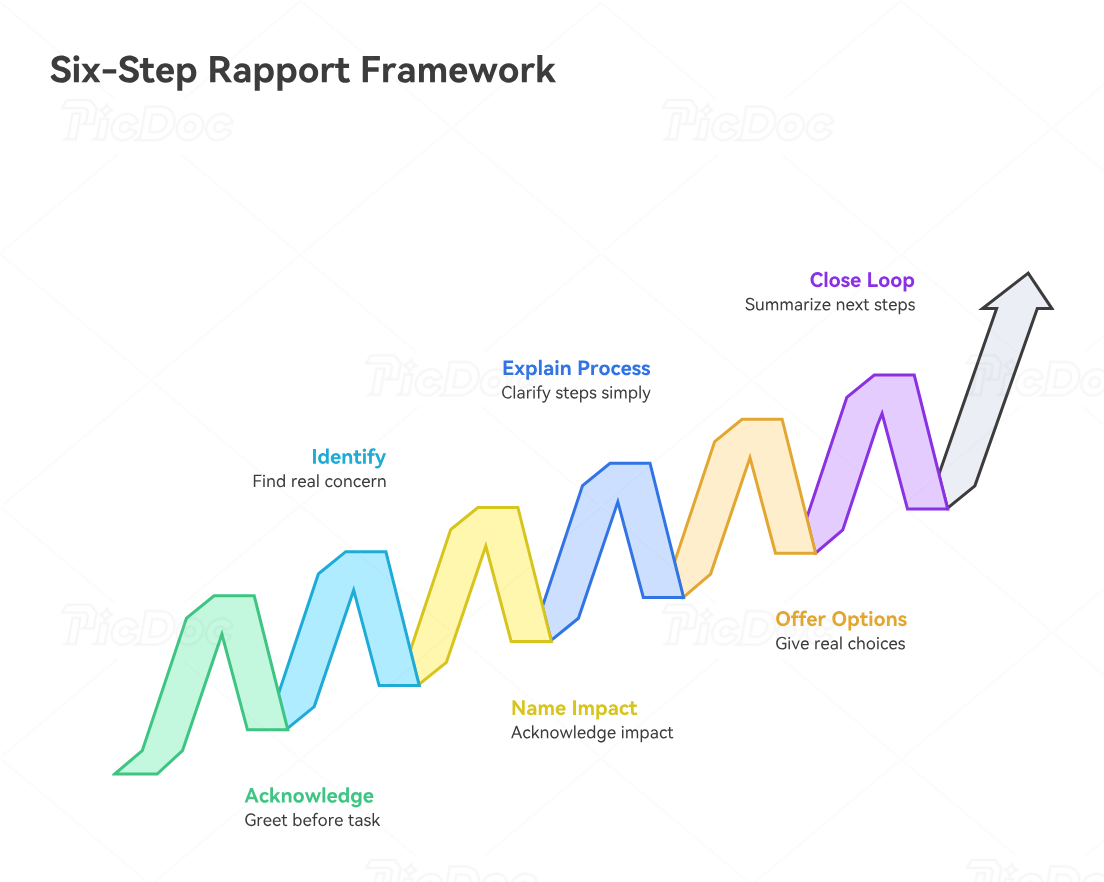
4. A Six-Step Framework for Building Rapport Under Pressure
Medical administrative professionals rarely work in ideal conversational conditions. The phone is ringing, another patient is waiting, a portal message is overdue, and a provider may be asking for immediate support. A usable framework must therefore be brief enough for real workflow. The following six steps can be practiced alongside time-management techniques, daily office checklists, medical admin scheduling tools, and office organization systems.
Step 1: Acknowledge the person before processing the task
Begin with eye contact when culturally appropriate, a greeting, and a brief statement showing readiness to help. On the phone, identify the practice and yourself before asking the patient to explain the issue. During a busy check-in period, even “I see you, and I will be with you in approximately two minutes” prevents uncertainty. This opening strengthens front-desk etiquette, professional communication, patient satisfaction, and medical office professionalism.
Step 2: Identify the real concern
A patient’s first sentence may describe the visible problem rather than the central concern. “My appointment disappeared” may actually mean “I rearranged work and fear I will lose access to care.” Ask one open-ended question, summarize the answer, and confirm the priority. This method improves appointment conflict resolution, active listening performance, patient intake accuracy, and medical triage communication.
Step 3: Name the impact accurately
A concise acknowledgment lowers the patient’s need to prove that the issue deserves attention. Useful language includes “That delay has disrupted your planning,” “The unexpected bill needs a clear explanation,” or “You have already repeated this information twice.” Avoid exaggerated agreement, promises of a specific outcome, or statements that assign blame before review. This balance supports empathy skills, complaint handling, risk management, and legal communication responsibilities.
Step 4: Explain the process in plain language
Patients often become more frustrated when they receive a policy statement without understanding the reason, timeline, or decision-maker. Explain what the office will check, who controls the outcome, what information is required, and when the patient should expect an update. This is especially important for prior authorization, coordination of benefits, claims processing, and medical credentialing.
Step 5: Offer realistic options
Options restore a sense of control. A scheduling issue may allow a waitlist, another provider, telehealth, a different location, or a later date. A portal issue may allow telephone communication, a new invitation, identity verification, or technical escalation. Every option must stay within the staff member’s authority and the practice’s policy. This approach works well with telehealth platforms, virtual patient management, secure scheduling platforms, and patient portal workflows.
Step 6: Close the loop
End by summarizing what was completed, what remains pending, who owns the next action, and when the patient will hear back. Document the interaction in neutral language and create the required reminder or task before moving to the next patient. Closed-loop habits are essential for healthcare CRM use, EMR integration, medical workflow management, and team collaboration.
5. How to Train, Measure, and Improve Rapport-Building
Rapport training should evaluate observable behavior rather than personality. A quiet employee can build excellent trust through accurate summaries and reliable follow-up. An outgoing employee can damage trust through interruptions, overpromising, or casual privacy violations. Supervisors should therefore assess whether the staff member acknowledges the patient, identifies the main concern, uses understandable language, protects confidentiality, offers an appropriate next step, and documents the outcome. This approach aligns with medical admin policies, compliance training, patient satisfaction measurement, and professional development planning.
A practical coaching rubric can score six behaviors from zero to two. Award zero when the behavior is absent or harmful, one when it is partially demonstrated, and two when it is clear and effective. The six categories are acknowledgment, listening accuracy, emotional validation, plain-language explanation, boundary management, and closed-loop follow-up. A score below eight identifies a need for targeted practice. Supervisors can connect the results with CMAA professional organizations, online CMAA communities, career development planning, and future-ready administrative skills.
Role-play should recreate the pressure that causes weak communication. Give the employee a ringing-phone sound, an impatient patient, incomplete authorization, and a strict three-minute time limit. The observer should record exact phrases rather than general impressions. “Interrupted twice before the patient explained the problem” creates a coachable behavior. “Needs to be friendlier” provides little direction. This method strengthens de-escalation skills, crisis communication, scheduling conflict handling, and patient complaint management.
The best performance indicators examine both patient experience and operational consequences. Useful measures include repeat calls about the same unresolved issue, complaints mentioning communication, missed follow-up deadlines, incomplete registration fields, portal messages requiring clarification, and escalations caused by unclear expectations. These measures can be reviewed alongside medical admin time-tracking tools, practice management systems, predictive analytics in medical administration, and AI automation in medical administration.
A 30-day improvement plan can focus on one skill each week. Week one develops acknowledgment and listening. Week two covers plain-language explanations and teach-back. Week three practices boundaries, privacy, and escalation. Week four measures follow-through and service recovery. Daily five-minute practice is more effective than a single annual lecture because staff repeatedly apply the language to active workflows. The training can be reinforced through medical terminology mastery, HIPAA terminology, billing terminology, and scheduling terminology.
6. Frequently Asked Questions About Rapport-Building in Medical Administration
-
Acknowledge the patient promptly, identify the main concern, and provide a specific next step. A useful opening is: “I can help with that. Tell me what happened, and I will determine the best next step.” The patient receives attention, direction, and a reason to continue explaining. This method works across front-desk operations, telephone communication, patient portal support, and telehealth administration.
-
Acknowledge the impact, explain the constraint, and offer the available path forward. For example: “I understand that the later date creates a transportation problem. Today’s schedule is full, so I can add you to the cancellation list and check availability at our other location.” This protects credibility while applying empathy principles, appointment scheduling practices, de-escalation methods, and difficult conversation skills.
-
Yes, when the name is verified, pronounced correctly, and used naturally. Repeating it too frequently can sound scripted, while guessing a preferred name can create discomfort. Staff should confirm pronunciation and preference during registration, record the information appropriately, and follow patient intake procedures, cultural competence guidance, patient record standards, and confidential communication practices.
-
Lower the pace of speech, acknowledge the concern, set a behavioral boundary, and offer a safe next step. A useful statement is: “I want to help resolve this. I can continue the conversation while we speak respectfully. I can also involve my supervisor.” Threats, discriminatory abuse, or behavior that creates a safety risk should trigger the practice’s escalation procedure. Staff preparation should include crisis communication, de-escalation training, risk management, and legal complaint handling.
-
Common causes include interrupting before the patient explains the issue, giving vague timelines, transferring calls without context, using unexplained jargon, discussing private information within hearing distance, and promising actions that are never documented. Each problem can be reduced through active listening, privacy communication, healthcare CRM workflows, and medical office procedures.
-
Use a compressed structure: acknowledge, verify, act, and close. For example: “I understand you need the earliest available visit. Let me confirm your preferred location. I have Tuesday at 9:20 a.m. I will book it and send the portal confirmation now.” The interaction remains brief while supporting scheduling accuracy, portal communication, workflow efficiency, and time management.
