

Active Listening Techniques for Medical Admin Professionals
Active listening is not a soft extra in medical administration. It is one of the most operationally valuable skills in the entire office. It protects scheduling accuracy, reduces front-desk tension, prevents intake mistakes, improves handoffs, and helps patients feel heard during moments when they are often anxious, rushed, embarrassed, or confused. For medical admin professionals, strong listening is not passive silence. It is structured attention that turns fragmented information into clear next steps.
In real healthcare settings, poor listening creates costly downstream damage: wrong appointment types, incomplete messages, repeated callbacks, registration errors, privacy risks, and unnecessary conflict. This guide breaks down the active listening techniques that help medical administrative professionals communicate more clearly, document more accurately, and support smoother patient experiences under real-world pressure.
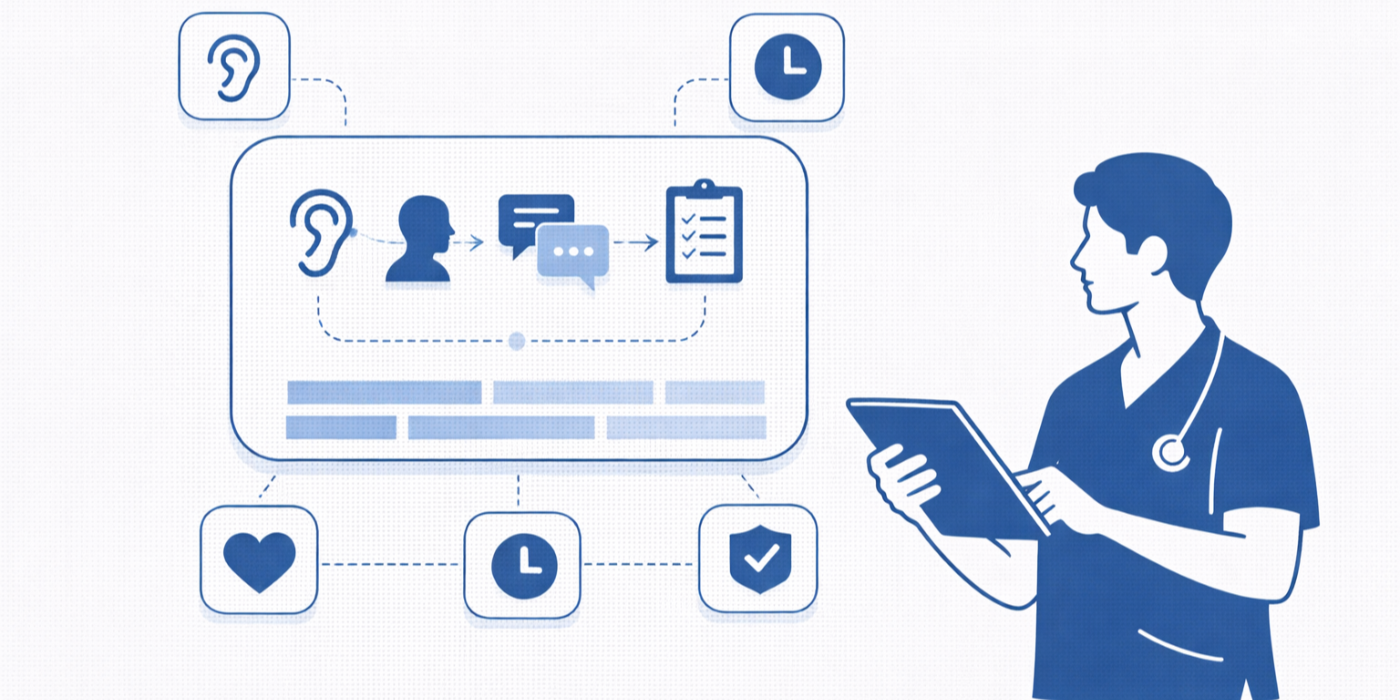
1. Why Active Listening Is a Core Performance Skill in Medical Administration
Medical administration runs on information quality. A patient calls with a medication question, a caregiver tries to explain a referral issue, a specialist office requests records, or a frustrated patient arrives saying “no one told me I needed that form.” In every case, the first administrative task is not typing. It is understanding. Teams that are stronger in effective patient communication, front desk operations, patient intake procedures, and appointment scheduling best practices usually outperform not because they talk more, but because they catch what matters sooner.
Active listening matters because healthcare communication is rarely clean. Patients skip details, use nonmedical language, combine multiple issues into one story, speak while upset, or leave out timing that affects triage and scheduling. Insurance callers may focus on policy language rather than the actual action needed. Providers may speak quickly and expect staff to grasp priorities on the first pass. Without disciplined listening, administrative staff fill gaps with assumptions. That is where avoidable errors begin.
This is especially important in roles connected to healthcare portal use, telehealth platforms, healthcare CRM workflows, and insurance verification. Administrative work now happens across calls, portal messages, front-desk interactions, digital check-ins, and virtual support channels. The more fragmented the communication environment becomes, the more valuable listening discipline becomes.
Another reason active listening matters is trust. Many patients do not know the technical terms for their problem. They judge the office first by whether someone seems attentive, calm, and competent. Staff who listen well can slow escalation, protect dignity, and create the emotional stability needed to solve practical issues. That is why active listening strengthens not only empathy in healthcare administration, but also de-escalation techniques, HIPAA-conscious communication, and long-term career value in future-proof CMAA roles.
| Listening Technique | What It Looks Like in Practice | Why It Matters | Common Mistake It Prevents |
|---|---|---|---|
| Full attention | Stopping side tasks while the patient speaks | Captures key context early | Missing the real reason for contact |
| Opening prompt | “Tell me what’s going on” | Invites fuller explanation | Over-controlling the conversation too soon |
| Minimal encouragers | “I understand,” “go ahead” | Keeps patient talking without interruption | Cutting off critical details |
| Keyword capture | Noting dates, symptoms, provider names, urgency | Improves message accuracy | Vague documentation |
| Reflecting | “So the issue started after your last visit” | Tests understanding in real time | Acting on wrong assumptions |
| Paraphrasing | Restating in simpler structure | Turns a long story into usable facts | Confused handoffs |
| Clarifying questions | Asking for missing dates, names, or sequence | Closes information gaps | Incomplete messages |
| Emotion labeling | “I can hear this has been frustrating” | Lowers defensiveness | Escalating tension |
| Silence tolerance | Pausing before jumping in | Lets patients recall more | Rushed, shallow intake |
| Sequence checking | Confirming what happened first, next, and now | Improves timeline accuracy | Out-of-order documentation |
| Purpose checking | Asking what outcome the patient needs today | Focuses the interaction | Solving the wrong problem |
| Priority filtering | Separating urgent from background details | Supports safer routing | Burying urgent issues |
| Nonverbal attention | Eye contact, open posture, calm face | Signals presence and respect | Looking distracted or dismissive |
| Tone monitoring | Listening for fear, anger, confusion, embarrassment | Guides response style | Using the wrong tone back |
| Interrupt-control | Waiting until the thought is complete | Protects key details | Premature assumptions |
| Trigger-word awareness | Catching terms like urgent, bleeding, reaction, denied | Improves escalation decisions | Missing risk cues |
| Confirmation close | Repeating agreed next steps | Prevents misunderstandings | Patients leaving confused |
| Teach-back request | Asking the patient to restate instructions | Checks true understanding | False assumption of clarity |
| Channel adaptation | Listening differently on phone, portal, and in person | Improves message handling | Using one script for everything |
| Documentation translation | Turning the patient story into concise notes | Supports cleaner handoffs | Messy chart messages |
| Bias-checking | Not assuming the issue before hearing it out | Protects accuracy | Pattern-based errors |
| Context separation | Distinguishing symptoms from logistics | Routes the issue correctly | Scheduling a clinical issue as admin-only |
| Boundary listening | Hearing concern without giving unauthorized advice | Protects role clarity | Overstepping scope |
| Escalation listening | Recognizing when the issue needs immediate handoff | Supports safety and service | Delaying urgent intervention |
| Closure listening | Checking for remaining concerns before ending | Reduces callbacks and dissatisfaction | Unfinished interactions |
2. The Most Important Active Listening Techniques Medical Admin Professionals Should Master
The first technique is attentive opening. Too many interactions fail in the first ten seconds because the staff member moves immediately into task mode. The patient starts explaining, and the admin professional jumps to “What’s your DOB?” or “Do you need to schedule?” before understanding the actual problem. Verification and workflow matter, but the most efficient first move is often a brief, focused invitation followed by real listening. That makes later verification cleaner because the staff member knows what lane the issue belongs in.
The second technique is paraphrasing. Patients often tell stories in emotional order, not operational order. A worried caller may mention a billing dispute, a missed callback, a medication concern, and an appointment problem all in one stream. The admin professional has to translate that into an actionable summary. This skill is especially important in environments shaped by medical office automation trends, virtual medical administration, telehealth expansion, and multi-channel communication. Without paraphrasing, information stays messy and hard to route.
The third technique is clarifying without interrogating. Weak listeners either fail to ask enough questions or ask them in a way that feels cold and mechanical. Skilled admin professionals know how to narrow the issue while preserving rapport. Instead of launching into a rapid-fire checklist, they ask targeted questions that fill operational gaps: when it started, what outcome is needed, whether this is about a past visit or future appointment, whether a specialist is involved, or whether records or authorization documents are already on file. This directly supports cleaner workflows in insurance verification, patient portal communication, scheduling terms, and HIPAA-aware documentation.
The fourth technique is emotional acknowledgment. This is where active listening stops being transactional and starts becoming stabilizing. Patients often escalate because they think they are being processed instead of understood. A calm statement like “I can hear this has been frustrating” or “I understand why you want this resolved today” does not magically fix the issue, but it often makes problem-solving possible. This is one reason active listening works hand in hand with de-escalation, empathy, and stronger patient experience leadership.
3. How Active Listening Improves Accuracy, Patient Trust, and Workflow Control
In medical administration, listening is not just about being nice. It is about reducing operational failure. When staff listen accurately, they schedule the correct visit type, send better internal messages, collect more complete intake information, and reduce repeated contact. Offices that invest in communication skill-building often see improvements across patient intake, front-desk performance, healthcare efficiency, and even broader career growth for CMAAs.
Accuracy improves first at the message level. A poorly listened-to message often becomes vague chart clutter: “Patient called about issue and wants callback.” That is almost useless. A well-listened-to message is specific, sequenced, and actionable: the patient reports worsening swelling after a recent visit, began two days ago, wants guidance on whether a sooner appointment is needed, and prefers a callback before 3 p.m. That kind of clarity saves provider time and reduces dangerous guesswork. It aligns with the same precision mindset found in medical administrative terminology mastery, EMR literacy, and documentation accuracy trends.
Trust improves because patients can feel the difference between waiting to speak and being heard. Offices often underestimate how strongly listening quality shapes the reputation of the entire practice. A patient may forgive a delay more readily than a dismissive interaction. When active listening is consistent, patients feel less need to repeat themselves, argue, or escalate. That strengthens relationships across healthcare communication, portal support, and telehealth coordination.
Workflow control improves because active listening filters chaos into categories. Not every upset caller is an emergency, and not every routine request is simple. Listening helps staff distinguish clinical urgency from administrative inconvenience, emotional intensity from actual risk, and background narrative from the one fact that determines next action. That is the difference between reactive office culture and controlled office culture.
4. Common Listening Mistakes That Hurt Medical Admin Performance
One of the most damaging mistakes is listening for a familiar pattern instead of the actual message. Administrative staff hear similar issues all day, so it is easy to assume this call is “another scheduling problem” or “another billing complaint.” But in healthcare, small differences matter. The patient who “just needs to reschedule” may actually be calling because of a postoperative concern. The caller who sounds angry about a portal issue may really be panicking because lab information was misunderstood. Pattern recognition is useful, but premature pattern closure creates dangerous blind spots.
Another mistake is multitasking visibly and mentally. Staff may technically hear the patient while clicking through screens, answering a coworker, checking someone in, and glancing at a queue. But divided attention weakens listening quality. It causes missed dates, wrong names, skipped qualifiers, and shallow summaries. In offices already under pressure from medical administration job demand, automation shifts, and technology-heavy workflows, multitasking is common, but it cannot be allowed to erase core communication accuracy.
A third mistake is over-questioning too early. Some staff respond to uncertainty by interrogating the patient with ten narrow questions before understanding the broad issue. That can make the caller feel controlled instead of helped. Skilled listening moves from broad to narrow, not narrow to broad. It invites the story, extracts the signal, then verifies the operational facts. This approach improves both patient trust and workflow efficiency.
The fourth mistake is closing the interaction without confirming next steps. Many misunderstandings happen not during the explanation, but during the ending. The patient thinks a message will go to the nurse immediately. The staff member thinks the patient knows to upload documents through the portal. The caregiver assumes records will be sent today. Active listening includes the close. That means stating what was heard, what will happen next, and what the patient should expect.

5. How to Build Active Listening Into Daily Medical Admin Practice
The most practical way to improve listening is to create a repeatable internal framework. One useful model is hear, sort, clarify, confirm. First, hear the patient without rushing to classify. Second, sort the information into the actual category: scheduling, billing, records, portal access, referral, clinical concern, or mixed issue. Third, clarify what is missing. Fourth, confirm the next step and document it clearly. This structure works across front desk, phone, portal, and internal team communication.
Training also matters. Offices should not assume listening is automatic just because staff are friendly. It should be coached the same way patient intake procedures, medical office technology, career-readiness skills, and medical administrative certification pathways are coached. Role-play difficult calls. Review weak and strong message examples. Teach staff how to move from patient language to office-action language without sounding robotic.
Documentation habits should also be tied directly to listening habits. A strong listener writes messages that preserve sequence, urgency, and outcome requested. A weak listener writes notes that merely prove contact happened. That difference affects everyone downstream. Better listening produces better documentation, and better documentation produces better care coordination.
Finally, staff should learn to protect their own listening quality under pressure. That means using short centering pauses, minimizing side conversations during sensitive calls, and recognizing when emotional contagion is affecting judgment. Listening is a performance skill, and like any performance skill, it gets weaker when the environment is chaotic unless staff have trained habits to stabilize it.
6. FAQs
-
Active listening in medical administration means intentionally focusing on what the patient, caregiver, provider, or caller is actually communicating, then organizing that information into an accurate next step. It includes attention, clarification, paraphrasing, emotional acknowledgment, and confirmation. It supports stronger patient communication, safer front-desk workflows, and cleaner patient intake.
-
Because medical admin professionals are often the first point of contact and the first filter for critical information. Poor listening can lead to wrong scheduling, incomplete messages, privacy mistakes, and patient dissatisfaction. Strong listening improves both workflow accuracy and trust, especially in offices balancing portal communication, telehealth support, and compliance-sensitive communication.
-
Hearing is passive. Active listening is structured and intentional. Hearing captures sound; active listening captures meaning, sequence, urgency, and emotional context. In healthcare administration, that difference determines whether an interaction turns into a useful action or a confusing callback.
-
It reduces friction by making patients feel understood before the office moves into process. Many tense interactions calm down when staff reflect the concern accurately, ask focused clarifying questions, and explain next steps clearly. That is why active listening is closely tied to de-escalation techniques and empathy in healthcare administration.
-
Use a brief opening prompt, avoid interrupting too early, capture key words, paraphrase the issue, ask only the clarifying questions that matter, and confirm next steps before ending the interaction. Staff can also review how well their notes reflect what the patient actually said. This supports stronger medical office efficiency and more consistent career growth skills.
-
Yes. Better listening produces more precise messages, cleaner handoffs, and fewer vague notes. It helps staff separate background detail from action-driving information and document it in a way providers and coworkers can use immediately. In that sense, listening is not separate from documentation quality. It is one of its main drivers.
