

How to Master Medical Administrative Terminology for Your CMAA Exam
Medical administrative terminology is not “memorize a glossary and hope.” It is the fastest way to raise your CMAA score because it removes confusion inside scenario questions, boosts reading speed, and makes answer choices feel obvious. This guide gives you a terminology mastery system built for the CMAA exam, using workflow context, active recall, and exam-style decoding. As you study, keep the payoff in sight through the CMAA career opportunities guide and the 2026–27 job market outlook.
1) Why Terminology Is the Hidden Score Multiplier on the CMAA Exam
Most candidates think terminology is a side task, something you do after “real studying.” That mindset is why strong candidates still miss points. On the CMAA exam, terminology is not trivia. It is the language layer that determines whether you understand the scenario quickly enough to choose the best answer without second guessing. That is exactly why employers care about terminology fluency, as shown in top skills employers look for in a CMAA and reinforced by the credibility outcomes in real CMAA success stories.
Here is the real pain point: when you do not understand a term instantly, you do not just “lose time.” You lose accuracy. Your brain switches into guessing mode. Guessing mode makes you latch onto the first answer that sounds professional, even if it breaks workflow. That is why the fastest way to improve scenario performance is to build terminology to workflow mapping using resources like the EMR software terms dictionary, the scheduling software glossary, and the patient flow management guide.
Terminology also drives exam confidence. Confidence is not a personality trait. It is the absence of ambiguity because you have a clean mental model of what the words mean and what actions they trigger. When you can translate terms into steps, you stop freezing on “two answers look right.” You can cross-check the workflow like a professional. That workflow thinking is also how modern admin roles are evolving, which connects directly to medical office automation trends and the shift described in virtual medical administration.
A final reason terminology matters is career leverage. Passing is step one. The real win is using terminology fluency to sound competent in interviews and perform well in real clinics. If you want proof that certification and performance stack together, use the market context from the annual CMAA salary report and the career framing in the salary calculator for medical administrative assistants. Your vocabulary is not just exam prep. It is professional identity.
2) Build a Terminology System That Makes Words “Stick” Under Pressure
If you try to memorize definitions in isolation, your brain will store them as fragile facts. Fragile facts break the moment the exam adds stress and context. You need a system that turns terminology into automatic recognition and workflow instinct.
Step 1: Build a “term to action” mapping
Every term should trigger a simple action or decision. “Eligibility verification” should immediately trigger “confirm coverage and document outcome.” “Prior authorization” should trigger “check requirements, track status, store authorization number.” When you learn terms this way, you do not just know what a word means. You know what it does in real life, which is the same operational value described in CMAA efficiency research.
Use the interactive resources as your term source bank and your workflow anchor. When you see an unfamiliar concept, build it inside a system instead of adding it to a random flashcard pile. The best anchors for CMAA terminology are the EMR software terms dictionary, the scheduling software glossary, and the patient management systems guide.
Step 2: Learn terms in clusters, not lists
Terminology is easier when your brain can group it into “families.” Think: scheduling family, billing family, documentation family, communication family, inventory family. This is the same idea behind modern tech-enabled admin work described in medical office automation trends and the broader industry direction in the 2026 healthcare administration report.
Clusters that consistently generate exam clarity:
Scheduling and throughput: triage, no-show, reschedule protocol, follow-up
Documentation and systems: encounter, chart review, patient portal, templates
Billing awareness: deductible, copay, coinsurance, claim, denial, appeal
Communication and professionalism: escalation, de-escalation, consent, authorization
To strengthen the communication cluster, pair telephone etiquette examples with active listening scenarios and conflict resolution terms. Those three together turn “soft skills” into repeatable scripts.
Step 3: Convert each term into a “context sentence”
A definition is not enough. Write one sentence that places the term inside a realistic admin moment. Example: “Before confirming the appointment, I completed eligibility verification and documented the payer response in the chart.” This trains your brain to recognize how terms appear in exam scenarios.
You can generate context sentences faster by using workflow hubs like patient flow management and medical billing explained clearly. These pages help you “hear” how terminology lives inside daily tasks.
Step 4: Use retrieval ladders instead of passive review
A retrieval ladder is a three-level test you run on a term:
Say the definition in plain English.
Name where it shows up in workflow.
Explain what could go wrong if it is handled poorly.
That third level is where exam performance spikes. It forces you to connect words to consequences, which makes the correct answer feel obvious. It also strengthens your interview value, which connects to the market payoff shown in the annual CMAA salary report and the salary calculator.
3) Master Terminology by Studying Workflows, Not Vocabulary Lists
CMAA terminology becomes easy when you can visualize a clinic day. Most exam scenarios are variations of a few repeating workflows: scheduling, intake, documentation, billing support, and patient communication. If you study terms inside those workflows, you stop memorizing and start recognizing.
Workflow 1: Scheduling and patient flow
Scheduling questions often hide the answer inside one term. If you understand triage language, follow-up language, and reschedule protocol language, you can solve questions quickly. Build this workflow using the scheduling software glossary and then reinforce it through the operational lens in patient flow management.
Now add a performance layer: identify which terms connect to clinic efficiency. Efficiency is not a buzzword. It is what hiring managers actually pay for, as described in top skills employers look for and proven through research on CMAA efficiency impact.
Workflow 2: Documentation and EMR usage
Documentation scenarios become simple when “encounter,” “chart review,” “patient portal,” and “PHI” are second nature. This is where candidates lose points because they confuse what belongs in which channel and what requires consent or authorization. Use the EMR software terms dictionary as your primary vocabulary base, then attach those terms to compliance instincts using patient advocacy role-play scenarios.
If you want to strengthen “tech vocabulary” with future relevance, connect it to the trends shaping the role in virtual medical administration and future-proof CMAA skills. That will also help you spot which terms matter most in modern clinics.
Workflow 3: Billing awareness and denial prevention
You do not need to be a coder to excel here. The exam typically tests whether you understand core revenue cycle language well enough to prevent avoidable denials and communicate responsibly with patients. The fastest way to master this domain is to tie each term to a patient-facing explanation and a workflow step.
Use medical billing explained clearly to build a clean mental model, then practice translating “deductible” and “coinsurance” into plain language. Build denial logic by linking “eligibility verification,” “prior authorization,” and “authorization number” to process control. This connects naturally to the operational discipline described in medical office automation trends.
Workflow 4: Communication, de-escalation, and professionalism
This is where terminology becomes “behavior language.” Words like “active listening,” “de-escalation,” “clarifying question,” and “documentation” show up as choices in scenarios. The best way to master this is to train response scripts using telephone etiquette examples, apply them in active listening scenarios, and pressure-test your choices using conflict resolution terms.
This is also the fastest path to sounding “job ready.” Hiring managers do not just want a credential. They want someone who can communicate under stress. That link between skill and outcomes is visible in real CMAA success stories and the hiring demand described in the medical admin job market outlook.
4) Memory Techniques That Make Terminology Exam-Proof
Terminology fails on exam day for one reason: the brain cannot retrieve under stress what it stored weakly. Your goal is to store terms in multiple pathways so retrieval is automatic.
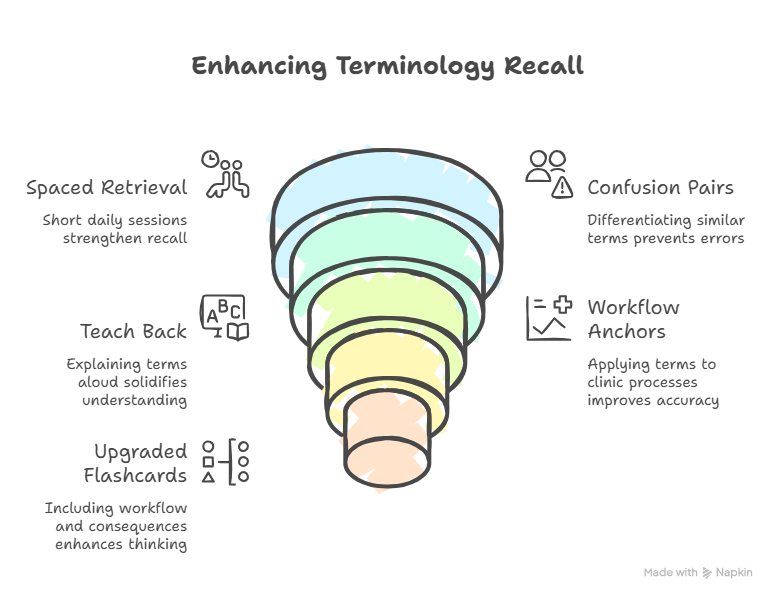
Use spaced retrieval, not marathon sessions
Do short daily terminology sets and re-test them across days. Ten minutes daily beats one hour once a week because it strengthens recall and reduces forgetting. Use the same term sources repeatedly: EMR software terms, scheduling glossary, and patient management systems. Keep your set small and repeat it until it becomes easy.
Build “confusion pairs” and solve them aggressively
Many wrong answers come from confusing similar terms. Build a confusion list and write the difference in one sentence each. Examples: deductible vs copay vs coinsurance, consent vs authorization, encounter vs chart review. Then write a scenario sentence that forces the correct one. This is high-value because it directly prevents exam misses.
Teach back in 90 seconds
Pick one term cluster per day and explain it aloud like you are training a new hire. If you cannot teach it clearly, you do not know it. This also builds interview readiness, which connects to the performance signals highlighted in top skills employers look for and the outcomes lens in CMAA certification career boost.
Use “workflow anchors” to stop overthinking scenarios
When terminology shows up inside a scenario, anchor yourself to the workflow. Ask:
Where are we in the clinic process: scheduling, intake, documentation, billing, follow-up?
What is the safest and most procedurally correct next step?
What documentation or consent is required?
These anchors become obvious when you train with patient flow management, communication tools like active listening scenarios, and workflow literacy through medical billing explained clearly.
Stop using “definition-only” flashcards
If you use flashcards, upgrade them. Each card must include:
A definition in plain English
A workflow location
A quick consequence if mishandled
This turns flashcards into professional thinking tools. It also makes your study time align with modern admin role expectations described in 2026 healthcare administration insights and future-proof CMAA skills.
5) Exam-Ready Terminology Tactics: How to Decode Questions Faster
Terminology mastery is proven on test day by speed and accuracy. You need practical tactics that make you faster without rushing.
Decode the question before you look at the answers
Many candidates scan the answers first, then try to fit the question to the options. That invites traps. Instead, read the scenario and identify the workflow stage using anchors like scheduling software concepts and patient management systems. Then predict what the correct action should look like.
Eliminate options that break workflow or compliance
If an option skips eligibility verification, ignores prior authorization, violates consent, or fails to document properly, it is likely wrong. This is where terminology becomes a filter. When you understand terms like PHI, authorization, and encounter, you can eliminate faster because you know what steps are required.
To strengthen this instinct, keep revisiting communication and professionalism resources like telephone etiquette, active listening, and conflict resolution. Those pages sharpen what “procedurally correct” sounds like.
Use a “flag quickly” rule on terms you half-know
If a question hinges on a term you do not fully understand, do not waste time debating. Flag it and move. Then return and solve it using elimination and workflow anchors. This protects your score by securing easy points first, which is exactly the kind of process discipline that shows up in real CMAA success stories.
Build your final-week plan around terminology compression
In the last 7 days, stop chasing new content. Your job is to compress and strengthen what you already know:
Re-test your confusion pairs daily
Review your workflow anchors
Do timed mini-sets focused on terminology-heavy scenarios
Use one-page “term to action” sheets
If your motivation drops, reconnect to outcomes using the job market outlook, the annual salary report, and the interactive salary calculator. Studying harder is not the goal. Studying smarter is.
6) FAQs: Medical Administrative Terminology for the CMAA Exam
-
Focus on high-frequency terms that appear inside workflows: scheduling, documentation, billing awareness, patient communication, and compliance language. Quality beats quantity. If you can instantly recognize terms in scenarios, you will score higher than someone who memorized a longer list without context. Use the EMR terms dictionary, the scheduling glossary, and patient flow management as your core term pools.
-
Because recognition is not retrieval. Rereading makes you feel fluent, but the exam demands that you produce meaning under pressure. Fix this with retrieval ladders: definition, workflow location, and consequence if mishandled. Re-test terms across days using spaced retrieval instead of long sessions. Tie your practice to real workflow anchors using patient management systems and medical billing explained clearly.
-
Cluster terms by workflow and learn them as families. Scheduling family, EMR family, billing family, communication family. Then write one context sentence per term so it becomes scenario-ready. Use interactive pages as your structured source and avoid random internet lists. The best workflow-aligned sources are EMR software terms and the scheduling software glossary.
-
Create a confusion pair list and write the difference in one sentence each, then force the term to appear in a realistic sentence. Example: copay is the fixed pay-at-visit amount, deductible is the patient threshold before insurance helps, coinsurance is the percentage split. Then practice identifying them inside billing scenarios using medical billing explained clearly. This turns confusion into certainty.
-
Terms related to tone, consent, escalation, de-escalation, and documentation show up constantly. Train these through scripts and scenario drilling, not memorization. The best practice sources are telephone etiquette examples, active listening scenarios, and conflict resolution terms. When you know what “best response” looks like, options become easier to eliminate.
-
Terminology fluency increases speed because you stop rereading scenarios and you eliminate answers faster. Train with timed mini-sets and a flag-and-return method. When you see a critical term, translate it to workflow immediately. Reinforce speed through workflow anchors like patient flow management and systems thinking from medical office automation trends.
-
Terminology fluency makes you sound competent in interviews and perform reliably on the job. It reduces documentation errors, improves patient communication, and strengthens workflow execution. That is why it converts into better opportunities and pay, supported by the market context in the annual salary report, the salary calculator, and the outcomes framing in why CMAA certification boosts careers.
