

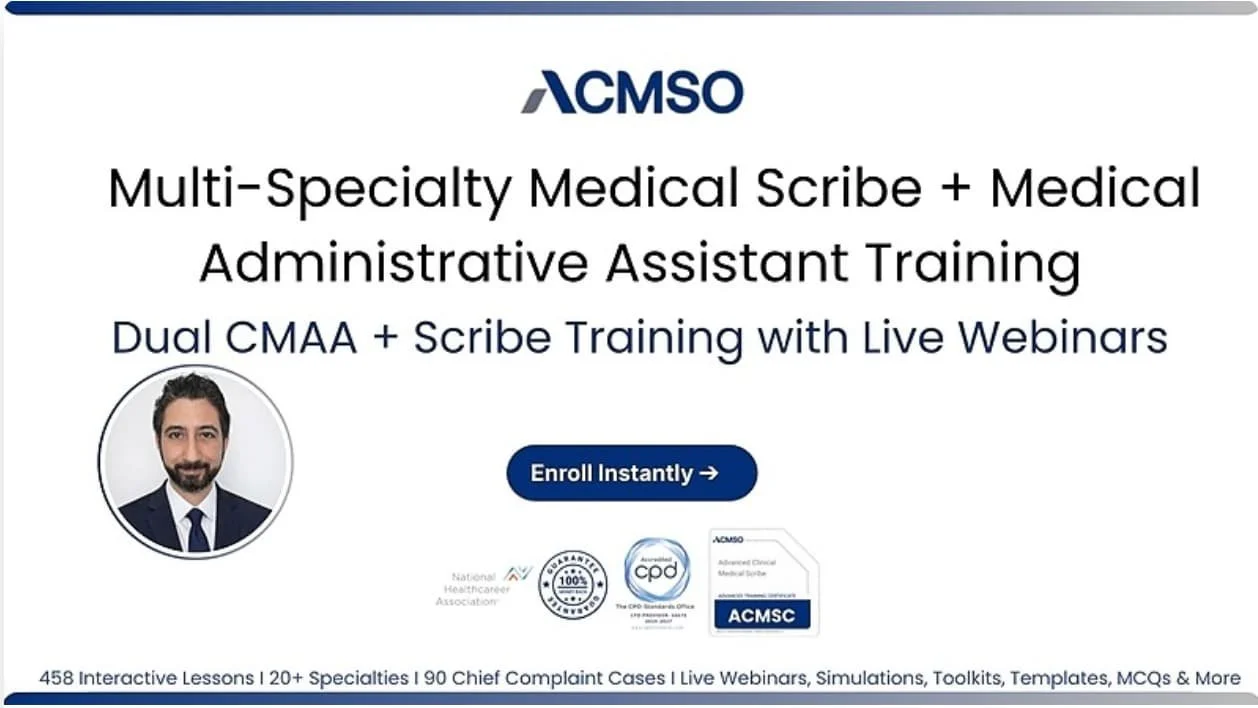
Accreditations and Standards
How ACMSO ensures healthcare training credibility is earned rather than assumed through extensive third-party evaluation that allows students to maximize the benefit from their in-depth learning.
ACMSO was built around a reality that most healthcare adjacent programs avoid. In medical environments, credibility is not created by excitement, a glossy certificate, or “completion.” Credibility is created when your documentation decisions hold up under scrutiny. When a physician reviews your note. When a clinic audits chart accuracy. When a patient safety issue appears and your documentation becomes part of the record. That is the level of accountability medical scribes and medical administrative professionals operate under.
Accreditation and standards exist to make that credibility legible. Not to prove you are talented, but to verify that the training was built with structure, governance, assessment integrity, and documented learning hours. ACMSO treats accreditation, professional alignment, instructional oversight, and student support as one integrated system. These elements exist for students who want real career outcomes, for employers who want defensible training, and for medical reviewers who care less about marketing and more about whether your education produced reliable judgment in live clinical workflows.
Institutional Identity
ACMSO operates as a training partner under Advanced Education Group LLC a non degree granting postsecondary educational institution headquartered in Orem, Utah. The organization delivers vocational and professional education designed for adult learners seeking continuing education and workforce aligned certification rather than academic degrees or licensure alone.
ACMSO as a partner of Advanced Education Group LLC maintains defined academic leadership, instructional oversight, advisory governance, and learner support infrastructure. This structure exists to ensure that education is accountable after enrollment and that we can provide 24/7 live student support.
ACMSO operates as a workforce aligned training provider focused on medical scribe and medical administrative assistant capability, not academic degrees and not clinical licensure. ACMSO issues professional certificates supported by third party accreditation pathways and verifiable credentials designed to improve career readiness and employer confidence.
This distinction matters because healthcare is a high trust environment. Clarity protects learners and protects patients. ACMSO training is designed to develop documentation accuracy, workflow understanding, compliance literacy, and operational competence. It does not represent itself as a medical licensing body. It does not authorize independent clinical diagnosis or treatment. It trains learners to perform inside real clinical operations with scope discipline and professional accountability.
Why accreditation matters in medical scribing and healthcare administration
Many learners only start asking about accreditation after they experience the consequences of weak training. They finish a course but still freeze when documentation becomes complex. They know terminology but cannot structure a note. They understand concepts but cannot chart fast, accurately, and safely. Employers notice quickly because documentation is measurable. Accuracy rates. Completeness. Time to chart close. Compliance errors. Denial risk in administrative workflows.
Accreditation does not create competence. It creates shared reference points. It allows employers and third parties to evaluate whether training was designed, reviewed, and assessed against recognized standards rather than assembled as content only. ACMSO treats accreditation as accountability. The goal is simple. Produce learners whose capability holds up in real workflows.
Continuing Professional Development Accreditation
ACMSO maintains CPD accreditation alignment as a core credibility layer for its Medical Scribe and Medical Administrative pathway. CPD accreditation exists to verify that training represents substantive professional education with documented hours, defined learning objectives, structured curriculum sequencing, and reviewable standards for instructional design and assessment.
For a learner, the value is portability. CPD makes your learning hours and training structure legible across regions and employment contexts. It reduces the burden of constantly explaining whether your education was real or superficial. It also signals that the course was designed as professional development, not just informational content.
CPD accreditation does not guarantee employment. It does not grant licensure. It does confirm that the training was built with documented learning hours and structured educational standards rather than informal completion certificates.
National Healthcareer Association alignment and CMAA readiness
ACMSO maintains organizational alignment and curriculum backing connected to the National Healthcareer Association to support CMAA exam readiness and healthcare administrative credibility. This is important because healthcare administration roles operate under operational and compliance expectations that employers recognize immediately. Scheduling, patient flow, documentation handling, HIPAA discipline, insurance and intake workflows, and practice operations are not optional knowledge areas. They are daily responsibilities.
ACMSO’s CMAA pathway is positioned as readiness training. It supports learners seeking recognized administrative competency that aligns with employer expectations in clinics, urgent care, outpatient environments, and hospital affiliated practices. ACMSO describes this clearly to protect learners from vague promises. Exam outcomes depend on the learner’s preparation, effort, and testing performance. ACMSO provides the structure and tools designed to make that outcome achievable and defensible.
Multi physician curriculum collaboration and clinical realism
ACMSO’s curriculum is designed collaboratively with multiple practicing physicians contributing real world insight into specialty specific documentation workflows, physician expectations, and clinical operations across hospital systems and outpatient environments. This matters because clinical documentation is not generic. A note that is acceptable in family medicine may be incomplete in emergency medicine. A cardiology workflow does not match a dermatology workflow. Psychiatry documentation has its own patterns. Specialty context changes what physicians consider useful, complete, and safe.
This physician contributed design approach is one of ACMSO’s strongest credibility anchors because it aligns training to real physician expectations rather than hypothetical scenarios. Learners are trained to think clinically in documentation, not just type words into a template.
Instructor credibility and instructional governance
ACMSO’s training leadership is built around lived clinical documentation and education experience.
Lead Instructor
Anas Malik Radif Alubaidi, MBChB, MSc, PgDip, PgCert
Licensed general practitioner and clinical educator with extensive experience training pre health students and medical scribes across academic medical centers, hospital systems, and outpatient clinical environments. Direct involvement in clinical documentation standards, chart accuracy, and compliance focused practices aligned with real physician expectations in live clinical environments.
Senior instructional support
ACMSO provides senior instructional support through physicians and experienced medical scribes with extensive multi specialty documentation exposure and major EHR platform familiarity. This matters because documentation competency is not only knowledge. It is performance. Feedback, calibration, and correction are what convert knowledge into job ready accuracy.
Instructional governance exists to maintain consistency. Medical documentation has low tolerance for improvisation. ACMSO trains toward repeatable standards so learners can perform safely, not just understand concepts intellectually.
Standards embedded in the curriculum design
ACMSO’s standards are not isolated into a single “compliance module.” They are integrated into how the learner is trained to think and work.
Documentation accuracy standards
Learners train on SOAP note mastery, patient history capture, physical exam documentation patterns, and vital sign recording with a focus on completeness, clarity, and workflow relevance. Documentation is treated as a clinical tool, not just a transcript.
Compliance and privacy standards
HIPAA, patient safety, scope boundaries, and documentation discipline are taught as operational habits. In healthcare, compliance failures often come from small behavior patterns, not dramatic violations. ACMSO trains the habit level.
EHR literacy standards
Multi EHR exposure exists to reduce platform shock. Learners are trained to understand how clinical documentation moves through systems such as Epic, Cerner, Meditech, Allscripts, AthenaHealth, and additional platforms, so they can adapt to real workplace environments faster.
Specialty workflow standards
Training spans a broad set of clinical specialties so learners build pattern recognition across settings, not just a single niche. This is critical for pre health learners who may rotate through varied environments and for career switchers who need flexibility in where they can work.
Why ACMSO does not design around minimum thresholds
Many programs optimize for the appearance of training rather than the defensibility of training. They teach terminology lists without workflow. They teach templates without reasoning. They teach medical words but do not teach what physicians actually need from a note.
ACMSO builds beyond minimum thresholds because healthcare performance is evaluated in real time. Physicians notice immediately when documentation is inaccurate, missing, or clinically unhelpful. Clinics notice immediately when administrative workflows are disorganized. The goal of ACMSO is not to help learners “finish a program.” It is to help learners become reliable inside systems that demand accuracy, speed, and accountability.
Accreditation reduces friction. It should never replace competence.
Credential issuance and verifiable proof
ACMSO issues certificates designed to be used professionally. Credentialing is structured to support external visibility and verification, including certificate issuance that can be referenced in professional profiles and career documentation. The goal is not a badge for show. The goal is external proof that is legible to employers who screen for credible training signals.
Learner support and accountability infrastructure
ACMSO provides support systems designed for adult learners balancing schedules, exams, and career transitions. Support exists because healthcare learning breaks when learners get stuck and cannot resolve confusion quickly. In documentation training, one unresolved gap becomes ten downstream errors.
ACMSO treats reachability as part of credibility. A program cannot claim seriousness if students cannot access help when precision matters.
What accreditation means at ACMSO
At ACMSO, accreditation functions as an accountability framework.
It confirms that learning hours are real and documented.
It confirms curriculum is structured and reviewable.
It supports professional recognition and portability.
It reduces uncertainty for employers and reviewers.
Accreditation does not replace competence. It supports its evaluation. The core ACMSO promise remains capability that holds up inside real clinical documentation and healthcare operations.
ACMSO’s perspective
ACMSO was designed to behave like a serious workforce training institution, not a content brand. Standards are explicit. Leadership is visible. Curriculum is built with real physician input. Instruction is aligned to real clinical expectations. The objective is straightforward. Produce graduates who can document accurately, operate inside healthcare workflows, and carry professional discipline into the environments that demand it.
Programs provide non-degree professional education and certification training. Completion does not confer government licensure or guarantee eligibility for any particular position. Employers and independent credentialing organizations establish their own education, experience, certification, and hiring requirements.
For accreditation or pathway questions, contact [email protected].
For technical or platform support, contact [email protected].
FAQ: Accreditations and Standards at ACMSO
What does CPD accreditation verify and what does it not verify
CPD accreditation verifies that a program is structured as professional education with documented learning hours, clear learning objectives, and standards for instructional design and assessment integrity. In practical terms, it makes your training legible to employers because the curriculum is not improvised, the hours are not vague, and the learning can be evaluated against recognized CPD criteria. What CPD does not do is guarantee employment, salary, or identical outcomes for every learner. It does not grant clinical licensure. It does not automatically prove individual job performance. ACMSO treats CPD as an accountability layer that supports credibility, not a substitute for real competence built through practice and feedback.
What does NHA backing mean for a CMAA pathway
NHA backing is valuable because it connects training to an established credential ecosystem that employers recognize in healthcare administration contexts. For learners, it signals that CMAA readiness is being treated seriously, not as a superficial add on. It supports credibility when applying for administrative roles because it aligns learning with real operational expectations such as scheduling, patient flow, compliance discipline, documentation handling, and practice operations. What it does not mean is a guaranteed exam pass or guaranteed job placement. Exam outcomes depend on preparation and performance, and hiring depends on market demand and individual execution. ACMSO’s role is to provide the structured training pathway that makes readiness defensible.
Why does medical scribe training need standards at all
Because documentation is measurable and auditable. A medical scribe is not judged by enthusiasm. They are judged by whether the chart is accurate, complete, clinically useful, and compliant. Poor documentation can create patient safety risk, billing issues, legal exposure, and operational inefficiency. Standards matter because they force training to address real workflows, real physician expectations, and real compliance boundaries rather than teaching vague note templates. ACMSO trains documentation as a clinical responsibility, not as typing practice. That is why standards and accreditation alignment are treated as central, not optional.
How does physician contributed curriculum improve credibility
Physician contributed curriculum matters because physicians are the primary consumers of clinical notes. They know what is useful, what is missing, and what creates risk. They also understand how documentation changes by specialty, setting, and workflow. When physicians contribute to training design, education becomes aligned to reality rather than theory. Learners are taught how to think clinically in documentation, not just how to fill sections. This typically increases chart relevance, accuracy, and readiness for real clinical environments because the training reflects what physicians actually expect when the encounter becomes complex.
Does ACMSO provide clinical licensure or medical authority
No. ACMSO provides professional workforce training in medical scribing and medical administrative capability. It does not provide clinical licensure. It does not authorize independent diagnosis or treatment. It trains learners to operate inside healthcare environments under appropriate supervision, with strict scope discipline and compliance habits. This clarity protects learners and protects patients. In healthcare adjacent roles, credibility collapses when programs blur scope. ACMSO positions its credentials accurately as job aligned education designed to improve competence, workflow understanding, and employability.
Why does ACMSO emphasize governance and instructional oversight
Because healthcare documentation has low tolerance for ambiguity. Learners need consistent standards, clear correction, and calibration across scenarios. Governance ensures the curriculum stays coherent, updates are handled responsibly, and assessment integrity remains intact. Oversight also protects learners from the common problem in online training where content exists but feedback does not. In documentation training, feedback is not a luxury. It is how accuracy improves. ACMSO’s instructional oversight is designed to keep training defensible and consistent, not dependent on individual improvisation.
What should I look for when evaluating whether a program is credible
Look for legible standards and accountability. Documented learning hours. Clear scope boundaries. Assessment structure. Instructor credibility tied to real clinical environments. Evidence of multi specialty realism rather than generic templates. Support reachability that exists after enrollment. Verifiable credentials that employers can understand. In healthcare roles, credibility is not about logos alone. It is about whether the training produces repeatable competence and whether the institution can be held accountable for its claims.
Who do I contact for accreditation questions or pathway clarity
For accreditation, pathway guidance, and program fit questions, contact [email protected]. For technical or platform support, contact [email protected]. If your question is about outcomes, the best approach is to ask with your target role, timeline, and background so guidance can be accurate and conservative rather than promotional. ACMSO treats clarity as part of credibility, especially in healthcare adjacent education.