

Front Desk Operations Terms: Interactive Guide & Checklist
Front desk operations can look simple from the waiting room, but the real work happens in the invisible layers: patient identity accuracy, scheduling logic, insurance readiness, intake sequencing, communication control, privacy discipline, and documentation flow. When those layers break, clinics feel it immediately through delays, denials, duplicate work, frustrated patients, and provider slowdowns. This guide turns front desk terminology into practical operating knowledge so aspiring and working admins can understand not just what each term means, but why it matters to access, compliance, revenue, and trust across the entire care journey.
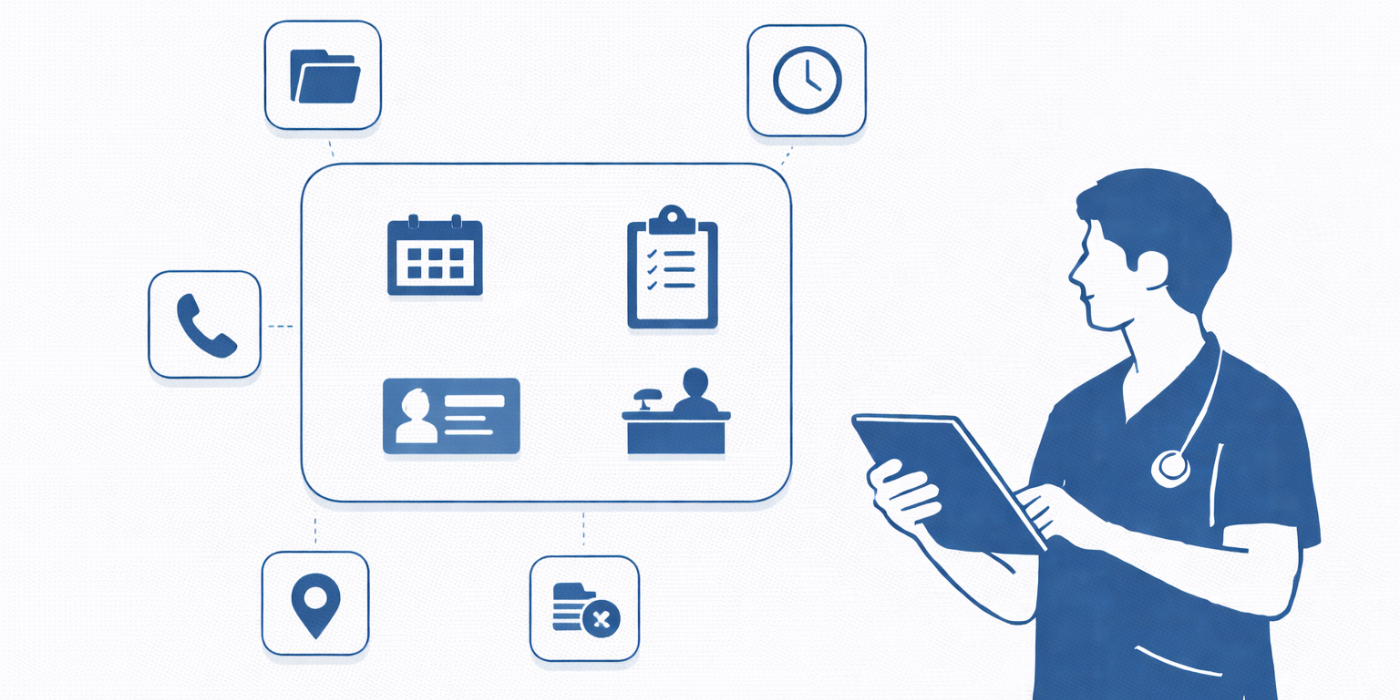
1) Front Desk Operations Terms Are Really Workflow-Control Terms
Most beginners learn front desk vocabulary as if it were a memorization exercise. That is the wrong approach. In real clinics, front desk terms are not isolated definitions. They are control points inside a live patient-access system. If a staff member misunderstands appointment confirmation, registration status, eligibility verification, or check-in sequencing, the error rarely stays at the front desk. It spreads into documentation, billing, patient communication, schedule integrity, and provider productivity.
That is why strong teams train front desk staff with the same seriousness they apply to patient intake procedures, insurance verification, and healthcare portal terms. A receptionist who knows the difference between a referral requirement and a prior authorization issue prevents downstream chaos. An admin who understands demographic verification protects the accuracy of the chart before the clinician even walks into the room. A scheduler who understands visit type mapping stops a fifteen-minute follow-up from being booked into a slot that requires forty minutes and extra prep.
Front desk operations also sit close to patient emotion. When patients are confused, rushed, sick, anxious, or already irritated by payer rules, the front desk becomes the first test of whether the organization feels competent. That is why communication discipline matters as much as technical accuracy. Teams that study effective patient communication terms, empathy in healthcare administration, and de-escalation techniques reduce conflict before it hardens into complaints, bad reviews, walkouts, or missed care.
For career growth, mastering these terms is not minor administrative polish. It is proof that you understand how access, compliance, and revenue connect. That is one reason employers increasingly value people who train through structured pathways like the ones discussed in medical scribe certification exam breakdown, essential skills every healthcare employer wants from a medical scribe, medical scribe career pathways, and how medical scribe certification boosts your healthcare career. Front desk excellence is not “just admin.” It is operational healthcare literacy.
2) The Terms That Most Directly Affect Schedule Accuracy, Patient Flow, and Revenue
The highest-value front desk terms are the ones that determine whether a visit moves cleanly from booking to billing. That starts with appointment architecture. “Visit type,” “template slot,” “buffer time,” and “provider block” are not scheduling jargon for their own sake. They are the grammar of clinic flow. A scheduler who ignores visit-type precision can destroy the day before it begins. That is why teams studying telehealth platforms, healthcare CRM terms, remote medical scribing, and medical scribe job market outlook quickly realize that access work and documentation work depend on the same operational discipline.
Next comes financial clearance language. “Eligibility verification,” “benefits check,” “copay,” “coinsurance,” “deductible,” “referral,” and “prior authorization” belong in every front desk employee’s active vocabulary. These terms decide whether the patient can be seen, what the patient owes now, and whether the organization will get paid later. That is why front desk professionals benefit from reading both insurance verification definitions and the wider logic behind CPT codes explained, ICD-10 codes dictionary, medical scribes impact hospital revenue, and medical scribes crucial to documentation compliance. Front desk errors often look administrative in the moment but become financial failures in the back end.
Identity and chart integrity terms matter just as much. “Demographic verification,” “photo ID match,” “guarantor,” “subscriber,” “policyholder,” and “registration status” protect the patient record from contamination. One wrong birth date, one unverified insurance update, or one missed guarantor detail can lead to rework that consumes far more time than a careful two-minute verification at arrival. This is also why strong admins understand the digital side through healthcare portal use cases, future EMR systems insights, top EMR/EHR platforms every scribe should know, and documentation trends crucial for scribes. Clean access data is not clerical neatness. It is infrastructure.
How Strong Front Desk Teams Use Definitions as Checklists, Not Trivia
A weak front desk operation treats terminology as passive knowledge. A strong one turns each term into a repeatable checkpoint. That is the difference between “knowing the word” and “controlling the workflow.” For example, “pre-registration” should trigger a mental checklist: confirm demographic details, validate payer information, identify missing forms, check referral status, verify visit type, and send portal prompts if appropriate. If staff only know the label but not the linked tasks, the clinic still bleeds time.
The same principle applies to “check-in.” In high-performing clinics, check-in is not simply clicking an arrival button. It is the handoff moment where identity, financial readiness, form completion, and routing are confirmed. Anyone serious about front desk excellence should connect this concept with mastering medical terminology for medical scribes, new research on clinical efficiency, real-time industry report on data accuracy, and annual report on clinical documentation accuracy. The front desk is the first accuracy filter in the clinical record lifecycle.
Another overlooked term is “message routing.” Staff often think this is just clerical forwarding, but poor routing can delay medication questions, leave referral problems unresolved, bury portal complaints, and create provider inbox clutter. The better way to think about it is operational prioritization. That mindset is strengthened by studying effective patient communication examples, de-escalation practical tips, healthcare CRM references, and predictive insights on certified CMAAs transforming telemedicine. Routing is where service, urgency, and accountability collide.
The smartest teams also define failure modes in advance. What happens when insurance is inactive? What happens when a patient arrives without a required referral? What happens when portal registration fails? What happens when a provider’s template is already over capacity? Front desk excellence depends on having answers before the pressure arrives. That is how definitions become workflows, and workflows become trust.
3) The Front Desk Checklist That Prevents Delays, Denials, and Patient Friction
If you want a front desk checklist that actually improves performance, build it around risk concentration. The first block is identity and account accuracy: verify name, date of birth, contact data, guarantor, photo ID, and payer card status. The second block is visit readiness: correct visit type, referral presence, prior authorization flags, completed forms, and portal access. The third block is financial clarity: copay, deductible exposure, benefit limitations, and payment expectations. The fourth block is communication continuity: appointment confirmation, message routing, follow-up instructions, and next-step scheduling.
This checklist mindset is why ambitious professionals often outgrow generic admin training and look toward more structured skill stacks through top medical scribe training courses and certifications, medical scribe exam day preparation checklist, future-proof your medical scribe career, and automation and AI reshaping the medical scribe role. The market increasingly rewards people who can think in systems, not just tasks.
There is also a patient-experience angle most teams underestimate. Patients rarely judge a clinic by whether the internal terminology was technically correct. They judge it by whether the visit felt smooth. That smoothness depends on hidden operational wins: they were scheduled correctly, greeted confidently, financially informed without embarrassment, routed efficiently, and checked out with clear next steps. Front desk terms become patient experience when staff can translate them into calm, competent action. That is exactly where empathy definitions, communication scenarios, telehealth regulation insights, and data privacy regulations explained for CMAAs become practical, not theoretical.
A final checklist principle: document exceptions. If something could not be completed, the record should show what happened, what the patient was told, and what happens next. Front desk breakdowns become toxic when nobody owns the next step.
4) Where Front Desk Operations Overlap With Medical Scribing, Documentation, and Compliance
Many people separate front desk work from medical scribing, but the line is thinner than it looks. Both roles rely on precision, sequencing, terminology, EHR discipline, and communication under pressure. A front desk professional who understands documentation logic makes fewer intake errors. A scribe who understands access workflows creates cleaner upstream coordination. This overlap is one reason ACMSO content on medical scribe careers with certification, success stories from scribes to medical professionals, medical scribe hiring surge, and industry update on rising telehealth demand matters even to administrative learners.
Consider the term “chief complaint capture.” A front desk employee is not documenting the provider’s HPI, but poor initial intake language can still distort downstream understanding of visit purpose. The same is true for medication list updates, portal message summaries, and referral reason notes. If the starting information is vague, the whole visit is more likely to lose time. That is why operational literacy benefits from adjacent study in medical terminology quick study, specialty documentation templates and cheat sheets, voice recognition and dictation tools, and AI medical scribe and ambient dictation tools. Modern workflows are connected whether organizations admit it or not.
Compliance is another shared zone. Privacy acknowledgments, demographic accuracy, portal setup, patient communication boundaries, and message routing all affect whether the organization stays controlled or becomes exposed. This is why front desk staff should not ignore HIPAA updates every CMAA must know, future healthcare compliance changes, medical scribes navigating new compliance standards, and real-time insights on healthcare administration impact. Front-end staff are often closer to privacy mistakes than they realize.
The career takeaway is powerful: if you understand front desk terms in operational, documentation, and compliance context, you become harder to replace and easier to promote.

5) How to Turn Front Desk Terminology Into Career Leverage
Knowing these terms should improve your performance now, but it should also strengthen your position in the job market. Employers are not only hiring for friendliness and multitasking anymore. They want people who understand access, tech, compliance, patient communication, and data accuracy together. That is exactly why professionals who study beyond basic reception tasks gain an edge through resources like top medical administrative assistant opportunities in New York City, Texas medical admin career opportunities, Florida CMAA career insights, and annual CMAA job market report. Vocabulary becomes leverage when it translates into fewer errors, better patient handling, and more reliable workflow control.
One smart move is to build a personal glossary tied to real problems you have seen: no-shows, missed referrals, wrong visit types, inactive insurance, poor check-out compliance, high call volume, or portal confusion. Then connect each problem to a better process. That turns passive learning into evidence of operational thinking. It also aligns with future-ready content like how AI will transform medical administrative assistant roles by 2030, 10 emerging technologies every CMAA must prepare for, interactive guide to the medical office of 2025, and medical administrative assistants and technology 2025 report. The next wave of front desk professionals will not be judged only on courtesy. They will be judged on workflow intelligence.
Another move is to cross-train with documentation and scheduling analytics. Read hiring and salary trend material like 2025 CMAA salary report, interactive data visualization of CMAA salaries, in-depth report on certification and earnings, and how certification affects job security and salary growth. When you can speak the language of accuracy, compliance, and patient access with confidence, you stop sounding like entry-level support and start sounding like operational talent.
6) FAQs About Front Desk Operations Terms
-
Start with eligibility verification because it touches patient access, financial clarity, and denial prevention at the same time. If a staff member misunderstands what active coverage means, the clinic can schedule correctly and still fail operationally. From there, master visit type, demographic verification, referral, and check-out because those terms connect directly to flow, accuracy, and retained revenue. A good learning path is to pair front desk study with insurance verification examples, patient intake procedures, healthcare portal terms, and clinical efficiency research.
-
Because the front desk controls the first verified version of the visit. If the patient is misregistered, financially unclear, scheduled under the wrong visit type, or routed poorly, the rest of the clinic inherits that defect. Providers lose time, scribes work around bad inputs, billers chase preventable errors, and patients feel the confusion immediately. That is why front-end work has direct relevance to data accuracy reporting, documentation accuracy studies, hospital revenue impact analysis, and compliance standards.
-
Do not memorize lists in isolation. Learn in workflow clusters. Group terms into scheduling, registration, insurance, communication, privacy, and check-out. For each term, ask what action it triggers, what risk it prevents, and what happens if it is missed. Then practice translating the term into patient-facing language. To speed up progress, combine foundational admin resources with medical terminology study support, communication examples, de-escalation guidance, and career pathway content.
-
The biggest ones are appointment confirmation, wait time communication, copay explanation, portal activation, follow-up scheduling, and message routing. Patients usually do not know the internal vocabulary, but they absolutely feel the effect when those functions are handled badly. Smooth explanation, confident next-step guidance, and accurate scheduling reduce friction more than scripted friendliness alone. This is where studying empathy scenarios, patient communication terms, telehealth insights, and patient-experience leadership for CMAAs helps tremendously.
-
Yes, especially when your front desk knowledge is process-driven rather than purely clerical. Skills like terminology accuracy, EHR discipline, communication control, patient-flow awareness, and documentation readiness transfer well into scribing, patient access, care coordination, and administrative leadership. That is why ambitious professionals often continue into medical scribe certification pathways, career growth content, future documentation roles, and emerging specializations in advanced healthcare.
-
Tie every checklist item to a measurable failure you are trying to prevent. Instead of generic prompts like “verify insurance,” specify the exact outcome: active payer, correct subscriber, current card scan, referral requirement checked, patient cost expectation communicated. Instead of “complete check-out,” specify follow-up booked, portal instructions given, payment addressed, and unresolved items documented. Effective checklists are not broad reminders. They are precision tools for preventing repeatable operational pain.
