

How Medical Scribe Certification Boosts Your Healthcare Career
Medical scribe certification is no longer a “nice extra.” It is a career signal that tells employers you understand documentation standards, can ramp fast inside an EHR, and will reduce provider workload without creating risk. In a market where automation is drafting notes and compliance is tightening, certification separates you from applicants who only claim they are accurate. This guide shows how certification boosts hiring speed, pay leverage, specialty access, and long term growth. You will also get a practical roadmap to turn certification into proof artifacts that hiring managers trust.

1. Why Medical Scribe Certification Matters More Than Ever
Healthcare employers are not only hiring for typing speed. They are hiring for trust, consistency, and risk control. Certification matters because it compresses the “unknown” in a hiring decision. A clinic cannot afford a scribe who needs weeks of corrections, causes documentation rework, or increases compliance exposure. That is why certification aligns directly with employer priorities highlighted in documentation compliance expectations and the reality of new compliance and documentation standards.
Certification also matters because the workflow is evolving. AI and dictation tools can draft notes, but clinics still need humans who can validate accuracy, structure documentation, and protect medical decision making. If you do not understand that shift, you get compared to tools from the AI and ambient dictation buyer’s guide and the ecosystem covered in the voice recognition and dictation software guide. Certification helps you position yourself as the person who makes those tools safe and usable.
Hiring demand also keeps concentrating in systems that run at scale. Large groups and health systems need standardized documentation performance across teams. Certification supports that standardization mindset, which is why it pairs well with growth signals found in the medical scribe hiring surge report and the employer concentration mapped in the health systems hiring mega list.
Finally, certification is career mobility. It helps you move into higher trust specialties and remote workflows, especially as telehealth expands. If you want to see where remote demand is going, use the market signal in telehealth scribe demand and target the right employers through the telehealth companies using scribes directory.
2. What Employers See When You Are Certified (And What They Assume When You Are Not)
Certification acts like a filter. Employers do not have time to deeply test every applicant. They use signals. Certification tells them you have baseline knowledge, you understand clinical documentation workflows, and you can be trained into their system without constant correction. That matters most in high volume environments mapped in the emergency departments and urgent care chains directory and in large networks listed in the top health systems hiring scribes by state mega list.
When you are not certified, employers often assume one of three risks. First, you will require heavy edits, which burns provider time. Second, you will miss compliance elements, which creates exposure. Third, you will not be able to navigate their EHR efficiently. These assumptions become stronger as documentation standards evolve, which is why clinics keep referencing the guidance in new compliance and documentation standards and the baseline rules in documentation compliance for medical scribes.
Employers also look for evidence that you can support data integrity. A scribe is often the person entering structured data fields that drive follow ups, referrals, and reporting. If your entries are inconsistent, downstream operations break quietly. That is why evidence like the real time data accuracy report matters. Certification supports the mindset of field level discipline, not only narrative writing.
Another employer lens is workflow efficiency. They want scribes who reduce chart closure time and cut after hours documentation. This is the exact value argument supported by clinical efficiency research and the practical improvement strategies in medical scribe efficiency innovations. Certification helps you speak that language in interviews because you understand why structure matters, not only how to type.
Finally, employers care about tools. A certified scribe who also understands common systems stands out immediately. Anchor your technical credibility using the EHR platforms every scribe should know guide, then expand your tool fluency with the AI and ambient dictation tools buyer guide and the broader workflow support from the top productivity tools for medical administrative assistants.
3. How Certification Boosts Pay, Job Options, and Long Term Career Mobility
Certification does not only help you get hired. It helps you get hired into better lanes. Better lanes usually mean one of these outcomes: higher trust specialties, better employers, remote flexibility, and a clearer promotion path.
Start with geography and employer density. If you are in a thin market, certification helps, but it cannot create jobs where demand is low. That is why smart candidates combine certification with location strategy. Use the best cities for medical scribe careers interactive guide to identify high opportunity markets, then compare large city dynamics using New York City hospital opportunities and Los Angeles job market and salary insights. Certification has more leverage when many employers are competing for reliable scribes.
Next, understand specialty access. High complexity and procedure heavy specialties often prefer candidates who can show structured thinking and terminology discipline. Certification supports that preference. If you want to target specialty dense employer networks, use directories like the outpatient specialty networks hiring scribes list and the academic environment mapped in the academic medical centers and teaching hospitals list. These settings often reward reliability and standards.
Remote work is another big unlock. Telehealth teams want scribes who can produce clean notes with minimal provider edits, even when visits are fast and exams are limited. Certification supports that trust signal. Validate the trend through the telehealth scribe demand report and target real employers using the telehealth companies using scribes directory. If you want scale and stability, also explore hiring concentration through the physician groups and MSOs hiring directory.
Certification also boosts mobility into adjacent healthcare operations. Many clinics blend scribing with admin tasks, especially in outpatient settings. If you build that blended skill stack, you become harder to replace and easier to promote. Strengthen that side with the workflow automation tools directory, the task management software guide, and the office management software directory. Employers love candidates who can keep documentation clean and keep operations organized.
If you want the clearest certification pathway, use the career framing in medical scribe careers with certification and choose a structured learning option from the top medical scribe training courses and certifications guide. That way your certification becomes a plan, not a guess.
4. How to Turn Certification Into Real Hiring Advantage (Portfolio, Resume, Interview)
Certification is a credential. Hiring advantage comes from proof. The best candidates treat certification as the foundation, then build a portfolio that shows they can produce results inside real workflows.
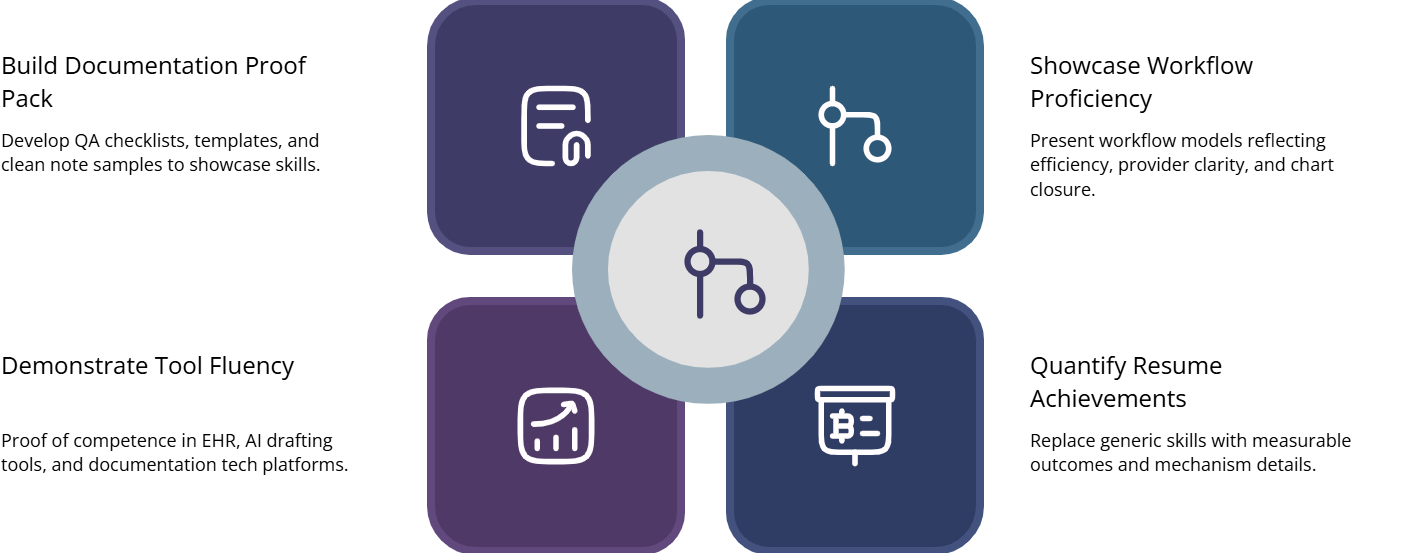
Start with a “documentation proof pack.” It should include a simple QA checklist, a template structure you can explain, and a few de identified note samples that show clean structure and decision flow. Your QA checklist should reflect the standards in documentation compliance requirements and the expectations discussed in new documentation standards. This proves you understand risk, not only writing.
Next, add a workflow proof pack. This is what separates a scribe from a documentation operator. Include a simple workflow map for note completion, provider clarification, and chart closure. Tie your process to measurable outcomes supported by clinical efficiency research and the field tactics in medical scribe efficiency innovations. If you can explain how your workflow reduces provider edits and improves closure time, you sound like an asset, not a helper.
Then prove tool fluency. Hiring managers fear slow ramp time. Reduce that fear by showing you understand common platforms and documentation tooling. Use the EHR platforms guide as your baseline, then add awareness of modern drafting tools from the AI and ambient dictation buyer guide and the voice recognition software guide. Your message should be simple: you can work with tools without sacrificing accuracy.
Resume positioning matters too. Avoid generic bullets like “assisted with documentation.” Replace them with outcomes such as “reduced provider edits by standardizing templates” or “improved turnaround time by using structured note flows.” Even if you cannot quantify yet, you can describe the mechanism. For credibility, align your language with outcomes in the data accuracy report and the coordination outcomes described in patient care coordination findings.
Finally, apply strategically. Choose employers where certification is rewarded and where documentation scale creates consistent demand. Use the job opportunities directory, then target large employers using the health systems hiring mega list and the physician groups and MSOs directory. If you want high intensity experience quickly, focus on the employers in the emergency and urgent care chains directory.
5. Staying Relevant Through 2030 (Continuing Education, Tools, and Career Progression)
Certification is a starting line. Long term growth comes from staying current as documentation evolves. The market is moving toward measurable performance, tighter standards, and more tools. If you stop learning after certification, you will feel the gap within a year.
First, commit to continuing education. Treat it as a weekly habit, not a yearly scramble. Use the curated learning resources in the CMAA continuing education programs directory and keep your broader professional development organized through the CMAA certification resources directory. Even if you remain a scribe, clinics increasingly value documentation staff who understand adjacent admin processes.
Second, build systems that support your own performance. By 2030, clinics will expect documentation teams to run like operators. Use tools and processes from the task management software directory, the document management tools directory, and the office communication tools directory. These systems reduce errors and reduce stress under volume.
Third, treat AI as a skill, not a threat. Your job security improves when you can validate drafts quickly and protect data accuracy. This is exactly why the AI tools buyer guide matters, and why it should be paired with the field reality in the data accuracy report. Tools change. Quality standards do not.
Fourth, consider remote opportunities. Telehealth growth creates new career paths for certified scribes who can work independently and maintain low edit rates. Track demand through telehealth scribe hiring trends and target real employers using the telehealth companies directory. Remote roles reward structure, clarity, and tool discipline.
Finally, plan your progression. Many scribes move into lead roles, training roles, and operations support roles. If you want a structured path, use the roadmap in medical scribe careers with certification and keep your technical foundation strong through the EHR platforms guide. Your long term leverage comes from being the person who creates stability in documentation, not the person who only completes tasks.
6. FAQs
-
Yes, because it reduces employer uncertainty. Certification signals baseline competence, standards awareness, and a lower onboarding burden. It also helps in high volume employers where speed and consistency matter, such as those listed in the health systems hiring mega list and the ED and urgent care chains directory. To strengthen your interview credibility, align your answers with documentation compliance expectations and clinical efficiency outcomes.
-
AI and dictation often produce drafts, not finished documentation. Clinics still need humans to validate details, maintain structure, and protect accuracy. Certification helps you present yourself as a quality and compliance professional, not only a typist. Build your AI awareness through the AI and ambient dictation buyer guide and the workflow landscape in the voice recognition guide. Anchor quality expectations using the data accuracy report.
-
Focus on outcomes: lowering provider edits, improving turnaround time, and maintaining audit ready structure. Build a template library, a QA checklist, and a workflow map you can explain in interviews. Use the tactics in medical scribe efficiency innovations and align your process with the standards in new compliance documentation standards. For technical readiness, build EHR fluency through the top EHR platforms guide.
-
Employers with scale and documentation pressure benefit most. This includes health systems, large physician groups, MSOs, and high volume ED and urgent care networks. Those employers prioritize standardization and low rework. Use the physician groups and MSOs hiring directory and the health systems hiring mega list to target the right organizations. If you want concentrated demand by setting, use the ED and urgent care directory.
-
Yes, because remote workflows require trust and consistency. Telehealth teams want scribes who can produce clean notes with minimal provider edits and strong structure. Track market demand through telehealth scribe hiring trends and apply to employers listed in the telehealth companies using scribes directory. Strengthen your tool readiness with the AI tools buyer guide and EHR confidence through the EHR platforms guide.
-
Choose markets with employer density and consistent hiring. Certification works best when many employers compete for reliable scribes. Use the best cities for medical scribe careers guide to pick high opportunity regions, then validate with deep dives like NYC hospital opportunities and Los Angeles salary insights. For employer targeting, use the health systems mega list and the MSO hiring directory.
-
Use a curated program list so you do not waste time on random courses. Start with medical scribe careers with certification to understand the pathway, then pick from the medical scribe training courses and certifications guide. To stay current afterward, use the continuing education programs directory and keep your workflow strong with the task management directory.
