

Interactive Salary Calculator for Medical Scribes (2025 Edition)
Medical scribe salaries in 2025 are not “one number.” They change by state, city, setting, specialty, shift type, and whether you are working in telehealth or on site. Employers know that, and candidates who negotiate like it is one flat rate usually lose money. This guide gives you an interactive salary calculator framework you can use to estimate pay with real decision variables, plus the exact proof points employers use when they pay top range.

1) How the 2025 medical scribe salary market really works
Salary conversations break down because most people compare the wrong things. A busy emergency department, a specialty clinic, and a telehealth operation are three different labor markets, even inside the same city. If you want accurate salary expectations, anchor your thinking to demand intensity and documentation complexity, not just the job title.
Demand intensity shows up in hiring surges and expansion areas. If a market is actively scaling scribe coverage, employers pay more to reduce onboarding churn and protect provider throughput. This is why broad demand signals matter, like the trends in medical scribe hiring surge and the industry pressure described in medical administration workforce trends.
Documentation complexity is the hidden driver. When compliance standards tighten, employer risk increases. In risk heavy settings, strong scribes are not treated as “support.” They are treated as a defense layer. That is exactly why compliance focused employers lean on frameworks like new compliance and documentation standards and invest in audit safe processes described in healthcare documentation compliance.
Location matters, but do not oversimplify it. High cost cities can still have low pay if employers view scribes as replaceable. Meanwhile, a smaller market can pay surprisingly well if the employer is losing provider time without scribes. Use city level market context to calibrate your expectations, especially when comparing heavy markets like medical scribe opportunities in New York City hospitals versus cost pressure and competition in Los Angeles job market and salary insights.
The fastest way to raise your pay ceiling is to raise your “trust level.” Employers pay more when they believe you reduce edits, prevent documentation errors, and keep notes near real time. If you want a proof based approach, align your skills with the performance logic covered in scribe efficiency innovations and the accuracy expectations in real time data accuracy report.
2) Build your interactive salary calculator in 5 inputs
A salary calculator becomes powerful when it uses inputs employers actually price. Use this framework and you will stop guessing.
Step 1: Pick your market anchor
Start with a market anchor based on where you are applying. If you are comparing high volume metros, ground your thinking in market specific context like New York City hospitals and Los Angeles salary insights. If you are looking at opportunity clusters across multiple regions, use a broad reference like best cities for medical scribe careers.
Your anchor is not the final number. It is your baseline that you will adjust using reality variables.
Step 2: Choose your setting multiplier
Setting is where pay changes fast. ED and urgent care tend to price in intensity. Specialty clinics price in terminology and documentation density. Telehealth pricing depends on remote workflow maturity and documentation risk, which keeps rising as telehealth expands in telehealth settings.
If you want to earn more, choose settings where the employer is losing money without clean documentation. That is why compliance frameworks like documentation standards and documentation compliance indirectly raise pay ceilings.
Step 3: Score your performance level honestly
Employers pay top band when they believe your performance reduces rework.
Use three proof metrics:
Provider edit rate: How often your notes need heavy edits.
QA pass rate: How often your documentation passes internal checks.
Closure time: How fast notes are signed and closed.
This is why employers care about efficiency systems in scribe efficiency innovations and accuracy outcomes in data accuracy reporting.
Step 4: Add your schedule premium
Most candidates ignore schedule value. Employers do not. Nights, weekends, overtime, and float roles can materially raise compensation because coverage is harder to staff. If you want higher pay without switching cities, this is often the cleanest lever.
Step 5: Add your tool leverage bonus carefully
Tools can raise output per hour, but employers will not pay for tools if they increase risk.
If you can safely use modern tooling, you can justify a premium by referencing tool maturity and workflow design in AI scribe and ambient dictation tools and baseline dictation options in voice recognition and dictation software. The keyword is safe. Compliance comes first, always, as emphasized in documentation compliance.
3) Calculator formula and example outputs you can use today
Here is a simple but employer aligned model that works without overfitting.
Baseline hourly rate
Start with your market anchor based on city and employer type.
Adjusted rate formula
Adjusted Rate = Baseline × (1 + Market Premium) × (1 + Setting Premium) × (1 + Performance Premium) × (1 + Schedule Premium) × (1 + Tool Bonus)
You do not need perfect math. You need consistent logic.
Example A: High volume metro, ED, strong performance
Market premium: +15% (high demand metro)
Setting premium: +20% (ED intensity)
Performance premium: +12% (low edits, high QA)
Schedule premium: +10% (evenings or weekends)
Tool bonus: +4% (safe dictation and templates)
This candidate can confidently negotiate because they can explain how they protect throughput and reduce risk. That value is not abstract. It maps to documented industry priorities like provider time savings and efficiency innovation and how scribes strengthen care coordination in patient care coordination data.
Example B: Suburban clinic, standard schedule, early career
Market premium: +0% to +5%
Setting premium: +5% (clinic)
Performance premium: +0% to +5% (still calibrating)
Schedule premium: 0%
Tool bonus: 0% to +2%
This is not bad. It is stable. The path to higher pay is upgrading performance proof and choosing higher premium settings, not “hoping” a manager raises your rate.
Example C: Telehealth scribe, strong virtual documentation
Telehealth scribes can earn well when they reduce follow ups and create clean virtual notes. Your premium depends on workflow maturity and documentation standards, which are evolving as telehealth demand rises in telehealth settings growth. If you want to position yourself as high trust, link your documentation approach to new documentation standards.
The negotiation message is simple. You are paid more when you reduce risk, not when you ask louder.
4) Why your salary jumps when your documentation becomes “audit safe”
In 2025, compensation is tied to employer risk more than people admit.
If your notes trigger provider edits, delayed signatures, and compliance concerns, you cost money. If your notes protect the provider and reduce follow ups, you make money. That is why employers invest in compliance aligned scribe operations described in navigating documentation standards and why they treat scribes as a compliance asset in documentation compliance.
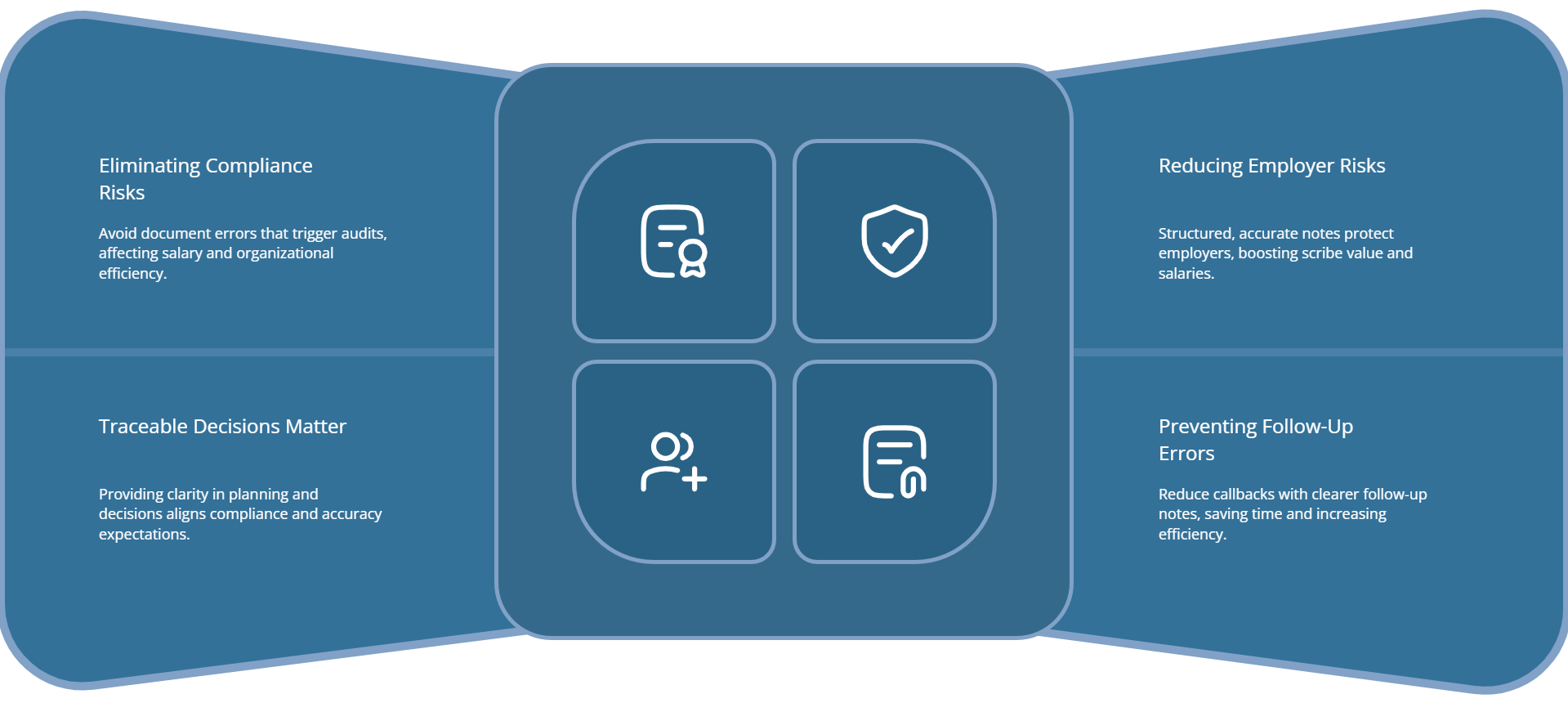
Audit safe documentation is not about writing longer notes. It is about writing accurate notes.
Employers raise pay when they see:
Consistent structure across encounters
No template bloat and no copy paste noise
Clear decision trail in the plan
Clean follow up instructions that reduce call backs
This also ties into broader quality outcomes and coordination wins covered in how scribes improve care coordination and data expectations highlighted in data accuracy reporting.
If you want to earn more, do not ask for more money first. Build proof first.
5) Make the calculator actionable with market and employer targeting
A calculator is only useful if it changes your actions.
Target markets with strong demand signals
If you want the highest probability of top range pay, follow hiring momentum and market demand. Use a national lens like scribe hiring surge and then drill into metro level specifics using New York City hospitals, Los Angeles salary insights, and the broader map in best cities interactive guide.
Choose employer types that price outcomes
Some employers pay more because they treat scribes as throughput protection. Others pay less because they treat scribes as a cheap layer.
If an employer is investing in tech, workflows, and documentation quality, they often pay higher for stable talent. You can sense that by the way they talk about tools and efficiency, like the themes in efficiency innovations, and their approach to compliance and risk in documentation compliance.
Use tool stacks as a compensation advantage
When an employer is adopting AI and ambient documentation, they will pay for someone who can deliver speed without risk. That is why tool literacy matters, but it must be grounded in safe workflows referenced by AI medical scribe tools guide and complemented by basics in dictation and voice recognition.
The result is simple. The calculator tells you what to pursue, not what to hope for.
6) FAQs
-
Include market, care setting, shift type, telehealth vs onsite, documentation complexity, and performance proof like edit rate and QA strength. These inputs reflect how employers price labor under throughput pressure and compliance risk. Use market research from best cities interactive guide and layer in risk priorities from documentation standards to keep the calculator realistic.
-
Because employers are pricing different problems. ED and high volume urgent care roles price intensity and speed, while specialty clinics price terminology density and documentation precision. Employers also pay more when compliance exposure is higher and edits are costly. If one employer is tightening documentation operations, their pay bands usually reflect the compliance mindset in documentation compliance and the process expectations in new standards.
-
Increase schedule premiums and performance proof. Nights, weekends, and float roles often add meaningful pay because coverage is difficult. Then reduce provider edits by writing cleaner notes and closing charts faster. Employers reward scribes who protect throughput, which aligns with efficiency themes in scribe efficiency innovations and accuracy expectations in data accuracy reporting.
-
It depends on workflow maturity and documentation risk. Telehealth can pay well when the employer values clear virtual documentation and reduced follow up clarifications. It can pay less when the role is treated as low skill data entry. If you want to price it correctly, factor in telehealth demand growth from telehealth settings and your ability to produce audit safe notes under virtual constraints.
-
Yes, when you can prove they increase output without increasing risk. Safe tool use improves documentation speed, reduces rework, and supports provider throughput. Employers will pay for that if they trust your compliance instincts. Use tool benchmarks from AI and ambient dictation tools and fundamentals from voice recognition software to position yourself as a safe power user.
-
They negotiate with generic claims instead of proof. Employers do not pay more because you “work hard.” They pay more when you reduce edits, prevent documentation errors, and keep notes near real time. If you want leverage, align your negotiation story with what employers prioritize in documentation compliance and show how you support care coordination outcomes in patient care coordination data.
-
Use interactive market guides and city level breakdowns, then validate using employer type and setting. Start with best cities for medical scribe careers, compare major metros like NYC hospital opportunities and Los Angeles salary insights, and then filter your targets using growth signals from scribe hiring surge.
