

2025 Medical Scribe Job Market Outlook: Trends & Opportunities
Medical scribing is no longer a “nice-to-have” role in many settings. In 2025, it is becoming a throughput lever, a documentation risk buffer, and a care coordination stabilizer. The job market is shifting fast because telehealth keeps scaling, compliance pressure keeps rising, and provider burnout keeps forcing workflow redesign. If you want the best scribe opportunities this year, you need to follow the signals that employers actually hire for, not the generic job posts.

1) What the 2025 Medical Scribe Job Market Is Really Being Shaped By
The biggest mistake people make is treating scribe hiring like a simple supply and demand story. In reality, scribe demand rises when documentation becomes the bottleneck that blocks revenue, quality scores, and patient flow. That is why the strongest signals in 2025 come from settings where documentation complexity is rising and where providers are forced to deliver care faster with less support.
First, compliance expectations are tightening and organizations are investing in documentation integrity. If you understand how scribes support healthcare documentation compliance and how teams adapt to new compliance and documentation standards, you understand why hiring keeps expanding. The employer pain is simple. Audits, denials, and incomplete notes are expensive.
Second, telehealth is still forcing new workflows. Virtual visits often produce messy notes, delayed sign off, and inconsistent documentation unless someone standardizes it. That is why the market keeps growing around telehealth scribe demand and why directories like telehealth companies using scribes matter for job seekers. If a company is scaling visits, they either hire scribes or they accept chaos.
Third, data quality has become a competitive advantage. Healthcare is now measured, reported, and benchmarked at scale. If the documentation is sloppy, the data is trash. That is why employers care about accuracy and why the market ties strongly to data accuracy expectations. Scribes are being hired as a quality layer, not just a typing layer.
Fourth, the tools are changing the job. Voice and ambient dictation can speed up capture, but they still create errors and require editing standards. If you understand the ecosystem from dictation and voice tools and the core systems from EMR and EHR platforms, you can position yourself as “tool fluent” instead of “replaceable.”
Finally, market intensity varies by location. Big hubs can offer faster learning, more openings, and clearer advancement paths, especially in large health systems. Use the best cities guide and compare specific markets like New York City hospitals and the Los Angeles market to avoid guessing.
| Setting or Specialty | 2025 Demand Signal | Why It Is Growing | Skills That Get You Hired | Fast Proof Artifact |
|---|---|---|---|---|
| Telehealth primary care | Expanding teams | Visit volume scaling | Clean HPI edits, template discipline | Telehealth note SOP |
| ED and urgent care | High turnover hiring | Throughput pressure | Speed with accuracy, triage clarity | Shift throughput checklist |
| Hospitalist teams | Coverage expansion | Complex documentation | Problem list hygiene, daily summary clarity | Rounding template map |
| Cardiology | Specialty growth | High documentation burden | Risk factor capture, procedure vocabulary | Cardio note quality rubric |
| Orthopedics | Stable demand | Procedure and imaging heavy | MSK terminology, plan documentation | Ortho template upgrade list |
| Gastroenterology | High volume clinics | Workflow standardization | Procedure prep, follow up tracking | GI visit workflow map |
| Dermatology | Consistent openings | Documentation repetition | Structured exam language | Derm phrase bank |
| Ophthalmology | Specialized hiring | High visit volume | Terminology precision | Ophtho template index |
| Oncology | Selective hiring | Complex medical necessity | Problem prioritization, med safety | Onc plan clarity checklist |
| Behavioral health | Rising telehealth use | Documentation variability | Neutral language, structure | Visit summary standards |
| Endocrinology | Steady demand | Chronic care complexity | Lab trend capture | Chronic care note outline |
| Nephrology | Niche openings | Complex follow ups | Timeline precision | Follow up tracker |
| Neurology | Specialty expansion | Long visits | History clarity, neuro exam structure | Neuro template library |
| Rheumatology | Demand pockets | Chronic disease load | Symptom timeline logic | Timeline capture checklist |
| Pediatrics | Mixed by region | Volume and prevention | Parent communication clarity | Well visit documentation guide |
| OB and GYN | Stable hiring | Compliance and documentation | Structured notes, screening capture | Screening checklist |
| Pain management | Selective hiring | Medical necessity scrutiny | Procedure and assessment clarity | Necessity phrasing bank |
| Sleep medicine | Growing clinics | Testing and follow ups | Workflow consistency | Follow up cadence template |
| Family medicine groups | High volume openings | Primary care load | Efficiency, consistency | Template version index |
| Academic medical centers | Structured hiring | Teaching workflows | Standards compliance | Training checklist |
| Large health systems | Ongoing growth | Standardization projects | Process discipline | SOP contribution log |
| Physician groups and MSOs | Scaling clinics | Revenue integrity pressure | Accuracy and speed | Quality scorecard |
| Scribe staffing agencies | High placements | Coverage flexibility needs | Adaptability | Skills matrix |
| Ambient scribe programs | Rapid expansion | Tool adoption wave | Editing, QA mindset | Editing standards SOP |
| Compliance focused clinics | Targeted hiring | Audit readiness | Standards knowledge | Audit checklist |
| Care coordination teams | Increasing investment | Follow up outcomes focus | Handoff clarity | Referral tracking template |
2) Where Demand Is Rising Fastest in 2025
If you want opportunity, stop searching “medical scribe jobs” and start searching “where documentation is breaking.” The fastest hiring growth shows up where notes are delaying throughput, where sign off is lagging, or where documentation quality is failing audits. That is why the biggest accelerators in 2025 are telehealth, urgent care, EDs, and large groups scaling standardization.
Telehealth is not a side channel anymore. It is a production system. That is why employers are building scribe teams around telehealth settings and why lists like telehealth companies using scribes are effectively a hiring map. If a telehealth org is scaling across states, it needs consistent templates, consistent phrasing, and someone who can edit fast without changing meaning.
Emergency and urgent care demand is driven by throughput. Documentation has to keep up with patient flow or the whole system stalls. That is why regional hubs like New York City hospitals and high volume markets like Los Angeles often show constant openings. Employers in these settings hire for calm under pressure, accuracy under speed, and disciplined note structure.
Specialty networks are another growth engine. Large outpatient groups are standardizing documentation across providers to protect revenue and reduce rework. Directories like physician groups and MSOs hiring scribes and niche lists like outpatient specialty networks hiring scribes show where the demand clusters. These settings often pay off long term because you build repeatable expertise in one specialty.
Ambient and AI enabled scribing is expanding fast, but it is not removing the need for scribes. It is changing what employers value. They need people who can manage tools, edit outputs, enforce standards, and prevent garbage from entering the chart. If you want to ride this wave, study scribe efficiency innovations and become fluent in the tooling ecosystem, including dictation platforms.
Location still matters because opportunity density is not evenly distributed. Use the best cities interactive guide as your starting filter and then validate with job market deep dives like NYC and LA. The goal is to put yourself where openings are frequent and the learning curve is steep.
3) Pay, Scheduling Reality, and What Employers Actually Screen For
In 2025, the strongest scribe candidates are not the ones who type fast. They are the ones who reduce friction and protect the chart. Employers screen for three things that map directly to outcomes: reliability, documentation quality, and workflow discipline.
Reliability matters because clinics run on predictable coverage. Many hiring managers have been burned by high turnover, missed shifts, and inconsistent performance. If you want to stand out, position yourself as low risk by emphasizing consistency and structured performance. That aligns with why organizations invest in medical scribe hiring surges and why scribe staffing keeps expanding across systems.
Documentation quality matters because it reduces downstream damage. Poor notes create addendums, coder queries, denied claims, and compliance exposure. If you can speak the language of quality by referencing documentation compliance and the reality of new documentation standards, you will sound like someone who understands risk, not just tasks.
Workflow discipline matters because the modern clinic is a system. Employers want scribes who keep the visit moving, follow provider preferences consistently, and do not create rework. This is where tool fluency becomes leverage. If you can navigate major systems from the EMR and EHR platforms list and you understand how voice tools create errors without standards, you become a productivity asset.
Scheduling in 2025 is also splitting into two major tracks. One is high intensity in person work, like EDs and urgent care. The other is structured remote support, often tied to telehealth. If you want more predictable hours, telehealth and large outpatient groups can be stronger fits, especially in organizations listed in the telehealth directory. If you want maximum clinical exposure, high volume in person settings in markets like NYC and LA typically give the steepest learning curve.
One more reality that matters. Employers increasingly expect scribes to contribute to data integrity. That is why market reports like data accuracy and the link between scribes and care coordination improvements are not just content. They describe what employers want, even if the job post does not say it.
4) The Best 2025 Opportunities by Goal
To win in 2025, you need to pick the opportunity type that matches your goal. Different settings build different skills and different leverage.
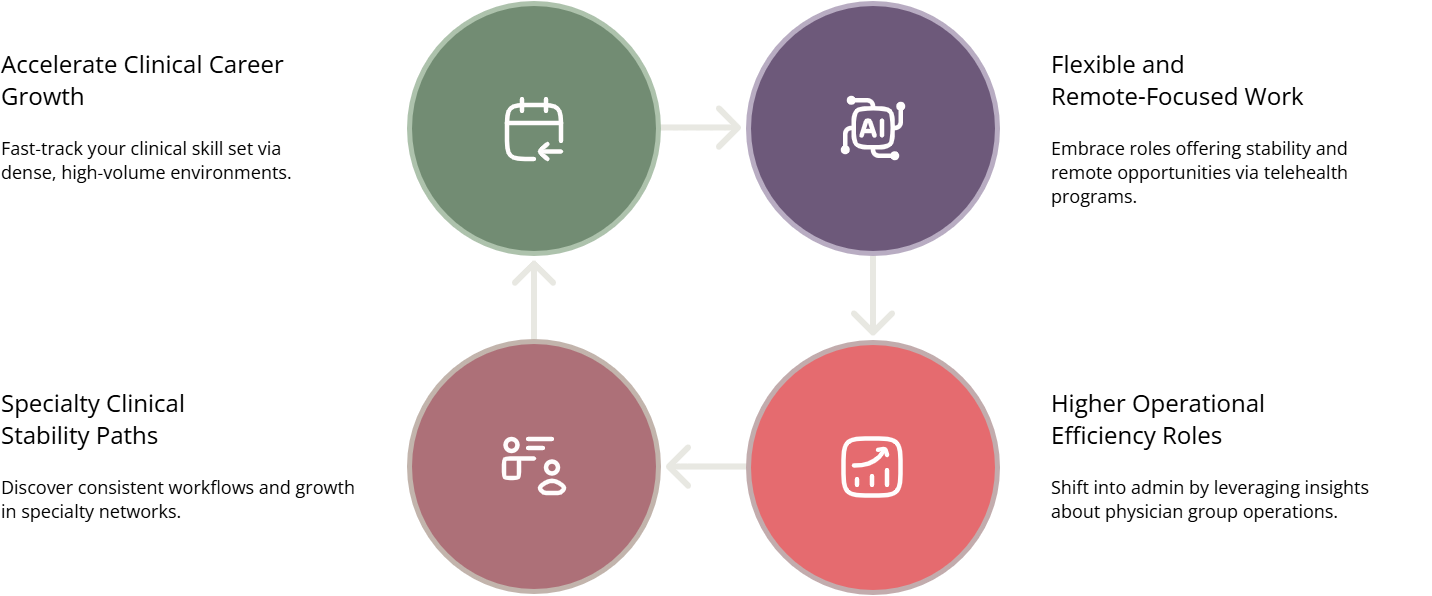
If your goal is clinical career acceleration
Choose environments where decision making is visible. ED, urgent care, hospitalist teams, and high volume specialty clinics create dense exposure. That is why markets mapped in the best cities guide and deep dives like New York City hospitals matter. The learning is faster because the volume is higher.
Your differentiator in these settings is documentation quality under pressure. Align yourself with the standards described in documentation compliance and learn what accuracy really means through the data accuracy report. That combination makes you trusted.
If your goal is predictable hours and remote friendly work
Telehealth and ambient scribe programs are the growth zones. The demand is explained in the telehealth industry update, and the most obvious employer targets are mapped in the telehealth directory. These roles often reward editing speed, standards, and strong template discipline.
Your differentiator here is tool fluency plus strict consistency. Employers care that your edits preserve meaning and reduce provider rework. If you learn the tooling landscape from voice and dictation platforms and you keep standards aligned with documentation standards, you become hard to replace.
If your goal is higher leverage in operations and administration
Large physician groups and MSOs are expanding scribe teams as part of standardization and revenue protection. That is why lists like physician groups and MSOs hiring matter. In these settings, the scribe role often expands into workflow design, template versioning, and coordination tasks.
If you want to pivot toward admin, it helps to understand adjacent workforce trends through medical administration workforce trends and to build tool literacy using resources like productivity tools for medical administrative assistants. This is how you evolve from note support to operations support.
If your goal is specialty expertise and long term stability
Specialty networks hiring scribes can create stable schedules, strong learning, and clear advancement. Use directories like outpatient specialty networks and focused employer lists like academic medical centers. Specialty experience becomes a long term asset because you learn consistent vocab, consistent workflows, and consistent documentation patterns.
Your differentiator in specialty roles is repeatable quality. Employers care that you can support the same provider style and keep templates consistent. Tool fluency helps too, especially if you know the major platforms from the EMR guide.
5) How to Make Yourself the Obvious Hire in 2025
In a crowded market, you win by being the candidate who reduces risk on day one. That means your resume and interview story must prove outcomes, not effort.
Build a documentation quality identity
Employers want scribes who produce clean notes without heavy provider edits. Learn the standards behind that by studying documentation compliance and the reality of new documentation expectations. Then build your own checklist. You can mention that checklist in interviews as your personal quality system.
Become tool fluent, not tool dependent
If you can walk into a clinic and adapt to their stack, you are valuable. Start with the platform landscape using the EMR and EHR list, then understand how dictation changes editing needs through the voice and dictation guide. Pair that with what is actually changing in workflows via efficiency innovations.
The goal is to show employers you can manage change without quality loss.
Choose your market intentionally
Do not apply everywhere. Apply where the hiring pressure is real. Use the best cities guide to shortlist, then validate using specific market pages like NYC opportunities and LA salary insights. If you want nationwide volume, anchor your search to the nationwide hiring surge.
Use certification and training as a credibility accelerator
If you are new or switching settings, training can reduce hiring hesitation. Explore pathways through scribe careers with certification and target programs from the training courses and certifications guide. Certification is not magic, but it helps you signal seriousness and structure.
Prove impact with a simple portfolio
You do not need patient data. You need artifacts that show competence.
A template improvement list tied to efficiency
A note quality checklist tied to compliance
A telehealth editing SOP tied to consistency
A skills matrix aligned to role requirements
This aligns with why organizations invest in data accuracy and why scribes improve care coordination outcomes. You are demonstrating that you understand outcomes, not just documentation.
6) FAQs: 2025 Medical Scribe Job Market Outlook
-
Yes, especially in settings where documentation is a bottleneck. Growth is strongest in telehealth, high volume urgent care, and large physician groups scaling standardization. The market drivers are visible in the telehealth demand update and the nationwide hiring surge report. Employers hire scribes when sign off delays, documentation errors, and compliance risk start costing real money.
-
The best setting depends on your goal. For maximum learning, high volume environments like ED and large hospitals often accelerate growth, especially in markets like New York City hospitals. For predictable structure, telehealth teams mapped in the telehealth directory can be a better fit. The best first role is the one that gives you consistent reps and stronger standards.
-
AI changes the role more than it removes it. Dictation tools still produce errors, omissions, and inconsistent phrasing without editing standards. That is why employers still need scribes who can enforce quality and consistency, especially using guidance from efficiency innovations. If you become fluent in the tool ecosystem like the voice and dictation platforms guide, you position yourself as an upgrade, not a risk.
-
Employers prioritize documentation quality, consistency, and workflow discipline. Candidates who understand documentation compliance expectations and the reality of new documentation standards stand out fast. Tool fluency also matters, especially with common systems listed in the EMR and EHR guide. The best candidates sound like outcome protectors, not note takers.
-
Start with markets where healthcare volume is high and systems are expanding. Use the best cities interactive guide as a shortlist tool, then validate with local market pages like NYC and LA. Combine that with the nationwide hiring surge to avoid relying on one region.
-
Certification can increase credibility when you are new, switching settings, or aiming for higher standard employers. It signals structure and trainability. Explore options through scribe careers with certification and choose programs from the training courses guide. The key is pairing certification with proof, like a note quality checklist or telehealth editing SOP, so you show outcomes, not just completion.
-
Apply with precision, not volume. Target employers where demand is obvious, such as those listed in the telehealth directory, large groups in the MSO and physician group list, and systems expanding per the nationwide report. Build a small portfolio artifact that proves quality and consistency, then bring that into interviews as your differentiator.
