

Success Stories: Real Journeys from Medical Scribes to Medical Professionals
Success stories in healthcare are rarely “overnight.” Most are quiet, compounding wins built inside messy clinics, chaotic emergency departments, and overbooked specialty practices. That is why medical scribing is such a powerful starting point. You sit next to decision makers. You learn how care is actually delivered. You see what good documentation looks like and what gets denied. You build credibility through consistency. If you treat scribing like a career launchpad, not just a job, you can move into clinical roles, administration, compliance, informatics, and beyond.

1) Why Medical Scribing Creates Fast Career Momentum
A medical scribe job can feel repetitive until you realize what you are really training. You are training pattern recognition. You are training clinical language. You are training how to think in assessments, plans, and medical necessity. That is the same mental model used by nurses, PAs, physicians, coders, and quality teams. The difference is that you get paid to sit inside the workflow while others pay tuition to learn it.
In high pressure settings, scribes pick up skills that map directly to promotion. You learn how to extract clean problem lists, capture the real reason for visit, and document time and complexity in a way that protects the provider and the practice. That is why organizations tracking documentation compliance and data accuracy increasingly view trained scribes as an operational asset rather than a cost. If you want proof, study how scribes support modern standards in healthcare documentation compliance and why they are central to compliance and documentation standards.
Scribing also gives you early exposure to the “why” behind decisions. You watch how clinicians weigh risk, choose tests, and justify treatment plans. You also see how systems fail. You see missed follow ups. You see prior auth delays. You see what happens when documentation is vague. That makes you dangerous in a good way because you learn outcomes, not just tasks.
If you are targeting stronger job markets, you also gain leverage by choosing the right location and setting. Compare opportunity density using the best cities guide, or zoom in on major hubs like New York City hospitals and the Los Angeles job market and salary insights. Picking the right environment is not luck. It is strategy.
When you treat the role like training, you stop asking “How do I get through the shift?” and start asking “What skills do medical professionals around me value most?” That shift changes everything.
| Target Role | Typical Timeline | Prereqs to Start | Scribe Skills to Leverage | Proof Artifact to Build | Common Pitfall | Next Best Step |
|---|---|---|---|---|---|---|
| Medical Assistant (MA) | 3–12 months | MA training or on the job route | Rooming flow, vitals logic, chart navigation | Clinic workflow checklist | Staying “only admin” | Shadow intake and orders |
| Certified Nursing Assistant (CNA) | 1–4 months | CNA course + exam | Patient communication, safety awareness | Patient care reflection log | Skipping clinical hours planning | Enroll and lock test date |
| Licensed Practical Nurse (LPN) | 12–18 months | LPN program | Clinical vocabulary, med lists, documentation | Medication safety notes | Weak science refresh | Prereq sprint plan |
| Registered Nurse (RN) | 18–36 months | ADN or BSN track | Assessment language, care coordination | Care plan mock cases | No study system | Schedule prereqs and TEAS |
| Nurse Practitioner (NP) | 4–7 years | RN then NP program | Clinical reasoning exposure | Case summaries with guidelines | Undefined specialty goal | Pick specialty early |
| Physician Assistant (PA) | 2–4 years | Prereqs + patient care hours | Differential thinking, note structure | Personal statement outline | Not tracking hours | Log patient care hours weekly |
| MD or DO | 6–10 years | Prereqs + MCAT | Clinical exposure depth | Shadowing narrative portfolio | MCAT late start | MCAT calendar and baseline test |
| Clinical Research Coordinator | 6–18 months | GCP familiarity preferred | Data accuracy, timelines, documentation | Deviation prevention checklist | Ignoring compliance nuance | Study documentation standards |
| Clinical Research Associate (CRA) | 2–5 years | CRC or similar foundation | Audit readiness mindset | Monitoring style note review | Skipping sponsor exposure | Move into trial operations |
| Medical Billing Specialist | 3–12 months | Training and practice | ICD logic, documentation specificity | Denial prevention guide | Learning codes without context | Pair coding with note review |
| Medical Coder | 6–18 months | Certification pathway | Medical necessity, terminology | Coder style query examples | Weak anatomy base | Anatomy refresh sprint |
| Revenue Cycle Analyst | 12–24 months | Billing ops exposure | Workflow mapping, problem spotting | Denial trend summary | No KPI literacy | Build KPI dashboard habits |
| Prior Authorization Specialist | 3–12 months | Payer workflow exposure | Medical necessity phrasing | Auth template library | Not escalating strategically | Standardize escalation criteria |
| Compliance Coordinator | 12–24 months | Compliance training | Documentation precision | Audit checklist | Fear of “being strict” | Learn risk framing |
| Quality Improvement Specialist | 12–36 months | QI methods exposure | Process observation, root cause sense | Mini QI project writeup | Only describing problems | Propose one fix per problem |
| Clinical Informatics Analyst | 18–48 months | EMR proficiency + analytics | EMR navigation, clinical workflows | Workflow diagram + metrics | No technical upskilling | Learn basic reporting tools |
| EMR Trainer | 6–24 months | Strong EMR fluency | Template efficiency, note standards | Training playbook | Teaching without structure | Build lesson plans |
| Practice Manager | 2–5 years | Ops experience | Clinic flow understanding | Operations SOPs | Avoiding conflict skills | Train feedback and coaching |
| Patient Navigator | 3–18 months | Care coordination mindset | Communication, follow up logic | Referral tracking template | No system for handoffs | Standardize handoff notes |
| Care Coordinator | 6–24 months | Clinic or hospital exposure | Care plan language | Follow up protocol | Not measuring outcomes | Track show rate and closures |
| Medical Transcription QA | 6–18 months | Strong listening and detail | Note accuracy, terminology | Error pattern log | Speed over accuracy | Quality thresholds first |
| Health Information Management (HIM) | 12–36 months | HIM training or degree | Record integrity mindset | Record completeness rubric | Ignoring regulations | Study standards and audits |
| Medical Documentation Specialist | 6–24 months | Documentation excellence | SOAP mastery, clarity | Note quality scorecard | Not aligning to guidelines | Use standards based templates |
| Telehealth Operations Coordinator | 6–24 months | Telehealth exposure | Virtual visit workflow | Telehealth note SOP | Tech friction unaddressed | Map friction points weekly |
| Ambient Scribe Lead | 6–18 months | Tool and process fluency | Editing, quality control | Editing standards guide | Overediting to perfection | Define “good enough” rules |
| Healthcare Project Coordinator | 12–36 months | Ops coordination skills | Documentation, stakeholder clarity | Project status template | Weak prioritization | Learn scope and KPIs |
| Clinical Education Coordinator | 12–36 months | Training interest | Observation and teaching | Training modules | Explaining without examples | Teach with real cases |
| Medical Administrative Assistant (CMAA track) | 3–12 months | Admin training | Front office flow, scheduling logic | Ops checklist | Not standardizing tasks | Build templates and SOPs |
2) The Success Story Patterns That Repeat Again and Again
Most “real journeys” follow patterns. The people who move up are not always the smartest. They are the most intentional. They identify a target role, then reverse engineer the next two steps. They stop floating.
Pattern A: The “Documentation Master” who becomes clinical
These scribes become elite at note quality. They learn to capture HPI details that matter, not just everything. They notice what changes coding level. They see how documentation affects patient safety and follow ups. That makes them excellent candidates for roles that demand structured thinking like nursing, PA school, and medical school. You can strengthen this path by learning what top teams do for data accuracy and how modern clinics measure patient care coordination improvements.
Pattern B: The “Workflow Fixer” who becomes operations
Some scribes cannot unsee inefficiency. They see where notes get stuck. They see why follow ups fail. They see why prior auth delays explode. They start documenting broken steps and proposing fixes. That naturally leads to operations, practice management, revenue cycle, or specialized admin tracks like the CMAA route. If you are leaning administrative, you should study workforce shifts using medical administration workforce trends and where demand is climbing in the annual CMAA job market report.
Pattern C: The “Tech Fluent” scribe who becomes informatics
This group learns the EMR deeply. They know what templates reduce errors. They know how macros change throughput. They know where clicking kills productivity. Many move into EMR training, clinical informatics, or digital health operations. The fastest movers treat tools as leverage and pair that with standards. They read the latest on scribe efficiency innovations, and they track the market shift toward telehealth scribing demand.
Pattern D: The “Market Strategist” who moves where opportunity is
Some scribes win by geography and setting. They pick high volume specialties where learning is dense. They choose health systems that sponsor training. They target regions with rising demand. They use directories and reports like medical scribe hiring surge, then triangulate with local guides such as Texas career opportunities, the Florida CMAA market, and the California CMAA salary report.
Here is the uncomfortable truth. Most scribes do not fail because they lack potential. They fail because they do not create a measurable story. They cannot prove impact. They cannot show progression. The winners can.
3) How to Turn “Scribe Experience” Into a Resume That Actually Gets You Selected
Hiring managers and admissions teams do not reward effort. They reward evidence. If your resume says “assisted physician with documentation,” you look replaceable. If your resume proves you improved accuracy, throughput, or compliance, you look like someone worth investing in.
Step 1: Translate tasks into outcomes
Instead of listing software, list results. Instead of “documented visits,” write what your documentation enabled. Did your provider sign notes faster? Did your edits reduce errors? Did you reduce addendums? Did you support cleaner coding?
To learn what “strong documentation” means in 2025, use guidance from new compliance standards and build your own quality checklist aligned to documentation compliance. When your language matches standards, you sound credible.
Step 2: Build a proof portfolio
You do not need protected patient data. You need artifacts that show your thinking.
A template improvement list, showing what you changed and why.
A personal “error pattern” log, showing the top five mistakes and how you prevent them.
A workflow map of a visit type you mastered, showing where time is lost.
A telehealth note editing SOP if you support remote care.
You can strengthen your portfolio by referencing market tools and frameworks from the top EMR and EHR platforms list and the voice recognition and dictation software guide. This shows you understand the ecosystem, not just one clinic.
Step 3: Quantify what you can control
Even if your clinic does not track everything, you can.
Notes completed per shift.
Average edits per note over time.
Time to sign off if you can observe it.
Reduction in rework such as addendums and clarifications.
If you want higher credibility, anchor your claims to industry language from the real time data accuracy report and show that your behavior aligns with modern expectations. This is how you stop sounding like a beginner.
Step 4: Choose the next rung, not the final mountain
A scribe who says “I want to be a doctor someday” is common. A scribe who says “I am applying for clinical research coordinator roles to deepen protocol documentation skills before PA school” sounds strategic. That specificity is a trust signal.
If you are aiming for certification backed roles, show alignment with pathways like medical scribe careers with certification and training ecosystems like the top scribe training courses. You are telling decision makers you are not winging it.
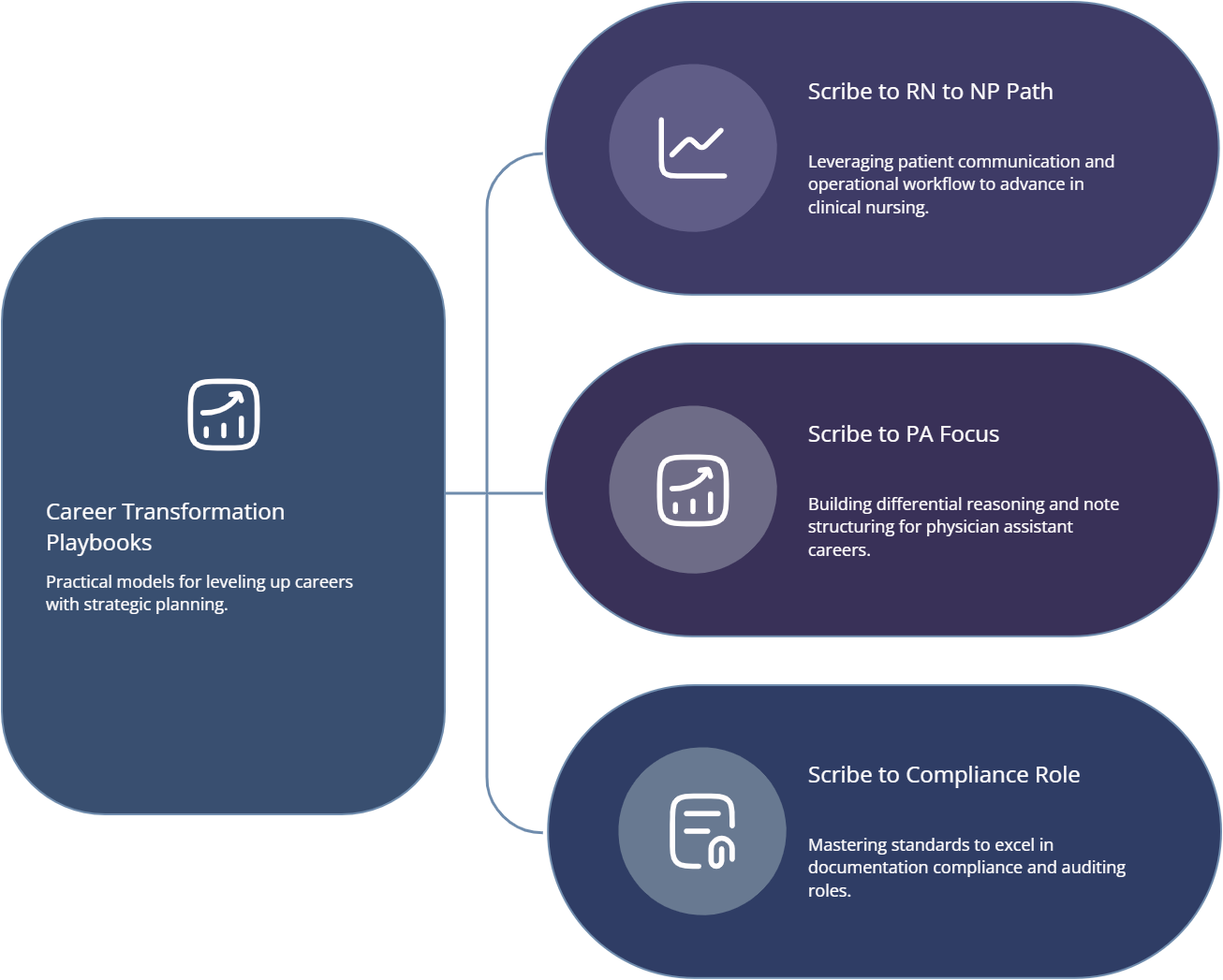
4) Real Journey Playbooks: How People Actually Move Up From Here
Success stories sound inspirational, but the useful part is the playbook behind them. Below are real journey models you can copy, even if your exact path differs.
Playbook 1: Scribe to RN to NP, built on patient communication mastery
This journey usually starts with a scribe who becomes excellent at patient language. They can take a messy story and translate it into clean clinical notes. That skill becomes powerful in nursing because charting and communication are core to safe care. The winning move is planning the transition so you do not burn out financially.
How they do it:
They pick settings with dense learning, often using the nationwide hiring surge to target health systems that support tuition assistance.
They build documentation strength aligned to compliance standards so their professional references speak about reliability and accuracy.
They choose a market where nursing demand is strong and cost of living is manageable, using regional guides like Texas opportunities or state level insights like Florida employment trends.
What makes them stand out is not motivation. It is operational planning.
Playbook 2: Scribe to PA, built on differential thinking and clean note structure
PAs need clinical reasoning and communication. Scribes can develop both, but only if they actively learn. These scribes review assessments, learn why plans change, and ask better questions at the right time.
How they do it:
They document a “case learning journal” without patient identifiers, focused on differential logic.
They practice writing tight, clear HPIs and assessments, modeled after data accuracy standards.
They use tools wisely and learn where automation helps and where it hurts, pulling context from efficiency innovations.
They also choose clinics where providers teach. That choice is a career multiplier.
Playbook 3: Scribe to compliance, built on obsession with correctness
Some people are wired for risk reduction. They notice documentation gaps others ignore. They see where consent is unclear. They see where templates cause error. That makes them ideal for compliance, HIM, and audit readiness roles.
How they do it:
They master the language of standards using documentation compliance guidance.
They build a personal audit checklist that mirrors real requirements.
They learn telehealth nuances through the telehealth industry update because virtual care raises documentation and workflow complexity.
They win because they are early. Most people only care about compliance after something goes wrong.
Playbook 4: Scribe to CMAA style admin leadership, built on workflow ownership
Not every success story needs a clinical license. Some of the strongest career jumps are into administration, operations, and revenue leadership. If you want stable hours, upward mobility, and long term leadership potential, this path matters.
How they do it:
They follow workforce signals from medical administration trends.
They study demand patterns using the CMAA career progression report and the job security and salary growth report.
They stack practical tools from the top productivity tools for medical administrative assistants so they can build systems, not just survive tasks.
When you can run workflows, you become difficult to replace.
5) Your 90 Day Career Upgrade Plan That Turns Stories Into Your Reality
If you want a real journey, you need a real timeline. Here is a 90 day plan that creates measurable momentum regardless of your target path.
Days 1 to 15: Pick a target and build your “why this role” narrative
Pick one role. Not five. Then write a one page narrative answering:
What problems do you want to solve in healthcare?
What work style fits you, high intensity, structured, patient facing, or systems focused?
What proof do you already have from scribing?
If you are exploring where demand is strongest, start with where CMAA demand is highest and compare with scribe market signals from the nationwide opportunities report. This helps you avoid choosing a path based on emotion.
Days 16 to 45: Build two proof artifacts that make you credible
Most applications fail because you look generic. Fix that by building two artifacts:
A documentation quality framework aligned to new compliance standards
A workflow improvement proposal tied to efficiency tools such as the EMR platforms guide and the dictation and voice recognition list
You are not claiming “I am detail oriented.” You are showing your system for being detail oriented.
Days 46 to 75: Upgrade environment and mentorship access
If your current setting is low learning, change it. Move to:
A higher volume specialty
A health system with training support
A telehealth model where documentation skill is scarce
Use market data from telehealth demand and local opportunity guides like New York City hospitals or Los Angeles salary insights. Mentorship access often comes from being in the right building.
Days 76 to 90: Apply with precision, not volume
Your job is not to apply everywhere. Your job is to apply where your story fits.
Match your resume bullets to outcomes.
Bring your proof artifacts to interviews.
Ask questions that signal maturity, like “What documentation quality thresholds do you enforce?” and “How do you measure rework?”
If you need structured training options, use scribe training courses and certifications and map them to your path. If you want a certification linked story, anchor it through scribe careers with certification so your progression feels intentional.
This is how success stories stop being inspiration and start being predictable outcomes.
6) FAQs: Success Stories and Career Moves for Medical Scribes
-
The fastest path depends on whether you want clinical licensing or operational growth. Many people move quickly into patient facing roles like MA or CNA, then stack toward nursing or PA. Others move into administration and scale faster through systems responsibility. Use market signals from the nationwide medical scribe opportunities report and choose an environment with high learning density. The fastest path is the one you can execute consistently without burnout.
-
Stop describing tasks and start showing outcomes. Build a documentation quality checklist aligned to documentation compliance expectations. Track your own metrics such as edits per note over time and reduction in rework like addendums. Pair that with a portfolio artifact, such as a workflow map or an editing SOP. When you can show a system, not just a job title, decision makers believe you.
-
Yes, and telehealth can accelerate growth if you treat it like skill development. Telehealth workflows reward clean documentation, strong editing, and tool fluency. Read the telehealth scribing demand update and build a “virtual visit SOP” that shows how you prevent errors and reduce provider edits. Telehealth roles also expose you to modern tooling and operational KPIs, which can lead into informatics and workflow leadership.
-
The promoted scribes build proof, not just experience. They master note clarity using standards from compliance and documentation guidance. They understand accuracy expectations from the data accuracy report. They also learn tools and workflow, using resources like the EMR and EHR platforms guide. The stuck scribes do shifts. The promoted scribes build systems.
-
Work where learning density is high and mentorship access is real. High volume settings and larger systems often create more exposure to clinical decision making and operational standards. Compare markets using the best cities interactive guide, then zoom into hubs like New York City hospitals or the Los Angeles job market. Pick the environment that increases reps and raises your standards.
-
Certification can act like a credibility accelerator when it aligns with your target path. It signals that you are intentional and trainable. If you want structured proof, explore scribe careers with certification and the training courses and certification guide. For admin leaning paths, tracking CMAA market and progression data can also strengthen your story, such as the career progression report. The key is using certification to support a plan, not replace one.
-
Burnout happens when you try to “push harder” without better structure. Pick a 90 day plan, define one target, and build two proof artifacts. Use telehealth and tooling improvements to reduce rework by learning from scribe efficiency innovations. Also choose a market and setting that supports growth using guides like Texas opportunities and Florida employment trends. Burnout drops when your effort produces visible progress.
