

Essential Skills Every Healthcare Employer Wants from a Medical Scribe
Medical scribes do not get hired because they type fast. They get hired because they protect provider time, reduce chart risk, and keep teams moving when the day is chaotic. Employers are hunting for scribes who can think inside a clinical workflow, write clean notes under pressure, and follow compliance rules without being babysat. This guide breaks down the exact skills healthcare employers screen for, how they test them, and how you prove you have them before day one.
1) The real job of a medical scribe in 2025
Healthcare employers hire scribes to create reliable documentation, protect clinical throughput, and reduce provider burnout. That means your skill set is not a checklist. It is a performance system.
You need to understand how documentation connects to patient safety, legal defensibility, and revenue integrity. If you want a hiring manager to trust you, you must show you can deliver clean notes in real time, in a real clinic, with real interruptions. This is why employers keep circling back to compliance and documentation standards, especially as policies evolve and audits get tougher. See how employers frame these expectations in new compliance and documentation standards, and why documentation is now treated like an operational risk in achieving healthcare documentation compliance.
If you want to stand out, stop presenting yourself as “a fast typist.” Present yourself as someone who protects outcomes. Employers track this. Some organizations even quantify scribe impact through time saved, documentation quality, and fewer addenda. You can reference the performance angle using efficiency innovations and new tools and the data lens in data accuracy reporting.
Scribes are also spreading deeper into telehealth. That changes what employers want. Remote documentation demands stronger communication, clearer note structure, and fewer follow up clarifications. If you want to align with hiring trends, study where growth is happening in telehealth settings and how teams use scribes to improve coordination in patient care and coordination.
2) Documentation skills employers judge first
Employers usually decide if you are “hireable” in the first ten minutes of watching your documentation thinking. They ask themselves one question: can this person create a note that a provider would sign without fear.
Start with structure. Your HPI needs a clean timeline, symptoms, severity, modifiers, and key negatives. Not every detail belongs in the note. The employer wants relevance that supports decisions. This is tied directly to documentation standards and why scribes are now used as a compliance defense layer in documentation compliance and in navigating new standards.
Next is clinical precision without clinical overreach. You document exactly what is said and what is observed. You do not diagnose. You do not interpret. Employers can spot a scribe who drifts out of scope because their phrasing gets sloppy. The fastest way to fail an interview is to write a note that implies clinical judgment you are not allowed to make.
Then there is defensibility. Your note must support why the provider chose an action. If the plan includes a referral, the note should show the reasoning that led there. If the provider reassures the patient, the note should capture the red flag education and follow up instructions. This is why employers like candidates who have studied real world documentation expectations from data accuracy reporting and who understand why scribes are a force multiplier in patient care coordination.
Finally, write like a professional. Neutral tone, clear language, and no emotional wording. Employers want a scribe who protects patient trust, not one who writes like social media. If you can write cleanly, you will also be faster, because you are not rewriting paragraphs all day.
3) Workflow intelligence and EMR speed without chaos
Employers do not care about raw typing speed. They care about workflow speed. They want to see you move through an EMR in a way that makes the provider feel lighter, not interrupted.
You need to understand where time disappears in a clinic. It disappears in hunting for the last note, finding meds, chasing problem lists, and rebuilding templates every visit. A strong scribe anticipates this and builds repeatable workflows. This is where modern tools and efficiency improvements matter, especially as new workflows are documented in scribe efficiency innovations and where tech adoption shows up in new tools and techniques.
Employers also want “clean reuse.” Templates are useful when they stay accurate. They become dangerous when they create copy paste bloat that triggers audits. That is why smart teams care about documentation quality trends and compliance expectations seen in achieving documentation compliance and in compliance and documentation standards.
If you want to impress, show how you think in systems:
Build a tiny phrase bank for common exams.
Use consistent headings so notes are scannable.
Keep plans structured so follow ups do not get missed.
Reduce provider edits by capturing decisions in real time.
Hiring managers love scribes who can explain how they keep notes near real time across a busy day. That is the difference between a scribe who survives and a scribe who becomes indispensable.
4) Communication skills that make clinicians trust you fast
Employers want scribes who are quiet, fast, and mentally present. That sounds simple until you are in a room with a stressed provider, a complex patient, and constant interruptions.
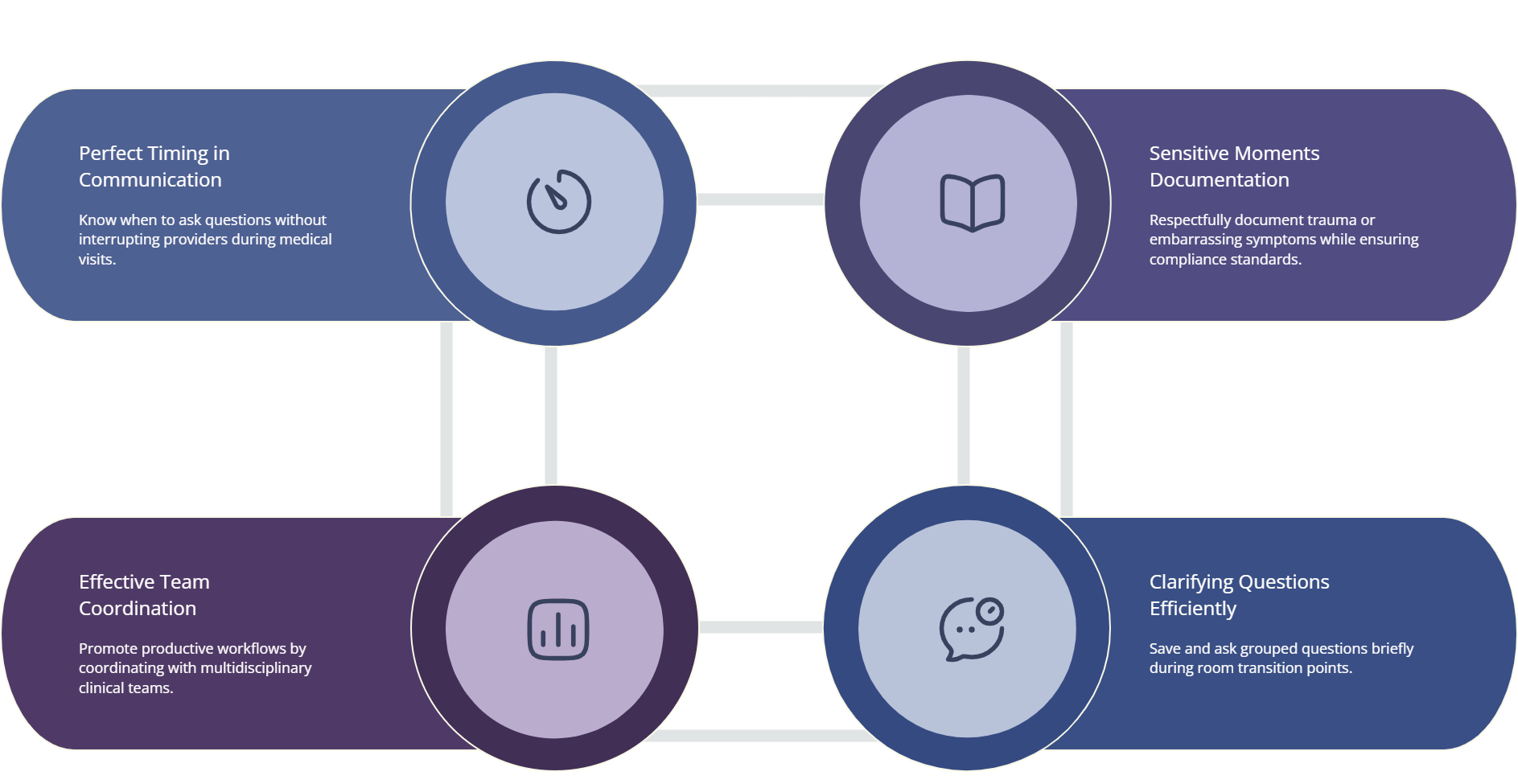
The key communication skill is timing. You must know when to ask a clarification and when to wait. The best scribes collect questions during the visit and confirm them in one short moment, ideally when the provider is transitioning out of the room. That reduces disruption and builds trust.
Another hiring signal is how you handle sensitive moments. When a patient shares trauma, mental health concerns, or embarrassing symptoms, your job is to document neutrally and respectfully. Employers know that one careless phrase can create complaints and compliance risk. This is why they connect scribe value to compliance standards like those explained in documentation standards and in documentation compliance.
In team settings, communication becomes operational. You may need to coordinate with nursing, front desk, and providers to keep the flow moving. Strong scribes reduce rework by capturing decisions clearly the first time, which supports outcomes like coordination and fewer follow ups reflected in patient care coordination.
If you want a hiring manager to trust you, do not say “I communicate well.” Show what you do:
You summarize the plan in structured bullets for the provider to confirm.
You keep your clarifications short and specific.
You maintain calm tone even when the clinic is behind.
You never speak over the provider or the patient.
5) Compliance instincts and risk awareness employers will not compromise on
This is the skill category that silently decides who gets hired and who gets rejected.
Employers know documentation can create legal and audit exposure. They need scribes who understand privacy, scope, and defensibility. Your job is to document what happened, not what you think should have happened.
Start with privacy. Do not discuss patients casually. Do not leave screens visible. Do not screenshot anything. Employers treat this as non negotiable because one incident can damage trust across an organization.
Next is scope. You cannot insert clinical conclusions. You cannot change meaning. You cannot “clean up” symptoms into something the patient did not say. Your note must be accurate and faithful. Employers who are serious about compliance lean on guidance like new compliance and documentation standards and the stronger enforcement mindset described in documentation compliance.
Telehealth also increases compliance sensitivity because documentation may be the main artifact of care. Employers want scribes who can capture virtual encounter specifics with clarity, especially as telehealth demand rises in telehealth settings. A weak telehealth note creates follow up calls, delays, and frustration. A strong note protects continuity and reduces errors.
If you are building your career strategy, align your skills with where demand is growing. You can explore market momentum and opportunities through hiring and demand signals in medical scribe hiring surge and broader workforce context in workforce trends for 2025.
6) FAQs
-
Employers want documentation judgment. That means knowing what details matter, writing them clearly, and keeping the note defensible under real clinic speed. A scribe who captures decision making cleanly reduces provider edits and protects compliance risk, which is why standards and audits matter so much in documentation compliance. Combine note structure with calm workflow presence and you become the person teams keep.
-
Many employers use timed note tests, mock encounters, terminology checks, and scenario questions about privacy and scope. They also look for how you think under interruption. The goal is to see if your notes stay structured and accurate when the visit gets messy. If you train with real standards, you will recognize what they want, especially the expectations mapped in new compliance and documentation standards.
-
Typing speed helps, but workflow speed is what gets you hired. Employers care more about whether you can keep notes near real time, navigate the EMR efficiently, and reduce provider edits. A scribe who writes clean notes at moderate speed often outperforms a fast typist who creates messy documentation. Efficiency and tool use show up in scribe efficiency innovations.
-
The biggest mistakes are privacy violations, documenting outside your role, and changing meaning through “helpful” rewrites. Employers also flag template abuse and copy paste bloat that creates audit risk. Your job is to document what happened, not to make the note look impressive. If you treat compliance as a daily habit, you align with the mindset explained in documentation compliance.
-
Yes. Telehealth requires stronger listening, clearer summaries, and tighter structure because you may not have physical exam context and the note becomes the main artifact of care. Employers want scribes who can capture key decisions and follow up instructions without missing details in a virtual flow. Telehealth demand is rising, and expectations are reflected in telehealth settings growth.
-
Bring proof. Create a small portfolio of simulated note samples, a terminology cheat sheet, and a one page workflow plan showing how you keep notes near real time. Talk in outcomes, not traits. If you also connect your training to formal learning, you signal seriousness. Use pathways like scribe careers with certification and options in training courses and certifications to frame your readiness.
-
Employers increasingly see AI and dictation as accelerators, not replacements, because humans still handle context, accuracy, and compliance judgment. The winning scribe knows how to use tools without letting them introduce risk, hallucinated text, or privacy issues. If you want to stay future proof, learn the landscape through AI medical scribe tools and keep your documentation skills strong.
