

CMAA Job Market & Salary Guide for California
California treats medical administrative assistants as a key part of its healthcare engine, not background staff. High patient volumes, aggressive technology adoption, and strict regulatory pressure mean clinics will pay competitively for CMAAs who reduce chaos instead of simply “answering phones.” In this guide, you’ll see how California’s CMAA job market actually works, what realistic salary bands look like from entry level to lead roles, and which skills, certifications, and tools turn you from replaceable front-desk support into someone practices fight to keep.

1. Why California is a high-stakes CMAA job market
California combines some of the country’s busiest health systems with some of the toughest compliance rules. That creates constant demand for CMAAs who can manage documentation, scheduling, and patient communication without generating billing or privacy risk. Articles like “How AI Will Transform Medical Administrative Assistant Roles by 2030” and “10 Emerging Technologies Every CMAA Must Prepare for in 2025” show how quickly California clinics are layering automation and new EMR tools onto already complex workflows. Employers want CMAAs who can adapt to that reality on day one.
The state’s size also hides multiple micro-markets. Urban centers like Los Angeles and San Francisco behave differently from smaller cities that resemble markets in Ohio or Michigan. FQHCs and community clinics mirror organizations listed in the top 100 community health centers hiring scribes, while large academic systems feel closer to environments described in “Major Healthcare Providers Increase Hiring of Certified Medical Admin Assistants”. When you understand which segment you’re targeting, you can tailor your resume, salary expectations, and interview stories instead of using the same generic pitch everywhere.
California also rewards CMAAs who think like future practice managers rather than task takers. Guides such as the interactive directory of office management software for CMAAs and the medical office budgeting tools directory highlight how admin staff now drive productivity, revenue integrity, and compliance. Clinics that use these tools need CMAAs who can spot bottlenecks, not just obey checklists. Those are the people who rise fastest into lead CMAA or supervisor roles and command the strongest salary jumps.
2. California CMAA salary ranges and compensation levers
Across California, new CMAAs typically see hourly offers in the 17–23 dollar range, but location, employer type, and certification status can quickly push that number up or down. Urban hubs behave more like the high-energy markets described in “New York State CMAA Job Market Analysis”, while smaller regions resemble the patterns outlined for Pennsylvania or Illinois. You need to understand which benchmark you’re negotiating against.
Benefits can add thousands of dollars in hidden value. Employers similar to those in the Virginia CMAA job-market growth guide often offer generous health coverage, retirement matches, and education stipends, while some small practices trade those perks for slightly higher hourly rates. Resources like the directory of medical office policy and procedure tools and the interactive directory of performance-metrics tools show how modern clinics use data to link CMAA productivity directly to revenue and compliance. When you can tie your contributions to those metrics, you have a stronger case for mid-year raises and role upgrades.
Overtime and differentials are another compensation lever. Hospital-based roles and urgent-care environments, similar to those hiring scribes in the top 75 hospitalist groups directory or the top 100 urgent care and retail clinic brands guide, often rely on CMAAs for extended evening and weekend coverage. If your life allows for those shifts, the combination of differentials and occasional overtime can move your annual earnings well above a more comfortable Monday–Friday clinic role. The outcome planner table helps you compare two offers with very different schedules and see which one truly pays more after you factor in commute time, benefits, and long-term growth potential.
3. Where California employers are hiring CMAAs right now
California CMAA roles cluster in several predictable settings: large health systems, community clinics, specialty groups, and rapidly growing telehealth providers. Community health centers and FQHCs operate similarly to organizations listed in the top 100 community health centers hiring medical scribes. These clinics value CMAAs who understand sliding-scale billing, social-determinant screening, and multilingual communication. If you’re bilingual, highlight that aggressively, because it directly affects patient access and satisfaction.
Primary-care networks and multi-specialty groups behave more like the systems in the Ohio employment guide and the North Carolina medical admin career opportunities article. They rely heavily on CMAAs to keep preventive-care panels up-to-date and to manage complex referral patterns. Patient-flow tools described in the directory for improving patient flow are often implemented by these groups, which is why they prefer candidates who think in terms of throughput and bottlenecks rather than simply “checking in patients.”
Telehealth and hybrid care are the fastest-expanding segments. Articles like “Telehealth Expansion: How It’s Changing Medical Admin Roles Right Now” and “Industry Update: Rising Demand for Medical Scribes in Telehealth Settings” illustrate how California is using virtual visits to relieve pressure on in-person clinics. CMAAs in these environments coordinate digital intake, troubleshoot connectivity, and safeguard HIPAA compliance with patients joining from homes, cars, and workplaces. Employers will quickly shortlist candidates who can talk confidently about remote identity verification, consent, and data privacy using language from guides such as “CMAAs & Data Privacy: Future Regulations Explained Clearly”.
Your biggest blocker to better CMAA pay in California?
4. Skills, certifications, and technologies that boost California CMAA pay
California employers are drowning in regulation and technology change, so they immediately favor CMAAs who can talk about both. Start by understanding the regulatory landscape using resources like “Future Healthcare Compliance Changes: How CMAAs Can Prepare Now”, “HIPAA Updates 2025: Key Changes Every CMAA Must Know”, and “Predicting HIPAA Updates & How They Will Impact CMAAs”. When you can confidently explain how incorrect scheduling or sloppy messaging can trigger violations, you sound like risk protection rather than an extra cost.
Technology fluency is the second pillar. The interactive guide to the medical office of 2025 and “The Future of EMR Systems: What CMAAs Need to Know Now” break down ambient documentation, AI-assisted triage, and automation tools that are already appearing across California. Pair those insights with process-focused resources such as the patient-flow improvement tools directory and the performance metrics interactive directory. Then, in interviews, share concrete ways you’ve reduced phone abandonment, closed care gaps, or shortened check-in times using those concepts. That’s the language that convinces managers you’re worth the top of their pay band.
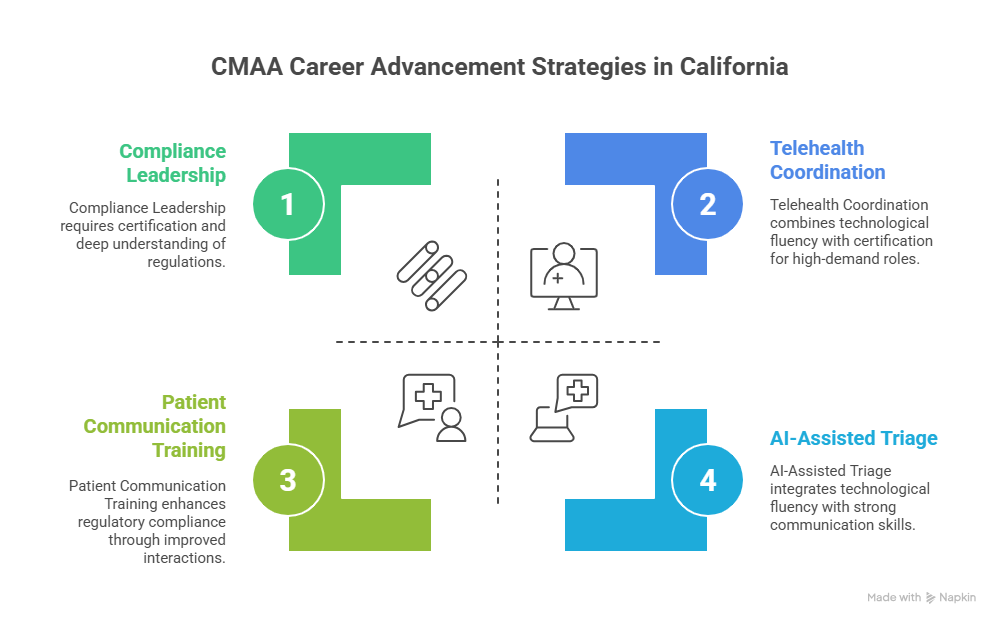
Certification remains a powerful differentiator in a competitive state. Overviews like the Western region CMAA training and certification guide, the top emerging career specializations for CMAAs, and “Future-Proof CMAA Specializations: The Best Areas to Pursue” help you choose pathways that match California’s demand: telehealth coordination, revenue-cycle support, compliance, or patient-experience leadership. If you combine a recognized certification with strong communication training from resources like “How to Master Patient Communication” and “The Art of Empathy: A CMAA’s Guide to Improving Patient Interactions”, you become the person clinics trust with their highest-risk, highest-visibility interactions. That’s where the best raises and promotions come from.
5. Roadmap to land your ideal CMAA role in California
Step 1: Map the landscape instead of blindly applying.
Start with job-market overviews such as the Illinois, Ohio, and North Carolina CMAA articles to see how employers structure roles in different regions. Then, adapt that mental map to California’s urban centers and regional hubs. Identify 25–40 specific organizations – community clinics, health systems, specialty groups, and telehealth vendors – rather than chasing every listing you see.
Step 2: Align your story with the future, not just today’s tasks.
Use forward-looking guides like “How CMAAs Will Lead the Patient Experience Revolution by 2030”, “Predictive Insights: How Certified CMAAs Are Transforming Telemedicine & Virtual Healthcare”, and the interactive career planner for future healthcare roles to build a narrative about where you’re heading. When you talk about using California CMAA roles as stepping stones to compliance, operations, or telehealth leadership, interviewers recognize you’re planning for longevity, not just clocking hours.
Step 3: Build communication and scheduling skills that translate directly to revenue.
Scheduling guides like the “Ultimate Guide to Medical Appointment Scheduling Efficiency” and “Best Practices for Reducing No-Shows in Medical Scheduling” teach you how your daily clicks impact provider capacity and financial performance. Pair those with communication resources such as telephone etiquette best practices and the patient-communication guide. Then, practice turning those ideas into concrete stories: specific situations where you calmed frustrated patients, rescued a collapsing schedule, or protected privacy in awkward situations.
Step 4: Choose the right first job instead of the first job.
Use the outcome planner table to evaluate every California offer against your salary, learning, and lifestyle goals. Cross-check with broader hiring trends described in “Major Healthcare Providers Increase Hiring of Certified Medical Admin Assistants” and regulatory updates like the CMS billing code changes. If a role doesn’t expose you to telehealth, automation, or compliance work, you may be standing still while the rest of the state moves on.
Step 5: Treat your first 12–24 months as an acceleration program.
Once you’re in a California CMAA position, use tools and directories that track performance and patient flow – including the patient-flow tools directory and the performance-metrics directory – to set quarterly targets. Tie your raise requests to measurable improvements: fewer no-shows, shorter check-in times, improved front-desk satisfaction, or reduced scheduling errors. When you bring those numbers, plus refreshed knowledge from compliance and technology articles, salary conversations become about shared results rather than personal needs.
6. FAQs: CMAA job market & salary guide for California
-
Most new California CMAAs see offers in the 17–23 dollars per hour range, with higher rates in major metros and slightly lower ones in smaller cities. To benchmark whether an offer is fair, compare it to patterns discussed in state-level job market guides and salary overviews for similar roles. Then factor in benefits, differentials, and education stipends reflected in the outcome planner table. A job with slightly lower hourly pay but strong benefits and certification funding can easily beat a “higher” offer that gives you no growth path and minimal support.
-
Many California clinics will hire strong entry-level candidates without certification, especially those with customer-service or call-center backgrounds. However, guides like the Western region CMAA training and certification overview and the future-proof specializations article show that certified CMAAs reach better roles and salaries faster. Certification also strengthens your credibility when you discuss compliance changes outlined in HIPAA update guides and CMS billing-code changes.
-
Top compensation usually appears in large health systems, specialty groups tied to strong revenue services, and telehealth programs operating at scale. These environments work a lot like organizations highlighted in major provider hiring updates and telehealth expansion reports. However, community clinics and FQHCs similar to those in the community health center directory may offer lower pay but richer experience with underserved populations, language skills, and social-determinant screening – all of which can later support transitions into leadership or public-health roles.
-
Negotiation should be data-driven and respectful. Use articles such as the Virginia job-market growth guide and Illinois career outlook to show that your request aligns with what similar markets pay. Then highlight concrete skills from the EMR and technology guides and patient-experience resources. Ask whether there is room to move your offer closer to the top of their band or to strengthen differentials, rather than demanding a specific number. Employers respond better when you connect pay to the measurable value you will bring.
-
California CMAAs need three categories of skills: communication, compliance, and technology. Communication is developed through resources like the patient-communication guide, empathy training article, and telephone etiquette best practices. Compliance comes from understanding regulatory changes explained in future compliance guides and data-privacy articles. Technology requires staying current with tools described in the medical office of 2025 guide and the automation opportunity article.
-
AI is not replacing CMAAs; it is changing what “good” CMAAs do. Articles like “How AI Will Transform Medical Administrative Assistant Roles by 2030” and the emerging technologies guide show how automation can handle repetitive tasks while leaving humans responsible for exception handling, empathy, and judgment. In California, that means CMAAs supervise digital check-in tools, validate AI-generated messages, and ensure workflows match HIPAA and state privacy rules summarized in data-privacy explainers. CMAAs who learn to manage and improve these systems become much harder to replace and more valuable at salary-review time.
-
Starting as a CMAA in California can lead to roles in practice management, revenue-cycle leadership, compliance, telehealth operations, or patient-experience strategy. The interactive career planner for future healthcare roles and the emerging specializations guide map out common transitions. You can move from front desk to scheduling lead, then into operations coordinator and eventually clinic manager, especially if you combine real-world results (like those tracked with performance-metrics tools) with continuing education and certifications. California’s scale means there is always another rung to climb if you intentionally build the skills each rung requires.
-
International graduates and career-changers must translate their experience into California-specific language. Start by grounding yourself in U.S. regulations using HIPAA update guides, CMS guideline updates, and billing-code change summaries. Then highlight your transferable skills with examples shaped by the patient-communication and empathy guides. Finally, pursue a recognized certification via pathways described in the Western region CMAA training guide. That combination reassures California employers that you understand their rules, can communicate with their patients, and are committed to the profession long term.
