

New Research: How Medical Scribes Improve Clinical Efficiency
Clinics do not lose efficiency because clinicians “work slowly.” They lose it because documentation, compliance, and revenue steps are scattered across the day like landmines. One unsigned note becomes five downstream problems: delayed coding, missing modifiers, claim holds, prior auth delays, and patient follow up that never gets closed. Medical scribes fix efficiency at the real bottleneck: turning live care into clean, complete, billable documentation fast. When that happens, throughput rises, rework drops, and teams stop living in the inbox after hours.

1) The Real Reasons Clinical Efficiency Breaks in 2025
The most expensive inefficiency is not a slow intake or a long wait time. It is invisible rework. Notes that get “mostly done” now, then reopened later. Orders that sit because the plan was not documented clearly. Charts that bounce between staff because the right phrasing was missing for payers. If you want true efficiency, you have to remove rework at the source, not add more reminders.
A common pattern shows up in practices that struggle with efficiency. Providers finish the visit, then mentally move on to the next patient, but the chart stays unfinished. That gap becomes after hours work, which becomes burnout, which becomes shorter visits, which creates thinner documentation, which creates more denials and more inbox tasks. That is why documentation support is not “nice to have.” It is throughput protection. If you are tracking healthcare documentation trends, this is the year where speed and compliance collide, and the loser is usually the clinic.
Efficiency also breaks when teams confuse activity with output. A clinic can “do a lot” and still be inefficient. Lots of clicks, lots of chart messages, lots of edits, lots of addenda. None of that is output. Output is clean first pass documentation, accurate codes, and fewer interruptions in the day. That is why scribing is not only about typing. Done correctly, it is a workflow discipline that protects the plan of care. Many organizations overlook this until they hit compliance pressure, then scramble. If you have been watching new compliance and documentation standards and documentation compliance requirements, you already know that “close enough” notes are not safe anymore.
Another reason efficiency collapses is inconsistency. Templates differ by provider. Macros are not standardized. One clinician documents HPI in paragraphs, another in fragments, another in copy paste blocks. Coders cannot trust patterns, so they query more. Billers cannot predict modifiers, so they hold claims. QA reviewers cannot compare apples to apples, so audits take longer. A scribe program built around standardized templates, macro libraries, and version control removes that chaos. If you want a concrete way to think about tooling, the medical scribe efficiency innovations guide and the top EMR and EHR platforms scribes should know list make it obvious where most clinics leak time.
Finally, telehealth is a special efficiency trap. Visits are shorter, but edits are heavier. Providers tend to “fix it later,” which creates a backlog. If your organization is expanding telehealth, it is worth pairing this topic with telehealth scribe demand and the telehealth companies using scribes directory, because the market has already moved. The question is whether your workflow has.
| Capability | Primary Outcome | Target KPI | Proof Artifact |
|---|---|---|---|
| Pre visit templating Front load clarity |
Faster sign off | ≤ 12 min time to sign | EMR timing export |
| EMR macro library Standardize language |
Consistency and accuracy | ≥ 70% macro reuse rate | Macro usage analytics |
| Eligibility auto checks Prevent denials |
Fewer preventable denials | CO 16 down 40% | Denial trendline |
| Prior auth workflows Remove payer stalls |
Clean first pass | ≥ 95% first pass rate | Billing export sample |
| Medical necessity phrasing Coder trust |
Cleaner coding | Specific ICD 10 ≥ 95% | Coder QA sample |
| Modifier guardrails Stop rework |
Revenue integrity | ≥ 98% modifier accuracy | 100 claim audit |
| Template versioning Audit readiness |
Faster audits | All templates tagged | Version index log |
| Chart prep checklist Fewer surprises |
More on time starts | Late start visits down 25% | Schedule variance report |
| In visit real time capture No memory gaps |
Less addenda | Addenda per day down 30% | Addendum volume report |
| Structured ROS blocks Faster documentation |
More complete notes | ROS completion ≥ 98% | Documentation completeness audit |
| Smart order sets Fewer clicks |
Faster ordering | Orders per visit time down 20% | Order timing snapshot |
| Problem list hygiene Cleaner longitudinal care |
Less downstream confusion | Duplicate problems down 35% | Problem list QA sample |
| Inbox triage rules Protect clinician focus |
Fewer interruptions | Inbox touchpoints down 20% | Inbox analytics export |
| Visit summary automation Close loops |
Better follow up | Open tasks over 7 days down 30% | Task aging report |
| Referral documentation pack Fewer rejects |
Cleaner referrals | Referral bounce backs down 25% | Referral rejection log |
| Procedure note templates Fast compliance |
Stronger risk control | Procedure completeness ≥ 99% | Procedure audit sample |
| ED and urgent care fast charting High volume support |
Higher throughput | Patients per hour up 10% | Throughput dashboard |
| Telehealth documentation kit Lower edit load |
Less back end editing | Provider edits per note down 30% | Telehealth note QA |
| HCC capture prompts Risk adjustment |
More accurate RAF | HCC capture up 8% | Risk score report |
| Documentation compliance binder Audit defense |
Fewer findings | High risk findings down 40% | Audit outcome summary |
| Charge capture checklist Stop missed charges |
More captured revenue | Missed charges down 20% | Charge reconciliation sample |
| Coder query reduction scripts Fewer interruptions |
Less provider pinging | Coder queries down 25% | Query log trend |
| Scribe QA scorecards Consistent quality |
Cleaner documentation | QA score ≥ 95% | Monthly QA report |
| Note close SLA Kill backlog |
Shorter close times | 90% closed same day | Close time export |
| Provider preference profiles Lower friction |
Faster adoption | Ramp time under 14 days | Onboarding checklist |
| Cross coverage staffing model No gaps |
Stable throughput | Coverage gaps under 2% | Coverage calendar |
| Post visit coding review loop Continuous improvement |
Fewer errors over time | Downcodes down 15% | Downcode report |
2) Where Scribes Create Efficiency Gains Across the Entire Visit Cycle
Most people think scribes save time only by typing faster. That is the shallow version. Real efficiency comes from protecting clinical flow, reducing rework, and closing charts while the visit is still mentally fresh. Scribes create efficiency by being a documentation system that runs in parallel with care.
Pre visit: chart prep that eliminates the “surprise visit”
A prepared chart prevents the “wait, what are we doing today” moment that burns minutes. A scribe can preload history highlights, reconcile medications, pull recent labs, and tee up a note skeleton that matches the reason for visit. This matters even more in high volume environments like urgent care and ED, where the cost of context switching is brutal. If you want the high volume lens, compare workflows in emergency departments and urgent care job hubs and see how standardized intake patterns support speed.
Pre visit work is also where compliance wins are baked in. When problem lists and histories are clean, the final note is less likely to trigger audits. If you are building an internal playbook, tie this section to data accuracy reporting and care coordination improvements because the same prep discipline improves both.
In visit: real time capture that keeps clinicians in the room
The most damaging inefficiency is when clinicians split attention between the patient and the screen. It harms rapport and slows decision making. Scribes keep clinicians focused on the conversation while still capturing the story, the clinical reasoning, and the plan. That is where time gets saved without sacrificing quality.
Real time capture also changes the shape of the visit. When documentation is flowing, the provider can ask one more clarifying question instead of rushing to the next patient. Ironically, that can reduce follow up messages later, because the plan is clearer and patient instructions are more complete. If you are comparing scribe value in different environments, look at telehealth demand patterns and medical scribe hiring surge trends because the efficiency pressure is pushing adoption.
Post visit: the chart close window that kills backlog
Backlog is not a documentation issue. It is an operations issue. Once notes roll into after hours work, your clinic is paying the most expensive labor at the worst time of day. Scribes reduce backlog by enabling immediate note completion and fast provider sign off. The first win is emotional: clinicians feel lighter. The second win is operational: billing moves faster, coding is cleaner, and follow up tasks are more accurate.
The best clinics set a chart close standard and build the scribe workflow around it. For example, “90 percent of notes signed same day” is not an aspiration. It is a metric with a report behind it. If you are already building efficiency tech stacks, connect this with workflow automation tools for medical admin and task management software for CMAAs so the documentation close process is supported by a real system, not memory.
Revenue cycle efficiency: fewer denials and fewer coder queries
Clinical efficiency is not only visits per day. It is also how cleanly the visit turns into revenue without rework. Notes that clearly justify medical necessity reduce denials. Notes that include the right details reduce coder queries. When scribes are trained to capture key decision making elements, complexity coding becomes more defensible, and the clinic spends less time answering “please clarify” messages.
This is also where template discipline matters. A clinic with a standardized note structure makes coding faster and more accurate. If you want to align staff training to that goal, it helps to pair scribe operations with certification resources like medical scribe careers with certification and the training courses and certifications directory. When training and workflow agree, efficiency becomes repeatable.
3) The Metrics That Prove Efficiency Without Guesswork
If you cannot measure it, it will turn into opinions. Efficiency claims are easy to make and hard to verify unless you pick metrics that map directly to workflow. The goal is not to track everything. The goal is to track what causes improvement.
Time based metrics: where the day actually leaks
Start with note close time. Track median time from visit end to note signed. Then track the percentage signed same day. These two metrics alone expose whether you have backlog risk. Next, track time to finalize orders. If orders are placed late because documentation is incomplete, the patient experience suffers and staff chase tasks.
You should also measure after hours charting minutes. If your EHR can export timing, use it. If not, use a weekly self report with a clear definition. When after hours minutes drop, clinician satisfaction rises and turnover risk drops. For hiring and scaling, that matters as much as speed. If you are thinking about market demand and staffing, the best cities for medical scribe careers guide helps you understand where talent pools are strongest.
Quality metrics: efficiency that does not create risk
Fast notes that trigger audits are not efficiency. They are delayed pain. Track documentation completeness via QA sampling. Track coder query volume. Track downcodes and denials tied to documentation. If your program reduces time but increases queries, you have created a new bottleneck.
The compliance angle deserves its own dashboard. If you are navigating new rules, align your quality checks with documentation compliance standards and compliance and documentation changes. This is where a scribe QA scorecard becomes essential, because it keeps speed and safety aligned.
Throughput metrics: output that matters to operations
Track patients per session, but interpret carefully. If you push volume without protecting quality, the clinic will pay for it later. Instead, combine throughput with note close metrics. The best signal is “patients per session up while same day sign off stays high.” That shows you increased output without creating hidden debt.
In settings like ED and urgent care, also track left without being seen, door to provider time, and length of stay. Scribes do not solve triage, but they can reduce clinician documentation time during peak hours. Compare environments and staffing patterns using physician groups and MSOs hiring scribes and health systems hiring by state to see where efficiency pressure is driving adoption at scale.
Tech leverage metrics: the multiplier effect
If you use templates and macros, measure reuse rate. If you implement workflow automation, measure task aging and completion. If you deploy dictation tools, measure edit burden. The point is to prove that your tools reduce human work, not add steps.
For tool selection and benchmarking, it helps to cross reference voice recognition and dictation software and ambient and AI scribe tools. Even if you do not adopt AI, those lists clarify which features reduce editing versus which ones create cleanup.
4) Implementation Playbook: Add Scribes Without Breaking the Clinic
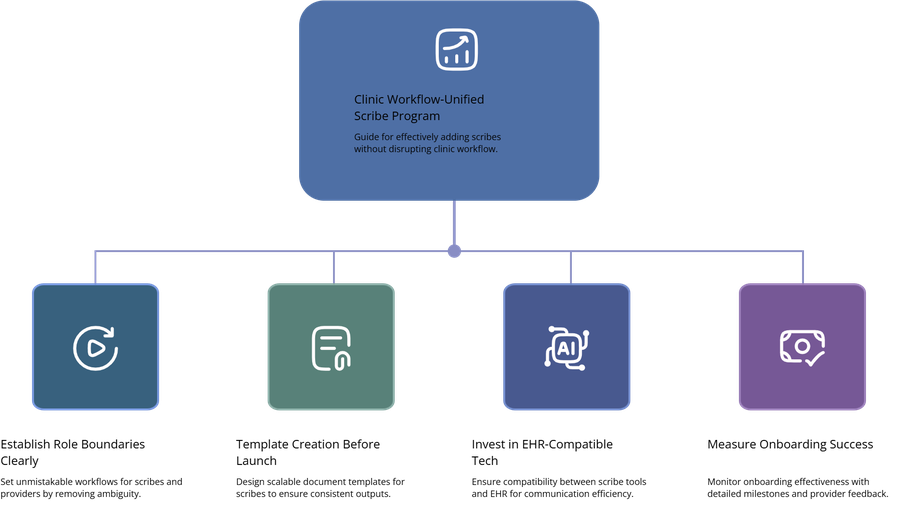
A scribe program fails when it is treated like staffing instead of workflow. You cannot simply place a person next to a provider and hope efficiency appears. You need role clarity, templates, training, and a QA loop.
Step 1: define the exact workflow boundary
Decide what the scribe owns and what the provider owns. For example, the scribe can capture HPI, ROS, exam, and plan structure, but the provider signs off medical decision making. Or the scribe can tee up orders but the provider reviews and clicks submit. The key is to remove ambiguity. Ambiguity creates double work, which kills trust.
Role clarity also helps compliance. A provider who trusts the boundaries is more likely to sign notes quickly, because they know what was captured and why. If you need language standards that match compliance expectations, use the framing in documentation compliance guidance and the compliance and documentation standards resource.
Step 2: build a template and macro standard before day one
If each provider uses a different note structure, scribes will spend months learning personal preferences. That delay shows up as slower ramp time and inconsistent output. Build a core template with optional modules. Then create macro libraries for common phrases and plans.
This is also where the tech stack matters. If your EHR supports smart phrases, use them. If not, pick compatible tools and workflows. Reference the EMR and EHR platforms guide and medical office communication tools so scribes can coordinate without constant hallway interruptions.
Step 3: onboarding should be measured, not guessed
Set a ramp timeline and define what “ready” means. Use a checklist: documentation accuracy, speed, template adherence, and provider satisfaction. Pair the scribe with one provider first, then expand. Cross coverage too early creates gaps.
If you are building a talent pipeline, use medical scribe career with certification and training courses and certifications as internal references for skill expectations. The more consistent the training baseline, the more predictable your outcomes.
Step 4: install a QA loop that protects both speed and quality
QA is not punishment. QA is how you keep efficiency from turning into risk. Review a small sample weekly. Score on completeness, accuracy, and template adherence. Track trends. Then coach the scribe and the provider together, because workflow is shared.
If your organization is already investing in medical admin tooling, connect the QA loop to document management tools and office management software for CMAAs so audit artifacts and version control are easy to produce.
5) The Tech and Workflow Systems That Multiply Scribe Impact
Scribes are a force multiplier, but only when the environment supports them. If the clinic runs on fragmented tools, scribes become human glue, and glue does not scale. The goal is a system where scribes help the clinic run the same way every day.
Standard operating system: tasks, messaging, and documentation all aligned
A scribe program needs a workflow backbone. That includes task management, secure messaging, document storage, and clear ownership. When those are missing, scribes become the default fixer, which destroys efficiency.
If you want a practical baseline, align the scribe workflow with task management software for CMAAs, workflow automation tools, and productivity tools for medical administrative assistants. The outcome is not “more tools.” The outcome is fewer manual steps, fewer handoffs, and fewer forgotten tasks.
Documentation acceleration: dictation, ambient tools, and smart templates
Not every clinic wants AI, but every clinic wants fewer edits. Dictation tools can help clinicians, while scribes capture the structured data. Ambient tools can reduce typing, but they still require verification and formatting. The best workflows treat these tools as draft engines and scribes as quality engines.
To evaluate options intelligently, compare features in voice recognition and dictation software and AI medical scribe tools. Then decide which parts of the note can be safely automated and which parts must be structured by humans.
Workforce strategy: staffing where efficiency pressure is highest
Scribes deliver the highest ROI in high volume and high interruption environments. ED, urgent care, busy specialty clinics, and telehealth are common starting points. Once your metrics prove the impact, you can expand.
If you are benchmarking where organizations are investing, use the directories for academic medical centers using scribes, physician groups and MSOs hiring scribes, and health systems hiring by state. The pattern is consistent: organizations adopt scribes where the cost of documentation drag is highest.
Tie it back to admin capability
Clinical efficiency is a team sport. Scribes make clinicians faster, but admin systems must catch up. Eligibility checks, prior auth workflows, referrals, and document control all affect efficiency. That is why CMAA workflows matter in the same conversation.
If your audience includes admins who want a stronger system, connect readers to medical administration workforce trends, annual CMAA job market reporting, and the CMAA certification resources directory. When admin operations improve, scribe impact multiplies.
6) FAQs: Medical Scribes and Clinical Efficiency
-
Start by targeting note close time and after hours charting. The quickest wins come from reducing the “finish later” habit. Build a same day sign off standard, standardize templates, and have the scribe capture the note in real time so the provider only reviews and signs. Pair this with a weekly QA loop so speed does not create compliance risk. If you want a workflow reference point, compare to medical scribe efficiency innovations and align your baseline with documentation compliance standards.
-
Telehealth often benefits more, because documentation edits can become a silent backlog. Short calls still require complete documentation, and clinicians tend to delay the write up. Scribes reduce that delay by capturing the conversation live and structuring the plan immediately. The result is fewer edits, faster sign off, and fewer follow up messages caused by unclear patient instructions. If your clinic is scaling telehealth, explore telehealth scribe demand and the telehealth companies using scribes directory to see how common this model is.
-
Compliance risk comes from unclear boundaries and inconsistent templates, not from the scribe role itself. Define what scribes document, what providers verify, and what requires explicit provider language. Then standardize note formats and install QA scoring that checks completeness, accuracy, and medical necessity phrasing. Keep a versioned template library so you can show audit readiness quickly. Use new compliance and documentation standards as the backbone and maintain an internal approach aligned to documentation compliance requirements.
-
Track time from visit end to note signed, percent signed same day, after hours charting minutes, coder query volume, denial rates tied to documentation, and addenda volume. Combine speed with quality so you do not optimize one at the cost of the other. For throughput settings, track patients per session alongside note close performance. If you want extra proof artifacts, align your dashboard with the type of reporting described in data accuracy reporting and the operational lens in care coordination improvements.
-
It depends on your risk tolerance and your workflow maturity. AI tools can generate drafts, but clinics still need verification, structure, and compliance safe formatting. Many clinics use a hybrid model where AI accelerates raw capture and scribes ensure accuracy, structure, and clean coding ready documentation. If your team does not have standardized templates and QA, AI can actually increase cleanup. To compare options, review AI medical scribe tools and pair that with voice recognition and dictation software to decide what reduces edits in your environment.
-
Require a consistent foundation: medical terminology, documentation structure, privacy rules, specialty specific workflows, and template standards. Then train inside your clinic with your actual note formats, macros, and QA expectations. The goal is fast ramp with predictable output, not “learning by guessing.” If your readers want a clear training pathway, point them to medical scribe careers with certification and the scribe training courses and certifications directory so skills and expectations match.
-
High volume specialties and high interruption settings see the biggest gains: ED, urgent care, primary care networks, cardiology, orthopedics, GI, and telehealth. Anywhere the clinician is interrupted frequently, documentation debt grows fast, and scribes prevent that debt. If you want to show market adoption, reference outpatient specialty networks hiring scribes and the broader employer view in health systems hiring by state.
