

Interactive Industry Report: Medical Scribe Job Growth by Specialty
In most markets, “medical scribe job growth” gets discussed like it is one trend. That is how people apply randomly and end up stuck in roles that do not match their strengths. Growth is specialty driven. It follows volume, billing pressure, documentation risk, and how badly a provider needs their time back. This industry report breaks job growth down by specialty so you can pick a lane, train for what clinics actually need, and speak the specialty language in interviews. If you want faster hiring, better pay leverage, and less burnout, this is how you choose intelligently.

1) How to Read “Job Growth by Specialty” Without Getting Misled
A specialty can have “high demand” and still be a terrible fit for you. The trap is treating growth like a single number. Real growth shows up as faster onboarding, more scribe shifts added, more remote roles, and more clinics standardizing templates to make scribes productive quickly. If you want proof that hiring pressure is real, cross check broader market movement using the medical scribe hiring surge report, then validate where demand concentrates with the annual job market report. To connect that demand to pay, anchor your expectations using the 2025 CMAA salary report and the CMAA salaries by state and specialty visualization. Even if you are applying for scribe roles, these salary signals matter because many systems blend admin and documentation responsibilities.
Next, understand what “growth” is responding to. It is rarely only staffing shortages. It is usually the collision of compliance risk, reimbursement pressure, and patient throughput. That is why specialty growth is tightly tied to documentation standards. If you do not understand this, you will write notes that look fine but fail audits. Use the compliance lens from new compliance and documentation standards and reinforce it with documentation compliance requirements for scribes. Employers are not only paying for speed. They are paying for fewer denials, fewer addendums, and fewer clinician hours wasted fixing notes.
Now connect growth to tools. If a specialty is rapidly adopting automation, AI transcription, or standardized EHR workflows, that means two things. One, there is pressure to scale. Two, the bar for scribe performance is rising. This is why scribes who understand EHR ecosystems and productivity tooling move faster. If you want that edge, study the tool landscape via the top EHR platforms every scribe should know, the AI and ambient dictation tools buyer’s guide, and the voice recognition and dictation software guide. Specialty growth is often “workflow growth,” and workflows are tool driven.
Finally, do not ignore geography. Specialty demand clusters by city, hospital networks, and outpatient groups. If you want better odds, choose specialty and location together instead of hoping the market bends toward you. Use the best cities interactive guide and compare it to city specific opportunity breakdowns like New York City hospital scribe opportunities and Los Angeles job market and salary insights. Growth is real, but it is not evenly distributed.
2) Specialty Growth Patterns: Where the Market Is Quietly Exploding
The fastest growth specialties share one trait. The provider’s time is being consumed by documentation. Not by patient care. When that pain reaches a certain level, systems pay for scribes because the ROI becomes obvious. If you want to understand the operational motivation behind this, use the efficiency angle in medical scribe efficiency innovations and the outcome lens from how scribes improve clinical efficiency. These show why employers are not “experimenting” with scribes. They are standardizing them.
Emergency medicine and urgent care continue to grow because documentation happens under pressure and mistakes are expensive. The scribe is not hired to type fast. The scribe is hired to protect throughput and capture medical decision making cleanly. If you have ever watched an ED provider lose 30 minutes fixing notes after shift, you understand why scribe demand persists. Pair this specialty choice with market saturation insight from the best cities guide and then target concentrated employers using the top health systems hiring scribes mega list and the top emergency departments and urgent care chains list.
Cardiology, gastroenterology, orthopedics, and dermatology show strong growth signals because they sit at the intersection of procedures and documentation. Procedure driven specialties require precise pre and post documentation, tight follow up language, and consistent templates. These clinics also scale through multiple providers, which makes standardization attractive. That standardization is exactly where a scribe becomes valuable quickly, especially if you can work inside EHR workflows with minimal friction. Strengthen your specialty readiness by learning common platform patterns via the EHR platforms guide and build your tool awareness using the voice recognition software list and the AI scribe tools buyer’s guide.
Neurology, rheumatology, nephrology, and oncology have a different growth pattern. Their visits are longer, histories are complex, and documentation quality impacts long term care. These roles reward scribes who can organize narratives, capture timelines, and avoid ambiguous phrasing. If you want to work these specialties, your edge is not speed. Your edge is clarity. These specialties also tie strongly into coordination and data accuracy. Use the evidence angle in patient care coordination impact and the accuracy angle in data accuracy report to frame your value in interviews.
Telehealth is not a single specialty, but it changes demand across specialties. When visits go virtual, documentation becomes more vulnerable to gaps because physical exams are different and providers rely heavily on structured questioning. That creates a new scribe profile: someone who can keep notes clean with minimal provider edits. If you want to follow this growth stream, reference telehealth scribe demand and target employers using the telehealth companies directory. If you want larger organizations, pair that with the physician groups and MSOs hiring list.
3) What Each High-Growth Specialty Expects You to Fix on Day One
Employers rarely say this directly, but most scribe hires are made because something is breaking. Notes are late. Providers are burned out. Billing is messy. Compliance is uncomfortable. Patients are waiting. If you want to get hired faster, walk into the interview already addressing the break.
In high volume settings, the break is time. Providers are not failing because they cannot document. They are failing because they cannot document and keep up with volume. In your resume and interview, show that you understand throughput. Mention that you build structured note flows and reduce provider after hours charting. Use the proof angle from clinical efficiency research and the workforce lens from medical administration workforce trends. That combination signals you understand both the clinic reality and the broader labor market context.
In procedure driven specialties, the break is consistency. The same procedure note cannot look different every time. If you can build and maintain templates, you become an operational asset. Build your skill stack around tool discipline and workflow automation. If you want a tool foundation, explore the productivity ecosystem through top productivity tools for medical administrative assistants and the scaling mindset via the workflow automation tools directory. When you link these to specialty documentation, you stand out as “systems minded,” not just “fast typist.”
In complex narrative specialties, the break is clarity and risk. Providers do not want to rewrite your note. They want to trust it. This is where compliance knowledge becomes a hiring advantage. Show you can document in a way that supports decision making, avoids ambiguous statements, and reduces audit stress. Use the compliance credibility from documentation compliance requirements and new documentation standards. If you want to reinforce that you are serious, reference the career track in medical scribe careers with certification and align your training plan with formal pathways using the training courses and certifications directory.
4) How to Position Yourself for the Fastest-Growing Specialties (Resume + Interview Playbook)
Most candidates describe themselves like a job title. That is why they blend in. Hiring managers do not want “a scribe.” They want a scribe who solves a specific operational problem in a specific specialty. Your resume should be built around specialty proof, not generic duties.
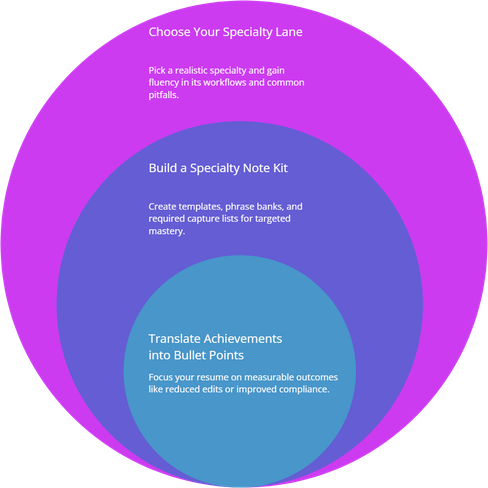
Start by choosing a lane. Use the table above and pick a specialty where you can realistically become fluent. Fluency means you understand the common visit reasons, typical documentation flow, and the common traps that create provider edits. Then build a specialty note kit. Your kit should include a template skeleton, a phrase bank for that specialty’s exams, and a list of “always capture” items. If you need EHR context to design this, ground yourself in the ecosystem using the EHR platforms guide and then connect it to workflow by exploring the office management software directory and the task management software directory.
Next, translate your kit into resume bullets that prove outcomes. Do not say “assisted provider with documentation.” Say you reduced edit time by creating consistent templates, improved data accuracy by standardizing fields, or supported compliance by capturing required elements consistently. Even if you cannot quantify yet, you can describe your process in a way that shows maturity. Then back that with industry context from data accuracy reporting and care coordination improvements.
In interviews, employers test one thing. Can they trust your output. You build trust by speaking their reality. Mention the specialty’s workflow pressure points. If it is ED, talk about capturing medical decision making cleanly and keeping documentation synchronized with reassessments. If it is GI, talk about procedure indications, follow up clarity, and consistent risk factor capture. If it is telehealth, talk about minimizing provider edits and maintaining clean structured notes even when exams are limited. For telehealth positioning, reference telehealth scribe demand and target employers more intelligently using the telehealth companies directory.
Finally, apply strategically. Random applications destroy motivation because you never learn what the market is rewarding. Use concentrated employer lists like the health systems hiring mega list, the ED and urgent care chains directory, and the physician groups and MSOs hiring list. If you want city leverage, use NYC hospital opportunities and Los Angeles salary insights to pick markets where specialty density is high.
5) Tools and Tech That Are Fueling Specialty Growth (And How to Stay Employable)
Technology is not replacing scribes evenly. It is reshaping expectations unevenly. In some specialties, AI transcription reduces typing but increases the need for validation and structure. In others, standardized templates reduce variability but punish sloppy work. The scribes who win are the ones who understand what the tools do well and where they fail.
First, understand the tool stack around you. Employers increasingly expect you to be comfortable with EHR navigation, structured fields, and template logic. Do not treat EHR familiarity like a nice bonus. Treat it like employability. Use the EHR platforms guide as your baseline, then connect it to documentation speed via the voice recognition software guide.
Second, understand where AI and ambient dictation fit. These tools can accelerate draft notes, but they create new risks: misheard terms, missing negatives, wrong laterality, and hallucinated details. In specialties like orthopedics, ENT, and cardiology, one incorrect detail can create serious clinical and billing consequences. That is why “AI savvy” scribes are not the ones who push AI. They are the ones who can QA outputs quickly. Build that awareness using the AI and ambient dictation buyer’s guide and then position yourself as the person who helps providers adopt tools without losing accuracy.
Third, build systems around your own work so you do not burn out. Specialty growth often means higher volume. Volume breaks people who rely on memory. Use operational tooling like the task management software directory, document management tools directory, and office communication tools directory. If you can show you manage throughput with systems, you look like a long term hire.
Lastly, stay credential aligned. Certifications are not only about passing an exam. They are about signaling you take standards seriously. For career positioning, use medical scribe careers with certification and explore structured education options in the training courses and certifications guide. If your target roles blend administrative duties, connect that to broader professional development through the CMAA certification resources directory and continuing education programs directory.
6) FAQs(Frequently Asked Questions)
-
If your priority is fast hiring, focus on specialties where volume creates constant staffing pressure. Emergency medicine and urgent care are common entry points because shift coverage is always needed and onboarding is designed to ramp scribes quickly. The key is proving you can handle pace without creating provider edits. Use market direction from the medical scribe hiring surge report and target employers using the ED and urgent care chains directory. If you want a smarter location pick, align your applications with the best suggests cities interactive guide so you are not fighting a thin market.
-
Choose a specialty where documentation complexity teaches you transferable skills: structured thinking, clean problem framing, compliance awareness, and tool fluency. Neurology, cardiology, GI, and internal medicine often build deeper competence because histories and assessments are more complex. These lanes prepare you for lead roles and higher responsibility. Anchor your approach in standards using documentation compliance requirements and new compliance standards. Then reinforce your value narrative using the outcome evidence in care coordination impact and data accuracy reporting.
-
Provider edits usually come from one of three failures: missing required elements, unclear clinical logic, or inconsistent formatting that slows review. In high volume specialties, even small inconsistencies become painful because they repeat all day. The fix is not typing faster. It is building a repeatable structure and learning each specialty’s “always capture” items. If you want to understand how clinics judge performance, study workflow focused reporting like clinical efficiency research and apply systems thinking using medical scribe efficiency innovations. Tools also matter, so learn platform expectations from the EHR platforms guide.
-
They are changing what employers expect, not eliminating demand across the board. AI can draft, but it still needs validation, structure, and specialty aware phrasing. In documentation sensitive specialties, errors are costly, which keeps the need for trained humans strong. The winning scribe becomes the person who can QA quickly, correct terminology, and keep notes audit ready. Build your advantage by understanding the tool landscape in the AI and ambient dictation buyer’s guide and supporting tech adoption with the voice recognition software guide. Pair that with compliance knowledge from documentation compliance requirements.
-
Use directories and employer lists that already segment hiring demand. Instead of applying everywhere, focus on organizations that hire at scale. Start with the health systems hiring mega list, then narrow by care setting using the ED and urgent care chains directory or specialty heavy organizations using the physician groups and MSOs hiring list. If remote is your goal, target the telehealth companies using scribes directory.
-
Do not try to learn everything. Build a specialty note kit. Learn the top visit reasons, the standard exam phrasing, the common tests, and the workflow of documentation from intake to plan. Then practice writing structured notes with consistent formatting. Your goal is to reduce provider edits, not impress with vocabulary. Ground your skill building in real workflows using medical scribe efficiency innovations and then align your training path with the medical scribe training and certification guide. If you want tech readiness, study common systems through the EHR platforms guide.
-
Telehealth growth rewards scribes who can keep notes clean with minimal provider edits and strong structure. Behavioral health, primary care, and follow up heavy specialties often translate well because the visit structure is conversational and repeatable. The best approach is to target organizations already scaling telehealth with scribes and build your resume around remote workflow readiness. Use the market signal from telehealth scribe demand and apply directly to employers in the telehealth companies directory. Then strengthen your tech profile using the AI scribe tools guide.
