

Effective Patient Communication: Terms & Interactive Examples
Effective patient communication isn’t “being nice.” It’s a repeatable, auditable skill that prevents mis-triage, reduces complaints, protects throughput, and keeps documentation defensible when something goes wrong. In real clinics, the breakdowns happen at predictable points: rushed intake, unclear expectations, unverified understanding, and emotionally charged moments where a single sentence can escalate or calm the room. This guide gives you a usable communication vocabulary plus interactive-style examples you can rehearse and apply on shift—especially if you’re building credibility as a scribe or admin professional aiming for higher responsibility and pay (see the career leverage pathways in how becoming a medical scribe skyrockets your medical career and the advancement logic in cmaa career roadmap).
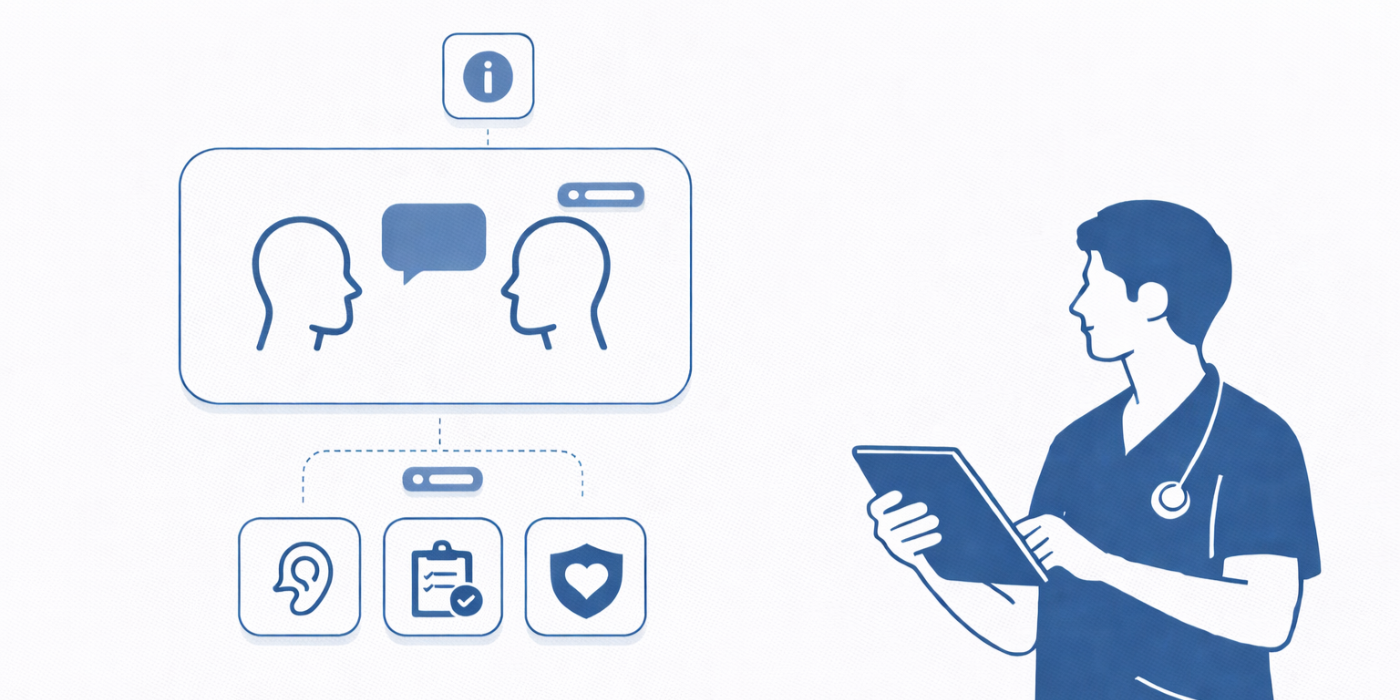
1: Where Patient Communication Breaks (and What It Costs You on the Floor)
Communication fails most often when the workflow is under pressure, not when people “forget to be polite.” Your front desk, MA, and scribe layer is where expectations are set, urgency is framed, and trust is either built or lost—fast. When that layer is weak, the downstream hits are brutal: longer visits, more rework, chart addendums, repeated callbacks, and provider frustration that shows up as burnout (compare how operational support reduces load in how medical scribes reduce physician burnout and why facilities prioritize trained staff in why healthcare facilities prefer certified medical scribes).
The 6 predictable breakpoints (and the fix you can control)
Intake ambiguity: patient gives a story; you document fragments. Fix with structured prompting and sequencing (pair this with documentation discipline from 5 surprising skills beyond documentation).
Expectation mismatch: “I thought I’d get results today.” Fix with “what happens next” scripts and time-bound framing (phone and desk scripts align well with medical office telephone etiquette).
Emotion spikes: fear looks like anger; urgency looks like aggression. Fix with validation + boundary language (train using conflict resolution interactive dictionary).
Health literacy gaps: nodding ≠ understanding. Fix with teach-back + chunking (practice using active listening interactive scenarios).
Cultural/language misalignment: “noncompliant” becomes a label instead of a barrier. Fix with neutral documentation + barrier discovery (tie to patient-centered support in patient advocacy terms + role play).
Documentation drift: what was said vs what was charted diverges. Fix with confirmation loops and precise phrasing (reinforce with accuracy standards in how scribes improve documentation accuracy and exam-level precision in mastering medical terminology for medical scribes).
If you want this to translate into raises and responsibility, your goal is to become the person who can reliably:
de-escalate tense interactions,
extract clean clinical narratives,
and prevent “chart clean-up” later (which leadership reads as costly inefficiency—see ROI framing in economic impact of medical scribes and career momentum in medical scribe career pathways).
2: The “Core Vocabulary” for Patient Communication (How to Use the Terms, Not Just Memorize Them)
Knowing terms isn’t the skill—deploying them under stress is. The fastest way to build real competence is to connect each term to a trigger (what you see/hear), a micro-goal (what you’re trying to accomplish), and a charting outcome (what must be defensible later). That’s the same mindset that separates average staff from trusted staff in documentation-heavy roles (see how credibility grows in essential skills employers want from a medical scribe and why accuracy becomes a leadership metric in annual report on documentation accuracy).
How to “activate” a term during real encounters
1) Spot the trigger (pattern recognition).
Patient repeats the same complaint three ways → you need summarizing + agenda setting.
Patient says “I’m fine” but looks panicked → you need validation + red flag screening.
Patient’s story jumps around → you need signal phrases + structured sequencing (helps you document clean HPI like you’d practice in interactive guide to mastering ER scribing and specialty workflows in cardiology scribe essential skills).
2) Choose a micro-goal (one move, not ten).
A common failure is trying to do everything at once—comfort the patient, fix the schedule, explain insurance, and defend policy. That’s how you slip into vague language and create conflict. Instead:
micro-goal = restore respect, or confirm understanding, or set timeframe (phone scripts: telephone etiquette dictionary; conflict moments: conflict resolution guide).
3) End with closed-loop confirmation (so you don’t get burned later).
“Just to confirm…” is the difference between smooth flow and repeat chaos. Closed-loop communication also protects you when patients later claim they “weren’t told” something—especially around wait times, results, or instructions (pair with systems thinking from patient flow management terms and documentation tools in EMR software terms dictionary).
The most valuable shift: from “polite” to “precise”
Politeness without precision still creates errors. Precision without empathy creates complaints. The winning combo is empathetic precision:
you validate emotion,
you give a clear next step,
you set a time expectation,
you confirm understanding,
you document what mattered (which is why communication excellence maps directly to career leverage and pay progression—compare pay pathways in medical scribe salary report (2025) and growth signals in career outlook 2026–27).
3: Interactive Examples You Can Rehearse (Scripts for 10 High-Stakes Moments)
Use these like drills: read the “bad version,” then rehearse the “better version” until it’s automatic. This is exactly how strong facilities build consistency across staff—standard language reduces variance, and variance is what creates patient complaints and documentation gaps (leadership logic aligns with healthcare efficiency gains from certified staff and operational reliability in why healthcare facilities prefer certified medical scribes).
Scenario 1: The “I’ve been waiting forever” escalation
Bad (escalates): “We’re busy. You’ll have to wait.”
Better (de-escalates): “You’re right to ask—waiting is stressful. Here’s what I can confirm: you’re checked in, the team is with another patient, and I’ll update you again in 15 minutes. If anything changes—new symptoms, worse pain—tell me immediately.”
Why it works: validation + timeframe + safety-netting + closed-loop. (Pair with flow language training in patient flow management terms and desk credibility in virtual medical administration.)
Scenario 2: Medication confusion at intake
Bad: “Do you know your meds?”
Better: “Let’s get this accurate—can you walk me through what you take in the morning, then at night? If you have a list or bottles, we’ll match it.”
Scribe/admin precision move: reconcile meds against portal/prior notes; document uncertainty neutrally (accuracy discipline connects to medical terminology quick study and quality standards from how scribes improve documentation accuracy).
Scenario 3: “I need antibiotics now”
Bad: “We can’t do that.”
Better: “I hear you want relief fast. The clinician will decide the safest treatment after evaluating you. What I can do right now is make sure your symptoms and timeline are clearly documented so the provider has the full picture.”
Why it works: empathy + boundary + action you control (supports provider efficiency described in new research on clinical efficiency and reduces rework highlighted in economic impact report).
Scenario 4: Sensitive topic—patient shuts down
Bad: “I need you to answer.”
Better: “You’re in control here. I’m asking because it helps us keep you safe. If you’re not ready, we can pause—or you can share only what feels okay.”
Charting move: document consent to discuss + minimal necessary details, avoid judgment (align with professionalism expectations in top skills employers look for and documentation trust in medical scribe certification boosts career).
Scenario 5: “My results aren’t back—why?”
Bad: “Lab hasn’t sent them.”
Better: “I can check the status right now. Most results arrive within X timeframe; if it’s beyond that, we escalate. If you don’t hear by (time/day), call us and reference this message.”
Why it works: expectation management + closed-loop + escalation pathway (reinforce phone workflow in telephone etiquette guide and scheduling systems in scheduling software glossary).
Scenario 6: Insurance/pricing anger at the front desk
Bad: “That’s your insurance, not us.”
Better: “Billing can be confusing—and I don’t want you surprised. Here’s what we know today, and here’s what requires your insurer. If you want, I can give you the exact codes or next steps to ask them.”
Credibility move: stay in scope; provide actionable next steps; avoid blame (scope discipline complements admin role growth in medical office automation trends and professional communication expectations in real-life success stories).
Scenario 7: Telehealth patient is confused about next steps
Bad: “Just check the portal.”
Better: “I’ll walk you through it: first you’ll receive a link, then you’ll complete the questionnaire, then you’ll enter the waiting room. I’ll stay on the line while you confirm you see it.”
Why it works: chunk-and-check + closed-loop (maps to remote operations in virtual medical administration and telehealth context in telehealth expansion update).
Scenario 8: Parent is anxious; child is the patient
Bad: “Calm down, please.”
Better: “You’re protecting your child—of course you’re worried. Let’s make sure the clinician has the key details: when it started, fever, hydration, breathing, and what you’ve tried.”
Scribe move: create a clean, fast timeline for the provider (supports high-acuity workflow skills in ER scribing guide and specialty accuracy in orthopedics training).
Scenario 9: Patient refuses instructions (“I’m not doing that.”)
Bad: “Then that’s on you.”
Better: “I respect your choice. Help me understand what makes it hard—side effects, cost, schedule, or something else? If we know the barrier, the clinician can offer an alternative.”
Why it works: MI micro-skill + barrier discovery + neutral language (pairs with patient support mindset in patient advocacy role-play and professionalism standards in top CMAA skills).
Scenario 10: The “second issue” at the door (“Also…”)
Bad: “You should’ve said that earlier.”
Better: “I’m glad you mentioned it. We want to respect your time and the schedule. I’ll flag it now—then the clinician will decide whether we can address it today or schedule a follow-up.”
Why it works: validation + agenda setting + realistic boundary (supports efficient care models discussed in clinical efficiency research and reduces provider overload described in burnout report).
4: The ACMSO “Communication Stack” (A Repeatable System That Makes You the Reliable One)
If you want communication to become a career advantage, you need a system—not vibes. The ACMSO-style professional advantage is consistency: you sound calm, you extract clean information, you protect workflow, and you leave a defensible note trail (that’s why credentials and structured training correlate with opportunity in why medical scribing is fast-growing and long-term stability in job market outlook 2025).
Layer 1: The 20-second opener that prevents 10 minutes of chaos
Use an opener that sets:
purpose (“I’m going to capture the key details”),
structure (“first your main concern, then a few specifics”),
safety (“tell me immediately if you feel worse”).
This mirrors high-performance intake discipline used in specialties (see structure across settings in ER scribing, surgical scribing, and complex documentation in advanced oncology scribing).
Layer 2: The “precision prompts” that clean up HPI and reduce addendums
When stories are scattered, don’t fight it—guide it:
“When did it start?”
“What makes it better/worse?”
“What’s the biggest concern today?”
Then summarize back. This creates cleaner documentation and reduces copy-forward errors (connect the discipline to future of documentation in an AI-driven world and to quality expectations in documentation trends 2025).
Layer 3: The “de-escalation ladder” (so you don’t get dragged into arguments)
Validate: “I can see this is frustrating.”
Boundary: “I can help, and I need respectful language.”
Options: “We can do A now, or B next.”
Escalate appropriately if safety is at risk (align with facility readiness training in facility safety & emergency procedures dictionary and workflow clarity in patient management systems guide).
Layer 4: The “proof phrases” you document (to protect care quality)
When communication is critical, you document that communication happened. Examples:
“Reviewed return precautions; patient verbalized understanding.”
“Teach-back performed; patient correctly described dosing schedule.”
“Discussed timeline for results and follow-up.”
These phrases reduce ambiguity and support defensibility (tie this to professional standards in medical scribe certification exam guide and competence signals in complete guide to passing your medical scribe certification exam).

5: How to Turn Communication Skill Into Raises (Metrics, Documentation, and Visible Impact)
The people who get promoted in clinics aren’t only “friendly.” They are the ones who reduce operational friction in measurable ways—fewer repeats, fewer complaints, clearer documentation, smoother handoffs. If you want leadership to see you as promotable, connect your communication work to outcomes the clinic cares about (and that staffing decisions reflect, especially as demand rises in industry reports on investment in scribes and hiring surges in medical scribe hiring surge).
The 5 “promotion-ready” communication metrics you can influence
Callback reduction: fewer “what do I do now?” calls → use chunk-and-check + teach-back (support tools: scheduling software glossary).
Complaint prevention: fewer front-desk escalations → use validation + boundary language (training: conflict resolution dictionary).
Chart quality: fewer addendums/clarifications → use structured summaries (quality logic: documentation accuracy by over 90).
Throughput support: smoother patient flow → set expectations early (workflow: patient flow management terms).
Provider satisfaction: less chaos, fewer interruptions → your communication becomes clinical efficiency (proof: new research on clinical efficiency).
“Language that sounds like leadership”
If you want to be taken seriously, adopt language that’s calm, structured, and action-oriented:
“Here’s what I can confirm.”
“Here are the next steps.”
“To confirm, you’ll…”
That’s the same professional tone expected in advanced settings and specialty workflows (compare with discipline required for surgical scribing and complex-case handling in advanced oncology scribing).
The fast track: combine communication + documentation excellence
Communication becomes a pay lever when it’s paired with documentation skill—because then you’re not only calming people down; you’re reducing risk and rework. That’s why the strongest path is:
sharpen terms + scripts (this guide),
sharpen documentation precision (see medical terminology quick study),
validate with credential signals (see how medical scribe certification boosts your career and exam readiness in essential study techniques).
Then your value is obvious in numbers—especially when you can point to market realities in salary analysis and region/city demand content like best cities for medical scribe careers.
6: FAQs (High-Value Answers That Make You Better on Shift)
-
Use a 3-part structure: validate → next step → timeframe. Example: “I hear you. Here’s what we’ll do next. I’ll update you in 15 minutes.” This structure pairs perfectly with desk/phone standards from telephone etiquette and de-escalation training in conflict resolution.
-
Use closed-loop confirmation and document it: “To confirm, you’ll…” Then chart that expectations were reviewed. This aligns with defensible documentation habits emphasized in documentation trends 2025 and quality results in accuracy by over 90.
-
Don’t argue policy. Validate emotion, state your boundary, offer options: “I can’t change X, but I can do A or B.” If safety becomes a concern, follow facility escalation pathways (tie in safety readiness with facility safety & emergency procedures and patient support language in patient advocacy role-play).
-
Start open-ended for 10–20 seconds, then switch to structure: timeline → severity → triggers → red flags → summary back. This method mirrors high-performance intake patterns used in ER scribing and specialty documentation like cardiology scribing.
-
Use plain language + chunk-and-check + teach-back. Replace “Do you understand?” with “Just to make sure I explained it well—how will you take it?” Practice listening moves using active listening scenarios and translate jargon with support from medical terminology quick study.
-
You improve communication by capturing the patient story cleanly, prompting for missing details, and documenting education/next steps clearly—reducing confusion after the visit. That upstream clarity is a major reason scribes improve efficiency and reduce burnout (see clinical efficiency research and burnout reduction report).
-
Bring evidence: fewer callbacks you handle, fewer escalations, cleaner documentation, smoother flow. Tie it to market data and role value—use benchmarks from salary report 2025 and the “value narrative” from economic impact of scribes. Then show your system: scripts + closed-loop + documentation proof phrases.
