

Why Medical Scribing is One of Healthcare's Fastest-Growing Careers
Medical scribing is growing fast because it solves a problem healthcare can’t “work around” anymore: documentation demand is rising faster than clinician time. As EHR complexity, coding scrutiny, quality reporting, and patient message volume keep climbing, the cost of incomplete or late notes shows up everywhere—burnout, missed revenue, denials, and slower throughput. A well-run scribe workflow turns documentation from a bottleneck into a measurable operational advantage. This guide breaks down why demand is accelerating, what specialties are hiring most, and how to build a career path that stays valuable even as AI evolves.

1) The real reasons medical scribing demand is accelerating (and why it’s not “just a trend”)
The job market for scribes is expanding because the documentation burden is expanding—and it’s expanding for reasons that are structural, not seasonal. Every time a health system adds new quality measures, tightens compliance, or expands services, documentation doesn’t simply “increase,” it multiplies across templates, orders, problem lists, and follow-ups. That’s why the market outlook continues to point upward in projections and hiring patterns you can track in medical scribe market trends and broader growth snapshots like the annual employment report.
What’s driving this “fast-growing” label in the real world:
EHR time is stealing clinician capacity. When notes are unfinished, everything downstream suffers: coding delays, incomplete orders, follow-up gaps, and after-hours work that pushes clinicians toward burnout. If you need proof points and how clinics measure it, borrow the KPI framing from the burnout reduction interactive report and the data mindset in how scribes impact hospital revenue.
Revenue integrity is less forgiving. Payers deny faster when documentation is unclear, inconsistent, or missing required elements. Clinics are increasingly treating documentation quality as a revenue-protection function—especially in high-volume specialties. Tie this to accuracy outcomes and controls discussed in documentation accuracy improvements and the operational evidence in the documentation accuracy annual report.
Healthcare is scaling remote + hybrid workflows. Remote scribes aren’t a novelty anymore; they’re an operations lever for coverage, cost control, and staffing flexibility. The growth is visible in the remote scribe market report and employer demand in the remote programs list.
AI isn’t replacing scribes—it’s reshaping the role. Ambient tools can generate text, but clinics still need humans to verify, structure, and align documentation with medical decision-making and coding expectations. This “AI + human QA” reality is laid out in how scribes fit into an AI-driven world and the buyer-side landscape in the AI/ambient tool guide.
Certification is becoming a filtering mechanism. Facilities want “ready-to-deploy” scribes who understand compliance, terminology, chart structure, and how to avoid risky documentation patterns. That preference is spelled out in why facilities prefer certified medical scribes and reinforced by workforce expectations in the workforce report.
The headline: scribing is growing because it produces measurable results in throughput, documentation quality, provider satisfaction, and revenue capture—the four categories executives actually fund. If you want a “career bet” in healthcare, you want one where the employer can prove ROI—and scribing is increasingly run like an ROI program, not a “helper role.” That’s also why content ecosystems like ACMSO publish role-specific proof frameworks such as employment trend visualizations and job growth analysis to support the “this role is expanding” argument.
Interactive Report Table: 30 High-ROI Ways Medical Scribes Drive Growth (What to Track, How to Prove It)
| Growth Driver / Pain Point | Scribe Action That Solves It | Clinic KPI to Track | Proof Artifact Leaders Trust |
|---|---|---|---|
| After-hours charting | Real-time note completion during visit | % notes closed same-day | EHR close-time export |
| Visit throughput constraints | Pre-load templates + order pends (per policy) | Patients per clinic session | Session throughput report |
| Provider burnout risk | Inbox triage drafts for review | Time to clear messages | Message queue trendline |
| Incomplete HPI/ROS | Structured history capture prompts | Addenda per note | Provider addendum audit |
| Coding denials | Ensure MDM elements are captured (non-coding) | Denial rate by CPT family | Denial dashboard snapshot |
| Prior auth friction | Document medical necessity in narrative | PA approval rate | PA turnaround report |
| Quality measure gaps | Reminder prompts for screenings/immunizations | Measure closure % | Quality registry export |
| Problem list chaos | Normalize problems + link to assessment | Problem list accuracy score | Chart review sampling |
| Medication reconciliation errors | Capture med changes + OTCs for review | Med mismatch rate | Safety/incident log |
| High message volume | Draft patient instructions + routing | Avg response time | Portal SLA report |
| Documentation variability | Standardize note structure across providers | Edits per note | Provider edit audit |
| Audit readiness | Ensure required fields are present | Audit exception rate | Internal audit checklist |
| Telehealth growth | Remote scribing + standardized telehealth templates | Telehealth note closure time | Telehealth ops report |
| Specialty complexity | Use specialty macros (cardio/ortho/ED) | Provider time-in-note | EHR time-on-task data |
| ED peak load | Rapid note scaffolding + results capture | Door-to-dispo time | ED throughput dashboard |
| Procedure documentation | Capture indications, technique, tolerance | Procedure note completeness | Procedure chart audit |
| Referral leakage | Document reason + urgency + routing | Referral completion rate | Referral loop report |
| Care coordination drag | Summarize plan + follow-up tasks | No-show reduction | Scheduling analytics |
| Patient satisfaction dips | Enable provider eye contact & listening | Patient experience scores | Survey trendline |
| Training new providers | Template standardization + workflow coaching | Ramp time to target volume | Ramp KPI report |
| Chart closure compliance | End-of-day closure check routines | % charts open >48h | Compliance export |
| Risk adjustment capture | Flag suspected gaps for provider review | RAF opportunity closure | HCC closure report |
| Lab/imaging follow-up | Track pending results + reminders | Open loop rate | Result follow-up audit |
| Duplicate documentation | Smart phrases + structured sections | Note creation time | Time-motion sampling |
| Inconsistent patient instructions | Standard discharge/after-visit summaries | Callback rate within 72h | Call center report |
| Burnout-related turnover | Reduce documentation hours + friction points | Provider turnover rate | HR retention report |
| AI draft errors | Human QA: verify + structure + correct | AI correction rate | QA sampling sheet |
| Multi-site consistency | Deploy standardized scribe playbooks | Site-to-site variance | Ops variance dashboard |
| Compliance anxiety | Policy-aligned documentation habits | Compliance incident count | Incident log summary |
| Leadership ROI proof | Monthly KPI pack + narrative wins | Cost per visit / margin | Monthly exec KPI pack |
2) Where the fastest growth is happening: specialties, settings, and workflows hiring scribes now
If you want a career that grows faster, aim where documentation is (a) high volume, (b) high complexity, and (c) tied directly to revenue or throughput. Those conditions exist across healthcare, but they’re concentrated in certain environments.
Emergency medicine and urgent care hire because speed is everything. The chart is part of the throughput engine; if documentation lags, the whole system clogs. That’s why city-based demand and hot markets show up in hiring rollups like top cities hiring scribes and facility lists like hospitals hiring scribes.
High-revenue specialties (cardiology, orthopedics, gastroenterology, oncology) hire because the documentation standard is higher and the risk of incomplete notes is more expensive. A strong scribe becomes “documentation insurance” that protects both clinician time and operational outcomes—especially when the clinic is under payer scrutiny. This is where “fast-growing” becomes very practical: leaders can connect a scribe’s impact to denial reduction and higher closure rates, supported by frameworks like how scribes impact hospital revenue and documentation accuracy reporting.
Primary care and multi-specialty groups hire for scale. These clinics carry enormous inbox volume, chronic care documentation, and quality programs. Scribes here often do best when they understand clinic systems and patient flow—skills that overlap with broader operations education like patient flow management terms and EHR navigation concepts in EMR software terms.
Telehealth and hybrid clinics are one of the biggest accelerators. When visits happen across time zones and providers are distributed, standardized documentation becomes crucial. That’s why employers show up in the telehealth companies using scribes list and remote demand is analyzed in the remote market growth report. Remote roles also reward scribes who communicate cleanly, follow process, and understand privacy boundaries—anchors you’ll see reinforced in HIPAA simplified and real-world workflow discipline like medical office telephone etiquette.
To stay employable across specialties, build a “portable” skill stack:
Clinical listening + structured capture (turn fast speech into clean, review-ready narratives)
EHR navigation + template discipline (don’t create messy notes that coders and auditors hate)
Documentation accuracy habits (catch contradictions, missing elements, and ambiguous phrasing)
Professional communication (clarify quickly; don’t interrupt care; escalate correctly)
This is exactly why hiring signals often favor candidates who train intentionally using structured resources like the complete guide to passing the medical scribe certification exam, mistake-proofing with the top 10 exam mistakes guide, and self-testing through an interactive scribe practice exam.
3) The career advantage most people miss: certification + metrics make you “easy to hire”
A lot of candidates try to win scribe roles by saying they’re “fast typers” or “good listeners.” That’s table stakes. What makes you easy to hire is demonstrating you understand the two things leadership actually cares about:
Risk control (compliance, accuracy, audit readiness)
Performance outcomes (note closure, throughput, revenue integrity, provider satisfaction)
That’s why certified candidates are preferred: they reduce training friction, reduce documentation risk, and move into productivity faster. You can see this employer logic spelled out in why facilities prefer certified medical scribes and supported by the expectations and data points in the workforce report.
Here’s how to make certification translate into job offers (not just a credential on paper):
Talk in KPIs during interviews. Bring up same-day close rates, addenda frequency, provider edit rates, and inbox response time (even if you’re new, show you understand what you’ll be measured on). Use KPI language from the burnout reduction report and hiring-market framing from job growth analysis.
Show you can protect accuracy. Accuracy isn’t “no typos”—it’s capturing the clinical story correctly and consistently. Build your approach using the study strategy from essential study techniques for scribe certification and the targeted framework in medical terminology quick study guide.
Demonstrate readiness for real workflows. Many new scribes fail because they don’t understand how the day actually runs: patient flow, scheduling pressure, follow-ups, and cross-team coordination. Cross-train your understanding with medical scheduling terms and operations language that supports clinic performance like patient management systems terms.
Use certification to increase your pay ceiling. Compensation differences often show up between certified and non-certified roles, which you can explore in salary analysis: certified vs non-certified scribes and sharpen expectations with tools like the salary comparison tool.
Professionally, this is the “fast-growing career” path: not just getting hired, but becoming the scribe who can step into complex clinics, stabilize documentation, and prove value. That’s also how scribes move into higher tracks—lead scribe, trainer, quality auditor, documentation specialist, or clinical operations roles.
4) AI, ambient dictation, and remote scribing: how the “fast-growing” role evolves (without disappearing)
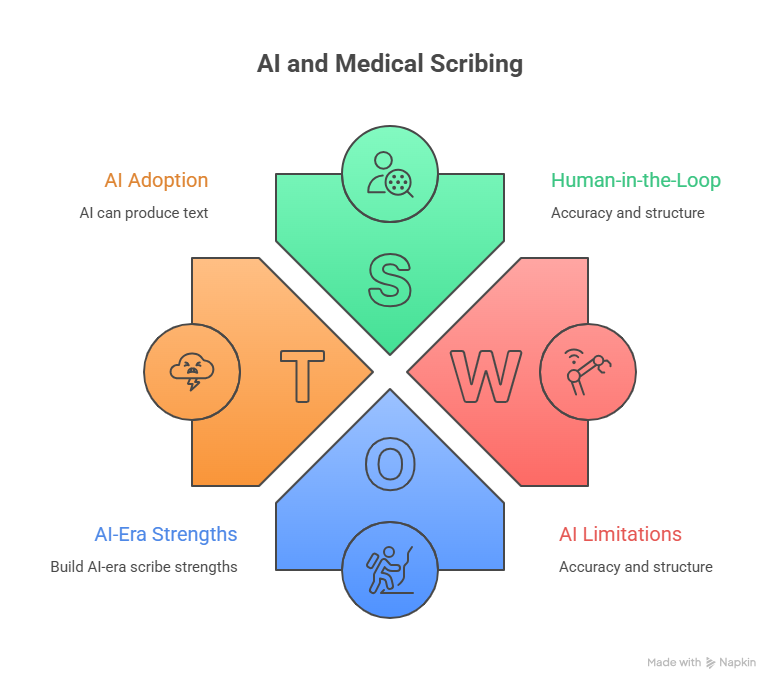
If you want longevity in this career, don’t fight AI—use it as a reason your human skill is worth more. The clinics adopting ambient tools still face three problems that keep scribes relevant:
1) Accuracy risk: AI drafts can mis-hear, confuse laterality, mix timelines, or summarize in ways that change meaning. A high-quality scribe acts as a QA layer. That “human-in-the-loop” future is explained in AI-driven documentation and scribes and practically mapped by tool categories in the ambient dictation buyer’s guide.
2) Structure and compliance: Even if the text is “correct,” it may not be structured in a way that supports coding clarity, quality reporting, or audit readiness. The scribe’s job becomes: verify, structure, standardize. This is why clinics emphasize trained staff and why performance claims like 90%+ accuracy improvements remain a hiring justification.
3) Workflow integration: Tools don’t fix messy workflows. Remote and hybrid care amplify the need for standardized templates, clean handoffs, and disciplined documentation routines. Remote demand signals are tracked in the remote growth report and employer adoption in the remote employer/program list.
To stay on the winning side of this evolution, build “AI-era” scribe strengths:
Verification discipline: confirm critical details (meds, doses, timelines, laterality, results) before finalization.
Narrative clarity: make the clinical story readable for coders, auditors, and other clinicians.
Template mastery: use smart phrases responsibly; avoid autopopulated clutter that creates risk.
Remote professionalism: privacy habits, secure workspace, consistent communication, and on-time closures—supported by compliance basics like HIPAA simplified and process language from scheduling software glossary.
The key reframing: AI can produce text, but healthcare needs trusted documentation—and trust is built through verification, consistency, and measurable outcomes. That’s why “AI adoption” and “scribe hiring” can rise at the same time.
5) How to break into the field and grow fast: the skill stack that gets promoted
The fastest-growing careers reward people who can prove impact quickly. In scribing, “impact” often means you reduce clinician friction without creating risk. Here’s a practical path that works even if you have zero healthcare experience today.
Step 1: Learn documentation structure before you chase speed
Speed without structure creates messy notes that providers hate. Start by mastering how a visit note is organized (HPI, ROS, exam, assessment/plan) and how specialties differ. Build your foundation using the scribe exam breakdown and reduce learning gaps with study techniques for certification success.
Step 2: Build medical terminology like a working tool, not a memorization list
Terminology becomes useful when you can catch mistakes and follow clinical logic in real time. Use the targeted approach in mastering medical terminology for scribes and validate readiness through the interactive practice exam.
Step 3: Become “low training cost” with checklists and workflow habits
Hiring managers love candidates who understand that scribing is a workflow role. Bring a simple “first 30 days” plan: shadowing, template library, QA feedback loop, and closure targets. You’ll stand out more if you reference employer preferences like certified scribes are preferred and tie your plan to measurable outcomes from the burnout reduction report.
Step 4: Target the fastest-growth job channels
Don’t just apply everywhere—apply where hiring is systematic: large hospital systems, telehealth organizations, and established remote programs. Use employer lists such as top hospitals hiring scribes, the telehealth companies using scribes directory, and remote role channels from the remote employer list.
Step 5: Plan your “next title” early
Medical scribing is a launching pad. The growth path often looks like:
Scribe → Senior/Lead scribe (quality + training)
Lead scribe → Scribe trainer / QA specialist (audit readiness + standardized workflows)
QA specialist → Clinical operations / documentation specialist
Or pivot to adjacent tracks (medical admin roles), where resources like medical billing explained and patient advocacy terms strengthen your “clinic operator” profile.
If you treat scribing as a measurable operations role (not just typing), you’ll grow faster than the average candidate—and you’ll stay valuable even as tools change.
6) FAQs: What people hiring and entering medical scribing actually want to know
-
Yes—if you position yourself as the person who ensures documentation is correct, structured, and policy-aligned. Clinics adopting AI still need verification, standardization, and workflow discipline. Use the framework from AI-driven documentation and scribes and understand tool limitations through the ambient tool buyer’s guide. Your job security comes from being the “trusted layer,” not the “typing layer.”
-
High-performing scribes reduce provider friction and increase note reliability without creating compliance risk. Employers care about: same-day close %, edits/addenda per note, documentation completeness, and consistency across providers. Anchor your KPI language using the burnout reduction report and accuracy benchmarks like documentation accuracy improvements.
-
Because certification signals lower training cost, faster onboarding, and reduced documentation risk. Facilities want scribes who can follow structured workflows, handle terminology, and avoid documentation mistakes that cause denials or audits. The employer rationale is detailed in why facilities prefer certified medical scribes and reinforced by industry expectations in the workforce report.
-
Be “ready to train fast.” Study documentation structure, build terminology, and show you understand clinic workflows. Start with the complete certification exam guide, avoid common traps using top exam mistakes, and validate readiness with the interactive practice exam. In interviews, speak in KPIs and process—managers hire confidence plus structure.
-
All three are growing, but remote and telehealth have become major accelerators. If you want remote, focus on established programs and employers from the remote scribe employer list and understand the ecosystem via the remote market growth report. For on-site hospital demand, reference directories like top hospitals hiring scribes and hiring hotspots via top cities hiring scribes.
-
Prioritize (1) note structure, (2) terminology you actually hear, (3) workflow discipline, and (4) accuracy/QA habits. Start with the exam breakdown, build speed the right way using study techniques for success, and strengthen terminology through the quick study guide. Then translate it into performance: same-day close routines and clean, consistent notes.
