

Medical Scribe Market Trends: Where the Jobs Will Be in the Next 5 Years
Medical scribe hiring is not slowing down. It is shifting. The next five years will reward people who understand where demand is moving, how documentation workflows are changing, and what employers actually screen for. If you want predictable job options, you need to think in specialties, care settings, and operational pain points, not vague “healthcare growth.” This guide breaks down where the jobs will be, why those pockets are expanding, and how to position yourself so you do not get filtered out. If you want baseline context first, start with the job market outlook and the documentation trends report.

1) The next 5 years will reward scribes who solve specific operational problems
If you are job hunting right now, you can feel the noise. Listings look similar. Pay ranges are inconsistent. “Experience required” shows up everywhere, even for entry roles. Meanwhile, clinics are under pressure from every direction: faster throughput, tighter documentation compliance, higher patient volumes, and less tolerance for claim errors. The scribe market is growing, but employers are hiring with one question in mind: “Will this person make my documentation faster, cleaner, and safer?”
Here is the reality most candidates miss. Scribe demand is not just about “more patients.” It is about documentation risk and revenue risk. Every specialty has unique charting patterns, and those patterns drive audits, denials, and time loss. That is why employers keep investing in scribes even while they test automation. If you want to understand what employers value, read how scribes improve clinical efficiency and how they impact documentation accuracy at scale.
Over the next five years, job growth will concentrate where documentation is hardest to standardize and where clinician time is most expensive. Expect the strongest hiring in environments that have all three of these conditions:
High visit volume and high documentation burden
High reimbursement risk if notes are weak
Workflow friction inside the EMR that providers hate
This is why high intensity settings such as emergency care keep expanding scribe usage, and why outpatient specialties with high coding complexity continue to create roles that are “scribe plus” rather than pure note taking. You will see more titles that blur lines: scribe, documentation specialist, clinic workflow assistant, and intake plus scribe. If you want a clean picture of what is changing, review the automation and AI trends and the broader employment trend visualization.
The pain points that drive hiring are not abstract. They show up in daily operations:
Providers rewriting notes because templates are messy and inconsistent
Notes missing key medical necessity language, which triggers denials
Delayed chart completion, which breaks billing cadence
Incomplete histories and ROS because intake is rushed
Documentation variability across providers that creates compliance exposure
Burned out clinicians who want fewer clicks, fewer edits, and more patient focus
If you can speak to these problems in interviews, you stop sounding like “another applicant.” You sound like a workflow fix. That is why candidates who build strong fundamentals from a study techniques playbook and a clean medical terminology guide tend to win faster.
2) Where the jobs will be: the 5 highest probability growth zones
You do not win the next five years by applying everywhere. You win by targeting the zones that are structurally forced to hire. Use the table above as your map, then focus on five categories that repeatedly show up across markets and employers.
1) High volume acute care roles will keep expanding
Emergency departments, urgent care networks, and hospitalist teams will keep hiring because speed is non negotiable. When providers are racing through visits, documentation becomes a bottleneck. A good scribe is not “typing faster.” A good scribe is reducing chart completion time and reducing provider edits.
If you want to compete in this zone, you must show competence with fast note structures and common acute presentations. Build this using an exam breakdown guide, real practice through an interactive practice exam, and execution checklists like the exam day preparation checklist.
2) Outpatient specialties with heavy coding complexity will hire “scribe plus”
Cardiology, orthopedics, GI, neurology, and oncology are not just expanding patient volumes. They are expanding documentation complexity. More tests, more structured plan language, more follow ups, and more risk if the note is vague.
In these markets, the employer wants someone who can capture details cleanly and consistently. That is why skills content matters, like the essential skills employers want and broader industry patterns in the job growth by specialty report.
3) Remote and hybrid roles will grow, but will become more competitive
Remote scribing is already real, and it will keep growing because clinics want flexibility and expanded hiring pools. But remote roles attract more applicants and tighter screening. You must prove you can handle audio based workflows, asynchronous tasks, and strong documentation standards without constant oversight.
If you want to prepare for this track, study the operational realities in remote medical scribing and the market signals in the remote market growth report. Also learn to interpret pay patterns using the annual salary report and tools like the interactive salary calculator.
4) Large systems and staffing agencies will consolidate hiring
As hospitals and multi site groups scale, hiring becomes centralized. This creates more standard role descriptions, more ATS screening, and more emphasis on proof. You will see this in mega lists and directory style hiring hubs like top medical scribe companies and large employer breakdowns like top health systems hiring.
This is a pain point for candidates because “apply online” becomes a black hole. The fix is to build evidence that survives screening, which we will cover later.
5) Scribes will increasingly be used as workflow multipliers
Clinics are tired of hiring roles that only do one thing. In many settings, a scribe becomes a workflow multiplier: documentation support plus basic coordination tasks, prep work, and communication support. This is why career paths are expanding and why roles connect to leadership tracks. If you want to see the long game, use the career pathways guide and real examples in success stories.
3) What will change because of AI and what will stay valuable
The biggest mistake candidates make is arguing extremes. Either they panic and assume AI will erase jobs, or they ignore automation and pretend nothing will change. The truth sits in the workflow.
AI will help with transcription, suggestion prompts, and template support. It will not magically turn messy clinical conversations into clean, billable, defensible notes in every specialty. The more complex the visit, the more human judgment matters. That is why the next five years will reward scribes who understand quality, structure, and compliance language, not just typing.
Here is what will change:
More “ambient” tools will exist, and more providers will still edit
You will see more clinics testing ambient dictation tools and voice recognition platforms. But provider edits are the hidden cost. If a provider must rewrite half the note, the tool is not saving time. The scribe role becomes “quality control plus structure,” ensuring the note is accurate, complete, and ready.
To understand the technology angle without hype, study automation and AI in the scribe role and keep an eye on tool ecosystems like voice recognition software guides.
More employers will demand proof of quality
As tools become common, employers will want scribes who can show measurable output: lower provider edits, faster chart completion, fewer documentation errors. If you have never thought about metrics, start now with how data is presented in industry analysis reports and how value is explained in research on efficiency.
More roles will be specialty specific
Generic scribes will still exist, but specialty specific hiring will grow. This is especially true in settings where documentation impacts revenue and compliance. That is why specialty directories like outpatient specialty networks hiring scribes are so important for job targeting.
Now, what stays valuable:
Understanding clinical language and documentation structure
Capturing the right details the first time
Keeping notes consistent with provider style
Managing templates and workflows inside EMRs
Reducing provider workload rather than adding steps
If you want a practical foundation, anchor yourself in terminology mastery and avoid predictable mistakes using a top mistakes guide.
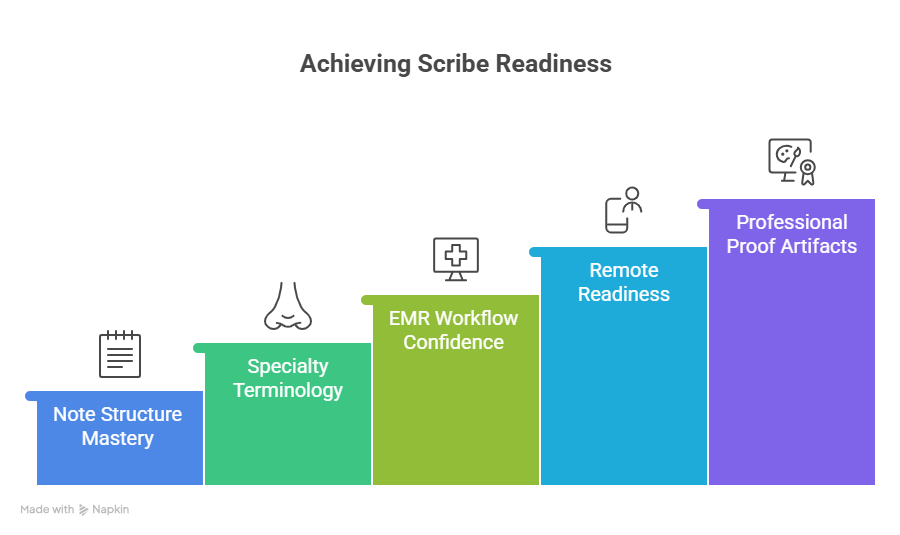
4) Skills that will get you hired in a tighter market
Over the next five years, the market will reward scribes who show “proof of readiness” fast. Employers do not want to babysit. They want clean output. Here is what hiring managers actually look for, and how you can build it.
1) Note structure mastery, not generic typing speed
Typing speed is a bonus. Structure is the job. A strong scribe captures the story of the visit in a way that makes the assessment and plan defensible. Train this using practice tests like the interactive practice exam and reduce errors by studying common exam mistakes.
2) Terminology that matches the specialty
If you are applying to cardiology but your language is generic, you will not stand out. Build a baseline with medical terminology mastery, then specialize your vocabulary based on the job pocket you want.
3) Workflow confidence inside EMRs
Employers care about how quickly you adapt to their system. You do not need to claim you “know every EMR.” You need to prove you can learn fast and keep documentation consistent. If you want a list of platforms that appear across roles, study the ecosystem using the EMR and EHR platforms guide.
4) Remote readiness skills for work from home roles
Remote scribing requires discipline, audio comprehension, and clean communication. You must show you can handle the workflow. Learn how remote work changes expectations in remote medical scribing and track the demand signals in the remote market report.
5) Professional proof artifacts that hiring managers trust
This is where most candidates fail. They say “hardworking” and “detail oriented.” That is noise. A proof artifact is something real: a structured note template you built, a checklist you follow, a quantified practice result, or a training completion result.
For example, you can build a “job ready portfolio” based on:
Practice exam scores and improvement trend, supported by study techniques
A clean exam prep plan aligned with passing the certification exam
A readiness checklist modeled on exam day preparation
A career plan that signals long term intent using career pathways
Employers want stability. If your story shows a path, not randomness, you look safer to hire.
5) Your 5 year job strategy: how to pick markets, win interviews, and grow your income
The next five years will produce winners and frustrated applicants. The difference is strategy. Here is the playbook that works even when listings feel saturated.
Step 1: Choose a “job pocket” first, then build your profile around it
If you apply to everything, your resume becomes generic. Instead, pick one of these tracks:
High volume acute care track
Outpatient specialty track
Remote first track
Staffing agency track for fast placement
Academic medical center track for long term growth
Use market intelligence sources to pick your lane. If you want city based hiring signals, explore tools like the interactive job market report and broader employer lists such as top hospitals hiring.
Step 2: Build an ATS friendly resume that proves outcomes
In the next five years, hiring will become more standardized. That means more screening. Your resume must show outcomes and workflow impact. Do not write fluff like “excellent communicator.” Write proof like:
Reduced provider edit time by improving note structure
Completed notes within clinic targets
Maintained consistent templating and avoided missing elements
Supported high volume clinics without documentation backlog
You can learn how documentation value is framed in data heavy articles like how scribes impact revenue and accuracy reports such as the annual documentation accuracy report.
Step 3: Use certification and structured prep to remove doubt
In competitive markets, certification signals that you take the role seriously and that you have baseline knowledge. It also gives you language for interviews. If you are preparing, use the complete exam guide, avoid predictable errors with the mistakes guide, and validate readiness with the practice exam.
Step 4: Target employer ecosystems, not random job boards
Job boards are where everyone applies. Ecosystems are where you can build a repeatable pipeline. Examples:
Hospital and health system lists like top health systems hiring
Staffing agencies like scribe companies directory
Specialty network directories like outpatient specialty networks
Remote employer lists like remote employers list
When you build around ecosystems, you reduce randomness. You also learn patterns in job descriptions so you can tailor fast.
Step 5: Plan your growth into higher leverage roles
Your income growth is tied to your ability to move into complex settings, leadership support, or adjacent tracks. Many scribes move into clinical roles, operations, or specialty workflows. If you want a roadmap, use the career pathways guide and benchmark your pay expectations using salary comparisons.
The biggest trap is staying “entry level” by never choosing a specialty or never building proof artifacts. You can avoid that by following structured prep routines like study techniques and by staying current with the employment report.
6) FAQs: Medical scribe market trends and job growth (next 5 years)
-
Yes, but the role will shift toward quality control, structure, and workflow support. AI can generate text, but employers still need notes that match specialty standards, capture medical necessity, and reduce provider edits. That is why clinics keep investing in scribes as an operational fix, especially in high volume settings. If you want a realistic view, follow the patterns in automation and AI impact and compare it with evidence on clinical efficiency gains. Your edge will be accuracy, consistency, and speed to chart completion, not typing alone.
-
Expect continued demand in emergency care, urgent care, primary care networks, and procedure heavy outpatient specialties like orthopedics, cardiology, GI, and dermatology. These settings combine high visit volume with documentation complexity, which creates persistent hiring pressure. Use specialty level data and directories like the job growth by specialty report and the outpatient specialty networks directory to decide where to focus. Picking a specialty track early helps you tailor terminology, note structure, and interview language.
-
Remote roles should grow, but they will become harder to win because the applicant pool is larger. Employers will screen for audio based documentation ability, reliability, and proof of structured note skill. If you want remote work, treat it like a specialty. Build remote workflow competence through remote scribing guidance and track demand in the remote market growth report. Then target known remote employers using the work from home employers list.
-
You stand out by showing proof artifacts and role specific readiness. Hiring managers do not just want “experience.” They want confidence that you can produce clean notes with minimal provider edits. Build proof using structured practice, measurable improvement, and a portfolio of checklists and templates. Start with the practice exam, sharpen execution with study techniques, and avoid credibility killers using the mistakes guide. When you can describe your workflow clearly, “no experience” stops being a wall.
-
Pick a job pocket, specialize, then plan a progression. Many people stay stuck because they never choose a specialty or a market lane. A stable path usually looks like this: entry role in a high volume setting, specialization in one outpatient or inpatient area, then growth into senior scribe, trainer, team lead, or adjacent healthcare operations roles. Use the career pathways roadmap and real examples from success stories to map your next moves. Stability comes from skill depth and proof, not from applying randomly.
-
Use city and employer level signals instead of guessing. Look at where health systems are expanding, where urgent care chains are dense, and where specialty networks operate at scale. Then validate with hiring data tools and directories. Start with the top cities hiring report and cross check against employer hubs like top hospitals hiring and health systems hiring by state. This approach keeps you focused on high probability employers instead of chasing low signal listings.
-
Certification helps most when it supports your proof story. It signals baseline knowledge, commitment, and structured training. It also gives you a framework for interviews and reduces employer fear about readiness. If you are preparing, follow a structured route using the complete certification exam guide, practice repeatedly with the interactive practice exam, and lock your performance using study techniques. The combination of certification plus proof artifacts is what turns you from “applicant” into “safe hire.”
