

Essential Study Techniques for Medical Scribe Certification Success
Medical scribe certification success is not about studying “harder.” It is about studying smarter under pressure, building speed without losing accuracy, and training your brain to think like documentation systems demand. If your prep feels scattered, it usually means you are missing a workflow, not motivation. This guide gives you a professional study method that mirrors real scribe performance standards in healthcare documentation trends, the skill expectations in essential employer skills, and the credibility boost explained in how certification accelerates careers.
1) Build a Study System That Forces Progress (Not “More Notes”)
Most people fail certification prep because they collect information instead of converting it into performance. The test is designed to reward rapid recognition, not slow rereading. If your current method is highlighting, copying notes, or watching videos twice, you are training familiarity, not recall. That gap shows up in real work too, which is why efficient EMR data entry and patient chart audit mastery focus on repeatable workflow habits.
Start with a baseline. Take a short practice set and classify misses into four buckets: workflow order, documentation accuracy, compliance judgment, and time management. This maps directly to what modern roles demand in real time scribe impact and what is evolving through automation and AI. When you know your miss pattern, you stop wasting hours on topics you already own.
Next, set a simple weekly cadence:
Two high focus learning blocks for deep understanding
Three performance blocks for recall and timed practice
One review block to fix your personal error patterns
Tie your plan to real career outcomes so your discipline stays sharp. When you feel tempted to skip, remember the market reality in the 2025 job market outlook, the earning benchmarks in salary trend data, and the growth pathways in success stories. Certification prep is not “school.” It is the first proof you can execute.
Finally, reduce your study scope to what moves scores. Treat everything else as noise. That is how professionals operate in high volume settings like emergency department scribing where clarity and speed decide outcomes.
2) Use High-Leverage Learning: Active Recall and Spaced Repetition Done Right
Active recall and spaced repetition are not buzzwords. They are the fastest way to turn knowledge into instant access. In scribing, instant access is the difference between clean documentation and messy, slow output, which is why training tends to align with documentation trends and skill standards in essential employer skills.
Build recall prompts that match test thinking
Do not make flashcards that ask for definitions only. Make prompts that force decisions:
“What is the safest next step?”
“What is out of scope?”
“What must be documented first?”
This trains the same judgment that shows up in HIPAA compliance essentials, updated expectations in HIPAA updates for 2025, and practical security patterns in EMR security best practices.
Use spaced repetition to attack weaknesses, not to feel productive
Most people schedule review based on “what is next in the book.” That feels organized but it does not raise scores. Instead, schedule review based on error patterns that show up in your practice sets. If your misses cluster around process order, you anchor your repetition to workflow resources like efficient EMR entry and chart audit mastery. If your misses cluster around compliance, you anchor your repetition to HIPAA essentials and privacy regulations best practices.
Turn every wrong answer into a rule you can execute
A wrong answer is only valuable if you can explain:
What you missed
What cue you ignored
What rule would have prevented the miss
This is how you build professional judgment that translates to real outcomes in clinical efficiency research and strong operational habits described in real time scribe impact.
3) Train Like the Job: Documentation Drills and EMR Workflow Simulations
Medical scribe certification success improves when your practice looks like the work. The test does not reward passive familiarity. It rewards performance behavior: extracting key information, sequencing actions, choosing compliant steps, and documenting cleanly.
Run “mock notes” from short scenarios
Take a prompt and write a structured note quickly. Then review it with an audit lens:
Is it clear
Is it complete
Is it safe from privacy risk
Is it readable under time pressure
This mirrors the quality expectations in patient chart audits, the speed discipline in efficient EMR entry, and the precision demanded in documentation trend insights.
Build workflow maps for common scenario types
When a question asks “what happens next,” many test takers freeze because they cannot visualize the process. Fix that by mapping steps for common workflows. Your goal is rapid sequencing, not memorizing isolated facts. This aligns with how systems thinking is rewarded in new research on efficiency, especially as roles evolve through telehealth expansion and higher-volume workflows in telemedicine demand for scribes.
Practice speed without sacrificing accuracy
Speed alone is not the goal. Controlled speed is the goal. Do timed mini-sets and track two numbers: accuracy and time per question. If accuracy drops when you speed up, you tighten your reading protocol and use qualifier scanning. That is the same discipline that separates reliable scribes in emergency departments from scribes who create risk through rushed work.
4) Master Compliance and Risk Questions Without Overthinking
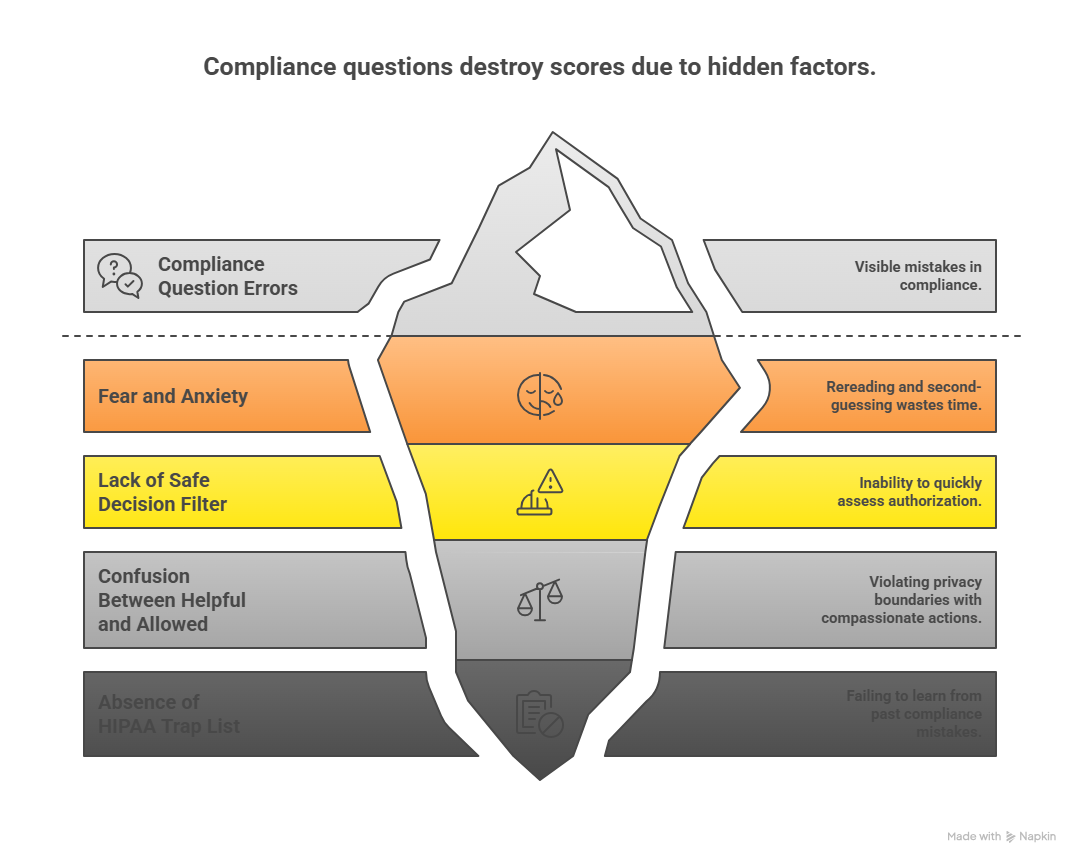
Compliance questions destroy scores because they trigger fear. Fear makes people reread, second guess, and waste time. The goal is not memorizing laws like trivia. The goal is building a fast “safe decision filter” that works under pressure.
Use a three-step safety filter for every scenario
Identify the protected information and who is requesting it
Decide whether the requester is authorized
Apply minimum necessary and secure handling
This maps directly to practical guidance in HIPAA compliance essentials, the scenario patterns highlighted in privacy regulations best practices, and the secure workflow thinking in EMR security best practices.
Learn the difference between helpful and allowed
Many trap answers look compassionate or efficient. They are still wrong if they violate privacy boundaries. Your job as a scribe is to support the clinical team while protecting patient information. That professional boundary becomes more important as healthcare expands through telehealth changes and as documentation systems become more connected, which is why documentation trends keeps emphasizing governance and process.
Make a “HIPAA trap list” from your wrong answers
Every time you miss a compliance question, write the trap pattern. Over time, you build a library of traps you can spot instantly. This is how you stop feeling unsure and start feeling controlled, which is part of what differentiates certified professionals as explained in career benefits of certification and the employability signals in essential employer skills.
5) Convert Studying Into Passing: Timed Practice, Review Protocols, and Exam Execution
If you want a passing score, your final phase must be performance training. This is where you stop “learning” and start proving you can execute quickly and correctly.
Use a review protocol that upgrades your decision making
After each practice set, do not just check answers. Diagnose decisions:
Did you misread the stem
Did you ignore a qualifier
Did you violate workflow order
Did you overthink a compliance scenario
That protocol aligns with quality control thinking in chart audit mastery, speed discipline in efficient EMR entry, and real-world impact expectations in clinical efficiency research.
Train pacing like a professional
Set checkpoints. If you are behind pace, you tighten your stuck rule and protect easy points first. This is exactly how high performers manage pressure in emergency department scribing and why operational discipline is valuable for the market described in the 2025 job market outlook.
Use certification prep to build career leverage
While you study, build a professional narrative: you are training for accuracy, speed, and privacy discipline. Those signals translate directly into better roles and better pay, which connects to salary trend data, tools like the interactive salary calculator, and long-term paths like clinical documentation specialist opportunities. Your certification is not just a pass. It is proof you can execute.
6) FAQs (Medical Scribe Certification Study Techniques)
-
Stop rereading and switch to active recall plus timed mini-sets. Build an error log and review only recurring mistakes. This targets score movement faster than broad review. Use workflow resources like efficient EMR entry and quality control thinking from chart audit mastery. If compliance is your weakness, anchor your practice to HIPAA essentials and privacy best practices.
-
Use time boxing and pick one high impact skill per session. Do 10 minutes of recall, 10 minutes of timed questions, and 10 minutes of reviewing your errors. This creates daily progress without burnout. Focus on the skills employers value in essential employer skills and the decision patterns found in documentation trends. Consistency beats intensity.
-
Because passive review creates familiarity, not retrieval strength. You need active recall and spaced repetition. Build prompts that force you to decide, not define. Then revisit weak areas on a schedule. This mirrors how professionals build stable performance in clinical efficiency research and why disciplined systems matter as the role evolves with automation and AI.
-
Stop memorizing facts and start visualizing sequences. Build simple workflow maps and practice applying them to scenarios. Run mock notes so your brain learns structure and order. Use efficient EMR entry steps and verify your thinking with patient chart audits. When you can visualize the process, workflow questions stop feeling abstract.
-
Use a fast safety filter: who is requesting, are they authorized, and what is the minimum necessary. Many trap answers sound helpful but violate privacy boundaries. Anchor your practice in HIPAA compliance essentials, confirm scenario logic with privacy best practices, and reinforce secure handling through EMR security best practices.
-
Your prep builds proof of execution: speed, accuracy, and privacy discipline. Those signals matter in hiring and advancement, which is why certification boosts your healthcare career is such a high-leverage step. Pair your certification with market targeting from the 2025 job market outlook and salary benchmarking from salary trend data. If you want long-term growth, align your next skills with clinical documentation specialist opportunities.
