

Interactive Guide to Mastering Emergency Room (ER) Scribing
Emergency medicine is where documentation fails fast—not because people don’t care, but because the environment is engineered for interruptions, ambiguity, and speed. ER scribing is the skill of creating clean, defensible clinical narratives while a clinician is juggling triage realities, consult churn, procedures, and rapid disposition decisions. This guide trains you to think like the chart: what must be captured, where it belongs, and how to keep accuracy high when the room is loud and the pace is unforgiving—so providers can move, coders can code, and risk doesn’t creep in unnoticed.
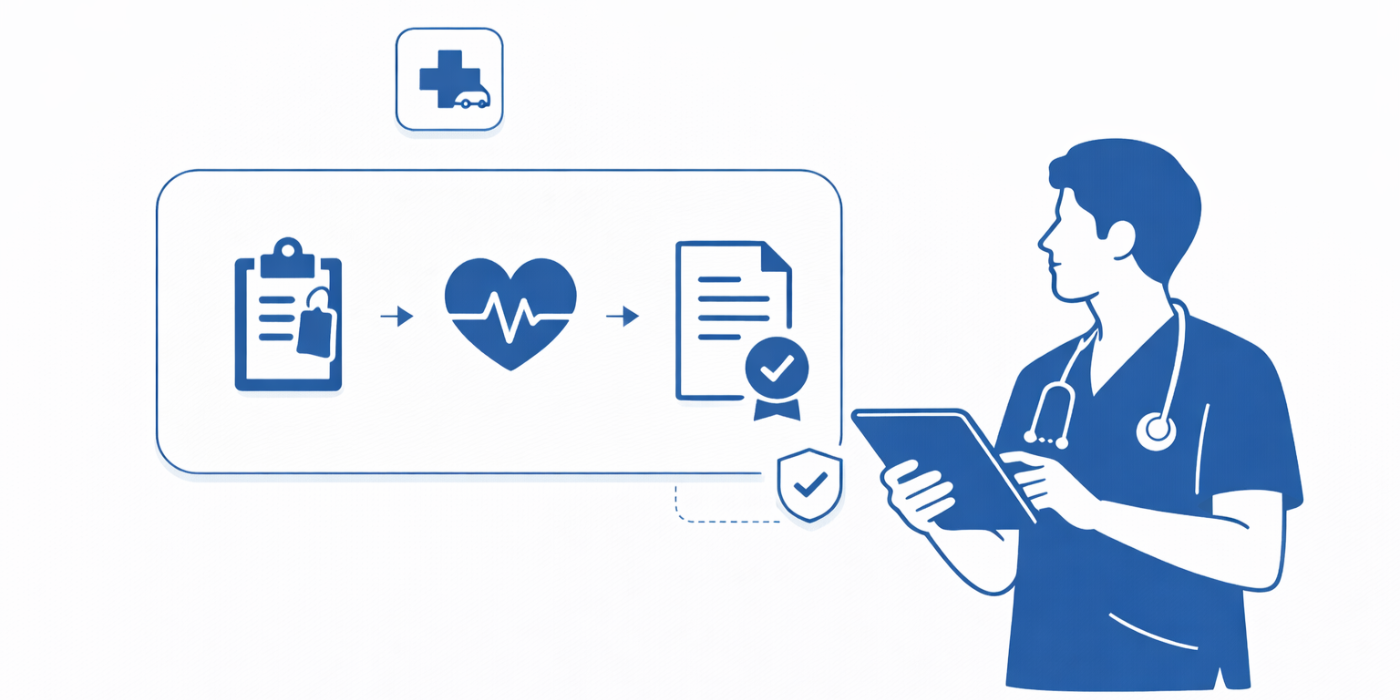
1. ER Scribing Is Not “Fast Typing” — It’s Real-Time Clinical Risk Control
ER documentation is a legal record, a care-continuity tool, and a billing/quality artifact—all at once. When your note structure collapses under pressure, you don’t just create “messy charts.” You create downstream chaos: delayed dispositions, coder queries, claim denials, audit exposure, and provider burnout (and yes, scribes are directly tied to reducing that burden—see the data in the interactive report on reducing physician burnout). In the ER, the scribe is often the only person tracking the story from arrival → evaluation → interventions → reassessment → decision-making.
To master ER scribing, you need a mental model that’s stronger than the shift. Think in phases and risk points:
Arrival context (why now, why here, what changed?)
Clinical reasoning (differential + why the plan makes sense)
Time-based evidence (reassessments, response to meds, evolving vitals)
Procedure fidelity (indications, consent, technique, tolerance, outcome)
Disposition logic (why discharge vs admit vs transfer is justified)
This mindset is what separates “notes that exist” from “notes that protect.” It’s the same discipline behind high-accuracy environments, including the approach outlined in how scribes improve documentation accuracy by over 90% and the broader shift described in the future of medical documentation in an AI-driven world.
ER scribing is also a workflow role. You’re managing:
Provider preference consistency (what they always want, what they never want)
EHR navigation under stress (smart phrases, macros, orders visibility)
Team handoffs (nursing notes, EMS, consultants, radiology reads)
Compliance boundaries (what you document vs what you do)
If you’re shaky on compliance basics, anchor yourself with HIPAA simplified for medical admin assistants and operational communication standards like medical office telephone etiquette (because ER callbacks, consultant coordination, and communication clarity are chart-adjacent risk factors).
2. Triage-to-Disposition: The ER Scribe Workflow That Keeps You Ahead (Not Behind)
ER scribing becomes manageable when you stop trying to “catch everything” and start running a repeatable workflow. Your job is to keep the chart synchronized with reality. That requires capture strategy more than typing speed—especially when you’re juggling patient flow dynamics (use patient flow management terms and scenarios as a vocabulary backbone) and EHR complexity (ground yourself with EMR software terms).
Phase 1: The “Front-End Frame” (First 2–3 minutes of the encounter)
Your goal is to lock in the story spine:
Chief complaint + context: why they came today, what changed, what failed at home.
Timeline: start time, progression, key turning points.
Risk flags: anticoagulation, immunosuppression, pregnancy, severe allergies.
Baseline: functional baseline, chronic symptoms, “normal” vitals for them.
This is where new scribes lose time: they over-document low-value narration and miss high-value anchors. Keep the HPI clinically organized and consistent with provider patterns. The facility preference for consistency is exactly why certified scribes are valued (see why facilities prefer certified medical scribes).
Phase 2: The “Exam + Differential + Plan” Synchronization
ER providers are often speaking in fragments: quick exam notes, a test ordered mid-sentence, a differential updated after a nurse update. Your job is to convert fragments into a coherent record:
Exam highlights only (abnormal + relevant normals)
Differential as reasoning, not a list
Plan tied to uncertainty: “to evaluate for __ we will __”
If you want a clean template mindset, practice with structured documentation frameworks from complete guide to passing your medical scribe certification exam and calibrate your note logic using annual report on documentation accuracy.
Phase 3: ED Course as a Timeline (This is the ER scribe “superpower”)
The ED course is where you earn your keep. It’s where the record shows:
consults happened,
imaging changed decisions,
meds worked or didn’t,
reassessments occurred,
patient was stable at disposition.
Your ED course should read like a controlled timeline, not a dumped pastebin. If you need a mental model, think “event → action → patient response → updated plan.” That structure is directly connected to measurable outcomes like note closure time and fewer edits—metrics often used in workforce performance reports like medical scribe workforce report key insights & data 2026–27 and hiring trends covered in medical scribe market trends.
Phase 4: Disposition Documentation That Prevents 3 AM Callbacks
Disposition is where risk hides. Your documentation must justify why discharge is safe or why admission/transfer is necessary. This is where many ER notes fail: they list a diagnosis but don’t show the decision logic. Tighten:
objective improvement (pain, vitals, exam),
test results + interpretation,
return precautions that match the condition,
follow-up specificity.
This “decision logic” discipline is a career differentiator, and it shows up in employer demand patterns (see interactive data visualization on employment trends).
3. High-Pressure Note Quality: How to Capture ER Complexity Without Creating Chart Liability
In the ER, your note must support speed and defensibility. The trick is knowing what to emphasize and what to avoid.
1) Document uncertainty like a professional, not like a guesser
ER medicine is probabilistic. Your provider may not know the final diagnosis—but they must show the thinking that guided safe action. Your role is to make sure the record reflects:
what was considered,
what was ruled out (and why),
what was treated,
what follow-up mitigates residual risk.
This is where coders and auditors look for quality signals. It’s also where scribes dramatically reduce errors by ensuring the story and the MDM match (the operational impact is explored in how medical scribes impact hospital revenue).
2) Procedures: capture the “four proof points”
When procedures happen fast, documentation often becomes incomplete. Build your reflex around four proof points:
Indication (why needed now)
Consent (verbal/written + patient capacity where relevant)
Technique + materials (what was done, what used)
Tolerance + outcome (no complications, improved, stable)
If your EHR has procedure macros, learn them like a pilot learns checklists. If you need macro discipline, practice the same way you’d prep for credentialing—like the structured approach used in essential study techniques for scribe certification success.
3) Medication and allergy precision is not “admin work” — it’s safety work
Allergies without reactions are a classic ER chart weakness. High-risk meds without context create liability. Use structured terminology and verify reaction types; sharpen your language with mastering medical terminology for medical scribes so your charting is clinically accurate, not just “close enough.”
4) The fastest scribes use “capture buckets,” not full sentences
To stay ahead, organize real-time capture into buckets:
Symptoms/timeline
Pertinent positives/negatives
Vitals + exam highlights
Tests ordered
Interventions + response
Consults + recommendations
Disposition logic
Then convert buckets into clean narrative when there’s a natural pause (labs pending, imaging in progress, provider stepping out). This approach reduces errors and improves consistency—key outcomes employers want (again, see why facilities prefer certified scribes).
5) ER communication is part of documentation quality
Miscommunication becomes documentation gaps. If you’re not trained in high-stakes communication fundamentals, fill those gaps with resources like active listening in healthcare terms and scenarios and conflict resolution in medical admin. In the ER, “soft skills” become hard outcomes: faster clarifications, fewer chart corrections, smoother consult documentation.
4. ER Team Integration: How Top Scribes Make Clinicians Faster Without Becoming “Another Task”
The ER is a team sport—physicians, nurses, techs, EMS, consultants, radiology, registration, and case management. Your value multiplies when you reduce friction between those lanes while staying inside compliance boundaries.
Build a “provider preference map” in week one
Every ER clinician has:
a preferred note order,
a favorite macro structure,
specific phrases they rely on,
a tolerance level for “drafting” vs “finalizing.”
You should be able to answer, instantly: What does this provider consider “complete”? That’s not optional—it’s how you prevent the constant edit churn that destroys efficiency (and contributes to burnout metrics tracked in the physician burnout reduction report).
Translate real-time updates into chart clarity
The ER is built on micro-updates: nurse reports, radiology prelims, consultant callbacks, family history add-ons. Your job is not to paste all of it. Your job is to turn it into:
what changed
what action occurred
what the patient did next
what the plan became
That’s why strong scribes are increasingly positioned as workflow stabilizers—even as AI tools grow (see AI-driven documentation + scribes and the market demand in job growth nationwide analysis).
Own the “handoff-ready chart”
A chart is handoff-ready when:
ED course reads as a timeline,
consult recommendations are visible,
reassessments exist after key interventions,
disposition logic is explicit,
return precautions match the risk.
This skill translates directly to remote workflows too—especially for ER groups using offsite scribes (see remote medical scribe market growth and hiring patterns in top remote employers list).
Handle friction professionally (because ERs have friction)
When things get tense, scribes who can keep communication clean become invaluable. Use practical frameworks from conflict resolution resources and keep your documentation neutral, factual, and time-linked. You’re documenting clinical reality—not emotion, not opinions, not assumptions.

5. Pro-Level ER Scribe Performance: Metrics, Career Growth, and Certification Strategy
If you want to stand out (and move into better roles), you need two things: measurable performance and credential credibility.
Track performance like a system, not like a feeling
ER leaders care about operational outcomes. Top scribes can prove impact using:
same-day note closure rates
provider edit counts per note
coder query rates
documentation completeness audits
time-to-disposition improvements (where measurable)
These measurement mindsets appear across ACMSO workforce resources like the medical scribe workforce report 2026–27 and employer-focused content such as why facilities prefer certified scribes.
Certification is not “a badge”—it’s a shortcut to trust
In high-risk environments like the ER, managers want fewer unknowns. Certification signals:
baseline competency,
terminology fluency,
documentation standards,
safety awareness and professionalism.
If you’re serious about mastering the role, align your study with the real mistakes new scribes make. Start with top 10 medical scribe exam mistakes, drill with the interactive scribe practice exam, and use the structure from the medical scribe exam breakdown. Then run your final prep like a shift checklist using the medical scribe exam-day checklist.
Future-proof your ER scribing career
The strongest ER scribes don’t fear AI—they learn to work beside it. AI tools can draft, but they still struggle with:
chaotic multi-speaker environments,
incomplete context,
nuanced timeline logic,
defensible procedure documentation,
the difference between “heard” and “clinically true.”
That’s why the future is not “scribe vs AI.” It’s “scribe + AI + strong standards.” If you want a realistic view of how the role evolves, connect the dots between AI-driven documentation, hiring trajectories in market trends, and macro workforce insights like the annual medical scribe employment report.
6. FAQs: Emergency Room (ER) Scribing — High-Value Questions With Real Answers
-
They document everything they hear instead of documenting what’s clinically and operationally material. The fix is to build a repeatable capture workflow (HPI spine → exam highlights → MDM logic → ED course timeline → disposition proof), reinforced by documentation standards like those discussed in improving documentation accuracy.
-
Use capture buckets in real time, then convert to narrative during micro-pauses (labs pending, imaging ordered, provider stepping out). Mastering EHR navigation matters here—tighten your fundamentals with EMR software terms and learn structured documentation habits like those baked into the scribe certification success techniques.
-
A clean ED course should show: key events, interventions, reassessments, consults, result-driven plan changes, and stability at disposition. If you can read it later and instantly understand why the provider made the decision they made, you did it right.
-
Capture: who, time, reason, recommendation, and outcome (accepted, declined, follow-up plan). Consult documentation is a classic audit target because it’s often implied but not written—your job is to make it visible.
-
Defensible disposition includes objective improvement (or reason for escalation), results interpretation, explicit return precautions tied to risk, and follow-up timing. This is a major reason employers prefer trained and certified scribes (see facility preference for certified scribes).
-
Yes, and the biggest difference is that clarity must be even higher because you can’t “read the room” the same way. Remote success depends on tight provider preference maps, cleaner ED course timelines, and airtight communication—see the landscape in remote market growth and the employer ecosystem in remote employer programs.
-
Be consistently accurate, anticipate documentation risk points (procedures, reassessments, consults, AMA/transfer), and prove reliability with standardized training. If you want an organized roadmap, start with the complete certification guide, validate with the practice exam, and eliminate avoidable mistakes using the top exam mistakes guide.
