

Phone Triage Communication: Interactive Guide & Definitions
Phone triage can fail in surprisingly small ways: one incomplete callback number, an ambiguous symptom description, an unverified caller, or a message routed without urgency context can turn a two-minute call into hours of avoidable delay. Medical administrative professionals therefore need more than a pleasant phone manner. They need structured patient communication, disciplined medical office triage, reliable patient record updates, and strong HIPAA communication habits. This guide turns those skills into definitions, decision points, scripts, and role-play scenarios that can actually be used during a busy shift.
1. What Phone Triage Communication Actually Requires
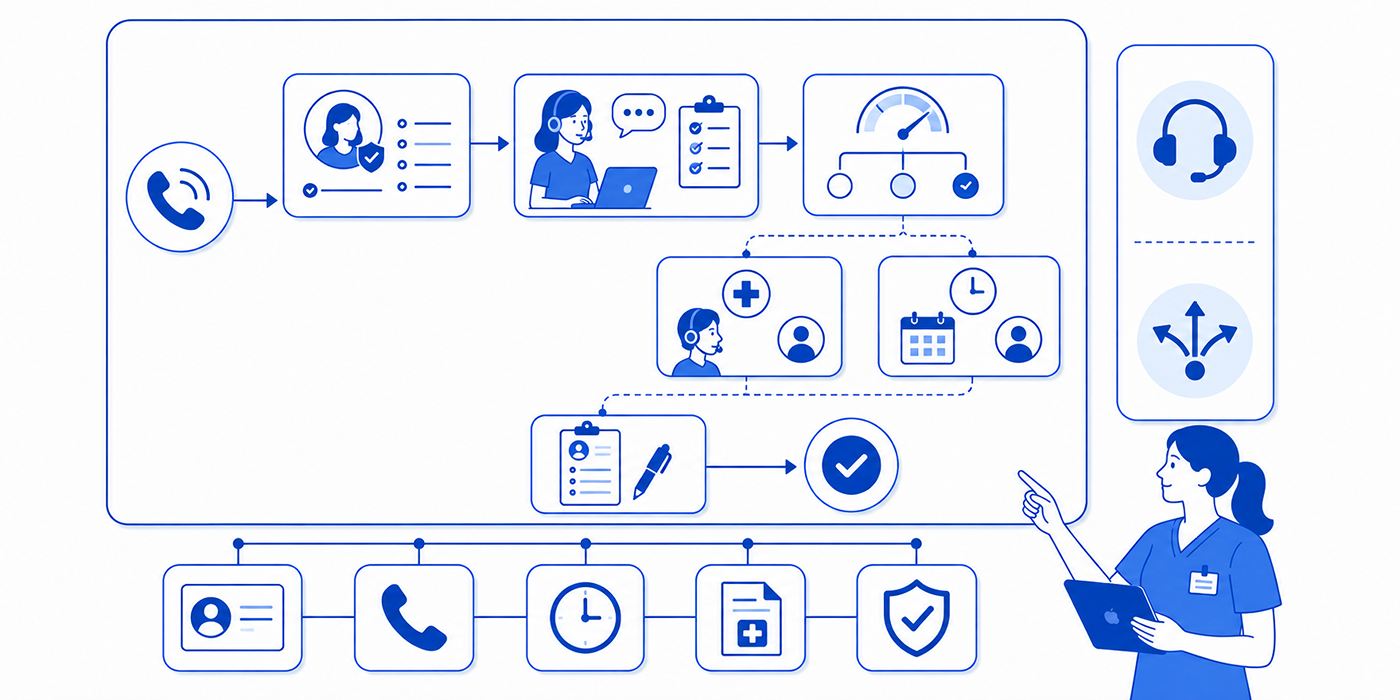
Phone triage communication is the structured process of receiving a healthcare-related call, identifying the caller and purpose, gathering the information required for safe routing, documenting it accurately, communicating appropriate next steps, and closing the loop. The difficulty is that telephone communication removes many visual cues available at the front desk. Staff must compensate with deliberate active listening, precise medical terminology, reliable medical administrative workflow, and disciplined EMR charting practices.
A crucial distinction is administrative call handling versus clinical triage. Administrative personnel may collect information, apply approved routing rules, document messages, schedule appointments, and trigger predefined escalation pathways. Clinical assessment, diagnosis, treatment advice, and symptom-based disposition require the appropriate clinical professional and the organization’s approved protocols. The administrative employee’s job is therefore to recognize when a call has crossed the boundary of ordinary appointment scheduling, patient intake, or portal support and needs the practice’s emergency appointment management or clinical escalation pathway.
That distinction protects patients and staff. When a caller describes a potentially urgent change, an administrative professional should follow the organization’s approved escalation procedure rather than independently deciding how serious the condition is. The Joint Commission’s current patient-safety framework emphasizes correct patient identification, timely communication of critical results, effective handoffs, and processes for responding to changes in patient condition. These principles make structured risk management, clear legal responsibilities, accurate medical records management, and consistent office policies and procedures essential parts of telephone work.
The most dangerous calls are often messy rather than dramatic. A patient may start with, “I just need an appointment,” then mention a worsening concern halfway through the conversation. A caregiver may give an excellent history but lack permission to receive protected information. A caller may say, “The nurse knows what this is about,” leaving no usable message. A patient may disconnect before confirming a callback number. Preventing those failures depends on clarification techniques, careful patient confidentiality, dependable healthcare CRM workflows, and standardized front-desk operations.
| # | Term | Working Definition | What It Sounds Like | Failure It Prevents |
|---|---|---|---|---|
| 1 | Caller identification | Establishing who is speaking and their relationship to the patient before sensitive information is discussed. | “May I have your full name and relationship to the patient?” | Information being disclosed to the wrong person. |
| 2 | Patient verification | Using the organization’s approved identifiers to locate and confirm the correct patient record. | “Please confirm the information we use to verify your record.” | Documenting or acting in the wrong chart. |
| 3 | Chief call reason | The primary reason the patient or caregiver contacted the practice. | “What is the main thing you need help with today?” | A long call ending without a clearly defined request. |
| 4 | Administrative triage | Sorting calls by purpose, workflow, routing requirement, and approved escalation rules. | Appointment request, refill message, billing concern, records request, clinical callback. | Every call being treated as the same type of task. |
| 5 | Clinical escalation | Transferring or routing a call to an appropriately qualified clinical professional according to protocol. | “I need to route what you have told me to the clinical team now.” | Administrative staff exceeding their clinical scope. |
| 6 | Red-flag trigger | A protocol-defined statement, symptom, circumstance, or change that activates an escalation pathway. | Staff follows the practice’s approved response rather than making an independent judgment. | Potentially serious concerns remaining in a routine message queue. |
| 7 | Open-ended question | A question that allows the caller to explain what has happened before staff narrow the details. | “Tell me what has changed since you last spoke with us.” | Premature assumptions. |
| 8 | Closed-ended question | A focused question used to confirm a specific fact. | “Did this begin today?” | Important details remaining ambiguous. |
| 9 | Clarification | Resolving wording that could be interpreted in more than one way. | “When you say it became worse, what changed?” | Vague messages being passed downstream. |
| 10 | Paraphrasing | Restating the caller’s explanation concisely to verify meaning. | “So the pharmacy has the prescription, but the insurer has not approved it yet?” | Staff solving a different problem from the one reported. |
| 11 | Check-back | Repeating important exchanged information so both parties can confirm accuracy. | “Let me read that callback number back to you.” | Transcription and communication errors. |
| 12 | Closed-loop communication | Ensuring information is sent, received, acknowledged, and acted upon. | Message sent → recipient acknowledges → action occurs → caller receives update. | Messages disappearing between departments. |
| 13 | Callback verification | Confirming the number and communication channel where the patient can actually be reached. | “Is 555-0168 the best number for the nurse to use today?” | Urgent callbacks going unanswered because an outdated number was used. |
| 14 | Callback window | The realistic timeframe given for the next contact when policy allows one to be stated. | “The team reviews these messages this afternoon.” | Patients repeatedly calling because they do not know when to expect action. |
| 15 | Routing priority | The workflow priority assigned according to approved organizational rules. | Routine, same-day review, immediate clinical escalation, administrative follow-up. | Priority depending on whichever employee happens to answer. |
| 16 | Message ownership | Identifying who is responsible for the next action after the call ends. | “I am sending this directly to the referral team for review.” | Everyone assuming someone else owns the task. |
| 17 | Warm transfer | Connecting the caller while providing enough context to prevent unnecessary repetition. | “I have Maria from Dr. Lee’s office on the line regarding the referral sent yesterday.” | The patient restarting the entire story after each transfer. |
| 18 | Handoff | Structured transfer of responsibility and relevant information to another team member. | Situation, context, unresolved issue, required action, callback details. | Critical context disappearing during transfer. |
| 19 | SBAR | A structured team communication format: Situation, Background, Assessment, and Recommendation/Request. | “Situation: patient called about… Background:… Request: please review…” | Long, disorganized internal messages. |
| 20 | Neutral documentation | Recording observable facts and patient-reported information without judgmental language. | “Patient reports three unanswered calls” rather than “patient is difficult.” | Biased or indefensible documentation. |
| 21 | Verbatim detail | Preserving the caller’s exact words when wording itself may matter to the receiving professional. | Patient states, “…” | A concerning statement being softened through paraphrase. |
| 22 | Teach-back | Asking the caller to explain an instruction or next step in their own words to confirm understanding. | “Just so I know I explained it clearly, what will you do next?” | The patient agreeing without understanding. |
| 23 | Plain language | Replacing technical or administrative jargon with wording the caller can understand and act upon. | “The insurer needs additional information before deciding coverage.” | The caller misunderstanding what is pending. |
| 24 | Scope boundary | Clearly stating when a question requires a clinician, biller, coder, manager, or another authorized professional. | “A clinician needs to answer that medical question, so I will route it appropriately.” | Staff improvising outside their role. |
| 25 | Minimum necessary | Limiting protected information used or disclosed to what is appropriate for the particular purpose when the standard applies. | Discussing only the information required to complete the call. | Unnecessary disclosure of protected information. |
| 26 | Interpreter escalation | Arranging appropriate language assistance when a language barrier affects accurate communication. | “I can arrange language support so we communicate this accurately.” | A family member informally translating important information inaccurately. |
| 27 | De-escalation | Reducing emotional intensity through calm pacing, acknowledgment, boundaries, and clear options. | “I can hear the delay has been frustrating. Let me identify what is still pending.” | Argument replacing problem-solving. |
| 28 | Service recovery | Responding to a communication failure with acknowledgment, correction, ownership, and a new commitment. | “The promised callback did not occur. I am reopening the request now.” | A correctable mistake becoming a formal complaint. |
| 29 | Contingency instruction | An approved instruction describing what the caller should do if the situation changes before follow-up occurs. | Given only according to the practice’s clinical protocols and authorized guidance. | The patient being left without a plan while waiting. |
| 30 | Call closure | Summarizing the request, action, owner, expected response, and confirmed contact details before disconnecting. | “I have documented the request, sent it to the nurse, and confirmed your mobile number.” | Both parties leaving the call with different expectations. |
2. The Phone Triage Dictionary in Practice: From First Ring to Closed Loop
A reliable call starts with identity, purpose, and reachability. Staff should establish the caller’s relationship to the patient, follow the organization’s approved patient-verification process, determine the main reason for the call, and confirm a usable callback number early enough that a disconnected call does not erase the opportunity to respond. HIPAA protects individually identifiable health information, while the Privacy Rule’s minimum-necessary principle limits certain uses and disclosures to information needed for the purpose. HHS also explains that HIPAA does not prescribe one universal identity-verification method for telephone communication, making organizational policy important. Staff should therefore connect HIPAA terminology, patient confidentiality, records-release procedures, and legal responsibilities to the actual phone workflow.
Next comes information capture. An effective sequence moves from broad to narrow: “What can we help with today?” followed by clarification such as “When did that change?” or “Which medication are you calling about?” The goal is to create a message another professional can act on without calling the patient back merely to discover what the first call was about. That discipline overlaps with medical terminology mastery, clinical documentation improvement, medical chart audits, and medical records management.
The third phase is routing. A message should identify what happened, what the caller needs, who must act, and how the caller can be reached. AHRQ’s TeamSTEPPS framework uses structured methods such as SBAR for team communication, while check-backs create a closed loop by verifying exchanged information. Those concepts fit naturally beside medical administrative workflow, collaboration tools, EMR integration, and EMR productivity shortcuts.
The final phase is expectation control. “Someone will call you” creates an open loop. Better communication states what has been done, which team owns the next action, what timeframe the practice can responsibly give, and what approved instruction applies if the situation changes. It also prevents patients from repeatedly calling because they cannot tell whether their message exists. This is where patient communication apps, healthcare portals, healthcare CRM systems, and time-management systems become trust tools rather than merely software.
3. A Seven-Step Phone Triage Communication Framework
Step 1: Open and orient
State the practice, identify yourself, and invite the purpose of the call. A rushed “date of birth?” before acknowledging the caller can make an anxious person feel processed rather than assisted. A brief professional opening supports rapport-building, effective patient communication, bedside manner for admin staff, and front-desk operations.
Useful opening: “Thank you for calling. This is Maya. How can I help you today?”
Step 2: Verify the correct record and callback path
Use the practice’s approved verification process, identify who is calling, and confirm how the patient can be reached. Avoid relying solely on caller ID because a patient may be calling from work, a caregiver’s device, or another temporary number. Protect the conversation using HIPAA communication principles, patient privacy terminology, patient record update procedures, and medical compliance practices.
Step 3: Define the call reason before chasing details
Ask for the core need: clinical callback, appointment, refill request, referral issue, test-result question, insurance issue, records request, billing question, or another administrative matter. This prevents a five-minute history from being collected for a call that ultimately belongs in insurance verification, prior authorization, claims processing, or appointment scheduling.
Step 4: Listen for escalation triggers
Administrative staff should know the organization’s approved triggers that move a call out of ordinary workflow. The trigger may involve the type of concern, a reported change, the age or status of the patient, a medication question, a post-procedure problem, or another practice-defined circumstance. The employee should activate the proper pathway rather than creating an improvised clinical judgment. This principle should be reinforced through medical office triage training, emergency appointment management, risk-management strategies, and legal CMAA responsibilities.
Step 5: Build an actionable message
A useful message answers six questions: Who is calling? Which patient? What happened? What changed? What does the caller need? How and when can they be reached? Include factual context and exact patient wording when wording may matter. Avoid interpretive labels such as “dramatic,” “noncompliant,” or “just anxious.” Strong messages borrow the precision used in medical chart audits, clinical documentation improvement, EMR terminology, and medical documentation terminology.
Step 6: Read back critical administrative details
Names, medication names reported by the patient, pharmacy information, dates, locations, telephone numbers, and appointment times are vulnerable to simple auditory error. AHRQ defines check-back as a closed-loop strategy used to verify information that has been exchanged. Apply it through active listening, medical terminology practice, patient intake procedures, and scheduling terminology.
Step 7: Close with ownership and understanding
State what you are doing, where the message is going, what the patient should expect, and any authorized next-step instruction. When understanding matters, teach-back can reveal whether the explanation worked. AHRQ describes teach-back as asking patients or caregivers to explain needed information or actions in their own words. This fits naturally with patient education, telehealth administration, virtual patient management, and patient portal management.
4. Phone Triage Role-Play Examples for High-Friction Calls
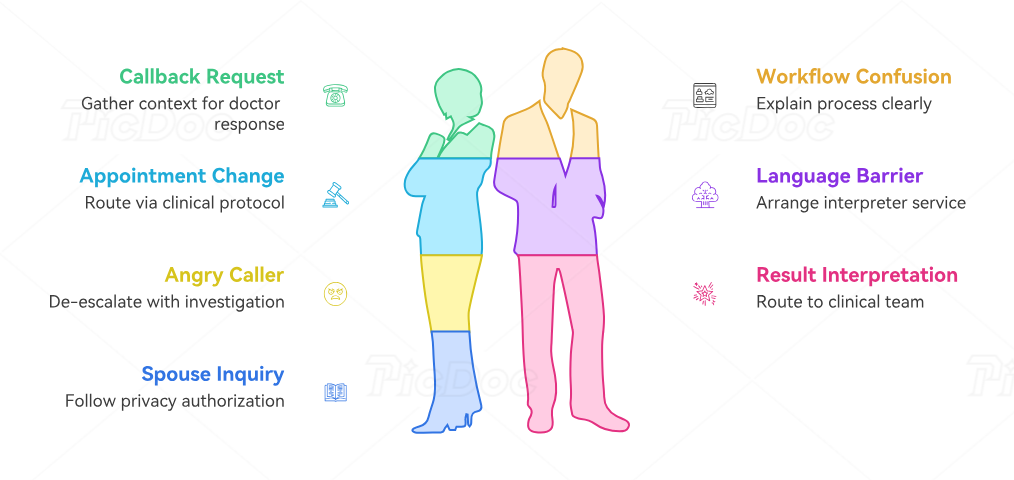
Role-Play 1: “I just need the doctor to call me”
Caller: “Tell the doctor to call me. She knows what this is about.”
A weak response accepts the message as-is. The provider then receives a task containing no context, cannot determine priority, and may have to send the message back to staff. The stronger response combines active listening, medical triage terminology, EMR documentation, and workflow management.
Better response: “I can send the message. To make sure the doctor receives enough information to respond appropriately, please tell me briefly what you need to discuss and whether anything has changed since your last conversation.”
That single sentence turns a useless callback request into an actionable handoff.
Role-Play 2: The appointment call changes halfway through
Caller: “I need to move my appointment. I thought I could wait, but something has changed.”
The employee should recognize that the call may have moved beyond ordinary scheduling conflict management. Rather than continuing to search the calendar automatically, the staff member should follow the practice’s medical office triage, emergency appointment, and risk-management procedures.
Better response: “Thank you for telling me that something has changed. I need to follow our clinical communication process before I continue with routine rescheduling. I’m going to document what you’ve told me and route the call according to our protocol.”
The key skill is recognizing a workflow transition before the employee inadvertently buries a clinical concern inside an appointment task.
Role-Play 3: An angry caller says nobody called back
Caller: “This is the third time I’ve called. Nobody there cares.”
Defending the office usually deepens the conflict. Use de-escalation techniques, empathy in healthcare administration, patient complaint handling, and crisis communication.
Better response: “You expected a callback and have already contacted us multiple times. I’m reviewing the earlier messages before I ask you to repeat anything. Then I’ll tell you exactly where the request stands and what I can do next.”
This response accomplishes something generic apologies often fail to do: it converts frustration into a concrete investigation.
Role-Play 4: A spouse wants information
Caller: “I’m his wife. Just tell me whether the test was normal.”
Staff should follow organizational authorization and disclosure procedures before discussing protected information. HHS guidance explains that disclosures involving family and friends depend on the circumstances and applicable Privacy Rule provisions, while HIPAA privacy protections continue to apply to protected health information. This requires competence in patient confidentiality, HIPAA terminology, privacy communication, and medical records management.
Better response: “I understand why you’re calling. Before I discuss information from the record, I need to follow our authorization and verification process. Let me check what I’m permitted to discuss and what the next step should be.”
Role-Play 5: The caller cannot understand the workflow
Caller: “What do you mean it’s pending authorization? Who am I supposed to call?”
The staff member should translate the process rather than repeat jargon. Use the same discipline applied in prior authorization workflows, insurance verification, revenue cycle terminology, and patient education.
Better response: “Your insurer has not made a final coverage decision yet because additional information is being reviewed. Our authorization team is handling that step. You do not need to restart the request today. I’ll tell you what is still pending and when the team expects to check the status again.”
The patient leaves knowing the status, owner, and next action.
Role-Play 6: A language barrier is affecting accuracy
When the caller and staff member cannot reliably understand important information, continuing through guesses creates avoidable risk. Follow the organization’s process for medical interpreter services, cultural competence, patient communication, and telehealth communication.
Better response: “I want to make sure we understand you accurately. I’m going to follow our process for language assistance so the information is communicated clearly.”
Role-Play 7: The patient wants medical interpretation from an administrator
Caller: “My result says abnormal. Does that mean I have something serious?”
A medical administrative professional should avoid interpreting the clinical meaning of a result. The correct move is scope recognition and reliable routing through patient portal management, legal CMAA responsibilities, risk-management procedures, and clinical documentation workflows
Better response: “I can see why you want that clarified. A clinical professional needs to explain what the result means for you. I can make sure your question reaches the appropriate team with the details needed for follow-up.”
5. How to Audit and Improve Phone Triage Quality
Phone communication should be measured through message quality, not merely call speed. A one-minute call that generates three callbacks is inefficient. A three-minute call that produces a complete, correctly routed message may save significantly more downstream work. Quality review should therefore examine whether the employee verified the patient, identified the call reason, captured the required details, confirmed the callback channel, used appropriate escalation, documented neutrally, routed correctly, and established follow-up expectations. These metrics fit alongside medical admin time tracking, office productivity systems, collaboration platforms, and practice management systems.
A practical 10-point call audit can award one point for each of these behaviors: correct patient verification, caller relationship identified when relevant, callback number confirmed, call reason clearly stated, relevant timeline captured, request explicitly documented, escalation pathway followed correctly, neutral language used, destination/owner identified, and closure expectations communicated. Scores reveal exactly where coaching is needed. Employees struggling with message completeness need documentation training; employees struggling with angry callers need de-escalation practice; employees repeatedly misrouting calls need workflow terminology and scheduling training.
Supervisors should also audit open loops. Search for messages older than the organization’s expected turnaround that lack acknowledgment, tasks passed between multiple inboxes, repeat calls about the same unresolved issue, callbacks to disconnected numbers, and messages that reach clinicians without a clear question. AHRQ’s closed-loop communication and check-back concepts are designed around verifying that information has been exchanged and understood. Practices can operationalize those ideas with EMR integration tools, healthcare CRM workflows, collaboration tools, and effective office procedures.
Training should reproduce difficult conditions. Give the employee a vague caller, a caregiver asking for information, a scheduling request that changes into a clinical concern, a disconnected callback number, and a patient frustrated by repeated transfers. Score exact behaviors rather than personality. “Failed to confirm the callback number” is coachable. “Needs better phone presence” is vague. This produces stronger development alongside CMAA exam preparation, medical terminology study, medical admin professional organizations, and future-ready CMAA skills.
6. Frequently Asked Questions About Phone Triage Communication
-
A useful message usually needs the verified patient, caller identity or relationship when relevant, callback information, reason for calling, relevant timeline, patient-reported details needed by the receiving professional, requested action, routing destination, and any protocol-driven escalation status. The exact fields should follow organizational policy. Build the message using patient intake procedures, medical documentation terminology, EMR terminology, and medical administrative workflow.
-
Administrative staff should operate within their defined role and the practice’s approved escalation protocols. When a caller’s description meets a predefined trigger or raises an issue that requires clinical assessment, the employee should activate the designated clinical pathway rather than improvise medical advice. This boundary belongs in medical office triage training, legal CMAA guidance, risk management, and emergency appointment procedures.
-
A transfer moves a call. A handoff transfers relevant information and responsibility with it. A patient who hears “I’ll send you to billing” may have to restart everything. A stronger handoff gives the next employee the reason for the call, relevant context, and unresolved need. AHRQ includes structured handoff and communication tools in TeamSTEPPS. Staff can strengthen this through team collaboration tools, healthcare CRM workflows, front-desk operations, and EMR integration.
-
Explain why a minimum amount of information is necessary for appropriate routing without pressuring the caller to disclose more than needed. A useful phrase is: “You may share only what you are comfortable sharing with me, but I need enough information to send your request to the correct team.” Staff should then follow patient privacy communication, HIPAA terminology, active listening, and difficult conversation guidance.
-
Replace “someone will call you soon” with the most specific expectation the practice can responsibly provide. State the team receiving the message, how the patient will be contacted, and the approved timeframe or process. Avoid inventing a deadline controlled by another employee. This approach supports patient communication, healthcare portal management, patient communication apps, and time-management workflows.
-
Use verbatim wording selectively when the precise statement may matter to the receiving professional, while documenting the rest concisely and neutrally. Avoid changing a patient-reported statement into a diagnosis or inserting an interpretation the caller never made. Develop this distinction through clinical documentation improvement, medical chart audits, medical coding error awareness, and medical records management
