

Patient Communication Apps Every CMAA Should Use (Interactive Directory)
Patient communication is no longer a side function in medical administration. It is the bloodstream of the front office. When messages sit unanswered, reminders fail, intake links break, or patients cannot confirm appointments without calling back, the damage spreads fast: schedules loosen, trust drops, staff burn out, and avoidable revenue leaks through no-shows and rescheduling chaos. The best CMAAs understand that communication software is not just about sending texts. It is about controlling access, expectations, follow-up, and patient experience with precision.
That is why this directory matters. The strongest patient communication apps do more than message patients. They connect reminders, self-scheduling, secure messaging, digital intake, telehealth, payments, and portal-style access into a workflow the front office can actually survive. This guide reviews 20 tools and connected apps CMAAs should know, while tying each one back to the operational skills behind effective patient communication, patient intake procedures, healthcare portal workflows, and telehealth platform decisions. Current product details below are based on official vendor pages and help content reviewed in March 2026.
1. Why patient communication apps now sit at the center of CMAA workflow
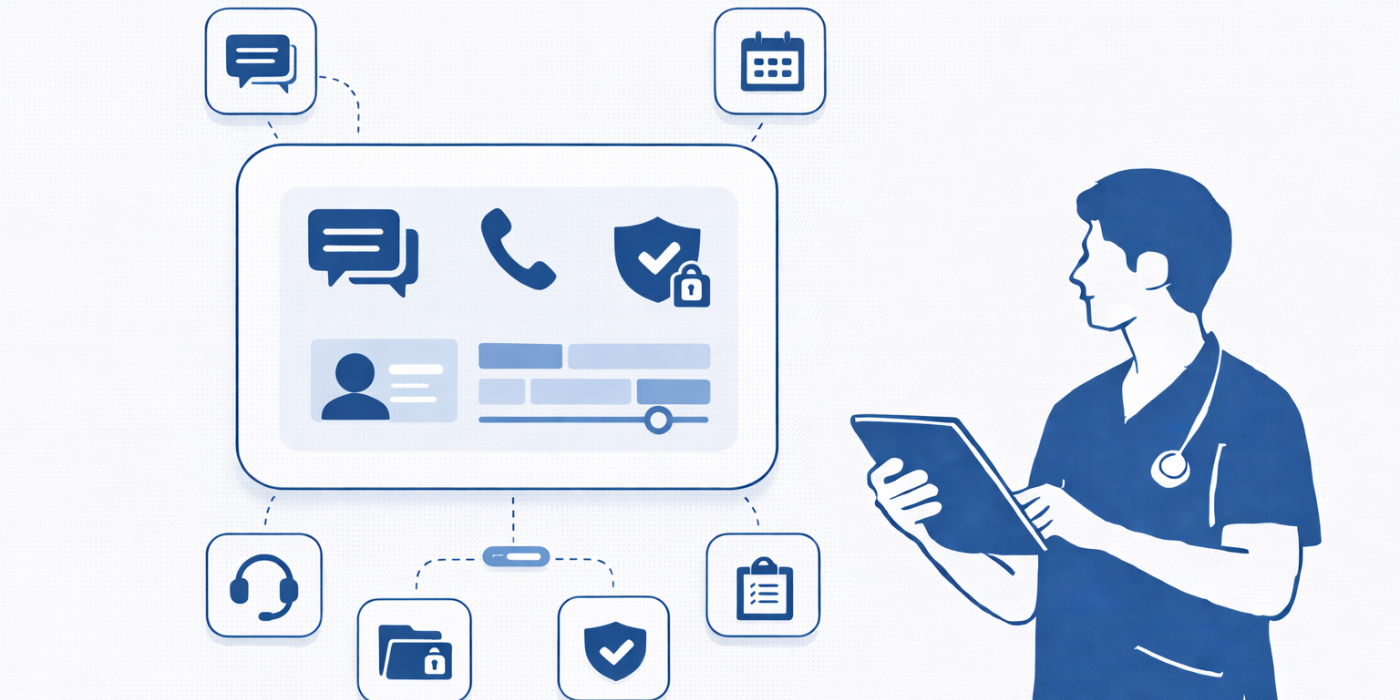
A CMAA who still thinks patient communication starts and ends with outbound appointment reminders is already behind the workflow reality of modern practices. Today’s tools are expected to centralize two-way texting, secure messages, intake prompts, scheduling changes, telehealth instructions, follow-up nudges, payment requests, and portal-driven self-service. Spruce presents itself as an all-in-one healthcare communication platform with secure messaging, phone, video, e-fax, team messaging, questionnaires, and workflow automation. Tebra emphasizes online scheduling, reminders, digital intake, and HIPAA-compliant two-way messaging inside a broader patient-experience stack. Greenway Patient Connect similarly focuses on omni-channel messaging, automated reminders, online booking, rebooking, and waitlist features. That tells you exactly where the market has moved: communication is now an operating system, not a simple notification tool.
That shift matters because every communication failure produces administrative waste somewhere else. A patient misses a reminder, the front desk absorbs a reschedule. A portal message goes unread, a phone queue gets heavier. A pre-visit questionnaire is never triggered, staff repeat intake at check-in. A telehealth link is confusing, the visit starts late and someone blames “technology” when the real problem was workflow design. That is why CMAAs who want to stay valuable should connect app selection to insurance verification, healthcare CRM terms, medical office technology trends, and future healthcare compliance changes instead of treating communication as an isolated feature.
The real professionals in this space are not the ones who can name a few patient texting vendors. They are the ones who understand which apps reduce call volume, which ones support portal-free engagement, which ones improve appointment recovery, which ones help multi-location teams stay coordinated, and which ones create hidden friction despite glossy demos. Klara, for example, highlights text, web chat, phone, self-scheduling, forms, and message conversations without requiring portal logins. OhMD leans hard into AI voice, texting, forms, reminders, and a unified inbox from the practice’s existing phone number. That distinction is not cosmetic. It changes whether patients actually respond and whether staff spend their day chasing them.
| App / Platform | Best Communication Strength | Best For | Why a CMAA Should Care |
|---|---|---|---|
| Spruce | Secure omnichannel messaging | Practices wanting text, phone, video, fax in one app | Reduces channel sprawl and phone chaos |
| Klara | Text-first conversational engagement | Offices wanting messaging without portal friction | Makes outreach and intake easier to complete |
| OhMD | AI voice + texting | Teams buried in inbound calls | Cuts phone tag and centralizes response flow |
| Luma Health | Automated patient communication | Larger systems needing reminders, broadcasts, chatbots | Strong for operational scale |
| NexHealth | Messaging tied to scheduling and intake | Practices wanting synced front-office workflows | Fewer reconciliation headaches |
| Tebra | Portal + messaging + reminders | Independent practices | Puts communication close to patient records |
| SimplePractice | Secure messaging + reminders | Small healthcare and behavioral clinics | Clean, low-friction communication basics |
| Weave | Reminders, texting, email, calls | Offices needing broad patient outreach | Useful when communication volume is high |
| Solutionreach | Reminders + outreach + scheduling touchpoints | Practices reducing no-shows and callbacks | Supports access and retention |
| Phreesia | Communication inside patient access workflows | Organizations managing access at scale | Useful for schedule recovery and intake prep |
| healow / eClinicalWorks | Portal, reminders, app, telehealth | Practices already in the eCW ecosystem | Strong patient self-service potential |
| athenaPatient / athenahealth | Mobile patient messaging and access | Athena-based organizations | Keeps communication tied to app-based access |
| Greenway Patient Connect | Omni-channel reminders and scheduling updates | Practices wanting automated patient touchpoints | Useful for no-show prevention and self-service |
| Updox | Patient engagement, reminders, telehealth | Practices wanting broad communication coverage | Good communication breadth |
| Mend | Automated reminders, forms, care instructions | Telehealth-heavy workflows | Useful for pre-visit and virtual communication |
| Rhinogram | Landline texting | Practices wanting SMS without extra app friction | Patients do not need a new portal habit |
| PatientPop / Tebra marketing stack | Reminders + two-way text + online scheduling | Practices blending communication and growth | Useful for patient acquisition and retention |
| DrChrono widget + messaging workflows | Scheduling-linked patient contact | Mobile-forward practices | Helpful when appointment flow drives communication |
| Practice Better | Booking, reminders, portal-style follow-up | Smaller care models and follow-up heavy practices | Good for lighter administrative teams |
| Carepatron | Scheduling and patient management communication | Teams seeking simple all-in-one workflows | Can simplify day-to-day follow-up |
| Portal-only legacy systems | Secure message access | Highly compliant but lower-response settings | Important baseline, but often less responsive than text-led tools |
| Voice reminder systems | Automated call reminders | Older patient populations | Still relevant when text alone is not enough |
| Bulk broadcast tools | Mass outreach and urgent updates | Closures, vaccine drives, disruptions | Critical during rapid schedule changes |
| Digital intake communication apps | Pre-visit forms and confirmation prompts | High-volume check-in environments | Reduces repeated front-desk collection work |
| Telehealth messaging apps | Visit links, instructions, follow-up | Remote or hybrid care | Keeps virtual care from turning chaotic |
2. The 20 patient communication apps every CMAA should know in 2026–27
The strongest communication apps are not identical, and that is exactly why CMAAs should study them comparatively. Spruce is one of the most complete communication environments in the space, combining secure messaging, files, audio notes, phone, voicemail transcription, video, e-fax, team messaging, internal notes, digital payments, questionnaires, and workflow automation in one healthcare-specific platform. For a CMAA, that matters because fewer disconnected channels mean fewer handoff errors, fewer missed messages, and less time bouncing between systems while trying to manage patient intake procedures, effective patient communication, de-escalation techniques, and healthcare portal workflows.
Klara and OhMD deserve to be studied together because both lean into conversational, lower-friction communication. Klara emphasizes text, web chat, phone, self-scheduling, and forms without making patients fight through portal credentials, and it reports an 84% utilization rate compared with 57% for patient portals on its site. OhMD focuses on AI voice, texting, appointment booking, reminders, forms, file sharing, and a unified inbox tied to the practice’s existing number, with no app required for patients. For front offices trying to reduce hold times and repetitive calls, these are not minor workflow differences. They directly influence whether patients actually respond to appointment reminders, complete follow-up steps, and stay reachable during high-volume days.
Luma Health, NexHealth, Tebra, and Solutionreach are especially important for CMAAs who need communication tied tightly to access and operations. Luma highlights automated reminders, broadcasts, chatbots, conversational agents, intake, forms, payments, and EHR integration. NexHealth centers messaging, scheduling, intake, payments, and insurance verification in a platform that syncs to the patient record. Tebra stresses online scheduling, reminders, digital intake, HIPAA-compliant two-way messaging, and integrated patient communication workflows. Solutionreach focuses on real-time openings, online scheduling, reminders, and pre-visit insurance collection. These are the tools that matter when a practice’s problem is not “we need to send messages” but “we need communication to reduce work across the entire patient journey.” That is exactly the operational mindset behind healthcare CRM terms, how CMAAs will lead the patient experience revolution by 2030, predictive insights on telemedicine and virtual healthcare, and interactive guides to medical office technologies CMAAs must master.
SimplePractice, Weave, Phreesia, and Updox each matter for a different reason. SimplePractice offers secure messaging and configurable appointment reminders inside a HIPAA-compliant practice environment. Weave emphasizes reminders, patient text and email outreach, bulk messaging, and payment reminders. Phreesia extends communication into appointment acceleration and access workflows. Updox focuses on patient engagement, communication, telehealth, reminders, and broadcasts. A CMAA who understands these differences can stop thinking in generic software labels and start matching tools to specific operational pain: reminders, two-way texting, intake prep, self-service, payment nudges, or follow-up engagement. That is where future-proof CMAA specializations, top emerging career specializations, medical administrative assistants and technology, and why automation is the biggest opportunity for CMAA growth become practical, not theoretical.
healow, athenaPatient, and Greenway Patient Connect represent the ecosystem-driven side of patient communication. healow and the eClinicalWorks patient portal support secure messages, reminders, appointment requests, telehealth, payments, records access, questionnaires, check-in, and refill requests across app and portal touchpoints. athenahealth promotes a mobile patient app for appointments, messaging, bills, and health information. Greenway Patient Connect centers omni-channel messaging, automated reminders, self-scheduling, rebooking, waitlists, and simplified appointment management. These systems matter because many CMAAs work inside larger EHR-connected environments where the best communication app is not always a stand-alone texting tool. Sometimes the right answer is the system that keeps communication closest to records, scheduling, and longitudinal patient access. That is why knowledge of telehealth platforms, healthcare portal terms, future EMR systems, and data privacy expectations matters so much.
Mend and Rhinogram are particularly useful to CMAAs who need to think beyond traditional patient portal behavior. Mend emphasizes automated appointment reminders, digital forms, care instructions in multiple languages, digital check-in, and telehealth-oriented communication. Rhinogram focuses on making a practice landline textable so patients do not need to download an app or remember additional credentials, while its recent materials stress HIPAA-compliant SMS workflows, reminder use, schedule-change communication, and reduced phone dependence. That is a major workflow insight: sometimes the best communication app is not the one with the most features. It is the one patients will actually use without resistance. That directly affects effective patient communication, empathy in healthcare administration, telehealth regulation changes, and how certified CMAAs are transforming telemedicine.
3. How CMAAs should choose the right app for the right communication problem
The worst software decisions happen when practices ask for “the best patient communication app” instead of identifying the exact communication failure hurting them most. If the office problem is endless inbound calls and voicemail loops, then AI-assisted, text-led platforms like OhMD or landline-text systems like Rhinogram may solve more pain than a portal-heavy solution. If the main issue is reminders, rescheduling, and access recovery, tools like Solutionreach, Greenway Patient Connect, Phreesia, Weave, and Luma deserve more attention. If the problem is broad workflow fragmentation, then platforms that tie messaging to intake, records, and scheduling—such as Tebra, NexHealth, healow, and athenahealth—become much more strategic. CMAAs who think this way are doing more than shopping for software. They are managing operations through the lens of medical office technology, future healthcare roles, automation opportunities, and AI-driven transformation of administrative roles.
Another key mistake is overvaluing compliance language while undervaluing response behavior. Secure portals matter. Protected messaging matters. Auditability matters. But a communication method that is technically compliant and practically ignored creates its own operational damage. Klara’s own marketing leans on higher utilization than portals. OhMD explicitly emphasizes that patients can text the practice the way they text everyone else, without app friction. Rhinogram emphasizes no patient app or portal at all. That should force every CMAA to ask a harder question: are we choosing software that feels safe to administrators, or software that patients will actually answer? The best answer is usually a system that balances data privacy expectations, predicting HIPAA updates, future healthcare compliance changes, and major regulatory shifts coming by 2030 without pushing patients into a dead channel.
4. Hidden workflow traps that make communication apps fail in real medical offices
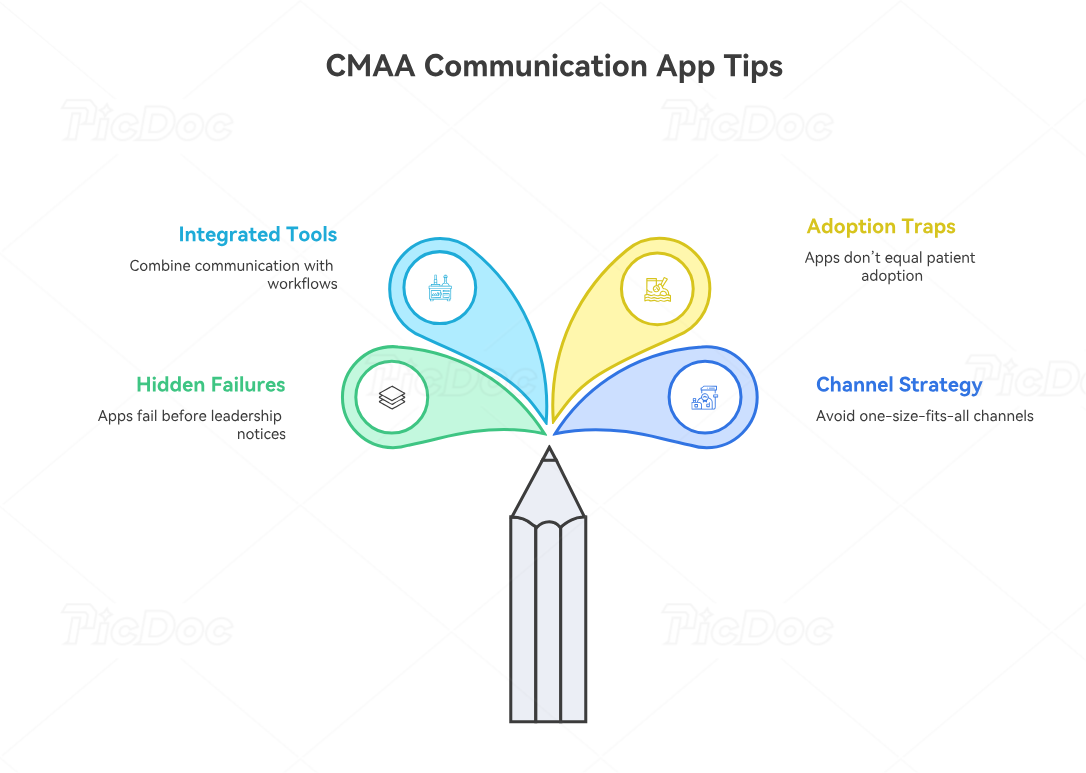
A communication app usually fails long before leadership notices. It fails when reminders go out but rescheduling is clumsy. It fails when the platform can send intake forms but cannot tie them cleanly to appointment status. It fails when portal messages exist but patients never check them. It fails when staff still have to log into three different places to manage one patient conversation. It fails when telehealth instructions are sent, but pre-visit forms and check-in steps are not. That is why product pages that combine communication with intake, scheduling, and follow-up should be studied carefully. Luma, Tebra, healow, Mend, and NexHealth all position communication as part of a larger patient journey, not as a disconnected feature. That is the signal CMAAs should pay attention to.
Another trap is assuming the patient app is the same thing as patient adoption. A vendor can offer a mobile app, portal, secure messages, appointment access, and billing tools, yet patients may still default to phone calls if the workflow feels too layered. That is why text-led products continue to gain attention. Klara, OhMD, Spruce, Weave, and Rhinogram all stress faster, lighter communication channels with less portal friction, though they do it in different ways. For a CMAA, the lesson is simple: do not evaluate “features” in a vacuum. Evaluate the number of steps between patient intent and patient response. That same discipline strengthens performance in patient communication, empathy in healthcare administration, de-escalation techniques, and how CMAAs will lead the patient experience revolution.
The last trap is assuming one communication channel fits every patient population. Some practices need text first. Some still need voice reminders because of age mix or channel habits. Some need multilingual pre-visit instructions. Some need mass broadcast capability during closures or vaccine drives. Some need stronger telehealth prompts than general messaging. That is why “best app” thinking is lazy. The more professional approach is channel strategy: which apps cover text, voice, portal, broadcast, forms, scheduling, telehealth, and follow-up in the way our patient base actually uses them? CMAAs who learn to think in channels rather than brand names become far more effective in real operations.
5. The smartest ways CMAAs can use these tools to improve patient experience and office efficiency
High-performing CMAAs do not wait for communication problems to become complaints. They use these apps proactively to shape patient behavior before confusion starts. That means selecting the strongest reminder pathway, pushing digital intake early enough to reduce waiting-room friction, keeping confirmation and rescheduling paths simple, and using secure text or portal follow-up strategically instead of randomly. In practical terms, it means a platform like healow or Tebra can be valuable when the office needs a more app-and-record-driven patient experience, while a platform like Klara, OhMD, Spruce, or Rhinogram may be stronger when the office needs lighter patient effort and faster response rates. The right choice depends on the kind of friction your office is trying to remove, not on whichever product sounds most modern.
This is also where career growth shows up. A CMAA who can identify whether an office needs automated reminders, better schedule recovery, stronger portal messaging, multilingual instructions, tighter intake communication, or better phone-volume deflection is already operating above routine task level. That is the kind of thinking connected to top emerging CMAA specializations, future-proof specializations, interactive career planners for future healthcare roles, and predictive insights on virtual healthcare transformation. The software itself matters, but the deeper value lies in the operational judgment behind choosing and using it well.
6. FAQs: Patient communication apps for CMAAs
-
A portal usually centers secure access to records, messages, forms, bills, and appointment details inside a login-based environment. A patient communication app may do that too, but many modern tools also prioritize text-first or lower-friction interaction, reminders, broadcasts, voice, and self-service workflows that do not depend entirely on portal behavior. Klara, OhMD, and Rhinogram are especially useful examples of how communication can move outside traditional portal habits.
-
Text-led tools are usually stronger in that scenario. Klara, OhMD, Spruce, Weave, and Rhinogram all emphasize direct patient messaging or texting workflows that reduce portal friction and phone tag.
-
Tools with strong reminder, confirmation, and schedule-recovery features matter most here. Solutionreach, Greenway Patient Connect, Weave, Phreesia, healow, and Luma all position reminders or appointment-management workflows prominently in their official materials.
-
OhMD is especially relevant because it emphasizes AI voice and texting for reducing call volume. Rhinogram is also strong for practices that want to shift routine communication into text without forcing patients into a new app. Spruce helps when the practice wants phone, text, voicemail transcription, and team coordination in one place.
-
No. Ecosystem tools like healow, athenahealth, Tebra, and Greenway can be excellent when you need communication tied tightly to records, portal access, and scheduling. But stand-alone or text-led tools may outperform them when patient responsiveness and front-desk speed matter more than deep ecosystem centralization.
-
Test reminder delivery, patient response friction, rescheduling flow, intake-link completion, portal or app login burden, telehealth instruction delivery, team inbox clarity, and whether messages become easier to track or just more scattered. Those points reveal whether a platform is truly operational or just marketable.
-
Preferences vary by population, but multiple vendors are clearly building around that assumption. Klara positions text as a preferred communication channel, OhMD emphasizes texting from the practice’s existing number with no patient app required, and Rhinogram’s entire value proposition is based on making texting easier than traditional phone-and-portal friction.
