

Risk Management Strategies Every CMAA Should Master
Risk does not usually arrive as a dramatic event in a medical office. It shows up as a wrong chart opened during a rushed call, a missed prior authorization deadline, an unverified demographic field that triggers a denial, a referral that never gets scheduled, or a patient complaint that grows because nobody documented the first warning sign clearly. For a CMAA, risk management is daily operational discipline. The strongest professionals build habits that protect patients, providers, revenue, compliance, and trust at the same time.
Mastering risk management means learning how to spot preventable failure points before they become chart corrections, payment delays, privacy incidents, scheduling conflicts, or damaged patient relationships. The strategies below focus on the real pressure points medical administrative assistants face every day and show how to reduce error exposure while improving workflow reliability.
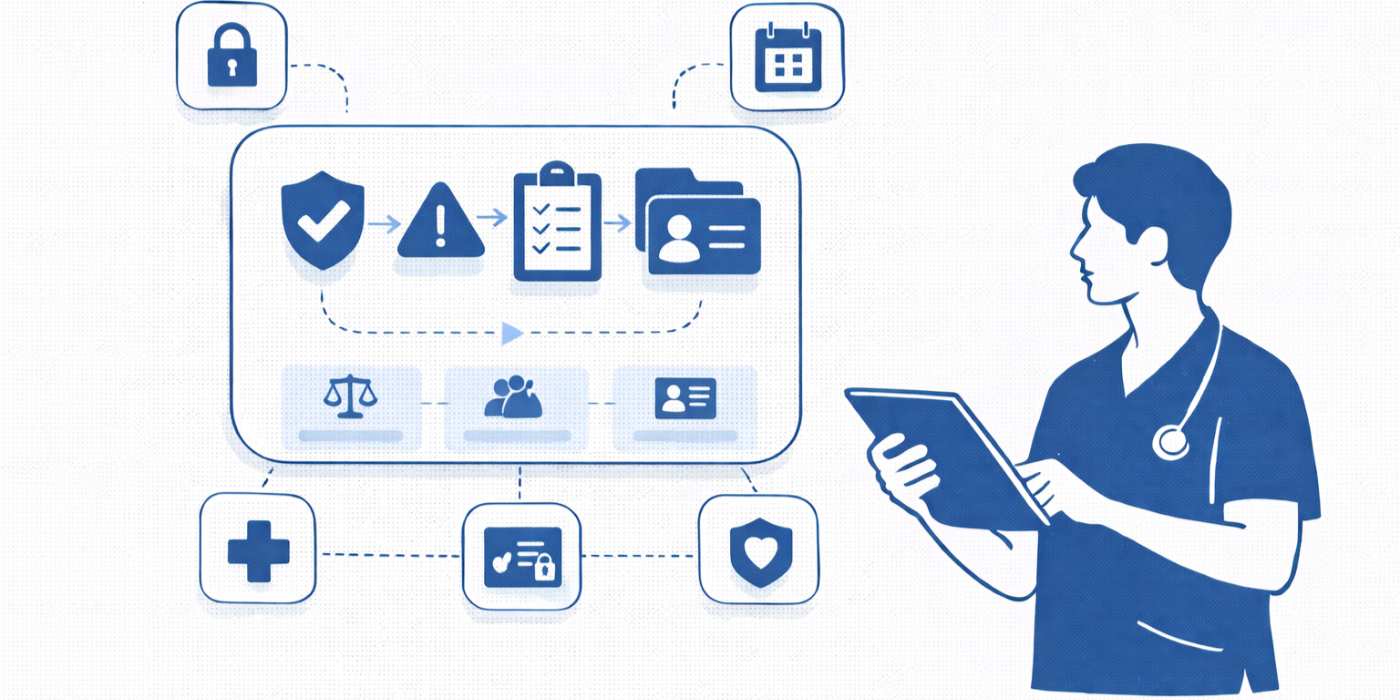
1. Build a Risk Radar Around the Highest-Failure Administrative Moments
Most CMAAs are taught tasks. Fewer are taught where those tasks fail under pressure. That gap matters because risk management starts with pattern recognition, not just rule memorization. A high-performing CMAA learns to identify the moments in the patient journey where small mistakes multiply downstream: registration, scheduling, insurance verification, intake, documentation routing, consent handling, records release, referral follow-up, and patient communication.
The first strategy is to separate routine work from high-risk work. They are not the same. Updating an address is routine. Updating a guarantor incorrectly can create billing confusion, claims delays, and privacy issues. Booking a follow-up is routine. Booking the wrong visit type can break provider flow, create authorization problems, and frustrate patients. That is why strong front-end judgment matters as much as speed. Resources like patient intake procedures, appointment scheduling best practices, front desk operations terms, and insurance verification help define where administrative errors most often begin.
A useful way to think about risk is in four categories. Clinical-adjacent risk includes errors that affect care coordination, chart accuracy, routing of messages, and follow-up timing. Compliance risk includes HIPAA, consent, documentation standards, and improper record access, which is why every CMAA should know patient privacy communication essentials, the top HIPAA and patient privacy terms, and interactive training on patient record updates and EMR compliance. Financial risk includes denials, eligibility failures, inaccurate demographic capture, and poor estimate communication, which connects directly to top medical billing terms all CMAAs should understand and CPT codes explained. Experience risk includes communication breakdowns, escalations, wait-time frustration, and lost trust, which is where active listening techniques, effective patient communication terms, and de-escalation techniques become operational, not optional.
The CMAAs who protect offices best are the ones who can answer one question all day long: “If this step goes wrong, what breaks next?” That mindset turns ordinary tasks into controlled processes.
2. Standardize the Front-End Controls That Prevent the Most Expensive Errors
Risk management becomes real when it is translated into controls. A control is any built-in step that makes the right action easier and the wrong action harder. In healthcare administration, this is the difference between hoping staff remember and designing workflows that catch predictable mistakes. CMAAs who understand this move from reactive cleanup to proactive protection.
Start with registration and scheduling. The combination of medical appointment scheduling tools, secure patient scheduling tools, directory of medical admin staff scheduling tools, and interactive guide to handling appointment scheduling conflicts shows how much risk lives in the calendar itself. A weak scheduler creates provider compression, missed prep requirements, wrong visit sequencing, no-show waste, and authorization failures. A strong scheduler uses visit-type scripts, preparation checklists, and hard-stop questions before the appointment is finalized.
The next control layer lives inside the EMR. CMAAs should know the workflow benefits of EMR integration tools, top EMR shortcuts, and resolving common EMR software issues, but speed features only help when paired with discipline. The operational rule should be simple: shortcuts may accelerate work, but they never replace verification. Auto-fill, copy-forward, favorite phrases, and templates save time, yet they also spread stale information fast when staff are rushing. Every templated field needs human review before it becomes part of the record.
Communication controls matter just as much. Many patient complaints begin as minor misunderstandings that nobody clarified early enough. That is why scripts for estimate language, arrival instructions, cancellation policies, follow-up expectations, and document requests reduce risk dramatically. Patient communication apps, healthcare portal terms, and telehealth platform guides are useful here because they reinforce channel-specific risks. A portal message, phone call, text reminder, and live front-desk conversation each need different handling standards.
The core lesson is that risk drops when routines are explicit. Checklists reduce reliance on memory. Scripts reduce inconsistency. Escalation triggers reduce guessing. Daily huddles surface pressure points early. Audit logs reveal repeat breakdowns. That is how a CMAA turns administrative reliability into a protective system.
3. Protect Privacy, Documentation Integrity, and Message Routing With Zero-Ambiguity Habits
Some risks are expensive. Others are existential. Privacy breaches, incorrect chart handling, and delayed message escalation can damage patient trust in seconds and create legal exposure far beyond the original mistake. For that reason, elite CMAAs follow habits that feel almost repetitive in the moment but prevent serious downstream harm.
First, never treat access as permission just because the system allows it. Access must match role and purpose. That principle sits underneath HIPAA and patient privacy terms, must-know HIPAA terms for scribes, and tools for efficient medical records release. Opening a chart out of curiosity, printing extra pages, sending records without destination verification, or discussing patient details in semi-public spaces are not harmless shortcuts. They are trust failures.
Second, documentation integrity is not just a clinician issue. Administrative staff influence documentation quality through intake accuracy, message capture, chart prep, and routed updates. A poorly captured patient concern can distort triage. An incomplete call message can bury urgency. An unchecked demographic change can redirect bills, test results, or refill notices. Training built around medical administrative terminology, interactive dictionaries for EMR and charting terms, and top terms medical scribes must master for accurate clinical documentation helps CMAAs understand how administrative precision affects record reliability.
Third, message routing needs timing rules, not vibes. Every office should define what is urgent, same-day, next-business-day, and routine. A patient saying “I’m getting worse” is not the same as asking for a school form. A refill request after an overdue follow-up is not the same as a demographic update. A result question after a procedure is not the same as a billing inquiry. Without routing categories and response targets, inboxes become silent risk accumulators. Strong teams support this with best collaboration tools for medical office teams, medical admin time tracking tools, and carefully defined handoff expectations.
When privacy, chart accuracy, and routing discipline are strong, the office becomes safer and calmer. When they are weak, staff spend their day chasing preventable fires.
4. Reduce Human Error by Designing Better Handoffs, Escalation Paths, and Contingency Plans
A surprisingly large percentage of office risk appears during transitions. One person assumes the next person handled it. A callback sits in a queue with no owner. A provider expects chart prep that never happened. A same-day add-on gets squeezed in without checking prep instructions, authorization status, or rooming capacity. Risk lives in the handoff because handoffs reveal whether the office runs on clarity or assumptions.
The first fix is explicit ownership. Every non-instant task should have a named owner, a due time, and a next action. “Sent to team” is weak. “Routed to referrals queue” is weak. “Assigned to Maria for authorization review by 2 p.m.” is safer because it closes ambiguity. This matters in front-office workflows, records release, referral completion, portal response, and rescheduling after provider changes. Networking strategies for medical admin professionals and medical admin professional organizations often emphasize growth, but the deeper professional lesson is that excellent administrators become trusted because they close loops reliably.
The second fix is red-flag escalation mapping. Every CMAA should know which situations require immediate provider review, nurse review, supervisor review, compliance review, or billing review. That includes threatening language, possible privacy incidents, urgent symptom statements, repeated failed contact on critical follow-up, disputed balances with documentation gaps, and process breakdowns affecting multiple patients. Offices that lack escalation maps create dangerous hesitation. Offices that define them create faster, cleaner decisions. This is especially important when using AI and automation in medical administration or emerging medical admin technologies, because automation can accelerate workflow while still requiring human judgment on edge cases.
The third fix is contingency planning. What happens when the internet drops, the provider runs an hour behind, an interpreter is unavailable, a telehealth link fails, or the printer for labels stops working during peak check-in? Risk management is stronger when teams prepare fallback processes in advance. Scheduling software mastery, emergency appointment management, and virtual medical administration all point to the same truth: resilience comes from pre-decided alternatives, not last-minute improvisation.
A CMAA who knows how to stabilize a handoff protects more than workflow. They protect patient confidence. Patients can tolerate delay more easily than confusion. They lose trust when nobody seems to know who is responsible.

5. Use Audits, Micro-Training, and Process Metrics to Catch Weakness Before It Becomes Damage
Risk management fails when offices only respond after something has gone wrong. Strong offices audit small signals early. That means examining near-misses, not just major incidents. If one wrong-chart near miss happened this week, there are probably more identity-verification shortcuts hiding in the workflow. If the same authorization error appears three times in a month, the issue is not the employee alone. The process itself is underbuilt.
A practical audit system for CMAAs should track no-show reasons, reschedule causes, registration corrections, returned mail, denied claims tied to front-end errors, unsigned consent incidents, records-release delays, complaint themes, callback turnaround, and message-routing misses. Each category tells you where risk is forming. The goal is not punishment. The goal is pattern visibility. Industry-facing resources such as the 2026 healthcare administration report, medical office automation trends, and future-proof your CMAA career become more useful when read through that lens: what systems will reduce avoidable admin risk as offices scale?
Micro-training is the next layer. Annual refreshers alone are too blunt. Teams improve faster with short, targeted practice on one recurring failure point at a time. Five minutes on records-release verification. Ten minutes on high-risk phone phrases that require escalation. A quick drill on scheduling rules for specialty visits. A live review of complaint de-escalation language. This is where step-by-step guides for managing difficult conversations, de-escalation resources, and empathy in healthcare administration have operational value. They give staff language they can actually use when tension is high.
Finally, CMAAs should learn to speak the language of measurable improvement. It is not enough to say a process feels smoother. Strong risk management can point to fewer scheduling corrections, faster callback closure, lower denial exposure from front-end errors, better documentation completeness, or fewer complaint repeats. That ability separates task performers from office problem-solvers. It also supports long-term growth, which is why content like CMAA career roadmap, top skills employers look for in a CMAA, and why CMAA certification boosts career opportunities matters beyond exam prep.
The CMAAs who rise fastest are often the ones who quietly become the office’s risk stabilizers.
6. FAQs
-
Start with verification discipline. Confirm patient identity, demographics, insurance status, visit type, and message details before moving work forward. Many costly administrative failures begin because staff assume information is current or complete. A verification-first habit prevents wrong-chart activity, scheduling mismatches, claim problems, and communication breakdowns.
-
Use the same privacy routine every time, especially when the office is rushed. Verify identifiers before opening or updating a chart. Avoid discussing patient details where others can overhear. Confirm authorization before releasing records. Use approved channels for communication. Busy environments increase shortcut behavior, so privacy protection must become automatic rather than situational.
-
The biggest ones are incorrect registration, incomplete insurance verification, wrong appointment type selection, missing authorization steps, and poor documentation of patient messages. These look small at the desk but later become denials, delays, provider frustration, repeat calls, and patient distrust. Front-end accuracy has more leverage than many new CMAAs realize.
-
Listen fully, document clearly, avoid defensive language, confirm what the patient is asking for, and route the issue according to office policy. Complaints become riskier when staff improvise promises, argue facts in the moment, or fail to create a clean record of what happened. Calm documentation and proper escalation protect both the patient experience and the office.
-
Follow the escalation pathway, not personal instinct alone. If the message suggests worsening symptoms, medication issues, abnormal results concerns, or a breakdown affecting timely care, escalate according to protocol. Uncertainty is exactly when process matters most. Guessing quietly creates more danger than asking early.
-
Technology helps when it standardizes work, improves visibility, and supports timely follow-up. It creates new risk when staff overtrust templates, ignore verification, or assume automation caught everything. Use tools to reinforce checklists, routing, scheduling logic, and communication consistency, but keep human review on anything that affects privacy, billing, clinical coordination, or patient instructions.
-
Because offices value people who prevent chaos. A CMAA who consistently protects workflow quality, privacy, scheduling accuracy, and communication reliability becomes trusted with more responsibility. Risk-aware professionals often move into lead roles, training responsibilities, office coordination, and management tracks because they make the system safer and more dependable.
