

Step-by-Step Guide: Managing Difficult Conversations with Patients
Difficult patient conversations are where healthcare administration stops being routine and starts becoming mission-critical. A calm check-in can turn tense in seconds when a patient feels ignored, confused, frightened, overcharged, delayed, or disrespected. In those moments, the difference between escalation and resolution is rarely luck. It is process, language, emotional control, documentation discipline, and situational judgment.
For professionals building stronger communication skills, this guide breaks the work down into repeatable actions. It shows how to manage emotion without sounding robotic, protect compliance without sounding cold, and move a charged interaction toward clarity, trust, and next steps. Along the way, it connects closely with patient-facing skills covered in effective patient communication terms and interactive examples, empathy in healthcare administration, de-escalation techniques, front desk operations terms, and top 20 HIPAA and patient privacy terms for medical administrative assistants.
1. Why difficult patient conversations go wrong so quickly
Most difficult conversations are not caused by a single sentence. They build from pressure points that stack fast: long waits, confusing insurance rules, unclear expectations, poor handoffs, rushed explanations, portal delays, billing surprises, scheduling failures, or a patient who already feels vulnerable before the interaction starts. Anyone working in a patient-facing role should understand that frustration often arrives before the patient reaches the desk, phone line, or portal message queue. That is why strong performance depends on more than courtesy. It depends on anticipating triggers explained in patient intake procedures, insurance verification, appointment scheduling best practices, healthcare portal terms, and healthcare CRM terms.
One of the biggest mistakes healthcare staff make is treating the patient’s emotional intensity as the main problem. The real problem is usually unmet clarity. Patients become difficult when they think nobody is listening, when no one can explain what happens next, or when they suspect their issue is being minimized. A patient who says, “This office never helps me,” may actually mean, “I have repeated this problem three times and still do not know who owns it.” A patient who sounds angry about a delay may really be panicking about missing work, arranging childcare, or worsening symptoms. That is why strong responses combine empathy, structure, and direction rather than generic reassurance. These same instincts support stronger outcomes in virtual medical administration, telehealth platforms, medical administration job demand by specialty, top 10 skills employers look for in a CMAA, and future-proofing your CMAA career.
Another reason conversations derail is that staff members jump too early into explanation mode. They begin defending policy before the patient feels heard. They cite rules before they clarify facts. They correct tone instead of addressing concern. In healthcare, that sequence is costly. Even accurate information can land badly when delivered before emotional acknowledgment. Teams that handle conflict well are often the ones trained to slow down first, define the actual issue, confirm the patient’s goal, and then walk through options. That foundation overlaps strongly with medical office automation trends, new study on certified medical administrative assistants improving healthcare efficiency, 2026 healthcare administration report, future healthcare compliance changes, and CMAA career roadmap.
| Scenario | What the Patient May Be Feeling | Primary Risk | Best First Response |
|---|---|---|---|
| Long wait time | Disrespected, trapped | Escalation at front desk | Acknowledge delay and give a realistic update |
| Unexpected copay | Blindsided, suspicious | Trust breakdown | Clarify source of balance and next verification step |
| Insurance denial confusion | Overwhelmed, anxious | Blame toward staff | Separate payer rules from office actions |
| Rescheduled appointment | Inconvenienced, powerless | Patient attrition | Offer options, not excuses |
| Prescription refill delay | Scared, irritated | Clinical safety concern | Clarify timeline and escalate per protocol |
| Portal message unanswered | Ignored | Repeat contacts and anger | Confirm receipt and owner of follow-up |
| Lab result misunderstanding | Afraid, confused | Panic or misinformation | Use plain language and direct next step |
| Referral delay | Stuck, frustrated | Care delay | State status clearly and identify blocker |
| Billing statement dispute | Defensive, distrustful | Aggressive confrontation | Break down charges into understandable parts |
| Provider running behind repeatedly | Devalued | Negative reviews and churn | Apologize specifically and reset expectation |
| No-show fee complaint | Punished | Policy argument | Explain policy and review documented notice |
| Family member demanding information | Urgent, protective | Privacy breach | Hold empathy and verify authorization |
| Language barrier | Embarrassed, uncertain | Misunderstanding | Use interpreter support and simple phrasing |
| Telehealth technical issue | Flustered | Missed visit | Guide step-by-step and offer backup workflow |
| Patient demands immediate provider access | Desperate | Unsafe bypass of triage | Acknowledge urgency and follow triage protocol |
| Complaint about staff attitude | Hurt, angry | Reputation damage | Listen without defending the team too early |
| Medical records delay | Impatient, suspicious | Formal complaint | Explain process, timeline, and status owner |
| Sensitive diagnosis discussion at desk | Exposed, vulnerable | Privacy failure | Move to private setting immediately |
| Patient crying in lobby | Overwhelmed | Public escalation | Use calm tone and reduce audience pressure |
| Patient yelling | Out of control | Safety event | Set respectful boundary and de-escalate |
| Threatening online review | Determined to be heard | Brand damage | Focus on present resolution, not argument |
| Patient says “nobody called me back” | Dismissed | Repeat cycle of distrust | Verify timeline and ownership of callback |
| Confusion about consent forms | Uncertain, guarded | Delay and refusal | Explain purpose in plain language |
| Pain patient feels minimized | Invalidated | Complaint escalation | Reflect concern without promising clinical decisions |
| Missed accommodation need | Excluded | Access barrier | Correct quickly and document preference |
| Discharge instruction confusion | Uncertain, fearful | Noncompliance and return visit | Use teach-back and written next steps |
2. The step-by-step framework that keeps conversations controlled
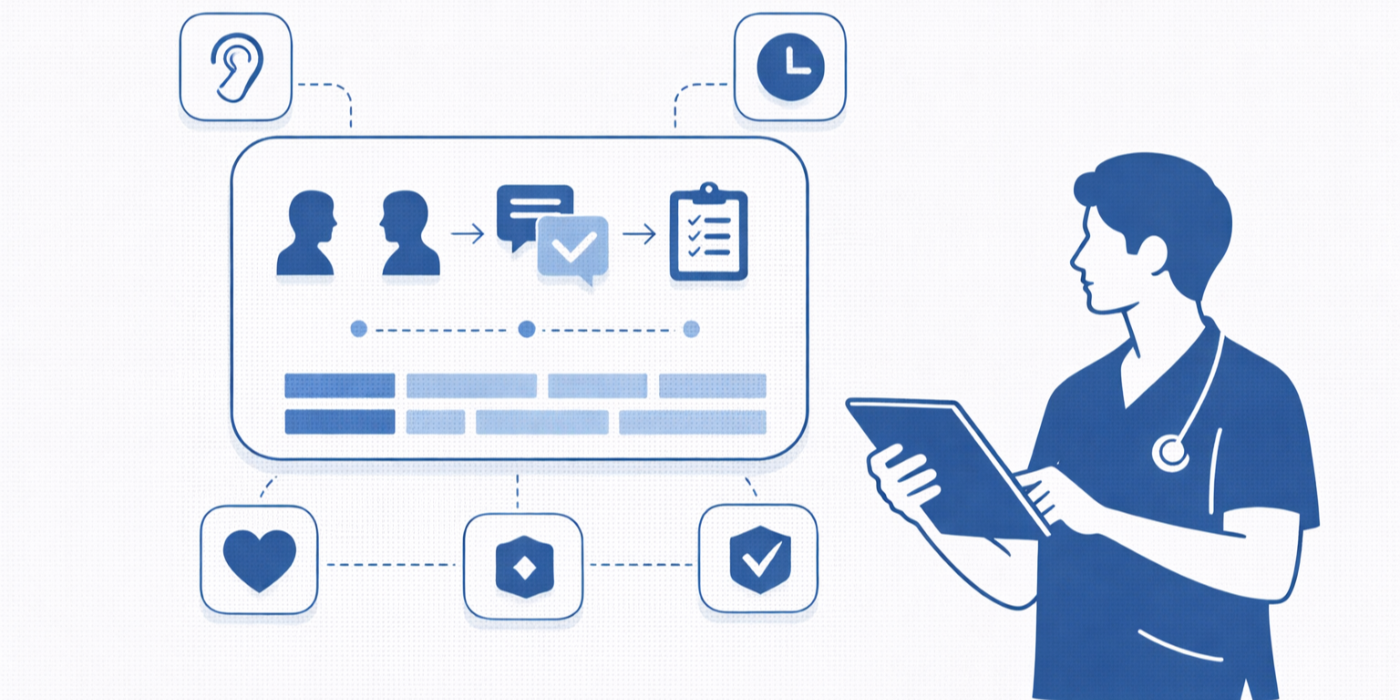
The best difficult-conversation framework is simple enough to remember under pressure and strong enough to protect accuracy, empathy, and workflow. A reliable sequence is: regulate yourself, acknowledge emotion, define the issue, verify facts, explain the boundary or process, offer options, confirm next steps, and document clearly. Professionals who can execute that sequence consistently become trusted not because they never face conflict, but because they keep conflict from spreading. That matters in every environment tied to medical administrative assistant career opportunities, medical admin assistant job market outlook, medical administration workforce trends, medical office of 2025 technologies CMAAs must master, and how CMAAs will lead the patient experience revolution by 2030.
Step 1: Regulate yourself before you respond.
A patient’s agitation can pull staff into defensiveness, urgency, or argument. The moment you mirror the patient’s emotional volatility, you lose leverage. Keep your voice slower than theirs. Lower your volume instead of raising it. Avoid abrupt policy phrases like “That’s not my department” or “There’s nothing I can do.” Those lines communicate abandonment. Professionals who train for this level of control often perform better across CMAA exam prep, top 10 mistakes students make on the ACMSO exam, real-life success stories from certified medical administrative assistants, future-proof your CMAA specialization, and predictive insights on certified CMAAs transforming telemedicine.
Step 2: Acknowledge the emotional reality first.
This does not mean agreeing with every accusation. It means showing the patient you understand the impact. Strong examples include: “I can see why that feels frustrating,” “I understand why you want clarity today,” or “I hear that you have been trying to solve this for a while.” That approach aligns with the patient-centered language emphasized in effective patient communication, empathy in healthcare administration, de-escalation techniques, front desk operations, and patient privacy terms.
Step 3: Define the issue in one sentence.
Many escalations stay messy because neither side can clearly name the problem. A powerful move is summarizing the issue back to the patient: “So the main issue is that your referral has not been sent and you do not know whether your appointment next week is at risk.” This reduces emotional fog and signals ownership. The ability to isolate the real issue supports stronger work in insurance verification workflows, appointment scheduling, healthcare portals, telehealth operations, and medical office automation.
Step 4: Verify facts before promising anything.
Do not guess. Check the chart, communication log, insurance note, appointment status, or portal thread. Difficult conversations get worse when staff offer confident but incorrect assurances. Accuracy under pressure is exactly why professionals benefit from top 20 EMR and charting terms medical scribes need to understand clearly, top 20 terms medical scribes must master for accurate clinical documentation, how scribes improve documentation accuracy by over 90, annual report on medical scribes enhancing clinical documentation accuracy, and medical scribes crucial to achieving healthcare documentation compliance.
Step 5: Explain process and boundaries without sounding dismissive.
Patients do not need jargon. They need translation. Instead of saying, “That claim adjudicated incorrectly,” say, “Your insurance processed this in a way that left a balance, and I’m going to show you what part came from the insurer and what part came from the office record.” Instead of “We can’t discuss that,” say, “I want to protect your privacy, so I need to verify permission before I share details.” This is where communication becomes both human and compliant, as reinforced by HIPAA updates every CMAA must know, CMAAs and data privacy future regulations explained clearly, predicting HIPAA updates, future healthcare compliance changes, and breaking new CMS guidelines impacting medical admin assistants.
Step 6: Offer options, not a dead end.
Patients calm down when they see a path. Even when the preferred solution is unavailable, alternatives preserve trust. That may mean a callback window, escalation to a billing lead, a rescheduling choice, interpreter support, a private room, or a documented follow-up task. Dead-end language creates emotional cornering. Option language restores collaboration. That same solution orientation shows up in interactive career planner for future healthcare roles for CMAAs, why automation is the biggest opportunity for CMAA career growth, telehealth expansion changing medical admin roles, medical-administrative assistants and technology 2025 industry report, and top emerging career specializations for CMAAs.
3. Language that calms patients down without sounding scripted
The strongest de-escalation language feels respectful, plain, and precise. Patients can hear canned empathy from a mile away. The goal is not to sound polished. The goal is to sound present. Saying, “I understand your frustration” repeatedly can become emotional wallpaper. Saying, “You were expecting an answer yesterday and you still do not have one, so let’s pin down exactly where this is stuck,” feels specific, credible, and action-oriented. High-performing healthcare teams learn this kind of phrasing the same way they learn documentation standards in medical scribe certification exam breakdown, essential skills every healthcare employer wants from a medical scribe, medical scribe certification boosts your healthcare career, success stories from medical scribes to medical professionals, and medical scribe career pathways.
There are also phrases that reliably worsen conflict. “Calm down” usually raises defensiveness. “That’s policy” sounds like a wall, not a solution. “You need to wait” without context sounds dismissive. “There’s nothing I can do” tells the patient the system has no owner. Better substitutes include: “Let me explain what I can do from here,” “Here is what I can verify right now,” “I want to make sure I give you accurate information,” and “I can walk you through the next step so you are not left guessing.” This kind of language matters whether the interaction relates to front desk operations, healthcare portals, telehealth platforms, appointment scheduling terms, or patient communication definitions.
Another overlooked skill is explaining boundaries without implying blame. Example: if a family member requests protected information, avoid cold refusal. Try: “I want to help, and I also need to make sure I protect the patient’s privacy correctly. Let me check what authorization is on file so I can guide you the right way.” That keeps the patient or family member from feeling stonewalled while still protecting compliance. The same balance appears in HIPAA and patient privacy terms, must-know HIPAA terms for medical scribes, healthcare compliance changes, CMAAs and data privacy future regulations, and medical scribes navigating new compliance and documentation standards.
4. How to manage the hardest conversation types in real healthcare settings
Some conversations need special handling because the emotional and operational stakes are higher. One category is delay-driven frustration. Patients do not only resent waiting; they resent uncertainty. The fix is not empty apology. It is transparent timing. State what caused the delay if appropriate, estimate the next checkpoint, and offer an option if the wait no longer works for them. This matters in settings shaped by medical appointment scheduling tools ranked by ease of use, top 100 urgent care and retail clinic brands hiring scribes, top 100 emergency departments and urgent care chains, medical scribe roles increasingly essential in emergency departments, and interactive guide to mastering emergency room scribing.
A second category is billing and insurance conflict. These conversations get tense because patients often think the office is inventing charges or hiding behind technicalities. Your role is to separate the financial explanation into clean parts: what was billed, what the insurer processed, what remains, what documentation exists, and what the patient can do next. Avoid flooding them with codes unless they ask. Translate first. This gets easier when staff understand top 20 medical billing terms all CMAAs should clearly understand, CPT codes explained, ICD-10 codes comprehensive interactive dictionary, insurance verification glossary and examples, and CMS announces changes in billing codes impacting CMAAs.
A third category is privacy-sensitive conversations. Anything involving results, diagnoses, family questions, or shared spaces can become a HIPAA risk if handled casually. The patient may be upset, but privacy rules do not disappear because the conversation is emotionally loaded. Move the discussion if needed. Verify identity. Check consent. Lower your voice. Document disclosures. Strong privacy instincts reinforce both safety and credibility, especially for teams preparing through ACMSO certification exam guide, ultimate guide to passing your CMAA certification exam on the first try, how to master medical administrative terminology for your CMAA exam, complete breakdown of the CMAA exam, and CMAA exam day checklist.
A fourth category is emotion-first interactions involving fear, grief, embarrassment, or shame. Here the patient may not even be ready for details yet. They may need emotional containment before operational guidance. This is where silence, pacing, and nonjudgmental acknowledgment matter more than rapid explanation. Healthcare workers who handle this well help patients feel safe without making promises outside their role. These same strengths are increasingly valuable in top medical administrative assistant opportunities in New York City, Texas medical admin assistant career opportunities, Florida CMAA career insights, Ohio medical administrative assistant employment guide, and North Carolina medical admin career opportunities.

5. Documentation, follow-through, and team handoffs after the conversation
A difficult conversation is not truly resolved when the patient walks away calmer. It is resolved when the next step is owned, documented, and visible to the right people. Poor follow-through creates repeat anger because the patient assumes the first conversation was performative. Strong documentation protects the patient, the staff, and the organization. It should capture what the issue was, what facts were verified, what was explained, what commitment was made, what escalation occurred, and what timeline was given. This discipline mirrors the accuracy standards found in top 20 EMR and charting terms, medical scribe practice exam resources, essential study techniques for medical scribe certification success, mastering medical terminology for medical scribes, and medical scribe exam day preparation checklist.
Documentation should also be operationally useful. Avoid vague notes such as “patient upset, advised to wait.” That tells the next team member almost nothing. Better documentation sounds like: “Patient upset regarding referral not received by specialist. Verified referral order present but fax transmission failed. Explained issue, apologized for delay, resent referral, provided specialist office contact, advised patient to call if not confirmed by 3 PM, and escalated to referral coordinator for confirmation.” That note reduces repeat storytelling, protects continuity, and prevents the next staff member from stepping into a landmine blind. This kind of precision supports broader healthcare efficiency discussed in real-time insights on medical scribe impact on healthcare administration, new research on how medical scribes improve clinical efficiency, how medical scribes impact hospital revenue, interactive report on how medical scribes reduce physician burnout, and economic impact of medical scribes on healthcare facilities.
Finally, difficult conversations should become training data for the team. If the same complaint appears repeatedly, the issue may not be the patient at all. It may be a broken workflow, unclear policy communication, weak portal messaging, inconsistent scripting, or poor interdepartmental ownership. High-performing organizations treat conflict patterns as operational intelligence. That mindset is central to healthcare administration key insights for CMAAs, annual CMAA job market reports, medical admin workforce trends, why certified medical admin assistants improve healthcare efficiency, and future-proof your CMAA career with emerging skills.
6. FAQs
-
Start by regulating your own tone and pace. Then acknowledge the patient’s frustration in specific language before moving into explanation. Patients rarely calm down because staff speak faster or defend policy harder. They calm down when they feel heard and guided. This approach aligns with de-escalation techniques, effective patient communication, empathy in healthcare administration, front desk operations, and patient intake procedures.
-
Empathy is not a promise. It is acknowledgment. You can validate impact while keeping boundaries intact: “I understand why this is frustrating, and here is what I can do next.” That allows you to remain human without overcommitting. The skill is especially important in telehealth expansion and changing medical admin roles, virtual medical administration, healthcare CRM communication workflows, healthcare portals, and future patient-experience leadership for CMAAs.
-
Avoid phrases that corner, shame, or dismiss: “Calm down,” “That’s policy,” “You’ll have to wait,” or “There’s nothing I can do.” Replace them with language that creates clarity and options. That distinction matters in both patient trust and compliance, especially alongside HIPAA and privacy terms, must-know HIPAA terms for medical scribes, future compliance changes, predicting HIPAA updates, and medical scribes navigating compliance standards.
-
Detailed enough that another team member can immediately understand the issue, verified facts, actions taken, escalation path, and promised next step. Avoid vague emotional summaries. Document operational value. This is consistent with charting terms for medical scribes, medical scribe documentation accuracy insights, clinical efficiency research, documentation compliance standards, and annual role-in-accuracy report.
-
Build skill through repetition, reflection, and structured training. Study patient communication, privacy, scheduling, documentation, and conflict language as one connected system, not separate topics. That growth path is supported by ACMSO certification exam guide, complete guide to passing your medical scribe certification exam, CMAA exam success resources, top 10 skills employers look for in a CMAA, and medical scribe and CMAA career growth resources.
