

CMAA Exam Day Checklist: Everything You Need for a Smooth Experience
Exam day should feel boring in the best way. This CMAA exam day checklist is built to remove the sneaky failure points that catch strong candidates: late arrival, ID issues, shaky timing, and mental fatigue that wipes out easy points. Use it like a systems plan, not a motivational post. If you are also comparing outcomes after certification, bookmark the CMAA career opportunities guide and the medical admin job market outlook so you can connect today’s test to next month’s offers.
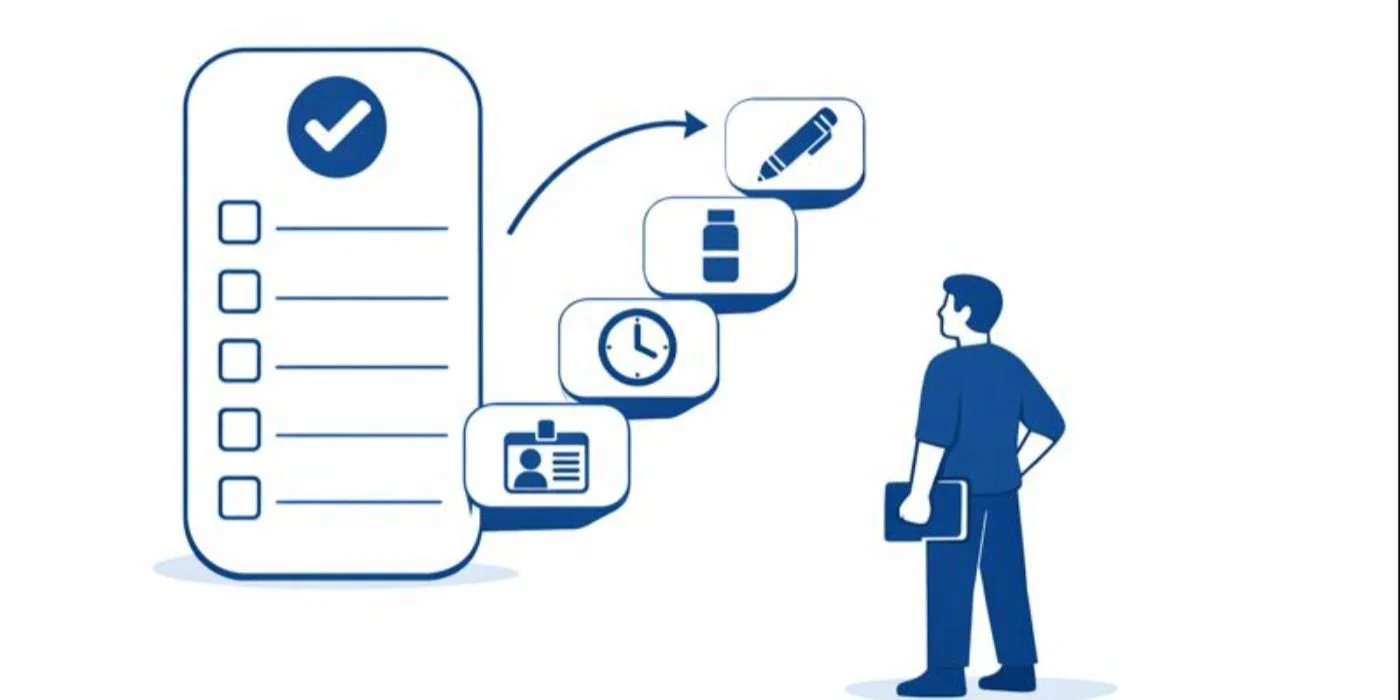
1) Lock Down the Exam Flow Before You Arrive
Your smooth experience starts days before the test, not in the parking lot. Your goal is to remove uncertainty, because uncertainty drains working memory and makes you second guess answers you actually know. Treat the process like patient flow management. You would not walk into a busy clinic without knowing the check in sequence, the bottlenecks, and the handoffs. Apply the same mindset using the patient flow management guide and the patient management systems walkthrough as your mental model.
Start by confirming your exam details and building a single source of truth. Write down the testing date, reporting time, testing address or remote portal, allowed items, break policy, and scoring rules. Put it in one note, not scattered across emails. This is the same principle behind clean documentation that employers care about. If you want a clear view of what employers value, skim top skills employers look for in a CMAA and match your exam day behavior to those traits.
Next, rehearse the check in sequence. If you are testing in person, drive the route at the same time of day, confirm parking, and locate the entrance you will use. If you are testing online, run a full tech check with the same laptop, browser, and network you will use on exam day. Do not “assume it will be fine.” That assumption is how confident candidates lose time and composure. This matters even more as remote medical administration continues to expand and testing environments keep evolving. If remote work is in your career plan, see how virtual medical administration is transforming the role.
Build a rules checklist and treat it as compliance. Many exam day problems are not knowledge problems. They are policy violations. If you want a strong compliance mindset, connect this to your everyday admin role using medical office telephone etiquette, active listening scenarios, and conflict resolution terms. Exam day is basically a high stakes workflow under observation. You win by staying calm, following steps, and avoiding avoidable flags.
Finally, plan your stress response in advance. If your heart rate spikes, your thinking narrows. Create a one minute reset protocol now: inhale four seconds, hold two, exhale six, repeat four times. Pair it with a “micro script” such as “Slow is smooth, smooth is fast.” That kind of internal coaching is not fluff. It protects performance. If you want to see how high performers translate preparation into results, read real success stories from CMAAs.
2) Pack Smart, Leave Smart, and Avoid the “Turned Away” Disaster
The fastest way to ruin exam day is to show up underprepared for the rules. Candidates imagine they will lose points from difficult questions. In reality, many lose the entire session because of ID mismatch, late arrival, prohibited items, or a remote proctor issue. That is why your checklist above is not “nice to have.” It is a risk control system.
First, protect your identity verification. Check that the name on your ID matches your registration exactly. If you recently changed names, fix it early. Even small differences can cause delays and stress you cannot afford. This is the same precision you need in healthcare documentation. If you want to reinforce that mindset, review EMR software terms and think like a person who prevents documentation errors before they occur.
Second, understand the silent penalty of extra items. Even if a testing center allows you to store personal items, each extra thing increases friction. Friction turns into distraction. If you are prone to anxiety, simplify. Bring only what is needed. This mirrors the best admin workflows, where fewer handoffs and fewer moving parts produce fewer errors. If you want to see how tech and process discipline changes outcomes, read medical office automation trends for CMAAs and adopt that same operational discipline for your exam.
Third, dress for the environment, not for style. Wear layers you can adjust. Avoid uncomfortable shoes. Avoid anything that makes you fidget, because fidgeting steals attention. Calm, stable comfort supports stable thinking. If you work in patient facing settings, you already know how much comfort affects performance. This is the same skill set behind front desk excellence and why employers keep looking for reliable execution. Revisit top skills employers look for in a CMAA and notice how often “accuracy,” “consistency,” and “professionalism” show up in different forms.
If you are testing remotely, treat your room as a compliance controlled zone. Clear your desk. Remove papers. Remove extra screens. Remove items that could trigger a proctor flag. Turn off notifications. Close chat apps. Put your phone in another room. The goal is to create a calm, clean environment with no surprises. This is the same logic behind audit readiness in healthcare admin, where the absence of chaos is the signal of competence. For extra context on how remote work reshapes admin expectations, revisit virtual medical administration.
Finally, commit to early arrival or early login. If you arrive “on time,” you are already late in psychological terms. You want time to breathe, settle, and enter the first question with control. That first minute matters more than people admit. A calm start prevents the early mistake cluster that spirals into time loss later.
3) The Morning of the Exam: A Routine That Prevents Brain Fog
You do not need a heroic routine. You need a predictable routine. Predictability keeps your nervous system stable and keeps your recall accessible. This matters because the CMAA exam is not just fact recall. It also tests applied judgment, process thinking, and scenario interpretation. Those skills collapse when you are overstimulated.
Sleep is the foundation, but do not obsess the night before. The bigger lever is the three nights leading up to the exam. Shift your bedtime earlier if needed. Wake up at the time you will wake up on exam day. This locks your circadian rhythm. If your mind races at night, write your checklist on paper, then stop negotiating with yourself. A written plan is a signal to your brain that the threat is handled.
Eat a stable breakfast. Aim for protein plus slow carbs. Avoid sugar spikes. Avoid trying new foods. Avoid doubling your caffeine. Your brain wants stability, not experimentation. Hydrate early, then taper. If you constantly sip during the exam, you create bathroom stress. Bathroom stress becomes time management stress. Time management stress becomes careless clicks. That is how “I knew this” turns into “I missed it.”
Do a short warm up that activates your admin brain. Think definitions, workflows, and core terms. This is where ACMSO’s interactive resources become useful. Skim a few entries in scheduling software glossary, review a few concepts in patient management systems, and ground yourself in communication skills through active listening scenarios. This kind of quick activation makes the first exam questions feel familiar instead of sharp.
Then run a two minute confidence audit. This is not affirmations. It is proof. List three things you have already done correctly in your preparation. One could be your practice routine. One could be mastering terminology. One could be learning how admin roles actually operate. If you need a strong reminder of why this certification translates into real outcomes, read why CMAA certification boosts your career opportunities and real life CMAA success stories.
Finally, set a single rule for yourself. Do not “speed up” to catch time by rushing questions. You catch time by avoiding mistakes, not by reading faster. Smooth beats fast.
4) During the Exam: Pacing, Question Strategy, and the Traps That Steal Easy Points
A smooth exam experience is mostly about protecting your attention. The exam is designed to reward clear thinking under constraints. Your job is to keep your thinking clear.
Start with pacing. Before you begin, decide your target pace per question. If you do not know the exact question count and time, still use a simple rule: if you are stuck, flag and move. Stuck questions are time traps. They do not just cost time. They create frustration, and frustration causes careless mistakes on the next five questions. Use a strict threshold such as 60 to 90 seconds. If you cannot make progress, flag it.
Next, use a two pass strategy. Pass one is for confident answers and quick wins. Pass two is for flagged questions. This protects your score because it guarantees you collect the easy points first. Easy points are what most candidates donate to stress. This is the same logic used in efficient admin workflows: process the predictable tasks first, then handle exceptions. If you want that workflow thinking in your daily job, review medical billing explained for admin assistants and notice how the best systems separate routine from exception handling.
For scenario questions, anchor yourself in patient safety, confidentiality, professionalism, and accurate documentation. Many options will be “almost right.” Choose the one that reduces risk and follows procedure. When in doubt, pick the step that clarifies information, confirms policy, or documents correctly. This is why knowing your foundational terms helps. If you get pulled into confusion, re center using EMR software terms and patient advocacy terms as your real world anchor.
Watch for these high cost traps:
Misread qualifiers. Words like “best,” “first,” “most appropriate,” and “immediately” change the correct answer. Slow down for those lines.
Overthinking simple workflow questions. If a question is about scheduling, insurance verification steps, or documentation sequence, answer it like a real clinic. Use the same reasoning you use with scheduling software concepts and patient flow management.
Emotion based guesses. If you feel panic, you will start selecting answers that “sound safe” but do not follow process. That is why your breathing reset matters.
Changing answers without evidence. If you reread and notice a clear misread, change it. If you do not have a concrete reason, keep your first answer. Constant switching is usually anxiety, not insight.
Also, respect micro breaks even if the exam does not offer formal breaks. Every 12 to 15 questions, do a three second posture reset, unclench your jaw, relax your shoulders, and take one slow breath. This is small, but it stops cumulative tension, which is what leads to late exam mistakes.
When you finish, do a controlled review. Do not relive every question. Check for unanswered items. Check for accidental double clicks. Confirm you did not mis mark a question. This is where easy points are saved.

5) After You Finish: Turn the Test Into Career Momentum Immediately
A smooth exam experience ends with a strong next step, not with stress scrolling and waiting. Even if you do not get instant results, you can use the same day to build momentum while the experience is fresh in your mind.
First, write down what felt difficult. Not because you want to panic, but because it reveals your growth edges. If scenario questions felt hard, that usually means you need stronger workflow clarity. If terminology felt hard, you need tighter definitions. ACMSO has multiple interactive resources that help you tighten that clarity, including patient management systems, active listening scenarios, and conflict resolution in medical admin.
Second, update your resume and LinkedIn immediately. Add two or three bullets that reflect capability, not just a credential. Employers respond to outcomes such as scheduling accuracy, patient communication quality, billing support, and documentation reliability. If you need a strong model of how certification translates into real value, read new study on how CMAAs improve healthcare efficiency and align your language to that impact.
Third, connect your exam pass to market reality. Knowing the demand and salary landscape helps you negotiate and target roles that fit you. Use the annual CMAA salary report, the interactive salary calculator, and the interactive industry report on job demand by specialty. This is how you turn a certification into a strategy, not a badge.
Fourth, build a 30 day action plan. Certification is leverage, but leverage works only when you apply it. If you want your career to keep growing through 2026 and beyond, review future proof your CMAA career and 2026 healthcare administration insights. Pick two skills to strengthen immediately such as documentation precision, scheduling mastery, or patient communication.
Finally, if you are also exploring related healthcare documentation paths, it can help to understand how adjacent roles think. The workflow discipline behind exam success is the same discipline behind documentation success. If you want a broader angle on exam preparation systems, you can also explore the medical scribe exam checklist and the medical scribe practice exam as optional cross training.
6) FAQs: CMAA Exam Day Checklist Questions That Actually Matter
-
It is usually not content difficulty. It is a chain reaction that starts with being rushed. Late arrival, last minute tech issues, or missing requirements spikes stress, and stress causes time loss and careless mistakes. The fix is simple but non negotiable: use a printed checklist, arrive early, and pre test your environment. If you want a strong operations mindset, treat the day like patient flow and eliminate bottlenecks ahead of time using patient flow management guidance. Smooth exam days are built by small controls, not by last minute willpower.
-
Aim for at least 30 minutes early for in person testing and 20 to 30 minutes early for online check in. This gives you time to clear security, settle your nerves, and begin in a calm state. The worst feeling is sitting down already behind schedule. If you are testing remotely, log in early so you can handle permissions and camera checks without panic. The same discipline is useful in real admin work, where early setup prevents downstream chaos. Explore how tech driven workflows reduce stress in medical office automation trends.
-
Do not fight it. Contain it. Use a 60 second reset: slow inhale, brief hold, longer exhale, repeat four times. Then immediately do one simple question to rebuild momentum. Anxiety becomes dangerous when it traps you on one question. That is why a flag and move strategy is powerful. If you want communication grounded calm, train it through active listening scenarios and conflict resolution skills. Those tools build emotional control under pressure.
-
Anchor your choice to process, safety, confidentiality, and documentation. Many options sound polite, but only one follows correct workflow. Ask, “What step reduces risk and follows procedure first?” That framing usually reveals the best answer. Also watch for words like “first” and “most appropriate.” If the scenario involves systems, scheduling, or workflow, think like a clinic using scheduling software concepts and patient management systems to guide your logic.
-
Only change an answer when you can name a clear reason such as a misread keyword or a rule you remembered. Random switching is usually anxiety disguised as analysis. A controlled review is still valuable because it catches skipped questions and obvious mismatches. Your goal is accuracy, not perfection. This mirrors real admin work, where you confirm the critical fields and avoid unnecessary edits. If you want a career angle, once you pass, align your resume language to employer expectations using top CMAA skills employers want.
-
Capture momentum. Write down what felt strong and what felt weak while it is fresh. Then update your job materials. Certification has the most impact when you apply it quickly. Use salary and demand tools to target roles strategically, including the CMAA salary calculator, the annual CMAA salary report, and the job market outlook. This is how you turn a test day into income and career growth.
-
Do not just say you passed. Translate your preparation into job relevant signals: workflow discipline, accuracy, communication, and compliance awareness. Share your system, such as your checklist approach, your time management method, and how you handled scenario logic. Employers love candidates who can execute reliably under constraints. For credibility, connect to evidence based value using research on CMAA efficiency impact and pair it with market context from the interactive job demand report.
