

Bedside Manner for Admin Staff: Key Terms & Interactive Scenarios
Patients begin evaluating a healthcare organization before meeting a clinician. The tone used during appointment scheduling, the discretion shown during patient intake, and the clarity of front-desk communication all shape whether a person feels respected, informed, and safe. Strong bedside manner for administrative staff combines empathy, boundaries, accuracy, privacy, and practical problem-solving. This guide defines the essential terms, supplies realistic response scripts, and shows medical administrators how to handle emotionally charged moments without making promises outside their authority.
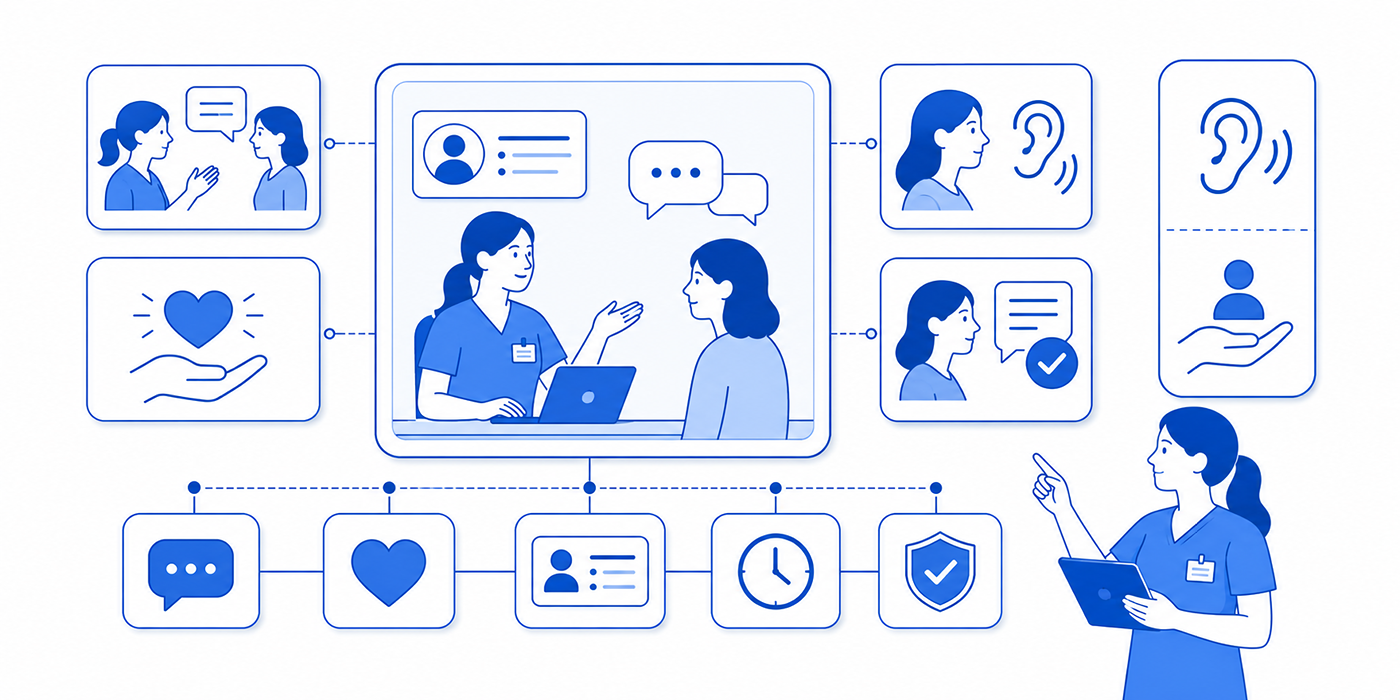
1. Why Bedside Manner Begins With Administrative Staff
Bedside manner describes the interpersonal behaviors that help a patient feel heard, respected, and properly guided during healthcare interactions. For administrative professionals, these behaviors appear during check-in, telephone calls, portal messages, payment conversations, referral coordination, insurance questions, appointment delays, and complaint handling. AHRQ includes timely appointments, access to information, and good communication with staff among the healthcare experiences patients value, while CMS patient-experience surveys examine staff responsiveness, care coordination, and communication throughout the care journey.
An administrator may spend only three minutes with a patient, yet those minutes can determine whether the patient discloses an urgent concern, understands the next step, or leaves feeling dismissed. Effective patient communication requires more than friendliness. Staff must combine active listening techniques, accurate medical administrative workflow, and appropriate medical office triage terminology. Warmth without operational accuracy can produce dangerous reassurance, missed escalation, or unclear instructions.
The administrative role also carries unique limits. Staff may explain processes, confirm documented information, route concerns, and identify the correct point of contact. Clinical interpretation, diagnosis, treatment advice, and promises about outcomes sit outside most administrative roles. A disciplined response uses legal responsibility guidance, follows approved medical office policies, protects patient confidentiality, and activates risk-management procedures whenever the concern exceeds administrative authority.
The four functions of strong administrative bedside manner
Emotional recognition means acknowledging the patient’s experience without claiming to know exactly how the patient feels. “I can hear that this delay has been exhausting” recognizes distress more credibly than a vague apology. This skill strengthens empathy in healthcare administration, supports cultural competence, and gives staff a stable opening for difficult patient conversations.
Information control means giving the patient a clear, accurate amount of information. Staff should separate confirmed facts from pending information, describe the next action, and identify who owns the next step. CDC communication guidance supports plain language, clear speech, verbal explanation of written information, and methods that confirm understanding.
Boundary management prevents an empathetic conversation from becoming an unauthorized clinical opinion, guarantee, privacy disclosure, or argument. Staff should know when to use de-escalation techniques, when to follow an emergency appointment workflow, and when to involve a supervisor through documented medical compliance procedures.
Closure gives the patient an understandable endpoint. Every interaction should close with an action, owner, timeframe, and contact route. “The referral coordinator will review the missing authorization today, and we will update you through the portal by 4:00 p.m.” is more useful than “Someone will look into it.” Reliable closure depends on patient portal management, healthcare CRM workflows, team collaboration tools, and accurate patient record updates.
| # | Key Term | Operational Meaning | Strong Admin Response | Failure Signal | Related Resource |
|---|---|---|---|---|---|
| 1 | Active listening | Giving focused attention, identifying the actual request, and checking that the concern was understood accurately. | “Let me confirm the main issue: you have received two appointment times and need to know which one is correct.” | Interrupting before the patient explains the problem. | Active listening |
| 2 | Acknowledgment | Recognizing inconvenience, confusion, fear, or frustration without debating whether the reaction is justified. | “I can see why receiving different instructions would be frustrating.” | Opening with policy language before recognizing the concern. | Healthcare empathy |
| 3 | Emotional labeling | Naming the emotion suggested by the patient’s words while leaving room for correction. | “It sounds as though the uncertainty is making you anxious. Have I understood that correctly?” | Telling the patient to calm down. | De-escalation |
| 4 | Validation | Confirming that the concern deserves attention without agreeing with every accusation or assumption. | “A missing referral can affect your appointment, so I am going to check its status carefully.” | “That is just how the system works.” | Difficult conversations |
| 5 | Plain language | Using familiar words, short explanations, and clearly ordered instructions. | “Your insurer needs more information from the clinical team before it decides whether to cover the scan.” | Unexplained abbreviations and billing jargon. | Prior authorization |
| 6 | Reflective statement | Restating the concern in neutral language so the patient can confirm or correct it. | “You were told the balance was paid, and a new statement has now arrived.” | Repeating the patient’s emotional wording in a sarcastic tone. | Patient communication |
| 7 | Open-ended question | A question that lets the patient explain the situation before staff narrow the issue. | “What happened when you tried to schedule the follow-up?” | Using several leading questions that assume the cause. | Scheduling practices |
| 8 | Closed-loop communication | Confirming the message, action, responsible person, and completion status. | “I sent the request to referrals, and Maria confirmed that she received it.” | Assuming a forwarded message has been handled. | Administrative workflow |
| 9 | Expectation setting | Explaining what will happen, when it should happen, and which factors may affect timing. | “Review usually takes two business days. We will contact you sooner if more information is needed.” | Promising same-day completion without confirmation. | Time management |
| 10 | Warm handoff | Connecting the patient to the next staff member with context so the patient does not restart the explanation. | “I am transferring you to billing and will explain that the concern involves a duplicate copay.” | Blind transfers and repeated retelling. | Team collaboration |
| 11 | Service recovery | A structured response that acknowledges a breakdown, corrects what can be corrected, and prevents recurrence. | “We entered the wrong telephone number. I have corrected it, resent the link, and flagged the record for verification.” | An apology with no corrective action. | Patient complaints |
| 12 | Scope boundary | A clear limit separating administrative assistance from clinical judgment or legal interpretation. | “I can document your symptom concern and connect you with the clinical team for medical guidance.” | Advising a patient to change medication use. | Legal responsibilities |
| 13 | Escalation threshold | A defined point at which the issue must move to a nurse, manager, privacy officer, billing specialist, or emergency pathway. | “Because you mentioned worsening shortness of breath, I am following our urgent clinical escalation procedure.” | Keeping a safety concern inside a routine message queue. | Office triage |
| 14 | Privacy-preserving language | Communicating discreetly and limiting protected information to the appropriate person and setting. | “Let us move to a private area before reviewing the account details.” | Repeating diagnoses or balances across a crowded lobby. | Privacy communication |
| 15 | Identity verification | Confirming required identifiers before discussing records, appointments, results, or financial information. | “Before I open the account, please confirm the identifiers required by our policy.” | Using recognition or caller familiarity as verification. | HIPAA terms |
| 16 | Trauma-aware communication | Using predictability, choice, respectful distance, and calm explanations when a patient may feel unsafe or overwhelmed. | “I will explain each registration step before asking for information.” | Sudden demands, raised voices, or blocking the patient’s exit. | Empathy scenarios |
| 17 | Cultural humility | Approaching differences with curiosity and avoiding assumptions about beliefs, family roles, literacy, or decision-making preferences. | “Who would you like included when we discuss scheduling and care instructions?” | Assuming the accompanying relative speaks for the patient. | Cultural competence |
| 18 | Language access | Arranging qualified language assistance so the patient can understand and participate in the interaction. | “I will connect a qualified interpreter before we continue with the registration questions.” | Using a child or unassessed visitor as the default interpreter. | Telehealth platforms |
| 19 | Accessible communication | Adapting the communication method for hearing, vision, speech, cognitive, or mobility-related needs. | “Which communication format works best for you during this appointment?” | Assuming louder speech solves every communication barrier. | Virtual patient management |
| 20 | Teach-back | Checking understanding by asking the patient to explain the next step in their own words. | “To make sure I explained it clearly, what will you do when you receive the portal message?” | Relying on “Do you understand?” | Healthcare portal terms |
| 21 | Nonverbal congruence | Keeping facial expression, posture, volume, and pacing consistent with the spoken message. | Use a calm tone and attentive posture while explaining a delay. | Saying “I am happy to help” while sighing or avoiding eye contact. | Patient satisfaction |
| 22 | Neutral wording | Describing facts without blame, accusation, or emotionally loaded labels. | “The form has one incomplete section” instead of “You filled this out incorrectly.” | Language that makes the patient defensive. | Encounter forms |
| 23 | Choice architecture | Offering realistic options in a clear order so the patient can make an informed operational decision. | “The available options are a video visit tomorrow or an in-person visit Friday.” | Listing many possibilities without explaining availability. | Scheduling conflicts |
| 24 | Process transparency | Explaining where a request sits, what remains outstanding, and what staff can verify. | “The claim reached the payer, and the current status shows a request for additional documentation.” | “Insurance is holding it up” without checking the record. | Claims processing |
| 25 | Financial sensitivity | Discussing balances, coverage, and payment options discreetly and without moral judgment. | “We can review the balance privately and explain the available payment process.” | Commenting on what the patient should be able to afford. | EOB dictionary |
| 26 | Complaint containment | Moving an escalating complaint into a private, structured conversation with the correct decision-maker. | “I would like to move this discussion to a private space and bring in the office manager.” | Arguing across the reception desk. | Complaint handling |
| 27 | Time acknowledgment | Recognizing the effect of waiting while providing a realistic update. | “You have been waiting 35 minutes. The clinician is finishing an urgent visit, and I will update you in ten minutes.” | Avoiding patients when the schedule falls behind. | Scheduling terms |
| 28 | Documentation neutrality | Recording observable behavior, exact requests, and actions taken without insulting or speculative labels. | “Patient raised voice and requested manager review” instead of “Patient was crazy.” | Emotional labels in the medical or administrative record. | Records management |
| 29 | Repair statement | A concise acknowledgment used when staff wording, tone, or process has caused confusion or harm. | “My explanation was unclear. Let me restate the process and confirm the next step.” | Defending wording after the patient identifies confusion. | Communication examples |
| 30 | Action-oriented closure | Ending with a specific next step, owner, timeframe, and contact route. | “Billing will review the duplicate charge by Thursday and send the outcome through your secure portal.” | Ending with “We will see what happens.” | Healthcare CRM |
Operational use: Adapt these responses to the organization’s approved scripts, escalation rules, privacy procedures, accessibility requirements, and staff scope of practice.
Hello, World!
| # | Key Term | Operational Meaning | Strong Admin Response | Failure Signal | Related Resource |
|---|---|---|---|---|---|
| 1 | Active listening | Giving focused attention, identifying the actual request, and checking that the concern was understood accurately. | “Let me confirm the main issue: you have received two appointment times and need to know which one is correct.” | Interrupting before the patient explains the problem. | Active listening |
| 2 | Acknowledgment | Recognizing inconvenience, confusion, fear, or frustration without debating whether the reaction is justified. | “I can see why receiving different instructions would be frustrating.” | Opening with policy language before recognizing the concern. | Healthcare empathy |
| 3 | Emotional labeling | Naming the emotion suggested by the patient’s words while leaving room for correction. | “It sounds as though the uncertainty is making you anxious. Have I understood that correctly?” | Telling the patient to calm down. | De-escalation |
| 4 | Validation | Confirming that the concern deserves attention without agreeing with every accusation or assumption. | “A missing referral can affect your appointment, so I am going to check its status carefully.” | “That is just how the system works.” | Difficult conversations |
| 5 | Plain language | Using familiar words, short explanations, and clearly ordered instructions. | “Your insurer needs more information from the clinical team before it decides whether to cover the scan.” | Unexplained abbreviations and billing jargon. | Prior authorization |
| 6 | Reflective statement | Restating the concern in neutral language so the patient can confirm or correct it. | “You were told the balance was paid, and a new statement has now arrived.” | Repeating the patient’s emotional wording in a sarcastic tone. | Patient communication |
| 7 | Open-ended question | A question that lets the patient explain the situation before staff narrow the issue. | “What happened when you tried to schedule the follow-up?” | Using several leading questions that assume the cause. | Scheduling practices |
| 8 | Closed-loop communication | Confirming the message, action, responsible person, and completion status. | “I sent the request to referrals, and Maria confirmed that she received it.” | Assuming a forwarded message has been handled. | Administrative workflow |
| 9 | Expectation setting | Explaining what will happen, when it should happen, and which factors may affect timing. | “Review usually takes two business days. We will contact you sooner if more information is needed.” | Promising same-day completion without confirmation. | Time management |
| 10 | Warm handoff | Connecting the patient to the next staff member with context so the patient does not restart the explanation. | “I am transferring you to billing and will explain that the concern involves a duplicate copay.” | Blind transfers and repeated retelling. | Team collaboration |
| 11 | Service recovery | A structured response that acknowledges a breakdown, corrects what can be corrected, and prevents recurrence. | “We entered the wrong telephone number. I have corrected it, resent the link, and flagged the record for verification.” | An apology with no corrective action. | Patient complaints |
| 12 | Scope boundary | A clear limit separating administrative assistance from clinical judgment or legal interpretation. | “I can document your symptom concern and connect you with the clinical team for medical guidance.” | Advising a patient to change medication use. | Legal responsibilities |
| 13 | Escalation threshold | A defined point at which the issue must move to a nurse, manager, privacy officer, billing specialist, or emergency pathway. | “Because you mentioned worsening shortness of breath, I am following our urgent clinical escalation procedure.” | Keeping a safety concern inside a routine message queue. | Office triage |
| 14 | Privacy-preserving language | Communicating discreetly and limiting protected information to the appropriate person and setting. | “Let us move to a private area before reviewing the account details.” | Repeating diagnoses or balances across a crowded lobby. | Privacy communication |
| 15 | Identity verification | Confirming required identifiers before discussing records, appointments, results, or financial information. | “Before I open the account, please confirm the identifiers required by our policy.” | Using recognition or caller familiarity as verification. | HIPAA terms |
| 16 | Trauma-aware communication | Using predictability, choice, respectful distance, and calm explanations when a patient may feel unsafe or overwhelmed. | “I will explain each registration step before asking for information.” | Sudden demands, raised voices, or blocking the patient’s exit. | Empathy scenarios |
| 17 | Cultural humility | Approaching differences with curiosity and avoiding assumptions about beliefs, family roles, literacy, or decision-making preferences. | “Who would you like included when we discuss scheduling and care instructions?” | Assuming the accompanying relative speaks for the patient. | Cultural competence |
| 18 | Language access | Arranging qualified language assistance so the patient can understand and participate in the interaction. | “I will connect a qualified interpreter before we continue with the registration questions.” | Using a child or unassessed visitor as the default interpreter. | Telehealth platforms |
| 19 | Accessible communication | Adapting the communication method for hearing, vision, speech, cognitive, or mobility-related needs. | “Which communication format works best for you during this appointment?” | Assuming louder speech solves every communication barrier. | Virtual patient management |
| 20 | Teach-back | Checking understanding by asking the patient to explain the next step in their own words. | “To make sure I explained it clearly, what will you do when you receive the portal message?” | Relying on “Do you understand?” | Healthcare portal terms |
| 21 | Nonverbal congruence | Keeping facial expression, posture, volume, and pacing consistent with the spoken message. | Use a calm tone and attentive posture while explaining a delay. | Saying “I am happy to help” while sighing or avoiding eye contact. | Patient satisfaction |
| 22 | Neutral wording | Describing facts without blame, accusation, or emotionally loaded labels. | “The form has one incomplete section” instead of “You filled this out incorrectly.” | Language that makes the patient defensive. | Encounter forms |
| 23 | Choice architecture | Offering realistic options in a clear order so the patient can make an informed operational decision. | “The available options are a video visit tomorrow or an in-person visit Friday.” | Listing many possibilities without explaining availability. | Scheduling conflicts |
| 24 | Process transparency | Explaining where a request sits, what remains outstanding, and what staff can verify. | “The claim reached the payer, and the current status shows a request for additional documentation.” | “Insurance is holding it up” without checking the record. | Claims processing |
| 25 | Financial sensitivity | Discussing balances, coverage, and payment options discreetly and without moral judgment. | “We can review the balance privately and explain the available payment process.” | Commenting on what the patient should be able to afford. | EOB dictionary |
| 26 | Complaint containment | Moving an escalating complaint into a private, structured conversation with the correct decision-maker. | “I would like to move this discussion to a private space and bring in the office manager.” | Arguing across the reception desk. | Complaint handling |
| 27 | Time acknowledgment | Recognizing the effect of waiting while providing a realistic update. | “You have been waiting 35 minutes. The clinician is finishing an urgent visit, and I will update you in ten minutes.” | Avoiding patients when the schedule falls behind. | Scheduling terms |
| 28 | Documentation neutrality | Recording observable behavior, exact requests, and actions taken without insulting or speculative labels. | “Patient raised voice and requested manager review” instead of “Patient was crazy.” | Emotional labels in the medical or administrative record. | Records management |
| 29 | Repair statement | A concise acknowledgment used when staff wording, tone, or process has caused confusion or harm. | “My explanation was unclear. Let me restate the process and confirm the next step.” | Defending wording after the patient identifies confusion. | Communication examples |
| 30 | Action-oriented closure | Ending with a specific next step, owner, timeframe, and contact route. | “Billing will review the duplicate charge by Thursday and send the outcome through your secure portal.” | Ending with “We will see what happens.” | Healthcare CRM |
Operational use: Adapt these responses to the organization’s approved scripts, escalation rules, privacy procedures, accessibility requirements, and staff scope of practice.
2. Essential Bedside-Manner Techniques for Daily Administrative Work
Listen for the request beneath the emotion
A patient who says, “Nobody here knows what they are doing,” may be describing an unreturned call, conflicting appointment instructions, a missing refill message, or fear about a delayed test. Responding to the insult alone keeps the actual operational failure hidden. A stronger approach uses active listening, a neutral clarifying question, and a review of the relevant patient communication record. Ask, “Which part of the process remains unresolved?” Then verify the facts through the practice management system or appropriate EMR integration tool.
AHRQ’s communication assessment guidance emphasizes empathy, sincerity, honesty, jargon-free language, and recognition of situations that require additional support. Those qualities give administrators a useful sequence: recognize the concern, clarify the request, state what is known, and escalate responsibly when the conversation exceeds their authority.
Use acknowledgment before explanation
Explanations are easier to hear after the patient knows the concern has been recognized. When a patient has waited an hour, opening with “The clinic is busy” can sound defensive. A more effective response begins, “You have been waiting much longer than expected, and I understand why you need a clear update.” Staff can then explain the current status, available options, and next review point.
This technique is especially valuable during appointment scheduling conflicts, delayed insurance verification, incomplete prior authorization, and disputed medical claims. The acknowledgment should remain specific. Generic phrases such as “Sorry for the inconvenience” can feel procedural when staff cannot explain the issue or provide a meaningful action.
Replace institutional language with patient-facing language
Healthcare employees work daily with phrases such as “pending review,” “payer response,” “provider template,” “medical necessity,” “release authorization,” and “referral work queue.” Patients may hear these phrases during a stressful moment with limited context. Translate the process into ordinary language while preserving accuracy.
Instead of saying, “Your prior auth is in the queue,” explain, “The insurer has received the request and has not issued a decision yet.” Instead of “The provider is unavailable,” explain whether the clinician is with another patient, outside the office, or reviewing messages according to the information staff are permitted to share. Plain explanations strengthen healthcare portal communication, improve virtual patient management, and reduce confusion during revenue-cycle conversations.
CDC advises using plain language and communication formats that help people understand and use health information. Its guidance also highlights speaking clearly, combining written information with verbal explanation or demonstration, and checking comprehension.
Give choices that actually exist
Offering options restores a degree of control during an inconvenient or emotionally difficult interaction. Those options must be available, clinically appropriate, and within staff authority. A scheduler might offer the earliest available visit, a waitlist position, or a different location. A billing representative might explain the documented payment process or route the patient for financial assistance screening.
Avoid presenting hypothetical solutions as confirmed outcomes. Strong scheduling software use, accurate front-desk workflows, and disciplined medical office organization help staff identify real choices quickly. When no immediate option is available, explain the escalation route and timeframe through a reliable team collaboration system.
Match communication to the patient’s needs
A standard script may fail when a patient uses an interpreter, has low vision, is deaf or hard of hearing, processes information slowly, feels overwhelmed, or needs a caregiver involved with proper authorization. Ask which format supports the interaction. Options may include a qualified interpreter, accessible digital content, written instructions, captioning, large print, or another approved auxiliary aid.
HHS guidance explains that covered healthcare entities may need appropriate aids and services to ensure effective communication with people with disabilities, with the suitable method depending on the complexity and circumstances of the interaction.
Staff should integrate accessibility into telehealth administration, patient portal management, appointment scheduling tools, and patient privacy procedures. Waiting until the patient reaches the front desk can create delays, rushed substitutions, and preventable frustration.
3. Interactive Scenarios and Professional Response Scripts
Scenario 1: The clinician is running far behind
Patient: “I have been sitting here for 45 minutes. My time clearly means nothing to this office.”
Weak response: “The doctor is busy. You will have to wait.”
Professional response: “You have been waiting 45 minutes, and you deserve a clear update. The clinician is completing an urgent visit. I can check the current estimate, review whether another appointment time is available, and update you again within ten minutes.”
This response acknowledges the waiting time, provides confirmed context, offers realistic options, and establishes a review point. The administrator should update the appointment record, coordinate through the staff scheduling workflow, and document any rescheduling through approved scheduling conflict procedures.
Scenario 2: A patient demands test results
Patient: “I can see the result in my portal. Tell me whether it means I have cancer.”
Professional response: “I can confirm that the result is available in your record. Interpretation of the finding needs to come from the clinical team. I will send an urgent message requesting that someone qualified review it with you and confirm how you will be contacted.”
The administrator avoids interpreting clinical information, recognizes the seriousness of the concern, and creates an accountable escalation. The message should follow patient portal protocols, appropriate EMR documentation practices, and the organization’s medical office triage process.
Scenario 3: Insurance denied the service
Patient: “You people said this would be covered. Now I owe thousands.”
Professional response: “A balance this large deserves a careful review. I will check what the insurer processed, what information the office submitted, and whether an appeal or correction is already underway. I will separate the insurer’s decision from the facility’s charges so you receive a clear explanation.”
This wording avoids blame before the record is reviewed. The administrator should compare the explanation of benefits, claim status, authorization history, and applicable denial-management workflow. Complex cases may require a billing specialist familiar with coordination of benefits and medical claims processing.
Scenario 4: A patient is shouting in the lobby
Patient: “I am staying right here until someone fixes this!”
Professional response: “I want to understand the problem and protect the privacy of everyone in the lobby. Let us move to this private area, where I can review the account and bring in the office manager.”
The priority is lowering stimulation, protecting privacy, and moving the concern to the correct decision-maker. Staff should maintain physical space, avoid matching the patient’s volume, and follow established de-escalation procedures. Threatening behavior, immediate safety concerns, or medical distress should activate the facility’s security or emergency plan through clear risk-management protocols and daily office procedures.
Scenario 5: A family member requests protected information
Caller: “I am her daughter. Just tell me what the doctor found.”
Professional response: “I understand that you are concerned. I need to verify whether the record authorizes us to discuss her information with you. I can review the approved communication permissions and explain the next step.”
The response respects the caller’s concern while maintaining patient confidentiality. Staff should verify identity, check authorization, and follow HIPAA terminology and procedures. Any disclosure should remain within the documented permission and relevant medical records release policy.
Scenario 6: The patient cannot understand the registration process
Patient: “I do not know what these forms mean. Can my child explain them to me?”
Professional response: “We can arrange qualified language assistance so you can complete the process accurately and privately. I will connect the service and explain each registration step in order.”
Qualified assistance protects accuracy, privacy, and patient participation. The team should record the patient’s preferred language during patient intake, use controlled encounter forms, and coordinate interpretation across telehealth platforms or in-person workflows as appropriate.
Scenario 7: The office made an error
Patient: “I took a day off work, and you scheduled me at the wrong location.”
Professional response: “The appointment was entered at the wrong location, and that error disrupted your day. I am correcting the record now. I will check the earliest available appointment and ask the manager to review whether the office can offer any additional service recovery.”
Ownership should identify the confirmed error without blaming an individual employee. The correction belongs in the practice management system, with follow-up through the healthcare CRM. Repeated location errors require a broader medical workflow review, rather than isolated apologies.
Which bedside-manner breakdown damages patient trust fastest in your workplace?
4. Managing High-Pressure Encounters Without Losing Professional Control
Slow the interaction without creating delay
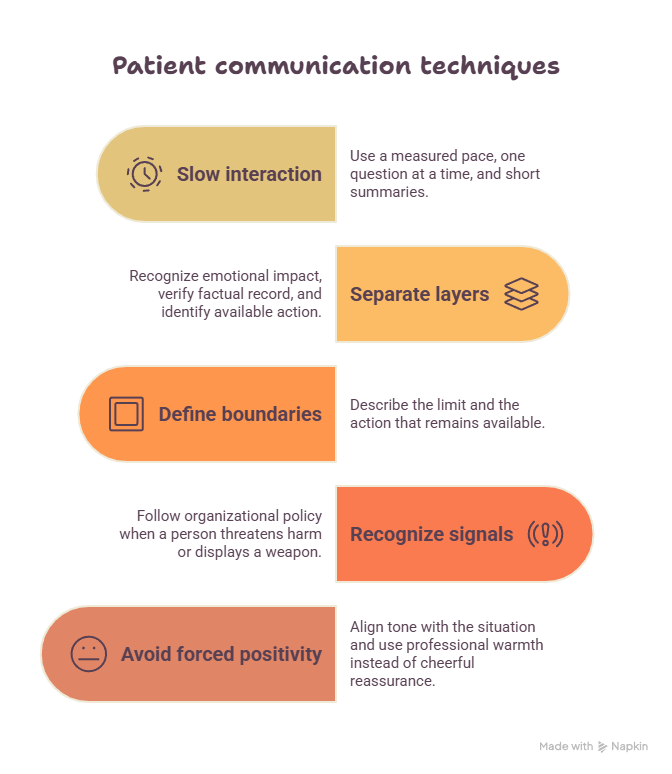
Fast speech and rushed explanations can make an angry or frightened patient feel that staff are trying to end the conversation. Use a measured pace, one question at a time, and short summaries after important details. A staff member can say, “I have three concerns documented: the missing referral, tomorrow’s appointment, and the portal message. I will address them in that order.”
This technique supports accurate medical record updates, efficient medical admin time management, and cleaner front-desk operations. It also reduces the risk that a clinically urgent detail becomes buried inside a long complaint and should therefore connect with medical office triage.
Separate emotion, facts, and action
A productive response handles three layers. First, recognize the emotional impact. Second, verify the factual record. Third, identify the available action. For example: “I understand why the unexpected bill is alarming. I am reviewing the claim and authorization history now. Once I confirm the source of the balance, I will connect you with the correct billing specialist.”
This structure works across denials management, insurance verification, coordination of benefits, and revenue-cycle management. It prevents emotional acknowledgment from replacing investigation and keeps factual correction from sounding cold.
Use boundaries that explain the available help
“I cannot help you” ends the conversation without direction. A boundary should describe the limit and the action that remains available. “I cannot interpret the laboratory result, and I can send the clinical team a priority message asking them to review it with you.” This wording preserves role clarity while keeping the patient connected to the system.
Administrators need defined boundaries for clinical documentation, CPT questions, ICD-10 information, and clinical concerns received through patient communication apps. Training should give staff exact escalation routes so a responsible boundary does not become a dead end.
Recognize safety signals
Anger alone does not automatically establish a safety threat. Staff should follow organizational policy when a person threatens harm, displays a weapon, attempts physical contact, blocks movement, damages property, or describes a medical emergency. Employees should avoid improvising a confrontation and activate the designated clinical, security, or emergency pathway.
A safe response depends on current risk-management strategies, accessible emergency appointment procedures, and rehearsed medical office checklists. Documentation should record observable conduct and actions taken. Neutral records support later patient complaint review without introducing insulting labels or unsupported conclusions.
Avoid forced positivity
Patients facing pain, financial stress, delayed diagnosis, or repeated administrative failures may experience cheerful reassurance as dismissive. Professional warmth can coexist with seriousness. “I am glad you called” may fit a routine question. “I understand that this delay has placed you in a difficult position” fits a high-stakes failure more appropriately.
Tone should align with the situation, the patient’s communication style, and relevant cultural competence practices. Staff can use empathy terminology, active listening skills, and professional de-escalation language to communicate steady support without minimizing the situation.
5. How Medical Offices Can Train and Measure Bedside Manner
Train with scenarios tied to real workflows
Generic customer-service training rarely prepares staff for a disputed copay, delayed pathology result, privacy-sensitive caller, missed authorization, or patient reporting worsening symptoms. Build scenarios from actual workflow failures and require employees to identify the concern, scope boundary, escalation point, privacy risk, and closing action.
Training should connect communication behavior with medical claims processing, appointment scheduling, patient portal management, and medical records release. Role-play should include a second attempt after coaching so staff practice replacing weak language with a reliable response.
Audit behaviors rather than personality
“Be nicer” gives employees no measurable target. Audit whether staff acknowledged the concern, avoided interruption, protected privacy, explained the process plainly, stayed within scope, offered available options, and closed with ownership and timing. These behaviors can be coached consistently across different personalities and communication styles.
CMS patient-experience programs examine communication, responsiveness, care coordination, medication communication, discharge information, and other concrete aspects of healthcare delivery. Practices can use the same operational mindset when designing internal communication audits.
Pair communication observations with patient satisfaction metrics, complaint categories, abandoned calls, repeated portal messages, scheduling errors, and failed handoffs. A strong score should reflect patient understanding and process completion, rather than polished wording alone.
Create a bedside-manner scorecard
A practical monthly scorecard can measure:
concern acknowledged before policy explanation;
identity verified before protected information was discussed;
patient’s main request summarized accurately;
plain language used;
interpreter or accessibility need identified;
clinical or privacy concern escalated correctly;
warm handoff completed;
next step, owner, and timeframe stated;
documentation remained factual and neutral;
promised follow-up completed.
The scorecard should feed into medical chart audits, administrative workflow reviews, medical compliance training, and employee development. A failure pattern across several employees usually points to a process problem, unclear policy, inadequate system access, or weak escalation design.
Give staff usable language under pressure
Employees often know the right principle and struggle to find safe wording during a tense interaction. Create a short script library for common situations:
“Let me make sure I have understood the issue correctly.”
“I can explain the process and verify the current status.”
“That question requires clinical guidance, so I am escalating it to the care team.”
“I need to verify your authorization before discussing the account.”
“I will update you again at 2:30, even when the final answer remains pending.”
“Let us move to a private area so we can discuss this discreetly.”
“The options currently available are these two appointments.”
“My earlier explanation was unclear. I will restate it in a simpler order.”
Embed these scripts within front-desk checklists, healthcare CRM templates, patient communication applications, and new-employee medical administrative training.
Fix systems that repeatedly create hostile interactions
Staff communication cannot compensate indefinitely for inaccessible phone trees, unexplained bills, inconsistent appointment reminders, unanswered portal messages, missing authorizations, or repeated scheduling errors. Review the operational source whenever the same complaint returns.
Use medical admin time-tracking tools to identify repeated rework, EMR troubleshooting procedures to correct routing failures, and medical office productivity practices to define ownership. Strong bedside manner earns trust most effectively when the underlying process also works.
6. Frequently Asked Questions About Bedside Manner for Admin Staff
-
Yes. Patient experience includes interactions with clinicians and staff, access to information, appointment processes, responsiveness, and care coordination. Administrative employees influence these areas through scheduling, check-in, telephone communication, portal management, referrals, billing support, and complaint handling.
Strong administrative bedside manner draws on effective patient communication, front-desk operations, patient intake procedures, and patient satisfaction measurement.
-
Acknowledge the effect on the patient and investigate the process before assigning responsibility. “I understand that receiving conflicting appointment instructions disrupted your plans. I am checking where the information changed and what we can correct now.” The response recognizes harm, preserves factual accuracy, and creates an action.
Staff can use empathy scenarios, difficult-conversation techniques, and complaint-handling procedures to maintain this balance.
-
State the role boundary and immediately provide the appropriate route. “I cannot advise you medically. I can document the concern and connect you with the clinical team.” Symptoms suggesting an urgent or emergency situation should follow the organization’s escalation procedure.
Employees should understand medical office triage terminology, legal responsibilities, emergency appointment management, and approved risk-management protocols.
-
Use a respectful structure: “I want to capture every concern. Let me summarize the first issue, then I will ask about the second.” Write down the issues, confirm their order, and address them one at a time. This gives the patient evidence that the concerns are being retained.
The approach combines active listening, de-escalation, and efficient administrative workflow management. Continued abusive or threatening conduct should follow facility policy and safety procedures.
-
An apology can acknowledge the patient’s experience or a confirmed service failure without making legal conclusions. “I am sorry this delay caused you to miss work” recognizes impact. “Our negligence caused your condition” introduces a legal and clinical conclusion that administrative staff may lack authority to make.
Organizations should provide approved service-recovery language through their medical policies and procedures, risk-management strategy, and patient complaint process.
-
Move the conversation to a private setting, use neutral language, describe the documented balance, and explain available processes without commenting on the patient’s finances. Ask whether the patient would prefer to review the information verbally, in writing, or with an authorized representative.
Accurate discussion may require the explanation of benefits, insurance verification record, claims-processing status, and coordination-of-benefits information.
