

Coordination of Benefits (COB): Interactive Definitions & Examples
Coordination of Benefits determines how medical claims are processed when a patient has two or more sources of health coverage. Accurate COB protects patients from avoidable bills, prevents duplicate payments, and keeps claims from cycling through denials caused by incorrect payer order. Medical administrative teams need command of insurance verification, medical claims processing, Explanation of Benefits terminology, and revenue cycle management to resolve coverage overlaps before they become expensive patient-account problems.
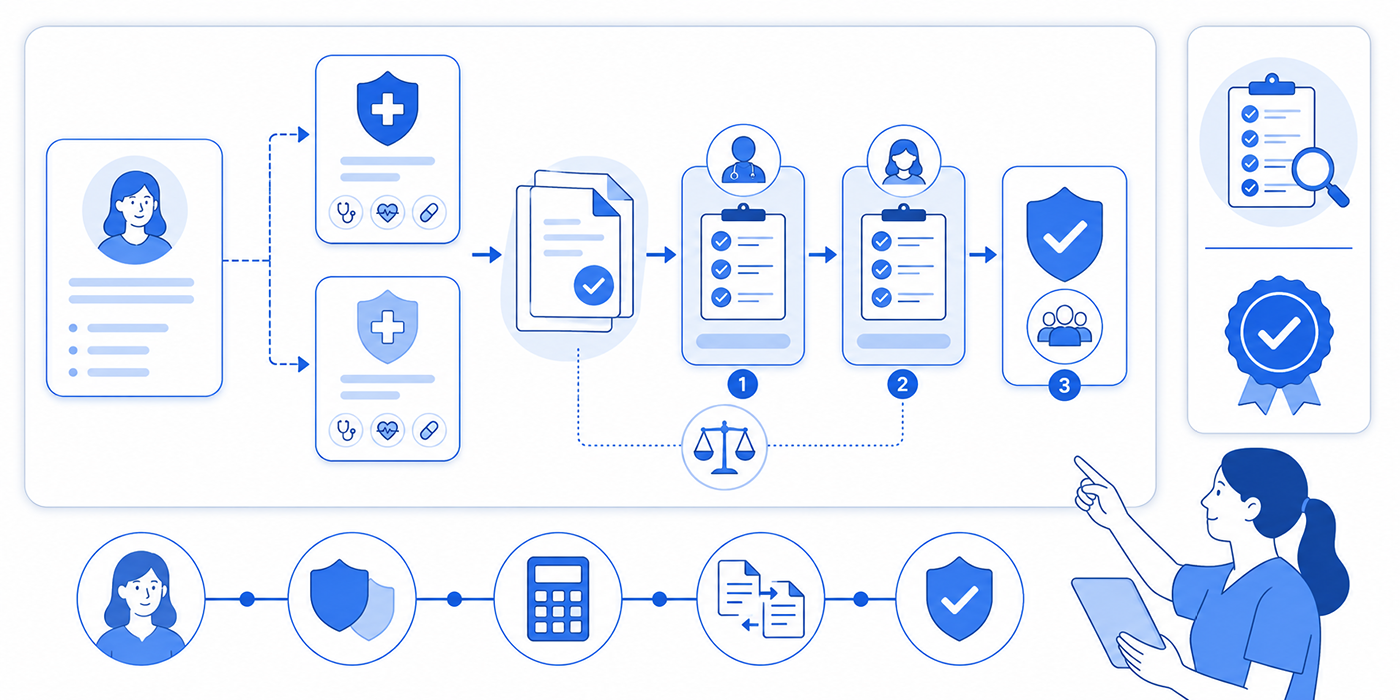
1. How Coordination of Benefits Determines Who Pays First
COB applies when a patient is covered by more than one health plan or another party may be responsible for medical expenses. The process establishes the order in which payers adjudicate the claim. The primary payer processes the claim first under its benefits, network rules, deductible, coinsurance, exclusions, and medical-necessity requirements. The secondary payer reviews the primary payer’s adjudication and determines whether it owes anything under its own contract. A third plan may become the tertiary payer.
Secondary coverage does not guarantee that every remaining dollar will be paid. The secondary plan may exclude the service, apply its own allowed amount, require authorization, reject an out-of-network provider, or calculate benefits using a nonduplication provision. Patients can therefore retain responsibility after both plans process the claim. The correct sequence must be established during patient intake, confirmed through insurance eligibility verification, and carried accurately into the medical administrative workflow. CMS similarly defines COB as the order determining which payer pays first and which may pay second.
COB errors usually begin with incomplete data rather than complicated mathematics. A registration specialist may collect one insurance card while overlooking coverage through a spouse, parent, former employer, Medicare, Medicaid, workers’ compensation, automobile insurer, or court order. The claim then reaches the wrong payer, generates a rejection, misses the correct payer’s filing deadline, and returns to the patient as a confusing balance.
Strong front-desk operations therefore capture the policyholder’s name, relationship to the patient, plan type, member ID, group number, effective dates, employer status, accident details, and any other coverage. Teams should integrate those questions into daily office checklists, healthcare CRM records, patient communication workflows, and reliable EMR integration tools.
For commercial plans, common order-of-benefit rules begin with the patient’s coverage status. Coverage held in the patient’s own name generally pays before coverage held as a dependent. When a child is enrolled under both parents, many plans use the birthday rule: the plan of the parent whose month and day of birth occur earlier in the calendar year pays first. The birth year does not determine the result. When both parents share the same birthday, length of coverage may break the tie.
Court orders, separation arrangements, custody, continuation coverage, active employment, retirement status, and plan-specific language can change the result. The NAIC Coordination of Benefits Model Regulation places a known court decree ahead of the ordinary birthday rule in specified dependent-child situations. It also contains rules for active versus retired employee coverage, COBRA continuation coverage, and length of coverage. State requirements and the actual plan documents still need verification because a model rule does not replace the controlling contract or jurisdictional law.
Government coverage introduces additional layers. Medicare Secondary Payer rules require providers billing Medicare to determine whether another payer has primary responsibility. Medicare may pay second in situations involving certain employer group health plans, liability insurance, no-fault insurance, and workers’ compensation. Medicaid generally operates as payer of last resort, meaning liable third parties must meet their payment obligations before Medicaid pays applicable covered services.
The following interactive table converts COB terminology into practical checkpoints. Staff can use it alongside medical billing terminology, the CPT reference guide, the ICD-10 dictionary, and the insurance claims tutorial.
| # | COB Term or Checkpoint | Practical Definition | Example or Failure Signal | Administrative Action |
|---|---|---|---|---|
| 1 | Primary payer | The plan or liable party required to adjudicate the claim first. | A spouse’s plan is incorrectly billed before the patient’s own employer plan. | Confirm coverage order during insurance verification. |
| 2 | Secondary payer | The plan that considers the balance after receiving the primary payer’s adjudication data. | The secondary claim is submitted without the primary EOB. | Follow the complete claims-processing workflow. |
| 3 | Tertiary payer | A third payer that considers eligible remaining charges after the first two plans process. | The tertiary plan receives incomplete payment information from the secondary payer. | Record every adjudication in the patient account history. |
| 4 | Order of benefits | The rule-based sequence identifying which plan processes first, second, and third. | Two payers each claim the other plan is primary. | Review plan documents through a controlled risk-management process. |
| 5 | Other health insurance | Any additional policy or program that may cover the patient’s medical expenses. | A patient reports Medicare after a commercial claim has already been denied. | Add recurring coverage questions to patient intake procedures. |
| 6 | Subscriber | The person whose eligibility or enrollment establishes coverage under the policy. | The claim lists the dependent as the subscriber, causing a member mismatch. | Validate subscriber data through front-desk controls. |
| 7 | Dependent coverage | Coverage received through a parent, spouse, or another eligible subscriber. | The patient’s dependent plan is billed before coverage held in the patient’s own name. | Document the relationship within the healthcare CRM record. |
| 8 | Birthday rule | A common rule using the parents’ birth month and day to order a child’s dual coverage. | Staff incorrectly compare the parents’ ages or birth years. | Verify the rule against both plans and written office policy. |
| 9 | Court-order rule | A custody or support order may assign responsibility for a child’s health coverage. | The birthday rule is used despite a known decree assigning responsibility. | Escalate sensitive records through CMAA legal procedures. |
| 10 | Active employee rule | Coverage linked to active employment commonly precedes coverage based on retirement or layoff. | Retiree coverage is billed before an applicable active employee plan. | Confirm employment status during benefit verification. |
| 11 | Continuation coverage | Coverage retained under COBRA or another continuation right after qualifying coverage changes. | Staff assume continuation coverage automatically pays before every other plan. | Check policy terms before completing the administrative workflow. |
| 12 | Length-of-coverage rule | A tie-breaking rule that may make the plan covering the person longer primary. | Plans share the same priority under earlier tests and no tie-breaker is checked. | Record verified effective dates in the appointment record. |
| 13 | Allowed amount | The maximum amount a plan recognizes for a covered service under its rules. | Staff assume the secondary plan will calculate payment from the provider’s full charge. | Compare adjudication data through the EOB reference. |
| 14 | Patient responsibility | The amount assigned to the patient after all applicable payers adjudicate the claim. | The patient is billed before the secondary payer finishes processing. | Hold statements according to documented billing policy. |
| 15 | Deductible | The covered amount a member may need to pay before plan benefits apply. | The secondary payer receives the charge without the primary deductible allocation. | Transmit complete data through the healthcare clearinghouse. |
| 16 | Coinsurance | A percentage of the plan’s recognized amount assigned under the benefit structure. | Staff calculate coinsurance manually from the billed charge. | Use payer adjudication shown on the Explanation of Benefits. |
| 17 | Copayment | A fixed member cost that may apply to a covered visit, service, or prescription. | The office refunds or rebills the copayment before secondary processing is complete. | Follow a consistent payment-collection workflow. |
| 18 | Primary EOB | The primary payer’s explanation of how the claim was processed. | Payment, adjustment, denial, and patient-responsibility details are missing. | Retrieve and interpret the primary EOB correctly. |
| 19 | Remittance advice | The provider-facing adjudication record explaining payments, adjustments, and claim messages. | Staff rely on the patient’s EOB while ignoring provider-level adjustment data. | Reconcile the remittance within revenue cycle management. |
| 20 | COB claim | A secondary claim carrying adjudication information from the earlier payer. | The secondary payer receives a clean primary-style claim with no COB segments. | Validate submission fields through the claims-processing guide. |
| 21 | Crossover claim | A claim transmitted from Medicare to a participating supplemental payer after Medicare adjudication. | Staff resubmit a claim that has already crossed over, creating a duplicate. | Check crossover status through the clearinghouse workflow. |
| 22 | Medicare Secondary Payer | A situation in which another insurer or liable entity must pay before Medicare. | Medicare receives the claim as primary despite active employer or accident coverage. | Train staff through medical billing terminology. |
| 23 | Conditional payment | A Medicare payment that may later be recovered when another payer had primary responsibility. | The account is closed without tracking a known liability or workers’ compensation case. | Escalate recovery risk through formal risk controls. |
| 24 | Medicaid payer of last resort | Other legally liable coverage generally pays before Medicaid. | Medicaid is billed while commercial coverage remains active. | Check third-party coverage through eligibility verification. |
| 25 | Third-party liability | The legal obligation of another entity to pay some or all healthcare expenses. | An accident-related claim is sent only to health insurance. | Capture accident details during patient intake. |
| 26 | Subrogation | A payer’s contractual or legal right to recover from a responsible third party. | A settlement occurs without the applicable payer’s recovery interest being addressed. | Route the case through legal-responsibility protocols. |
| 27 | Duplicate payment | Two payers reimburse overlapping amounts beyond the coordinated benefit calculation. | The account shows a credit after both plans pay independently. | Investigate credits through the revenue cycle process. |
| 28 | COB denial | A rejection caused by missing, outdated, or conflicting information about other coverage. | The payer requests another insurer’s EOB or termination date. | Apply the denial-management workflow. |
| 29 | Timely filing limit | The deadline for submitting an initial or corrected claim to a payer. | Repeated primary denials consume the secondary payer’s filing window. | Track deadlines with medical admin time-tracking tools. |
| 30 | Final account reconciliation | The comparison of charges, payments, adjustments, refunds, and valid patient responsibility after all payers finish. | The account is billed, refunded, or written off before secondary adjudication closes. | Complete reconciliation through daily office controls. |
2. Essential COB Terms and the Differences That Prevent Denials
Primary insurance refers to the plan that must adjudicate first. The term describes payment order rather than generosity. A primary plan can deny the service, apply the entire allowed amount to a deductible, or pay nothing because authorization was missing. The provider must still obtain that adjudication before the secondary plan can accurately calculate its responsibility.
This distinction matters because staff sometimes send a claim directly to the plan expected to pay more. That shortcut can produce a COB denial, consume the filing window, and force the patient to navigate conflicting insurer instructions. Accurate claims sequencing, strong denial management, precise insurance verification, and timely patient record updates prevent this error.
Secondary insurance evaluates eligible balances after primary adjudication. It may consider the primary deductible, coinsurance, copayment, or denied amount according to its own benefit design. Its payment can be limited by the secondary plan’s allowed amount, coverage exclusions, network provisions, and coordination methodology. Staff should avoid quoting a guaranteed secondary payment before receiving the secondary remittance.
Allowable expense is a COB concept describing an expense recognized by the applicable plan for coordination purposes. It may differ from the provider’s charge and from another plan’s allowed amount. Two payers can recognize different amounts for the same CPT-coded service. A reliable review compares the billed charge, primary allowance, contractual adjustment, primary payment, patient responsibility, and secondary calculation through the EOB terminology guide, CPT code reference, superbill workflow, and clearinghouse submission record.
Nonduplication of benefits limits secondary payment to prevent combined plan payments from exceeding the amount permitted under the coordination provision. Another method may calculate the secondary plan’s normal benefit and reduce it by what the primary plan paid. The exact method belongs to the plan contract, so staff should document the payer’s explanation rather than promise that dual coverage eliminates all out-of-pocket cost.
COB and third-party liability overlap while addressing different questions. COB organizes payment among health plans or other coverage sources. TPL identifies another person, insurer, employer, program, or entity with a legal obligation to pay. An automobile insurer, workers’ compensation carrier, liability settlement, court-ordered policy, or long-term care insurer can become relevant. Medicaid programs use COB and TPL processes to identify legally liable third parties and enforce Medicaid’s payer-of-last-resort position.
Subrogation concerns recovery after a health plan pays expenses that another party should ultimately bear. Crossover concerns transmission of adjudicated claim information to another payer. Medicare’s COBA program standardizes the exchange of eligibility and Medicare-adjudicated claim data with participating supplemental payers. In many cases, Medicare automatically crosses an eligible claim to the supplemental insurer, reducing the need for a separate provider submission.
These distinctions should appear in medical administrative policies, staff training checklists, medical billing terminology education, and CMAA exam preparation. Teams that merge these terms into a single “other insurance” category struggle to diagnose why the account remains unpaid.
3. Step-by-Step COB Workflow With Practical Examples
Begin by collecting complete coverage information before the encounter. Ask whether the patient has insurance through personal employment, a spouse, a parent, retirement, Medicare, Medicaid, military benefits, continuation coverage, workers’ compensation, or an automobile or liability claim. Ask whether any coverage changed after the previous visit. Patients may think an old policy disappeared automatically from every payer database even when stale information continues to affect claims.
Verify each plan independently. Confirm active status, effective and termination dates, subscriber relationship, plan type, network status, benefits, authorization requirements, and the payer’s recorded COB order. Document the payer reference number and representative guidance. Incorporate these fields into front-desk checklists, appointment scheduling procedures, secure scheduling tools, and healthcare portal workflows.
Next, determine the order using the first applicable rule. Consider whether the patient holds one plan in their own name and another as a dependent. For a child under two parental plans, check court-order terms and the plans’ dependent-child rules before applying the birthday rule. When coverage involves active employment, retirement, continuation coverage, Medicare, or Medicaid, use the applicable program-specific rules.
Example 1: Adult with personal and spousal coverage.
Maria has coverage through her own employer and also appears as a dependent under her spouse’s plan. Her own employer plan will commonly process first because it covers her as the employee or subscriber. Her spouse’s plan then evaluates the primary adjudication. Staff should send the secondary claim with the primary EOB or complete electronic COB data.
Example 2: Child covered by both parents.
One parent’s birthday is February 18 and the other’s is October 4. Under a plan using the standard birthday rule, the February birthday plan processes first. The parents’ ages have no role. A court decree or plan-specific rule could change the outcome, so staff should verify rather than hard-code assumptions. The NAIC model uses the earlier month and day and applies separate provisions when a known decree assigns responsibility.
Example 3: Primary plan applies the charge to a deductible.
The provider bills $300. The primary plan allows $220 and applies that amount to the member’s deductible. The secondary payer receives the $220 primary allowance, the primary adjustment, and the deductible allocation. It then applies its own rules. Staff should avoid billing the patient until the secondary plan completes adjudication unless a documented workflow permits a justified deposit or interim collection.
Example 4: Primary plan denies for missing authorization.
The secondary plan may also deny because the service failed the primary plan’s authorization requirements or because the secondary plan requires its own authorization. Secondary coverage rarely cures a preventable administrative failure. Teams should connect COB review with the prior authorization workflow, insurance claims tutorial, medical office triage process, and revenue cycle controls.
After primary processing, inspect the remittance before creating the secondary claim. Confirm the payer processed the correct patient, provider, service date, CPT code, modifier, diagnosis, units, and billed amount. Identify every adjustment reason. A COB submission carrying inaccurate primary data simply transfers the error downstream.
CMS describes a COB claim as one sent to a secondary payer with adjudication information from the prior payer. The claim may move from provider to payer to payer or from provider directly to the secondary payer. HIPAA-adopted transaction standards support these exchanges among covered entities.
Track the secondary claim until it pays, denies, requests information, or confirms no additional benefit. Then reconcile the account. Compare all payer payments, contractual adjustments, deductible allocations, coinsurance, copayments, denials, refunds, and patient responsibility. Use medical admin time-tracking tools, collaboration tools, EMR productivity shortcuts, and office organization systems to prevent secondary claims from disappearing into unowned work queues.
4. High-Risk COB Scenarios That Require Extra Verification
Medicare coordination creates high financial exposure because ordinary commercial-plan assumptions may produce the wrong order. Medicare Secondary Payer rules apply when another entity has responsibility before Medicare. Providers billing Medicare must determine whether Medicare is primary for the specific services. Relevant scenarios can include employer group health coverage, workers’ compensation, liability insurance, and no-fault insurance.
Staff should verify the reason for Medicare entitlement, current employment status, spouse’s employment, employer size when relevant, accident information, and the type of other coverage. A retired patient’s former-employer plan may coordinate differently from an active employee group plan. An account that simply labels both plans “active” lacks the facts needed to determine primacy.
CMS advises beneficiaries to keep Medicare’s coverage record updated when employment or insurance changes. The Benefits Coordination & Recovery Center gathers coverage information from beneficiaries, providers, employers, and health plans. Incorrect data can delay claims or make Medicare pay in the wrong position.
Connect Medicare review with patient intake verification, patient communication apps, healthcare portal terminology, and medical records release tools. Patients often need clear guidance about which organization can correct which record.
Medicaid accounts require systematic third-party screening. Medicaid beneficiaries can have commercial insurance, Medicare, court-ordered coverage, workers’ compensation, liability coverage, long-term care insurance, or other programs. State Medicaid agencies use eligibility information and data matching to identify third parties with possible payment responsibility.
Billing Medicaid first when another payer remains liable can trigger rejection, recoupment, or delayed reimbursement. Staff should examine the commercial payer’s EOB, verify whether the service is covered by Medicaid, and apply the state program’s crossover or secondary-billing requirements. This work belongs within medical claims management, clearinghouse procedures, denial management, and medical billing controls.
Accident-related encounters demand questions that routine eligibility checks may miss. Determine whether the condition resulted from a workplace injury, automobile collision, premises incident, product injury, or another event involving a liable party. Record the date, location, injury mechanism, employer, claim number, adjuster, insurer, attorney involvement, and affected body regions. Avoid assigning unrelated services to the accident claim.
Privacy still applies during COB investigation. Staff should share only information permitted for payment and operations and follow organizational procedures when communicating with employers, attorneys, family members, adjusters, or other insurers. Use HIPAA privacy terminology, patient privacy communication guidance, legal responsibility protocols, and risk-management strategies.
Newborn and pediatric claims produce recurring birthday-rule errors. Both parents may enroll the child immediately, the hospital may receive incomplete enrollment information, and one plan may initially process without knowing the second exists. When the insurers later update COB, earlier payments can be reversed. Staff should confirm the child’s final member IDs, coverage effective dates, both parents’ birthdays, custody or court-order information when relevant, and which plan has formally accepted primary status.
Secondary claims can also fail because primary data was transformed incorrectly. Common defects include missing payer-paid amounts, incorrect adjustment reason codes, inconsistent billed charges, mismatched service lines, altered units, duplicate claim indicators, or a primary denial uploaded as an unreadable attachment. A disciplined EMR issue-resolution process, reliable collaboration tools, clear office policies, and focused time management prevent repeated resubmission without diagnosis.

5. Building a COB System That Prevents Repeat Errors
An effective COB system assigns ownership before a claim fails. Registration collects and validates coverage relationships. Eligibility staff verify effective dates and payer-recorded order. Authorization staff confirm requirements under each relevant plan. Billing staff submit in sequence. Payment posters reconcile adjudication data. Denial specialists correct conflicts. Supervisors track recurring causes, payer behavior, and unresolved patient accounts.
Create a standardized COB questionnaire rather than relying on “Do you have any other insurance?” Patients may answer no because they view Medicare as a government benefit, forget dependent coverage, assume a former plan ended, or separate accident insurance from health insurance. Ask focused questions about personal employment, spouse coverage, parent coverage, retirement, Medicare, Medicaid, continuation coverage, workplace injuries, automobile accidents, and legal claims.
Build required fields into patient intake procedures, front-desk operations, appointment scheduling workflows, and virtual patient management. Remote and telehealth encounters need the same coverage discipline as in-person services.
Maintain a COB evidence log. Record which payer confirmed the order, the confirmation date, reference number, representative or portal source, coverage dates, reason for primacy, documents received, open issues, and next action. When payers disagree, the log gives staff a defensible record and prevents every employee from restarting the investigation.
Use work queues based on account status:
Coverage information incomplete
Primacy verification pending
Primary claim awaiting adjudication
Secondary claim ready to submit
Primary EOB missing
Payer COB record requires correction
Accident or liability documentation pending
Secondary denial under review
Refund or duplicate payment review
Patient responsibility ready for final billing
Connect these queues with medical admin time tracking, staff scheduling tools, medical office collaboration platforms, and office productivity systems. Every queue needs an owner, aging threshold, escalation rule, and closure definition.
Audit COB performance using meaningful measures. Track the percentage of registrations with complete other-insurance screening, claims denied for COB, average days between primary and secondary submission, secondary clean-claim rate, unresolved payer-order conflicts, timely filing losses, duplicate payments, refunds, and patient statements issued before final adjudication. Segment results by payer, location, employee, encounter type, and failure cause.
A high denial count may reflect one payer’s stale records rather than poor staff performance. A low denial count may hide accounts held indefinitely without submission. Combine volume, aging, payment, denial, and reconciliation metrics. Use predictive analytics in medical administration, AI and automation guidance, emerging technology training, and future-proofing skills carefully, with human validation of automated payer-order suggestions.
Patient communication completes the system. Explain that multiple policies must process in a defined sequence and that additional coverage may reduce the balance without guaranteeing full payment. Tell the patient what information is missing, which payer needs it, what deadline matters, and whether the office or patient must act. Techniques from active listening, difficult-conversation management, de-escalation training, and effective patient communication prevent a technical billing issue from becoming a trust failure.
6. Frequently Asked Questions About Coordination of Benefits
-
COB is the process used to determine payment order when a patient has more than one health plan or another responsible payer. The primary payer adjudicates first, and the secondary payer uses the first payer’s adjudication information to calculate any additional benefit. CMS describes COB claims as secondary claims containing prior-payer adjudication data.
Staff should connect COB with insurance verification, medical claims processing, EOB interpretation, and denial management.
-
Start with how the patient is covered. A plan covering the person as an employee, subscriber, or policyholder generally precedes a plan covering the same person as a dependent. For children covered under both parents, many plans use the birthday rule, subject to court orders and plan provisions. Active employment, retirement, continuation coverage, Medicare, Medicaid, liability, and workers’ compensation can introduce different rules.
Verify the final decision with each payer and record the evidence. Use patient intake questions, front-desk checklists, medical administrative policies, and risk-management procedures.
-
The secondary payer calculates benefits under its own contract and coordination rules. It may pay part, all, or none of the remaining amount. Coverage limitations, allowed amounts, network rules, authorization requirements, exclusions, deductibles, and nonduplication provisions can affect the result.
Review the primary Explanation of Benefits, confirm the CPT-coded service, inspect the superbill data, and reconcile the secondary claims response.
-
The birthday rule commonly determines primary coverage for a child enrolled under both parents’ plans. The plan of the parent whose birthday falls earlier in the calendar year processes first. Only the month and day are compared. When the birthdays match, the plan covering the parent longer may become primary.
Court decrees and plan-specific rules can override the ordinary sequence. The NAIC model includes separate rules for parents who are divorced, separated, or living apart and for decrees assigning responsibility.
-
Medicare can serve as primary or secondary depending on the circumstances. Employer group health coverage, workers’ compensation, no-fault insurance, liability insurance, and other situations can place payment responsibility elsewhere before Medicare. Providers billing Medicare must determine whether Medicare is primary for the services supplied.
Use current information from the patient, payer, employer, and Medicare coverage record. Connect this review with insurance verification, medical billing terminology, legal responsibility guidance, and patient communication standards.
-
Medicaid generally functions as payer of last resort. State Medicaid agencies identify other parties that may have a legal obligation to pay, including commercial plans, Medicare, court-ordered coverage, workers’ compensation, liability insurers, and other programs.
Accurate reporting prevents claims from being paid in the wrong order. Staff should verify third-party coverage through patient intake, claims processing, clearinghouse workflows, and denial-management controls.
