

Clearinghouses in Healthcare: Essential Terms & Interactive Guide
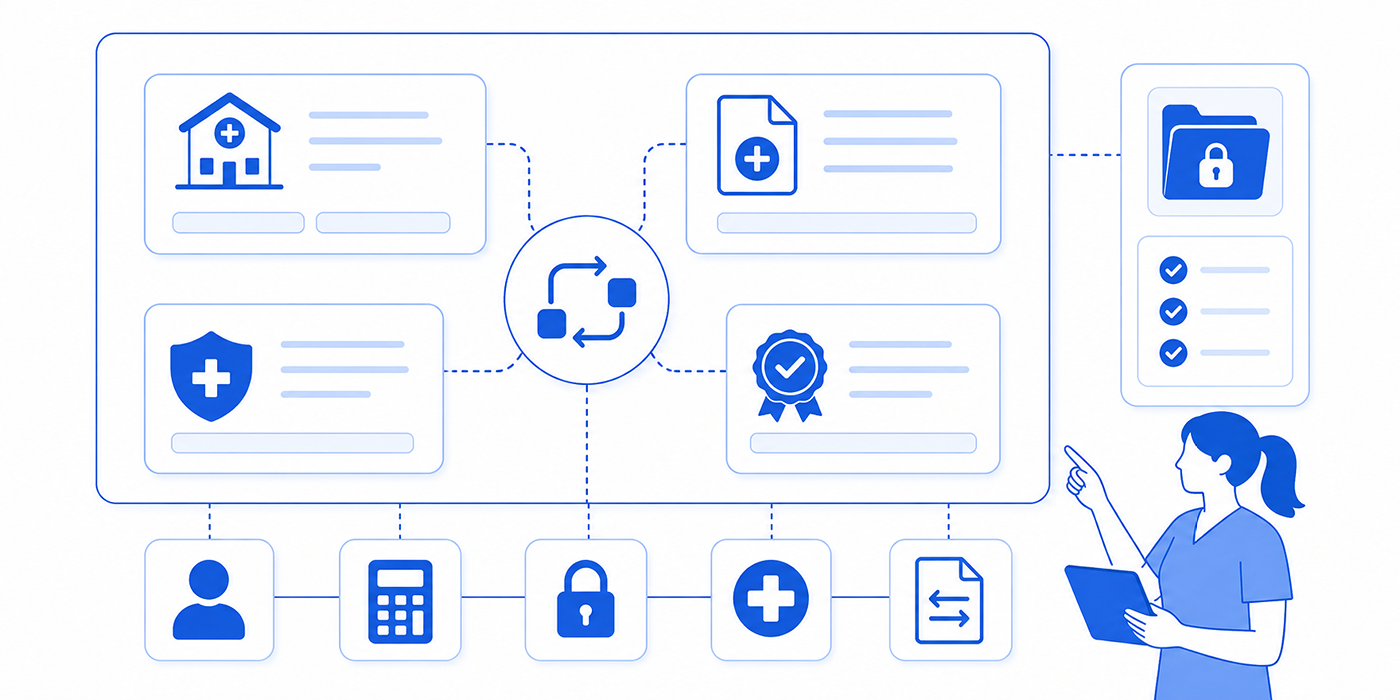
Healthcare clearinghouses connect medical practices, billing systems, and health plans by validating, translating, routing, and reporting electronic transactions. Their reports influence whether an insurance claim reaches the payer, whether an eligibility inquiry returns usable information, and whether an electronic remittance posts correctly.
Administrative teams often lose revenue because they confuse file receipt, clearinghouse acceptance, payer acceptance, adjudication, rejection, and denial. This guide turns those technical stages into practical revenue-cycle controls that protect cash flow, reduce rework, and expose hidden claim failures.
1. What a Healthcare Clearinghouse Does Between the Practice and the Payer
A healthcare clearinghouse processes health information received from another organization by converting nonstandard data into a standard format, converting standard data into another required format, or performing related transaction-processing functions. HIPAA identifies healthcare clearinghouses as covered entities. Clearinghouses also commonly perform services for healthcare providers or health plans as business associates when they process protected health information on their behalf.
In a typical claims workflow, information originates in the practice’s patient intake process, moves through EMR documentation, becomes a coded charge through CPT-related workflows, and enters the practice-management or billing platform. The clearinghouse then receives the electronic transaction, performs configured edits, translates formats when required, routes it to the identified payer, and returns acknowledgments or reports.
A clearinghouse can identify structural and data problems before the claim enters the payer’s adjudication system. Examples include an invalid payer ID, missing subscriber information, inconsistent provider identifiers, unsupported characters, absent claim segments, or an improperly formatted transaction. This early detection supports cleaner insurance-claim management, more accurate patient-record updates, and faster denial prevention.
The clearinghouse cannot guarantee payment. Several separate checkpoints remain:
The billing system creates the file.
The clearinghouse receives the file.
Technical and business edits evaluate the transaction.
The clearinghouse routes accepted transactions to the payer.
The payer’s front-end system accepts or rejects the claim.
The payer adjudicates accepted claims.
The payer issues payment, adjustment, denial, or an information request.
The practice receives the remittance and reconciles the payment.
A status reading “accepted” may describe clearinghouse acceptance, transaction-set acceptance, payer front-end acceptance, or entry into adjudication. Staff must identify which system issued the status and what operational action follows. This distinction should be embedded in medical billing training, medical office policies, and revenue-cycle time management.
CMS’s Administrative Simplification program establishes standards, operating rules, code sets, and identifiers for covered electronic healthcare transactions. Core transaction categories include claims, eligibility and benefits, claim status, healthcare services review, payment and remittance advice, and coordination of benefits.
A strong clearinghouse workflow therefore extends beyond clicking “submit.” It requires daily report review, documented error ownership, payer-enrollment maintenance, ERA reconciliation, claim-status follow-up, security controls, and measurable escalation rules. Without those controls, staff may repeatedly correct the same errors while managers see only a growing accounts-receivable balance.
The X12 healthcare transaction flow includes 837 claims, 270/271 eligibility exchanges, 276/277 claim-status exchanges, 278 healthcare services review, and 835 claim payment or remittance advice. CMS materials also distinguish acknowledgment transactions such as TA1, 999, and 277CA, which help report different levels of transaction acceptance or rejection.
| # | Clearinghouse Term | Essential Meaning | Practical Use | Control Question |
|---|---|---|---|---|
| 1 | Healthcare clearinghouse | An organization that processes, standardizes, translates, or routes healthcare transactions. | Connects provider systems with multiple payers through a controlled transaction network. | Which transactions and payers does the contract actually support? |
| 2 | Trading partner | An organization authorized to exchange electronic healthcare data with another organization. | A provider, payer, billing service, or clearinghouse may operate as a trading partner. | Are agreements, identifiers, contacts, and responsibilities current? |
| 3 | EDI | Electronic data interchange used to transmit structured business information between systems. | Supports electronic claims, eligibility, claim status, authorization, and remittance workflows. | Can staff trace each transaction from source system to destination? |
| 4 | 837P | The X12 healthcare claim transaction commonly used for professional services. | Transmits claims from physicians, clinics, and other professional providers. | Does the claim contain the payer-specific data required for processing? |
| 5 | 837I | The X12 healthcare claim transaction used for institutional billing. | Transmits hospital and facility-related claim information. | Is the correct institutional claim structure being generated? |
| 6 | 837D | The X12 healthcare claim transaction used for dental claims. | Routes dental services to participating dental payers. | Does the payer accept dental transactions through this route? |
| 7 | 270 | An electronic eligibility and benefits inquiry. | Asks a health plan for coverage and benefit information before service. | Was the inquiry sent for the correct patient, provider, and service date? |
| 8 | 271 | The electronic response to an eligibility and benefits inquiry. | Returns coverage, benefit, and plan-related information available through the transaction. | Which response details still require manual verification? |
| 9 | 276 | An electronic healthcare claim-status request. | Requests information about a previously submitted claim. | Are the claim identifiers sufficient for the payer to locate it? |
| 10 | 277 | An electronic claim-status response or related status-notification transaction. | Communicates claim status, pending information, or another defined status response. | Does the status require correction, documentation, or continued follow-up? |
| 11 | 278 | An electronic healthcare services review transaction. | May support authorization, certification, referral, or service-review exchanges. | Does the payer accept this transaction electronically for the requested service? |
| 12 | 835 | The X12 healthcare claim payment and remittance-advice transaction. | Explains payments, adjustments, denials, and patient-responsibility amounts. | Can the billing system post and reconcile every transaction accurately? |
| 13 | ERA | Electronic remittance advice containing claim-payment and adjustment information. | Supports automated or assisted payment posting and denial identification. | Are all expected remittance files being received? |
| 14 | EFT | Electronic funds transfer used to deliver claim payments to a provider’s bank. | Moves the financial payment associated with the remittance information. | Can each deposit be matched with its corresponding ERA? |
| 15 | TA1 | An interchange-level acknowledgment that can report acceptance or structural rejection. | Identifies certain envelope or interchange problems before claim-level processing. | Was the complete affected interchange corrected and resubmitted? |
| 16 | 999 acknowledgment | An implementation acknowledgment reporting transaction-set compliance or rejection. | Shows whether the electronic file met required implementation and syntax rules. | Does the report identify accepted and rejected transaction sets separately? |
| 17 | 277CA | A claim acknowledgment reporting acceptance or rejection at the claim level. | Helps staff locate claims that failed before adjudication. | Has every rejected claim been corrected and tracked through resubmission? |
| 18 | Submitter ID | An identifier assigned to the entity transmitting electronic transactions. | Connects a submitted file with an approved provider, vendor, or billing service. | Is the submitter authorized for the payer and transaction type? |
| 19 | Receiver ID | An identifier representing the intended transaction recipient. | Routes a file to the correct payer, contractor, or processing destination. | Does the selected receiver match the payer’s current routing instructions? |
| 20 | Payer ID | A routing identifier used to direct transactions to a specific health plan or processing route. | Prevents claims from being sent to the wrong electronic destination. | Has the payer ID changed by product, state, network, or claim type? |
| 21 | NPI | The National Provider Identifier used in covered healthcare transactions. | Identifies individual and organizational healthcare providers. | Is the correct billing, rendering, referring, or service-facility NPI reported? |
| 22 | Taxonomy code | A code describing a provider’s classification or specialization. | May support provider identification and payer processing requirements. | Does the submitted taxonomy align with payer enrollment? |
| 23 | Claim scrubber | An automated rules engine that checks claims for defined errors before submission. | Flags missing, inconsistent, or payer-sensitive information. | Which edits produce useful prevention, and which create unnecessary holds? |
| 24 | Front-end rejection | A claim failure occurring before adjudication begins. | Requires correction and valid resubmission rather than a clinical appeal. | Has the claim reached the payer’s adjudication system? |
| 25 | Claim denial | An adverse adjudication outcome after the payer processes the claim. | May require correction, reconsideration, appeal, additional information, or contractual review. | What root cause and deadline govern the next action? |
| 26 | Companion guide | A payer or program document clarifying specific transaction and data requirements. | Supplements the applicable implementation guide for a particular trading partner. | Are staff using the current guide for the correct transaction? |
| 27 | Batch transaction | A file containing multiple transactions processed together. | Supports high-volume claim, eligibility, or remittance exchange. | Can staff isolate one failed claim from the larger batch? |
| 28 | Real-time transaction | An exchange designed to return a response during an active system session. | Frequently supports immediate eligibility or claim-status inquiries. | How does the workflow handle unavailable or incomplete responses? |
| 29 | Trading-partner enrollment | The registration and approval required before electronic exchange begins. | Authorizes providers, vendors, identifiers, transactions, and delivery methods. | Who owns enrollment changes after a tax ID, bank, vendor, or location update? |
| 30 | Encryption | A security method that protects data by making it unreadable without authorized access. | Protects transaction data during transmission and storage. | Which approved encryption and access controls cover each connection? |
| 31 | CARC | A Claim Adjustment Reason Code explaining why an amount was adjusted. | Helps classify contractual, payer, patient-responsibility, or other adjustments. | Is the adjustment posted to the correct responsibility category? |
| 32 | RARC | A Remittance Advice Remark Code supplying additional explanation. | Adds context to a claim adjustment or payment decision. | Does the remark identify a missing document or required action? |
| 33 | TRN reassociation number | A trace value used to match an EFT payment with its corresponding ERA. | Supports deposit reconciliation and automated payment posting. | Are unmatched payments and remittances reviewed every day? |
| 34 | Timely filing limit | The deadline established for submitting a claim or corrected claim. | Determines how long the practice has to complete valid submission. | Are rejected claims aging toward an irreversible deadline? |
| 35 | Acceptance rate | The percentage of submitted claims passing a defined processing checkpoint. | Measures clearinghouse or payer front-end submission quality. | Which acceptance point does the metric represent? |
| 36 | Exception queue | A controlled worklist for transactions requiring manual investigation. | Separates actionable failures from successfully transmitted work. | Does every exception have an owner, deadline, and next action? |
2. Essential Clearinghouse Terms That Prevent Expensive Status Confusion
The greatest clearinghouse mistake is treating every acceptance message as proof that the payer possesses a payable claim. Transaction status must be read as a sequence.
File received confirms that a system obtained the transmitted file. It does not confirm that the file passed structural edits.
Interchange accepted indicates that the outer electronic envelope passed the applicable checkpoint. Individual transaction sets or claims may still fail later.
Transaction accepted means the relevant transaction set passed the reported implementation-level checks. Claim-level errors may remain.
Claim accepted by the clearinghouse means the clearinghouse’s configured edits permitted routing. The payer’s edits, enrollment records, and adjudication logic still apply.
Payer accepted generally means the payer’s front-end system admitted the claim for further processing. Payment remains dependent on adjudication, coverage, coding, documentation, contractual rules, and benefits.
Teams should display these stages inside their insurance claims workflow, connect them to denial-management procedures, and reinforce them through CMAA billing terminology. A report marked “processed” needs a precise system-specific definition before staff close the task.
Rejection and denial require different responses. A front-end rejection generally indicates that the claim failed before adjudication. Staff correct the data or transaction problem and submit a valid claim. A denial follows adjudication and may require correction, reconsideration, an appeal, supporting records, authorization review, coding investigation, or contractual analysis. Combining both outcomes inside one work queue hides deadlines and causes staff to use the wrong resolution process.
Companion guides translate standards into trading-partner requirements. CMS explains that its Medicare Fee-for-Service companion guides clarify and supplement specific data-content requirements while operating alongside the relevant X12 implementation guides. Billing teams may need assistance from software vendors, billing companies, or clearinghouses when implementing those technical instructions.
A practical medical office policy should identify who monitors guide changes, who updates EMR integrations, who tests new edits, and who trains the billing team. Otherwise, payer changes first appear as a sudden spike in rejected claims.
Claim edits also require ownership. A registration edit belongs with the team capable of correcting demographic or insurance data. A provider-enrollment edit may require credentialing support. A coding edit should reach authorized coding personnel. A missing-document problem may involve medical records workflows, while an authorization problem belongs in the insurance follow-up process.
Sending every error to one biller produces unnecessary investigation. The biller becomes a human router, urgent claims age beside minor formatting issues, and root causes remain invisible. Error categories should direct work to the team that controls the source data.
3. Practical Clearinghouse Scenarios From Submission to Payment
Scenario 1: The clearinghouse accepts a claim, but the payer reports no record
Begin with the clearinghouse transmission report. Confirm the payer ID, claim-control information, routing destination, date transmitted, and downstream acknowledgment. “Accepted” may indicate completion of the clearinghouse edit stage while leaving payer delivery or payer-front-end acceptance unresolved.
The employee should avoid immediately sending another claim. First determine whether the original transaction reached the payer. An unsupported duplicate can create further processing problems. Use the claim-status workflow, document the findings in the billing platform, and escalate unexplained routing failures through the clearinghouse support process.
Scenario 2: A complete batch receives a 999 rejection
A batch-level or transaction-set rejection can affect many claims simultaneously. Staff should identify the rejected functional group or transaction set, review the reported syntax or implementation error, determine whether the source lies in the billing system or export configuration, and correct the complete affected submission.
The practice should isolate the claim population, preserve the original submission evidence, record the correction, and verify successful resubmission. Manual correction of one visible claim leaves the remaining batch exposed. Strong EMR troubleshooting, medical office collaboration, and time-tracking controls prevent widespread failures from aging unnoticed.
Scenario 3: The 277CA accepts some claims and rejects others
The batch must be separated into accepted and rejected claim populations. Accepted claims continue through payer processing. Rejected claims enter an exception queue containing the error code, source field, responsible role, timely-filing deadline, correction date, resubmission identifier, and final acceptance evidence.
CMS materials describe the 277CA as a claim-level acknowledgment used to report the data-content status of submitted 837 claims. Clearinghouses and vendors can present those acknowledgment results in customer-facing reports.
Closing the batch as “submitted” hides the rejected claims. A reliable denial-management dashboard, claim tutorial, and medical office organization system preserve claim-level visibility.
Scenario 4: Eligibility returns active coverage, but the claim denies for coverage
A 271 response reflects the information returned for the specific eligibility inquiry. It does not promise payment for every service. Coverage may depend on benefit limitations, network participation, authorization, medical policy, service coding, date-specific enrollment, coordination of benefits, or other payer rules.
Staff should preserve the inquiry date, response, service date, payer, member details, and any reference information. Then compare the denial with the original response and payer guidance. The investigation may involve front-desk verification, insurance claim management, CPT review, and legal administrative responsibilities.
Scenario 5: The payer sends an ERA, but the bank deposit cannot be matched
The team should locate the ERA’s reassociation trace information, compare it with the corresponding EFT addenda data, verify the payment amount and date, and identify whether the deposit contains one or multiple remittances. The transaction should remain in a reconciliation queue until the payment and remittance are matched.
CMS explains that providers use reassociation information to match an EFT payment with the ERA describing that payment. This connection supports accurate accounts-receivable posting and patient-account updates.
A mature workflow assigns unmatched EFTs, missing ERAs, and posting variances to different exception categories. This improves medical billing accuracy, strengthens financial risk management, and supports administrative analytics.
Scenario 6: Claims suddenly reject after a provider or system change
Investigate every variable altered during the change: billing NPI, rendering NPI, tax ID, taxonomy, service location, submitter ID, payer enrollment, bank enrollment, software mapping, clearinghouse connection, and effective date. A successful internal system update does not automatically update payer or clearinghouse records.
Create a controlled change checklist covering patient-record systems, EMR integration settings, medical office procedures, and regulatory requirements. Test a limited claim set before releasing full production volume.
4. How to Evaluate and Implement a Healthcare Clearinghouse
Clearinghouse selection should begin with the practice’s transaction requirements. A vendor may offer excellent professional-claim routing while providing limited dental, institutional, eligibility, authorization, attachment, or ERA support. Create a transaction inventory covering claim types, payer volume, locations, provider identifiers, billing platforms, and required response formats.
Confirm payer connectivity. Ask for a payer list matched to your actual payer IDs, products, states, transaction types, and claim formats. A payer’s name on a marketing list provides limited assurance when different products use different electronic routes. Compare the vendor’s information with payer guidance and your insurance verification process.
Evaluate rejection visibility. Staff should be able to view batch status, claim-level status, error codes, plain-language explanations, payer acknowledgments, submission dates, and correction history. The platform should support filters for payer, provider, location, error type, age, and owner. These controls connect directly with denial management, medical admin analytics, and medical office time tracking.
Examine edit transparency. Ask which edits come from the clearinghouse, payer, implementation guide, companion guide, or provider-specific configuration. Teams need to know whether an edit blocks submission, generates a warning, or predicts a possible denial. Excessive warning noise trains staff to ignore important alerts.
Test integration behavior. Determine how claims, acknowledgments, eligibility responses, ERAs, and status updates move between the clearinghouse and the practice’s EMR integration. Confirm whether corrections occur inside the source billing system or directly in the clearinghouse portal. Direct portal correction may create discrepancies when the source system retains the original error.
Review support escalation. Document support hours, emergency contacts, average response expectations, incident communication, ticket history, and access to transaction specialists. A generic support queue may be inadequate when thousands of claims stop moving before a filing deadline.
Assess security and privacy controls. Healthcare clearinghouses fall within HIPAA’s covered-entity framework, and the Security Rule applies to clearinghouses and covered electronic protected health information. Contracts and workflows should address access, authentication, encryption, incident response, audit activity, retention, subcontractors, and termination procedures.
These controls should align with HIPAA terms for administrative assistants, privacy communication practices, medical scribe compliance, and administrative risk management.
Before launch, run controlled tests for a clean claim, a deliberately defective claim, eligibility, claim status, ERA import, secondary claim, corrected claim, void transaction where supported, and payer-specific enrollment. Record expected and actual results. Production volume should expand only after the team can trace every test transaction from creation through acknowledgment.

5. Clearinghouse Metrics and Troubleshooting Controls That Protect Revenue
A clearinghouse dashboard should reveal where transactions stop. Total claim volume alone cannot show whether claims reached payers, entered adjudication, or returned with actionable errors.
First-pass clearinghouse acceptance rate measures claims passing the clearinghouse’s edits without correction. Segment it by payer, provider, location, claim type, and error category.
Payer front-end acceptance rate measures claims admitted by the payer after routing. Keeping this metric separate from clearinghouse acceptance exposes payer-specific mapping, enrollment, and data problems.
Rejection correction time measures elapsed time from rejection receipt to valid resubmission. High rates combined with slow correction produce avoidable filing risk.
Unworked rejection count identifies failures with no assigned owner or next action. Every claim in this category represents hidden work and potential lost revenue.
Recurring-error rate shows which problems repeatedly originate from patient registration, provider documentation, coding processes, or system configuration.
Acknowledgment completeness measures whether the practice receives and retains the expected response for each submitted batch and claim. A missing response should trigger investigation instead of passive waiting.
ERA receipt rate compares expected remittances with files received. Missing ERAs can delay posting even when money reaches the bank.
EFT–ERA match rate measures successful reassociation between electronic payments and remittance information. CMS describes an ERA as the explanation of how a payer handled claim payments and adjustments, while EFT provides the related funds electronically.
Clearinghouse outage exposure measures transaction volume held during an interruption, the oldest affected service date, and the nearest timely-filing deadline. The downtime plan should identify alternative submission options, manual prioritization rules, communication responsibilities, and reconciliation steps after recovery.
When rejection rates spike, use a disciplined investigation:
Identify the exact first date and time of the increase.
Separate clearinghouse failures from payer-front-end failures.
Segment affected claims by payer, provider, location, claim type, and transaction.
Compare recent software, enrollment, mapping, coding, and payer changes.
Review acknowledgment codes and companion-guide requirements.
Test one controlled transaction after correction.
Confirm payer acceptance before releasing the complete backlog.
document the root cause and prevention action.
This process should feed the practice’s medical office policies, collaboration platform, time-management workflow, and administrative training program.
6. FAQs About Clearinghouses in Healthcare
-
A provider may submit transactions directly to a payer when the payer supports direct connectivity and the provider completes the required technical and trading-partner setup. Many practices use clearinghouses because one connection can support exchanges with multiple payers, normalize reports, apply claim edits, and simplify transaction management.
The decision should consider payer volume, technical capacity, claim types, reporting requirements, support needs, and the capabilities of the practice’s EMR integration. Direct submission still requires disciplined claim management, rejection monitoring, and HIPAA security controls.
-
Clearinghouse acceptance confirms that the claim passed a particular clearinghouse checkpoint. The payer must still receive the transaction, apply its front-end edits, admit the claim into adjudication, evaluate coverage and billing rules, and issue an outcome.
Staff should trace the claim through clearinghouse acknowledgment, payer acceptance, claim status, adjudication, and remittance. A complete insurance-claims workflow, denial-management process, medical billing glossary, and time-tracking system should display each stage separately.
-
A 999 acknowledgment communicates whether an electronic transaction set met applicable implementation and syntax requirements. A 277CA provides claim-level acknowledgment information for submitted healthcare claims, allowing accepted and rejected claims within a submission to be distinguished.
CMS describes TA1, 999, and 277CA acknowledgments as serving different levels of transaction reporting. Staff should use the relevant report to determine whether the entire interchange, transaction set, or individual claim requires correction.
Teams should connect these reports with EMR problem resolution, claims training, denial workflows, and office collaboration tools.
-
A rejection occurs before the claim completes adjudication, frequently because the transaction or claim failed technical, identification, enrollment, or data requirements. The usual response involves correcting the error and submitting a valid claim.
A denial represents an adjudicated outcome. Resolution may require a corrected claim, appeal, reconsideration, medical records, authorization evidence, coordination-of-benefits review, or contractual analysis. Practices should maintain separate queues, deadlines, and training for rejected insurance claims, denied claims, records release, and CPT-related corrections.
-
Claim-submission and rejection reports should generally be reviewed every business day, with higher-frequency monitoring during large submissions, system changes, payer transitions, or known outages. High-risk queues should surface rejected claims approaching timely-filing deadlines.
Each report needs a primary owner, backup owner, review deadline, escalation path, and closure standard. The workflow should integrate with medical admin time management, staff collaboration tools, medical office organization, and risk-management procedures.
-
The practice should identify affected transactions, suspend uncontrolled resubmission, preserve submission evidence, calculate timely-filing exposure, contact the clearinghouse, and activate its downtime procedure. Critical transactions should be prioritized according to payer deadlines, service dates, claim values, and available alternative submission routes.
After service returns, teams should reconcile held files, submitted files, acknowledgments, payer receipts, and possible duplicates before closing the incident. The plan should connect EMR issue resolution, medical office policies, claim-status controls, and administrative risk management.
