

Superbills in Medical Admin: Clear Definitions & Interactive Templates
Superbills turn a completed patient encounter into a structured record that billing teams, insurers, and patients can actually use. A strong superbill connects documented services with the correct CPT or HCPCS codes, supported ICD-10-CM diagnoses, verified payer details, and accountable provider information. When those elements are incomplete, staff lose time chasing corrections, patients receive confusing paperwork, and clean claims become avoidable denials. This guide explains every major field, ownership point, validation step, and template needed for a reliable superbill workflow.
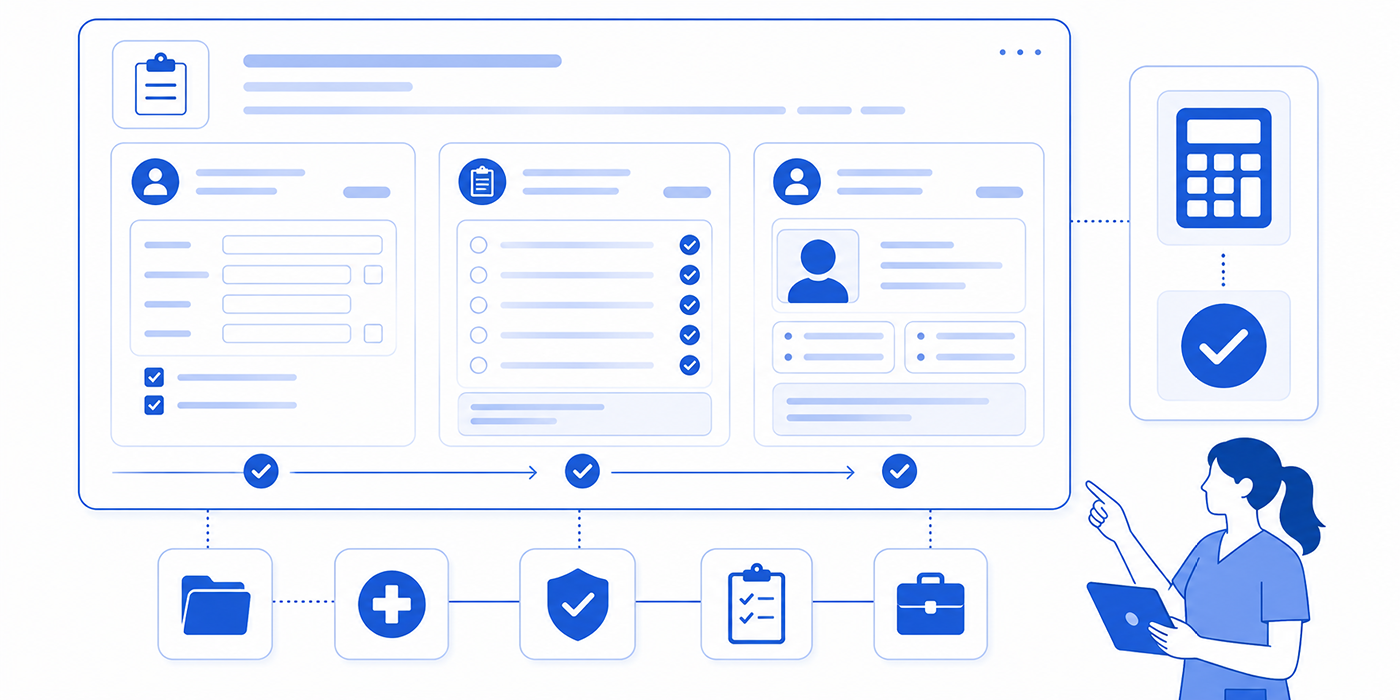
1. What a Superbill Does in Medical Administration
A superbill is an itemized summary of the services connected to a patient encounter. Depending on the organization, it may be called an encounter form, charge ticket, fee slip, routing slip, or patient reimbursement statement. It typically records the patient, provider, date of service, diagnoses, procedures, charges, and supporting administrative details. Those elements create the bridge between clinical documentation and the financial workflow described in revenue cycle management, medical administrative workflow, patient intake procedures, and insurance verification.
A superbill can support several workflows. A practice may use it internally to communicate charges to a billing team. An out-of-network provider may give it to a patient who intends to request reimbursement from an insurer. A specialty office may use it to capture procedure codes, supplies, units, and modifiers before claim creation. A virtual practice may generate one after a telehealth encounter, while a front-office team may attach payer details gathered through secure scheduling tools, patient portals, or approved patient communication apps.
The document carries real operational risk because every field feeds another decision. A wrong date of birth can prevent patient matching. An incomplete member ID can block eligibility confirmation. A diagnosis that lacks documented specificity can weaken medical-necessity support. A missing modifier can change how a service is interpreted. An unsigned form can stall billing because the rendering provider has not authenticated the information. These failures often surface later, when staff are already handling insurance claims, researching claim denials, correcting patient records, or resolving common EMR problems.
A superbill should also be distinguished from a finalized insurance claim. The superbill supplies organized encounter data; the claim is the transaction submitted according to payer, clearinghouse, and claim-format requirements. Staff still need to validate coding, coverage, authorizations, payer rules, and submission fields. That distinction belongs in every team’s medical office policies, legal responsibility training, HIPAA communication procedures, and risk-management process.
| # | Superbill Field | What It Means | Validation Standard | Risk When Incorrect |
|---|---|---|---|---|
| 1 | Patient legal name | Name used by the patient and payer | Match registration and insurance records | Patient-matching or claim rejection errors |
| 2 | Date of birth | Core patient identifier | Verify against demographic and payer records | Eligibility or identity mismatch |
| 3 | Medical record number | Internal patient identifier | Pull directly from the approved record | Posting information to the wrong chart |
| 4 | Patient address | Mailing and payer demographic data | Confirm current address during intake | Returned statements or payer mismatch |
| 5 | Contact information | Approved phone or email details | Apply documented communication preferences | Failed follow-up or privacy exposure |
| 6 | Insurance payer | Company responsible for adjudication | Confirm active payer for the service date | Routing the claim to the wrong payer |
| 7 | Member ID | Patient or subscriber plan identifier | Copy exactly, including letters and suffixes | Eligibility failure or front-end rejection |
| 8 | Group number | Employer or plan grouping identifier | Use the current insurance card or portal | Incorrect benefit mapping |
| 9 | Subscriber details | Information for the policyholder | Confirm name, DOB, and relationship | Dependent coverage mismatch |
| 10 | Rendering provider | Clinician who performed the service | Match the encounter documentation | Credentialing or attribution error |
| 11 | Billing provider | Entity submitting or billing the service | Use the enrolled billing identity | Enrollment or payment disruption |
| 12 | National Provider Identifier | Standard provider identification number | Validate the correct individual or organization NPI | Claim rejection or misdirected payment |
| 13 | Tax identification number | Billing entity tax identifier | Source from controlled practice records | Entity mismatch or privacy risk |
| 14 | Practice address | Service or billing location | Use the correct enrolled location | Place-of-service inconsistency |
| 15 | Date of service | Date the encounter occurred | Match appointment and clinical records | Timely-filing or duplicate-claim problems |
| 16 | Place of service | Setting where care was delivered | Confirm office, facility, home, or virtual setting | Incorrect payer processing |
| 17 | Encounter type | New, established, preventive, procedural, or other visit | Align with schedule and documentation | Wrong coding pathway |
| 18 | Chief complaint | Primary reason for the encounter | Use concise documented language | Weak connection between service and diagnosis |
| 19 | Diagnosis description | Plain-language condition or symptom | Use provider-supported terminology | Clinical-coding inconsistency |
| 20 | ICD-10-CM code | Standard diagnosis code | Use the highest supported specificity | Medical-necessity or coding problem |
| 21 | Procedure description | Service performed during the encounter | Match the authenticated note | Unsupported charge capture |
| 22 | CPT or HCPCS code | Standard service, procedure, or supply code | Validate against documentation and current rules | Underbilling, overbilling, or denial |
| 23 | Diagnosis pointer | Connection between a service and supporting diagnosis | Map every procedure deliberately | Medical-necessity edit or denial |
| 24 | Modifier | Additional information about how a service occurred | Use only when documentation supports it | Bundling, duplication, or payment error |
| 25 | Units | Number of services, supplies, or timed units | Reconcile with the note and code definition | Overpayment, underpayment, or audit exposure |
| 26 | Charge amount | Practice fee assigned to the service | Use the approved fee schedule | Inconsistent patient or payer billing |
| 27 | Payment collected | Amount received at or before the encounter | Reconcile with the payment system | Balance and posting discrepancies |
| 28 | Authorization number | Payer approval reference | Confirm service, dates, units, and provider | Authorization-related denial |
| 29 | Provider signature | Authentication of encounter information | Follow the organization’s signature policy | Incomplete or unauthenticated record |
| 30 | Supporting attachments | Records needed for review or reimbursement | Send only necessary, approved documentation | Delay, disclosure, or insufficient support |
2. Superbill Fields, Definitions, and Ownership
A reliable superbill workflow assigns ownership by field rather than treating the document as one person’s responsibility. Registration staff usually control demographics and payer data. Clinical staff document the encounter. Providers confirm diagnoses and services. Coding or billing personnel validate code selection, modifiers, units, charge rules, and payer edits. This division should appear in daily office procedure checklists, front-desk operations guidance, medical billing terminology training, and office organization systems.
Patient demographics must match the registration record and payer file. Small differences matter: a missing suffix, transposed birth date, outdated surname, or incorrect subscriber relationship can stop an otherwise valid claim. The team should verify these details through a controlled patient intake process, confirm eligibility using the practice’s insurance verification workflow, document changes through approved record-update procedures, and communicate discrepancies using HIPAA-safe language.
Provider information requires equal precision. The rendering provider, billing entity, NPI, service location, and place of service must reflect how the encounter actually occurred and how the provider is enrolled. A virtual visit performed from one location can create a different administrative pathway from an in-office service. Staff handling these distinctions benefit from telehealth administration training, medical scribes and telemedicine guidance, regulatory updates for medical scribes, and regulatory change guidance for CMAAs.
Diagnosis and procedure fields require disciplined separation. The diagnosis explains the condition, symptom, or reason addressed. The procedure code describes the service, test, supply, or professional work performed. A diagnosis should come from authenticated provider documentation, while the procedure must be supported by the actual service and coding rules. Staff should use an updated ICD-10 reference, strengthen their CPT code knowledge, review documentation terminology for scribes, and apply medical terminology mastery.
The diagnosis pointer is easy to overlook and costly to misunderstand. It connects each billed service with the diagnosis or diagnoses supporting that service. A superbill containing several diagnoses and several procedures needs deliberate mapping. Automatically pointing every procedure to every diagnosis can produce weak or illogical relationships. Teams should build this control into EMR integration tools, approved documentation templates, medical office collaboration tools, and role-specific medical admin staff scheduling.
3. Build and Validate a Superbill Without Creating Rework
Start with a completed or sufficiently documented encounter. The superbill should never become a substitute for the clinical note or a place where staff invent missing details. Review the service date, encounter type, location, rendering provider, and documented reason for the visit. Where the record is incomplete, route a focused clarification rather than guessing. This standard aligns with EMR and charting terminology, HIPAA compliance for scribes, medical scribe documentation standards, and risk-management strategies.
Next, reconcile the patient and payer information against the date of service. Coverage active today does not prove coverage was active when the encounter occurred. Confirm the correct plan, member ID, subscriber relationship, referral requirement, authorization status, and benefit pathway. An authorization number alone is insufficient when the approved service, provider, units, or date range does not match. These controls should be paired with prior authorization procedures, insurance claims training, appointment scheduling best practices, and emergency appointment management.
Then validate diagnoses, procedures, modifiers, units, and charges. Ask four separate questions: Does the documentation support the diagnosis? Does it support the service? Does the relationship between them make sense? Does the selected charge match the approved fee schedule? This layered review catches problems that a simple completeness check misses. Staff can strengthen it through the interactive CPT reference, ICD-10 interactive dictionary, medical billing terms guide, and denial-management solutions.
Complete a final handoff review before submission, patient release, or posting. Confirm that the provider authenticated the encounter, required attachments are present, privacy controls were applied, and the superbill reached the correct queue. Record who completed the form, who validated it, when it was transferred, and what remains unresolved. This prevents the “I thought someone else handled it” failure that repeatedly damages busy practices. Useful supporting systems include medical admin time-tracking tools, collaboration platforms, time-management methods, and records-release tools.
4. How to Build a Superbill Template That Prevents Errors
A useful superbill template should guide staff through the encounter in the same order that information becomes available. Patient demographics and insurance details usually come first through patient intake procedures and insurance verification. Provider, location, and appointment information follow through the practice’s medical administrative workflow. Diagnoses, procedures, modifiers, and units should appear only after the clinical record supports them. Designing the form around this sequence reduces skipped fields, premature coding, and the costly habit of filling gaps through assumption.
Every template should contain five clearly separated sections: patient information, insurance information, provider information, encounter details, and charge information. The patient section should include the legal name, date of birth, address, contact details, medical record number, and subscriber relationship. The insurance section should capture the payer, member ID, group number, authorization status, and referral information. These fields should align with the practice’s front-desk operations, appointment scheduling standards, patient portal procedures, and secure scheduling tools.
The provider section should identify the rendering provider, billing entity, National Provider Identifier, service location, date of service, and place of service. These details deserve separate fields because the clinician performing the service may differ from the organization submitting the claim. Telehealth visits need extra attention because location, platform, service type, and payer-specific requirements can alter the billing pathway. Practices handling virtual care should connect their templates with telemedicine terminology, telehealth administration procedures, medical scribes and telemedicine guidance, and current regulatory updates for medical scribes.
The clinical and charge sections should keep diagnoses, services, modifiers, units, diagnosis pointers, and charges visually distinct. Diagnosis codes should reflect the highest level of specificity supported by the provider’s documentation, using an updated ICD-10 reference. Procedure codes should match the actual service through a reliable CPT reference guide. Modifiers and units require their own columns because burying them inside free-text notes makes review difficult. Staff responsible for these fields should also understand medical billing terminology and complete structured CPT code training.
Specialty practices should customize the template around their highest-risk services. An orthopedic office may need laterality, body-site detail, imaging, injections, supplies, and procedure units. A pediatric practice may require guardian information, subscriber relationships, preventive service fields, and vaccine administration details. A behavioral health practice may prioritize session length, service format, and telehealth status. Specialty teams can use approved documentation template libraries, strengthen medical terminology knowledge, and review relevant pediatric and women’s health networks to understand how different settings organize documentation.
Every superbill template also needs a visible exception area. Staff should be able to flag missing authorization, incomplete documentation, provider clarification, payer uncertainty, signature status, or routing problems without hiding them in informal messages. That exception area should identify the issue, responsible person, required action, and deadline. Practices can support this process through medical office collaboration tools, medical admin time-tracking tools, daily office procedure checklists, and documented medical office policies.
The final template should be tested with real workflow scenarios before full adoption. Review examples involving an outdated insurance card, a dependent patient, an out-of-network visit, multiple diagnoses, several procedures, a modifier, an authorization, and a telehealth service. Track where staff hesitate, enter duplicate information, or miss a required field. Those findings should guide revisions and connect directly with denial management, EMR integration tools, record-update compliance, and risk-management strategies.

5. Prevent Denials, Privacy Errors, and Audit Problems
The highest-risk superbill errors fall into four groups: identity errors, coverage errors, coding-support errors, and routing errors. Each group needs a separate control. One generic “reviewed” checkbox provides little accountability because it does not show what was reviewed or by whom. A stronger process records the demographic check, insurance check, documentation check, coding check, authentication check, and handoff status. Practices can build those controls into medical office procedure checklists, EMR integration systems, collaboration tools, and medical admin time-tracking platforms.
Measure first-pass acceptance rather than total output alone. A team can produce hundreds of superbills while quietly creating a correction backlog. Useful measures include percentage completed without rework, average time from encounter close to billing handoff, missing-field rate, demographic-error rate, authorization-error rate, coding clarification rate, and denial rate connected to superbill data. These metrics fit naturally into predictive analytics for medical administration, AI and automation planning, emerging medical admin technologies, and future-proof CMAA skills.
Privacy failures require special attention when superbills are given directly to patients. The document may expose diagnoses, procedures, provider identifiers, contact details, and financial information. Staff should confirm the recipient, delivery method, minimum necessary content, and authority to release. Sending the right superbill to the wrong email address remains a serious failure even when every code is correct. Use patient privacy communication guidance, HIPAA terms for CMAAs, HIPAA terms for scribes, and approved medical-record release tools.
Training should use real error patterns stripped of identifying information. Ask staff to locate a mismatched service date, missing subscriber relationship, unsupported modifier, absent diagnosis pointer, expired authorization, and incorrect rendering provider. Scenario-based review develops stronger judgment than memorizing field names. It can be incorporated into CMAA certification preparation, medical terminology study, realistic scribe exam questions, and medical scribe interview preparation.
6. FAQs About Superbills in Medical Administration
-
A superbill is generally an encounter summary or source document containing information needed for billing or patient reimbursement. A claim is the formal transaction prepared and submitted according to payer and claim-format requirements. The superbill may supply demographics, diagnoses, procedures, charges, and provider details, while claim preparation still requires payer validation and submission controls. Staff should understand this distinction through revenue cycle terminology, insurance claims training, and medical billing terms.
-
Patients sometimes use superbills to request reimbursement for eligible out-of-network services. The insurer decides whether the service qualifies, what documentation is required, how the plan’s deductible or coinsurance applies, and whether additional forms are necessary. The practice should provide accurate encounter information without promising payment. Staff should verify release authority, use HIPAA-safe patient communication, explain relevant insurance verification terms, and apply strong active-listening techniques.
-
Coding responsibilities depend on the organization, credentials, workflow, and applicable rules. Administrative staff may enter information, but they should not independently diagnose patients or choose unsupported codes. Diagnoses must come from provider documentation, and procedure codes must reflect documented services. Ambiguities should move through an approved clarification process. Useful preparation includes ICD-10 code training, CPT code training, and legal responsibility guidance.
-
Authentication requirements depend on the document’s purpose, organizational policy, payer rules, and applicable regulations. A practice should define which electronic or handwritten authentication method is acceptable, when it must occur, and who may release the completed document. An unsigned encounter can create uncertainty over whether the provider approved the diagnoses and services. Teams should incorporate authentication into EMR compliance training, medical office policies, and risk-management procedures.
-
The most damaging pattern is usually a chain of small mismatches rather than one dramatic error. The patient name may differ from the payer file, the authorization may cover a different date, the procedure may lack a diagnosis pointer, and the provider location may be wrong. Each field appears populated, yet the complete transaction fails. A structured check using daily office procedures, denial-management methods, and medical workflow terminology catches those connected errors.
-
Many superbills include the practice’s charge for each service, particularly when the document supports patient reimbursement. The listed charge should come from the approved fee schedule and should be distinguished from the amount an insurer may allow, reimburse, or assign to patient responsibility. Staff should avoid predicting reimbursement. Charge information should be reconciled with revenue cycle procedures, medical billing terminology, and insurance claims management.
