

Medical Scribe Job Interview Prep: Questions & Expert Answers
A medical scribe interview rewards precision under pressure. Hiring teams want proof that you can listen fast, document cleanly, protect privacy, and stay calm when a provider moves quicker than your notes. This guide gives you practical answers, interview angles, and preparation steps for roles tied to medical scribe career growth, hospital scribe hiring, remote medical scribe opportunities, and accurate clinical documentation.
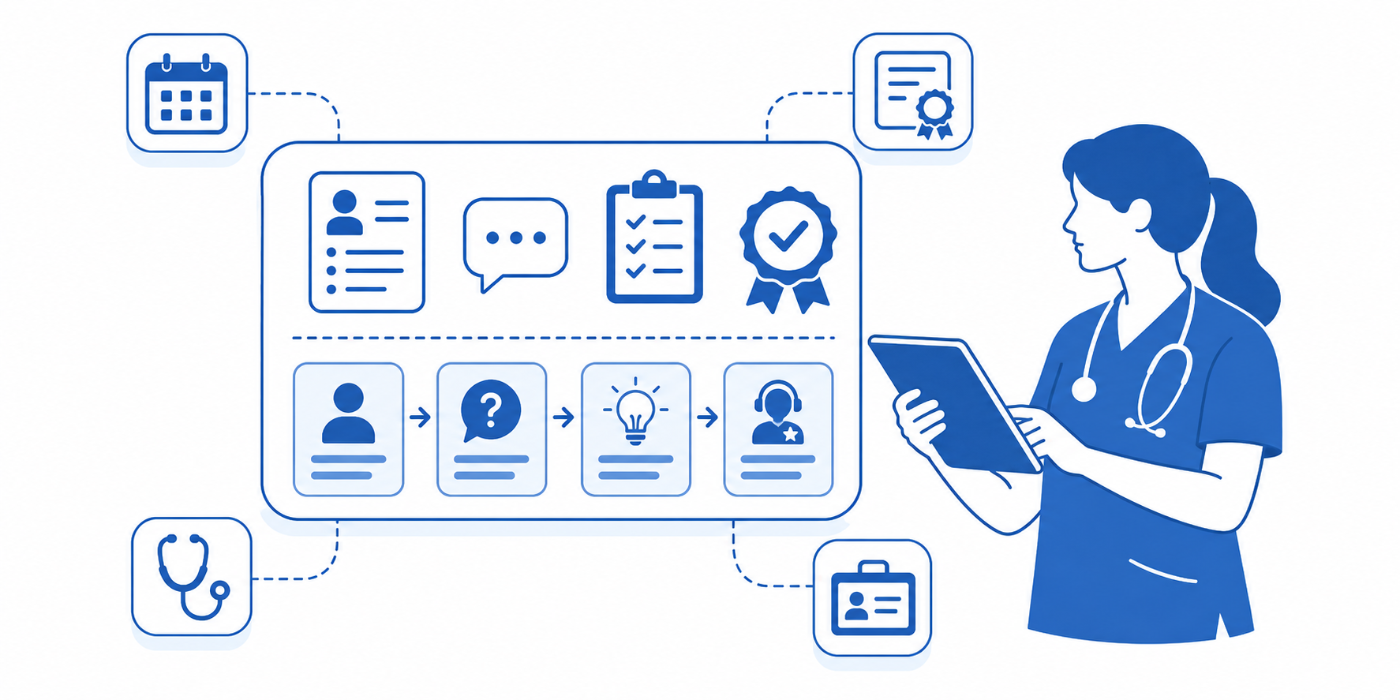
1. What Medical Scribe Interviewers Are Really Testing
A medical scribe interview is a documentation judgment test disguised as a job conversation. The interviewer wants to know whether you understand the difference between hearing medical words and building a useful chart. A candidate who has reviewed medical scribe terminology, EMR charting terms, ICD-10 documentation basics, and CPT code context can speak with more confidence because the interview becomes specific instead of vague.
The first thing they test is listening discipline. Busy providers rarely speak in perfect SOAP order. They may jump from HPI to assessment, mention a negative finding quickly, then return to the patient’s medication history. Strong candidates explain how they capture the provider’s clinical logic without inventing details. That is why preparation around documentation accuracy, medical scribe exam mistakes, practice exam readiness, and certification exam preparation gives you stronger language for interviews.
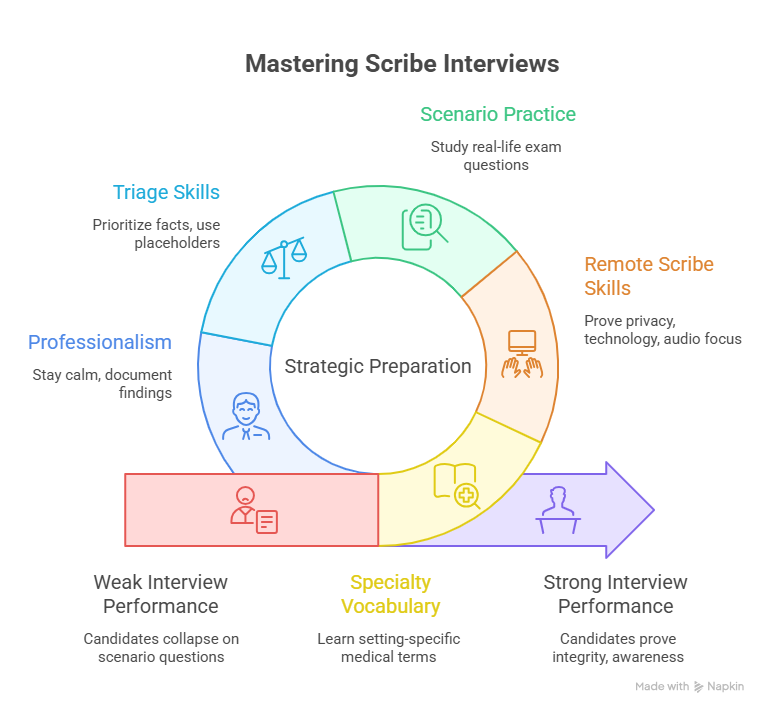
The second thing they test is boundary awareness. A scribe supports documentation; the provider owns medical decision-making. Your answer should show that you understand role limits, HIPAA responsibilities, and escalation rules. If you have studied HIPAA terms for scribes, patient privacy communication, effective patient communication, and de-escalation techniques, you can answer scenario questions with safer, more professional judgment.
The third thing they test is fit for the setting. Emergency department scribing requires speed and triage language. Orthopedics requires mechanism of injury, imaging references, and physical exam specificity. Cardiology requires symptom quality, risk factors, EKG references, and medication accuracy. Before interviewing, review the specialty itself through ER scribing training, cardiology scribe skills, orthopedic scribing, and oncology documentation.
| # | Interview Question | What They Are Testing | Strong Answer Angle | Weak Answer to Avoid |
|---|---|---|---|---|
| 1 | Why do you want to become a medical scribe? | Career intent and healthcare maturity. | Connect the role to medical career growth, documentation exposure, and physician workflow support. | “I need clinical hours.” |
| 2 | What does a medical scribe do? | Role clarity. | Explain real-time charting, provider support, EMR navigation, and documentation quality using EMR charting terms. | “They type what doctors say.” |
| 3 | How do you handle fast-speaking providers? | Listening discipline. | Mention shorthand, clarifying workflow, prioritizing HPI/assessment, and reviewing gaps after the encounter. | “I just try to keep up.” |
| 4 | How would you document unclear information? | Accuracy and escalation. | Say you leave uncertain items for provider confirmation and never assume clinical meaning. | Guessing to finish faster. |
| 5 | What is HIPAA? | Privacy awareness. | Use patient confidentiality, minimum necessary access, and secure communication from HIPAA terms for scribes. | Only saying “privacy law.” |
| 6 | Tell me about a time you made a mistake. | Accountability. | Show quick admission, correction, prevention system, and calm communication. | Claiming you never make mistakes. |
| 7 | How do you handle medical terminology you do not know? | Learning behavior. | Use context, ask when appropriate, keep a term log, and study medical terminology for scribes. | Pretending knowledge. |
| 8 | How do you manage pressure in a busy shift? | Composure. | Discuss prioritization, structured notes, active listening, and post-encounter cleanup. | Sounding overwhelmed by normal volume. |
| 9 | What is the difference between assessment and plan? | Clinical note structure. | Assessment captures provider impression; plan captures next actions, orders, follow-up, and counseling. | Mixing symptoms with treatment actions. |
| 10 | How would you document pertinent negatives? | Detail accuracy. | Explain that missing negatives can weaken the provider’s reasoning and medical necessity trail. | Only documenting positive findings. |
| 11 | Are you comfortable with EMR systems? | Technical readiness. | Reference adaptability, templates, shortcuts, and EMR platforms scribes should know. | Only naming one system. |
| 12 | How do you protect patient privacy in a shared workspace? | Operational HIPAA judgment. | Discuss screen awareness, secure logins, minimum access, and private communication channels. | Focusing only on passwords. |
| 13 | How would you work with a provider who gives little feedback? | Professional communication. | Ask for preferred note style, review recurring corrections, and improve quietly. | Complaining about vague expectations. |
| 14 | Describe SOAP note sections. | Documentation basics. | Explain subjective, objective, assessment, and plan with examples from patient encounters. | Memorized definitions without application. |
| 15 | How do you handle difficult patients? | Professional presence. | Keep calm, follow provider direction, protect accuracy, and use active listening techniques. | Taking the patient’s frustration personally. |
| 16 | What would you do if a provider forgets to mention a plan detail? | Safe clarification. | Flag it respectfully through approved workflow and document only confirmed information. | Adding a likely plan yourself. |
| 17 | Why should we hire you? | Evidence of fit. | Use speed, accuracy, coachability, privacy awareness, and specialty preparation. | Generic enthusiasm. |
| 18 | Can you handle repetitive work? | Consistency. | Explain how repetition builds pattern recognition and reduces documentation errors. | Calling repetition boring. |
| 19 | How do you prepare for a new specialty? | Learning agility. | Review anatomy, common complaints, template patterns, and specialty terminology. | Waiting to learn everything on shift. |
| 20 | How would you support physician efficiency? | Workflow awareness. | Connect clean notes to throughput, reduced after-hours charting, and reduced physician burnout. | Only saying “I type fast.” |
| 21 | What makes a good HPI? | Clinical storytelling. | Mention onset, location, duration, character, severity, associated symptoms, modifiers, and context. | Listing symptoms randomly. |
| 22 | How do you handle feedback? | Coachability. | Say you track patterns, apply corrections immediately, and ask targeted questions. | Defending every mistake. |
| 23 | What would you do during downtime? | Initiative. | Study templates, clean task lists, review terminology, and prepare for the next encounter. | Waiting passively. |
| 24 | Are you interested in remote scribing? | Remote readiness. | Mention audio focus, privacy-controlled workspace, stable technology, and remote medical scribe market growth. | Treating remote work as easier. |
| 25 | How do you manage multiple providers or rooms? | Task switching. | Use timestamps, structured note sections, quick summaries, and gap flags. | Relying on memory alone. |
| 26 | What do you know about our setting? | Research effort. | Link your prep to the clinic’s specialty, patient volume, and documentation demands. | Admitting you only skimmed the website. |
| 27 | Where do you see yourself in healthcare? | Long-term seriousness. | Connect scribing to patient care exposure, clinical vocabulary, and disciplined documentation habits. | Making the role sound like a temporary checkbox. |
2. How to Answer the Medical Scribe Interview Questions That Matter
The best answer to “Tell me about yourself” should last 45 to 60 seconds and move in three steps: your healthcare interest, your documentation readiness, and your fit for the specific role. A strong version sounds like this: “I’m preparing for a healthcare career and I’m drawn to scribing because it puts me close to real clinical reasoning. I’ve been building my terminology, EMR, and HIPAA foundation through focused practice, including medical terminology for scribes, medical scribe certification preparation, medical scribe exam breakdowns, and real-life scribe questions. I want to support providers with accurate, timely notes while learning how clinical decisions are documented.”
For “Why do you want this job?” avoid sounding like you are using the employer as a stepping stone. The honest answer can still be strategic. Say that medical scribing gives you a front-row seat to patient care, exposes you to provider reasoning, and trains you to document with discipline. Then connect the employer’s setting to your preparation. If the role is in urgent care, reference urgent care and emergency department scribe jobs, urgent care clinic hiring, medical scribe job market trends, and medical scribe workforce insights.
For “How do you handle pressure?” give a process instead of a personality claim. Say: “I stay organized by anchoring the note around the visit flow: chief complaint, HPI, ROS, exam, assessment, and plan. During fast encounters, I capture confirmed clinical details first, mark unclear items for provider review, and clean the note before submission.” That answer tells the interviewer you understand the work. You can strengthen it by mentioning documentation accuracy reports, provider burnout reduction, hospital revenue impact, and medical scribe economic impact.
For “What are your weaknesses?” choose a real weakness with a control system. A bad answer tries to impress. A good answer shows self-management. Say: “Early in my preparation, I found it difficult to recognize unfamiliar medication names quickly. I started keeping a running list by specialty, reviewing common abbreviations, and practicing with chart examples so I could reduce hesitation during live documentation.” This answer works because it shows learning. Link your prep to specialty template libraries, medical abbreviations for coders and scribes, clinical documentation terms, and medical scribe study techniques.
For “How would you handle a disagreement with a provider’s correction?” the answer should show humility and patient-safety awareness. Say: “I would review the correction, ask for clarification at the right time if I did not understand the pattern, and apply the preference going forward. The provider is responsible for the clinical note, and my job is to support that documentation accurately.” This response proves you understand hierarchy, teamwork, and chart ownership. It also fits roles connected to physician groups hiring scribes, health systems hiring scribes, academic medical centers using scribes, and medical scribe companies.
3. The Proof System: Turn Your Experience Into Hireable Answers
Interviewers trust examples more than adjectives. “I’m detail-oriented” is weak until you prove it with behavior. Use a simple answer structure: situation, documentation challenge, action, result, and lesson. For example: “In a busy volunteer setting, I had to track multiple patient requests while staff were moving quickly. I used a checklist, repeated key details for confirmation, and reviewed my notes before passing them along. That taught me to protect accuracy even when the environment feels rushed.” This style fits candidates preparing through patient intake procedures, front desk operations, appointment scheduling best practices, and healthcare CRM terms.
If you have no clinical job experience, build proof from school, volunteering, caregiving, customer service, research, tutoring, or administrative work. The transferable skills are accuracy, confidentiality, fast learning, communication, and emotional control. A restaurant shift can show pace management. A lab class can show procedural discipline. A tutoring role can show clear communication. A receptionist job can show privacy judgment. The goal is to connect every example to scribe work using resources such as patient communication apps, active listening for medical admin professionals, difficult patient conversations, and patient privacy essentials.
A strong interview answer also needs numbers when possible. You can mention typing speed, average study hours per week, number of practice cases reviewed, number of medical terms memorized, or the number of mock interviews completed. Numbers create credibility because they show preparation effort. For a candidate targeting competitive roles through top hospitals hiring medical scribes, top cities hiring scribes, medical scribe salary comparison, and certified versus non-certified salary analysis, measurable preparation can separate you from applicants who only sound interested.
You should also prepare one “mistake story” before the interview. The best mistake story has a small error, fast ownership, clean correction, and prevention method. Never use a story that suggests unsafe judgment, privacy failure, dishonesty, or blaming others. A strong version might involve missing a deadline, misunderstanding instructions, or needing extra practice with a technical tool. Then show how you built a system. Tie that system to EMR shortcuts, common EMR software issues, patient record updates and EMR compliance, and voice recognition tools.
4. Specialty, Remote, and Scenario-Based Interview Prep
Specialty interviews become much easier when you prepare the vocabulary and patient-flow logic of that setting. For emergency medicine, learn how to discuss acuity, chief complaint, triage context, re-evaluation, imaging, labs, and discharge instructions. For cardiology, prepare language around chest pain, palpitations, shortness of breath, risk factors, and diagnostic testing. For orthopedics, prepare mechanism of injury, range of motion, imaging, laterality, and conservative versus surgical plan language. Before applying, review ER scribe training, cardiology scribe skills, orthopedic and sports medicine hiring, and surgical scribing basics.
For remote scribe interviews, your answer must prove privacy, technology discipline, and audio focus. A hiring manager may ask where you will work, how you will protect patient information, what you will do if your internet fails, and how you handle audio lag. A strong answer mentions a private workspace, reliable headset, backup internet plan, secure login behavior, and immediate escalation for technical issues. This is especially important for applicants exploring remote medical scribe employers, telehealth companies using scribes, telehealth platform terms, and AI-driven documentation trends.
Scenario questions are where weak candidates collapse. The interviewer may ask, “What would you do if you missed part of the HPI?” The safe answer is: “I would avoid guessing, mark the gap, and ask the provider through the approved workflow at the right time. If the note is incomplete, I would make sure it is corrected before finalization.” This shows integrity and operational awareness. Study scenario prep through real-life exam questions, top scribe exam mistakes, interactive scribe practice exams, and ACMSO exam day essentials.
Another common scenario is a provider moving from room to room before you finish the previous note. Your answer should show triage. Say that you prioritize key clinical facts during the encounter, use structured placeholders for incomplete sections, and complete the note while the encounter is still fresh. You can also mention that speed comes from preparation, template familiarity, and specialty repetition. That connects naturally with specialty documentation templates, EMR platforms for scribes, voice recognition and dictation software, and AI scribe tool awareness.
If the interviewer asks about a difficult patient, keep the focus on documentation and professionalism. A scribe should stay calm, avoid inserting opinions into the note, document the provider’s confirmed clinical findings, and follow clinic policy for safety concerns. This answer proves that you understand your role during emotional encounters. It also reflects preparation in empathy in healthcare administration, effective patient communication, de-escalation techniques, and medical office conflict handling.
5. Final 48-Hour Prep Plan Before the Interview
Forty-eight hours before the interview, stop trying to learn everything and start organizing what you already know. Create a one-page interview sheet with five sections: employer facts, specialty vocabulary, strongest examples, scenario answers, and questions to ask. If the employer is a hospital, review top hospitals hiring scribes, health systems hiring by state, academic medical centers using scribes, and community health centers hiring scribes.
The day before the interview, practice your opening answer, your weakness answer, your HIPAA answer, and two scenario answers out loud. Record yourself once. Listen for filler, rushed explanations, and vague claims. A polished candidate sounds specific without sounding rehearsed. Review medical scribe certification steps, medical scribe exam preparation, medical scribe practice questions, and essential scribe study techniques so your language stays precise.
Prepare three smart questions for the interviewer. Ask, “How do providers typically give feedback to new scribes?” “Which EMR templates or workflows should new scribes master first?” “What separates a successful scribe from someone who struggles after training?” These questions show you care about performance, not just selection. They also fit employers connected to medical scribe training courses, pre-med gap year scribe programs, healthcare recruiters posting scribe roles, and medical scribe staffing agencies.
On interview day, your goal is to sound trainable, safe, and useful. Speak in short, clear answers. Use examples. Admit learning areas with a plan. Show respect for provider ownership of the note. When you discuss the job, connect your answer to the actual value scribes provide: cleaner documentation, better visit flow, fewer after-hours charting burdens, and stronger clinical records. That aligns with medical scribes and hospital revenue, physician burnout reduction, documentation accuracy improvement, and healthcare facilities preferring certified scribes.
After the interview, send a concise follow-up email the same day. Thank them for the conversation, mention one specific point from the interview, and reinforce your readiness to learn their workflow. Keep it professional and short. If you are applying broadly, track roles by specialty, location, employer type, interview status, and follow-up date. This approach helps when comparing medical scribe salary nationwide, medical scribe job growth, remote scribe opportunities, and future medical documentation trends.
6. FAQs
-
The most common question is usually “Why do you want to become a medical scribe?” Hiring managers ask it because they want to separate serious healthcare candidates from people who only see the role as a temporary resume item. Your answer should connect patient-care exposure, documentation accuracy, provider support, and long-term healthcare growth. Strengthen your preparation with medical scribe career outlook, why medical scribing is growing, medical scribe market trends, and medical scribe workforce data.
-
Use transferable proof. Talk about fast note-taking, customer service, science coursework, volunteering, patient-facing exposure, confidentiality, typing practice, or structured learning. Then explain how you are preparing for clinical documentation through medical terminology mastery, EMR charting vocabulary, HIPAA basics for scribes, and medical scribe certification prep.
-
Say that HIPAA requires protecting patient information through appropriate access, private communication, secure systems, and professional judgment. Then make the answer practical: you would avoid discussing patient details in public spaces, keep screens secure, use approved systems, and access only information needed for your assigned role. Review patient privacy communication, HIPAA patient privacy terms, healthcare portal terms, and telehealth platform privacy context.
-
Choose a weakness that is real, controlled, and relevant to learning. A strong answer might mention unfamiliar specialty terminology, speed during complex encounters, or confidence with new EMR layouts. Then explain the system you use to improve: term logs, practice cases, template review, feedback tracking, and mock documentation. Build that system with specialty template libraries, medical abbreviations, EMR platforms, and interactive practice exams.
-
Ask questions that show performance intent: “What documentation mistakes do new scribes commonly make?” “How is provider feedback given?” “What specialties or visit types should I study before training?” “Which EMR workflows should I master early?” These questions show that you care about doing the job well. They also align with scribe exam mistakes, EMR issue resolution, patient record compliance, and documentation accuracy reports.
-
Prepare to discuss your workspace, internet reliability, headset quality, privacy safeguards, and ability to follow live audio. Remote scribing requires extra discipline because the interviewer must trust that you can maintain focus and confidentiality away from the clinic. Study remote scribe employers, remote scribe market growth, telehealth companies using scribes, and AI and automation in medical administration.
