

How to Easily Memorize Complex Medical Terms for Your ACMSO Exam
Medical terminology is where many ACMSO exam candidates start losing speed, confidence, and points. The problem usually is not intelligence. It is overload. A candidate may understand prefixes in isolation, recognize common body systems, and still freeze when a long term appears inside a fast exam question. That gap comes from trying to memorize vocabulary as random fragments instead of learning the logic that makes medical language predictable.
This guide fixes that. You will learn how to break down complex terms, retain them faster, connect them to real documentation work, and study in a way that actually holds under exam pressure. Along the way, you should also strengthen weak spots through how to master medical administrative terminology for your CMAA exam, reinforce chart language with top 20 EMR and charting terms medical scribes need to understand clearly, and sharpen your exam plan through ultimate guide to passing your CMAA certification exam on the first try.
1. Why Medical Terms Feel So Hard to Memorize in the First Place
Most candidates struggle with medical terminology for one reason: they try to memorize finished words before learning the parts that build them. That approach makes every term feel like a new burden. Once you understand that a term is often just a prefix, root, combining vowel, and suffix arranged in a specific order, the language starts behaving less like chaos and more like a system. That same systems thinking also helps in complete breakdown what’s included in the 2026–27 CMAA exam, essential study tips to guarantee your CMAA exam success, and interactive CMAA practice exam test your knowledge before exam day.
Another major problem is false familiarity. A candidate sees a term like “gastroenteritis,” feels vaguely comfortable, and moves on. On exam day, that same candidate cannot explain what part means stomach, what part means intestine, and what part signals inflammation. That shallow recognition costs points. Deep recall wins. The same pattern shows up when learners misunderstand workflow language in patient intake procedures essential definitions and processes, coding references in ICD-10 codes comprehensive interactive dictionary, and billing language in top 20 medical billing terms all CMAAs should clearly understand.
Medical terms also become harder when candidates study them away from real use. A word learned as an isolated flashcard fades quickly. A word tied to patient communication, chart navigation, scheduling, privacy, or documentation sticks longer. That is why terminology retention improves when it is connected to effective patient communication terms and interactive examples, front desk operations terms interactive guide and checklist, appointment scheduling best practices interactive definitions, and top 20 scheduling and appointment terms CMAAs should know by heart.
Finally, many candidates keep rereading terms instead of forcing recall. Rereading feels productive. It is comforting and smooth. It also hides weakness. The ACMSO exam will not ask whether a term looked familiar in your notes. It will ask whether you can decode it fast, distinguish it from similar options, and apply it correctly. That is why active recall from CMAA exam prep the top 10 mistakes you need to avoid, performance habits from ACMSO certification exam your complete step-by-step guide 2025, and exam-day discipline from CMAA exam day checklist everything you need for a smooth experience matter so much.
| # | Term Part | Meaning | Example | How To Memorize It Fast |
|---|---|---|---|---|
| 1 | cardi/o | heart | cardiology | Think cardiac and pulse |
| 2 | neur/o | nerve | neurology | Link it to neurons and brain signals |
| 3 | hepat/o | liver | hepatitis | Group it with liver labs and hepatitis |
| 4 | gastr/o | stomach | gastritis | Picture gastric pain after eating |
| 5 | enter/o | intestine | enteritis | Pair it with GI tract flow |
| 6 | dermat/o | skin | dermatology | Connect it to rashes and lesions |
| 7 | oste/o | bone | osteoporosis | Think orthopedic fractures and bone density |
| 8 | my/o | muscle | myalgia | Link it to muscle soreness |
| 9 | arthr/o | joint | arthritis | Associate with swollen painful joints |
| 10 | hem/o | blood | hemoglobin | Think hematology and blood draws |
| 11 | cyt/o | cell | cytology | Visualize microscope cell slides |
| 12 | ren/o | kidney | renal failure | Tie it to kidney function |
| 13 | nephr/o | kidney | nephrology | Learn it beside ren/o to avoid confusion |
| 14 | pulmon/o | lung | pulmonary | Connect to breathing and oxygen |
| 15 | ot/o | ear | otology | Think otoscope and ear exam |
| 16 | ophthalm/o | eye | ophthalmology | Pair with vision clinic words |
| 17 | encephal/o | brain | encephalopathy | Break it into en-cephal and reuse often |
| 18 | tachy- | fast | tachycardia | Hear the speed in the sound |
| 19 | brady- | slow | bradycardia | Use it as the opposite of tachy- |
| 20 | hyper- | high, excessive | hypertension | Always learn it beside hypo- |
| 21 | hypo- | low, under | hypoglycemia | Train it as the reverse of hyper- |
| 22 | -itis | inflammation | tonsillitis | Associate the ending with irritation |
| 23 | -ectomy | surgical removal | appendectomy | Think exit, remove, take out |
| 24 | -algia | pain | neuralgia | Hear ache when you see it |
| 25 | -megaly | enlargement | cardiomegaly | Imagine an organ becoming too large |
| 26 | -oma | tumor or mass | lymphoma | Group it with oncology language |
| 27 | -pathy | disease or disorder | neuropathy | Think pathology and disease state |
| 28 | -scopy | visual examination | colonoscopy | Picture scope-based viewing |
2. The Fastest Way To Memorize Terms: Learn the Building Blocks, Not the Whole Word
The fastest path is to study medical language in chunks. Prefixes tell direction, quantity, position, speed, or status. Roots name the body part or system. Suffixes often tell the condition, procedure, disorder, or specialty. Once you train your eyes to hunt those parts first, long terms stop intimidating you. This method pairs especially well with top 20 terms medical scribes must master for accurate clinical documentation, mastering medical terminology for medical scribes a quick study guide, medical scribe certification exam breakdown everything to expect in 2025, and complete guide to passing your medical scribe certification exam.
Take a word like “tachycardia.” A weak study habit says memorize the entire term as one card. A stronger habit says split it immediately: tachy means fast, cardi means heart, and the ending signals a condition. You can do the same with hypertension, nephrology, osteoarthritis, hepatomegaly, and encephalopathy. Suddenly, one study session teaches dozens of future answers. That logic-heavy approach also helps candidates navigate interactive guide to emerging medical admin technologies 2025 edition, AI and automation in medical administration what CMAAs must know, and future-proof your CMAA career emerging skills for the next decade, where terminology and systems language often overlap.
A practical memorization framework is this: study ten prefixes together, ten roots together, and ten suffixes together. Then combine them into examples. Do not move on until you can explain each part out loud without looking. The moment a term appears in a practice question, decode it before reading answer choices. That habit trains real exam strength. You can sharpen that with interactive medical scribe practice exam test yourself now, essential study techniques for medical scribe certification success, top 10 medical scribe exam mistakes how to avoid them, and how to ace your medical scribe certification exam insider study secrets.
Another useful move is to study twins and opposites together. Learn hyper with hypo. Learn tachy with brady. Learn abduction with adduction. Learn benign with malignant. The brain holds contrasts better than isolated fragments. That same contrast principle can also improve your understanding of medical scribe vs medical assistant which career is best for you, top 10 skills employers look for in a CMAA, why CMAA certification dramatically boosts your career opportunities, and CMAA career roadmap from entry-level to medical office manager.
3. The Memory Techniques That Actually Work Under Exam Pressure
Rote repetition alone is too weak for a terminology-heavy exam. You need recall techniques that survive stress. The first is active retrieval. Cover the meaning and force yourself to answer. Cover the term and force yourself to rebuild it. Do this in both directions. Forward-only memorization creates false confidence. Bidirectional recall is what carries candidates through interactive CMAA practice exam test your knowledge before exam day, ACMSO exam day essentials everything you need for success, top 10 mistakes students make on the ACMSO exam and how to avoid them, and medical scribe certification real-life exam questions and expert answers.
The second is spaced repetition. Review on a schedule instead of cramming. Day 1, Day 3, Day 7, Day 14, and Day 21 is far better than one giant weekend panic session. This matters especially for confusing, high-density vocabulary such as charting language, patient privacy concepts, payer terms, and intake terminology found in top 20 must-know HIPAA terms for medical scribes clear definitions and examples, top 20 HIPAA and patient privacy terms for medical administrative assistants, insurance verification definitive glossary and interactive examples, and healthcare portal terms interactive dictionary and use cases.
The third is visual association. Not childish gimmicks. Strategic anchors. For “hepatomegaly,” picture an enlarged liver on a scan. For “bradycardia,” imagine a monitor with a slow heartbeat. For “dermatitis,” imagine irritated skin. For “nephrology,” picture kidney care. When an abstract word acquires an image, recall improves. That is useful not only for terminology but for process-heavy concepts in resolving common EMR software issues practical CMAA guide, interactive training patient record updates and EMR compliance, top 10 EMR shortcuts to boost CMAA productivity instantly, and EMR integration tools every medical administrative assistant needs.
The fourth is verbal teaching. Explain a term as if you were training a new hire. When you can say, “nephro means kidney and -logy means study of,” you own the term differently. Silent recognition becomes active command. Candidates who can teach the term usually answer faster. That advantage compounds across real-life success stories from certified medical administrative assistants, new study how certified medical administrative assistants improve healthcare efficiency, 2026 healthcare administration report key insights for CMAAs, and medical admin assistant job market outlook key trends for 2026–27.
4. How To Build a Study System That Makes Terms Stick
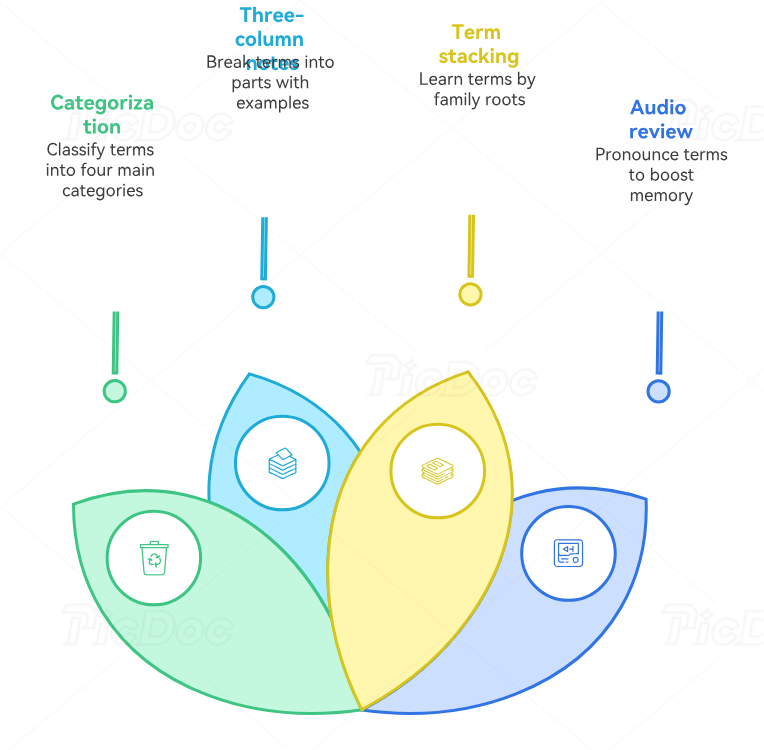
A strong study system is more important than raw study time. Start by creating four categories: body systems, diagnostic terms, procedure terms, and workflow terms. Then build short daily sets. Twenty to thirty minutes of focused terminology work beats two distracted hours. This system becomes even more valuable when paired with medical office automation trends opportunities for CMAAs, virtual medical administration how remote work is transforming the role, best collaboration tools for medical office teams CMAA approved, and patient communication apps every CMAA should use interactive directory, where precision and retention affect real performance.
Use a three-column note method. In column one, write the term. In column two, break it into parts. In column three, write a plain-English meaning plus a clinical use example. This prevents empty memorization. “Gastroenteritis” becomes gastr/o, enter/o, -itis, then “inflammation of stomach and intestines,” then “patient with vomiting and diarrhea.” That final example is what stops the word from fading. You can reinforce that applied style through day in the life of a medical scribe real stories from emergency departments, interactive guide to mastering emergency room ER scribing, 10 essential skills every cardiology medical scribe needs, and advanced oncology scribing how to document complex cases effectively.
Another effective system is term stacking. Learn by families. Example: cardiology, cardiomegaly, tachycardia, bradycardia, pericarditis. One root, multiple endings, multiple meanings. This expands vocabulary faster and reduces panic when unfamiliar combinations show up. Family-based learning also helps with specialty-focused references like scribing for orthopedics comprehensive interactive training, surgical scribing 101 essential techniques and best practices, top 100 specialty-specific documentation template libraries and cheat sheets for scribes 2025 mega guide, and top 50 EMR EHR platforms every medical scribe should know 2025 guide.
Do not ignore audio review. Reading terms is useful. Saying them out loud adds a second memory path. Hearing yourself pronounce “encephalopathy” correctly while explaining its parts helps lock it in. Candidates who avoid pronunciation often hesitate during recall, which slows decision-making. That same verbal confidence supports professional growth in networking strategies for medical admin professionals, medical administration conferences and workshops directory 2026–27 edition, medical admin assistant professional organizations directory, and online communities and forums for CMAAs interactive directory.
5. The Biggest Mistakes That Keep Candidates Forgetting Terms
The first mistake is studying terms only when motivation is high. That creates gaps. Terminology mastery comes from frequency, not mood. Consistency matters more than intensity. Candidates who review daily perform better than candidates who binge once a week, even when the weekly total hours look similar. This same pattern shows up in medical admin time tracking tools complete directory and usage guide, directory of medical admin staff scheduling tools, scheduling software mastery from beginner to expert CMAA, and secure patient scheduling tools 2026–27’s best picks and why, where systems beat improvisation.
The second mistake is memorizing terms without context. A candidate may know that “-itis” signals inflammation, yet still miss an exam question that frames the issue inside symptoms, workflow, or chart language. Context closes that gap. When you study a term, add where it appears, what kind of encounter might mention it, and how it could affect documentation. That richer approach aligns well with patient privacy communication essentials HIPAA guidelines simplified, active listening techniques for medical admin professionals, step-by-step guide managing difficult conversations with patients, and de-escalation techniques interactive dictionary and practical tips.
The third mistake is overloading one study session with similar-looking words and never revisiting them. Confusion then compounds silently. Separate near-duplicates and revisit them deliberately. Renal and nephro both point to kidney, but they appear in different constructions. Ot/o and ophthalm/o belong in different sensory buckets. Hyperglycemia and hypoglycemia must be drilled as opposites. That contrast discipline helps across telehealth platforms key definitions and interactive guide, healthcare CRM terms comprehensive interactive reference, interactive guide to handling appointment scheduling conflicts, and emergency appointment management step-by-step CMAA guide.
The fourth mistake is studying vocabulary as if the exam rewards pure definition recall. The ACMSO exam rewards understanding. It wants candidates who can interpret language accurately in administrative, documentation, privacy, scheduling, and communication settings. That is why terminology strength supports broader career readiness seen in future-proofing your CMAA career essential skills for 2030, cmaa certification maximizing your career opportunities, annual CMAA salary report real data and trends for 2026–27, and interactive salary calculator for medical administrative assistants 2026–27.
6. FAQs
-
Break every long term into prefix, root, and suffix before trying to memorize the full word. Then connect each part to a plain-English meaning and one real healthcare example. That method turns a word from a random obstacle into a structured clue. It also makes review faster when you are rotating between front desk operations terms interactive guide and checklist, ICD-10 codes comprehensive interactive dictionary, CPT codes explained interactive reference guide for medical admins, and insurance verification definitive glossary and interactive examples.
-
For most candidates, 15 to 25 terms per day is a strong pace if the review is active and repeated. More than that often creates shallow familiarity instead of lasting recall. A smaller number studied well, reviewed aloud, and tested with retrieval practice will outperform a bloated list. This is especially true when balancing terminology with broader exam prep from ultimate guide to passing your CMAA certification exam on the first try, essential study tips to guarantee your CMAA exam success, interactive CMAA practice exam test your knowledge before exam day, and CMAA exam day checklist everything you need for a smooth experience.
-
Use both, but for different jobs. Flashcards are best for rapid recall testing. Notes are better for breaking down structure, writing examples, and grouping term families. The strongest candidates usually build notes first, then convert the hardest material into flashcards. You can apply the same layered study logic to top 20 HIPAA and patient privacy terms for medical administrative assistants, effective patient communication terms and interactive examples, patient intake procedures essential definitions and processes, and appointment scheduling best practices interactive definitions.
-
That usually means recognition is stronger than recall. Reading a list and thinking “I know this” is passive. Answering a question that buries the term inside context is active. The fix is to study in test format more often: cover answers, decode words aloud, explain why wrong options are wrong, and revisit misses on a spaced schedule. That is why candidates should combine terminology review with interactive medical scribe practice exam test yourself now, medical scribe certification exam breakdown everything to expect in 2025, top 10 medical scribe exam mistakes how to avoid them, and essential study techniques for medical scribe certification success.
-
Start with high-frequency roots, major prefixes, and common suffixes. Focus especially on body systems, inflammation terms, pain terms, diagnostic endings, removal procedures, and opposites such as hyper and hypo. Then move into charting, privacy, scheduling, and communication language that appears in real ACMSO work. Candidates who do this first build a much stronger foundation for top 20 terms medical scribes must master for accurate clinical documentation, top 20 EMR and charting terms medical scribes need to understand clearly, how scribes improve documentation accuracy by over 90, and annual report medical scribes role in enhancing clinical documentation accuracy.
-
Absolutely. Strong terminology speeds up chart review, reduces misunderstandings, improves communication with clinical teams, and makes documentation cleaner and safer. It also helps with interview confidence and on-the-job adaptability across specialties and systems. That long-term value connects directly with why healthcare facilities prefer certified medical scribes, medical scribe career outlook 2026–27 salaries growth and trends, how becoming a medical scribe skyrockets your medical career, and 5 surprising skills you gain as a medical scribe beyond documentation.
