

10 Proven Strategies to Pass the ACMSO Certification on Your First Try
A lot of students fail certification exams for reasons that have nothing to do with intelligence. They fail because they study in scattered bursts, memorize isolated facts without learning how they connect, underestimate timing pressure, and walk into exam day with shaky command of the exact terms, workflows, and logic the test is designed to measure. The ACMSO certification rewards organized preparation, not random effort.
Passing on the first try requires more than “studying hard.” It requires a system that turns large amounts of material into fast recall, practical judgment, and calm performance under pressure. The strongest candidates do not keep rereading notes and hoping it clicks. They build a study structure, target their weak areas early, train under realistic conditions, and use every week before the exam to sharpen accuracy, speed, and confidence.

1. Strategy 1: Study the Exam Like a Blueprint, Not a Mystery
The first mistake many candidates make is treating the ACMSO certification as a vague academic challenge. That mindset creates weak preparation because it leads to generic study sessions, shallow note review, and far too much time spent on material that feels familiar instead of material that actually decides the outcome.
A much stronger approach is to study the exam like a blueprint. That means understanding exactly what the test is likely trying to measure: terminology control, charting logic, HIPAA and privacy judgment, EMR fluency, documentation accuracy, specialty-specific awareness, and the ability to make correct choices under time pressure. Students who start with a structured roadmap perform better than students who simply collect resources and study at random. That is why it helps to begin with the ACMSO certification exam guide, move through the complete guide to passing your medical scribe certification exam, and then reinforce your plan with how to ace your medical scribe certification exam.
A blueprint mindset also changes how you review content. Instead of asking, “What should I study today?” ask, “Which tested skill am I strengthening today?” That keeps your work targeted. One day might focus on top 20 terms medical scribes must master. Another may focus on top 20 EMR and charting terms. Another may center on top 20 must-know HIPAA terms for medical scribes. Now your study time is attached to performance categories, not vague effort.
This matters because the exam punishes students who only know definitions in isolation. A student may recognize a term on paper and still miss the question because they do not understand its role inside a real documentation flow. Someone who has studied mastering medical terminology for medical scribes, practiced interactive guides to mastering emergency room ER scribing, and reviewed medical scribe certification exam breakdown expectations will typically see those questions more clearly because the terms live inside a workflow in their mind.
The earlier you stop studying randomly, the faster your preparation becomes more efficient.
| # | Study Focus Area | Why It Matters for First-Try Passes | How to Train It Effectively |
|---|---|---|---|
| 1 | Medical terminology | Weak terminology ruins comprehension across the entire exam | Use active recall and phrase-level repetition, not passive rereading |
| 2 | EMR and charting terms | These appear in documentation-heavy questions | Review terms alongside actual workflow examples |
| 3 | HIPAA and privacy | Privacy errors are common high-cost exam mistakes | Practice scenario-based questions, not only definitions |
| 4 | Documentation accuracy | Accuracy separates prepared students from hopeful ones | Train with error-spotting and logic-based review |
| 5 | Specialty vocabulary | Improves interpretation of context-heavy items | Rotate through cardiology, orthopedics, oncology, and surgery content |
| 6 | Time management | Good students still fail when pace collapses | Take timed practice blocks early, not only at the end |
| 7 | Question interpretation | Many wrong answers come from reading sloppily | Analyze what the question is really testing before choosing |
| 8 | Retention under pressure | Test-day recall drops without stress training | Use mixed-topic review and rapid-recall drills |
| 9 | Weak-area correction | Ignoring weak zones causes repeat misses | Track errors by category and revisit them aggressively |
| 10 | Practice exam analysis | The review matters more than the score itself | Study why each miss happened and what pattern caused it |
| 11 | Abbreviation control | Abbreviation confusion causes fast, avoidable errors | Review abbreviation groups by specialty and usage context |
| 12 | Documentation flow understanding | Questions often reward sequence awareness | Study where information belongs and how notes are structured |
| 13 | Scenario judgment | The exam tests choices, not only memory | Use case-style review instead of single-term drills alone |
| 14 | Consistency in daily study | Cramming creates fast forgetting | Keep sessions short, regular, and cumulative |
| 15 | Error pattern awareness | Students repeat the same mistake family | Categorize misses: haste, confusion, guessing, or knowledge gap |
| 16 | Anatomy-related term associations | Helps decode unfamiliar-looking items | Group root words, prefixes, and suffixes together |
| 17 | Clinical context reading | Improves response accuracy in longer stems | Read full stems before jumping to familiar-looking answer choices |
| 18 | Exam stamina | Focus drops late in the test | Practice full-length sessions, not only short bursts |
| 19 | Note compression | Bloated notes slow revision | Turn long notes into compact review sheets |
| 20 | Memory retrieval speed | Knowing a fact late is still a problem | Use flash recall, self-quizzing, and rapid drills |
| 21 | Realistic practice conditions | Comfort disappears on exam day without them | Use timed conditions, limited breaks, and device discipline |
| 22 | Last-week review strategy | Many students panic and waste the final stretch | Review patterns, high-yield material, and prior mistakes only |
| 23 | Exam-day routine | Pre-test chaos weakens calm recall | Use a fixed routine and decision-light morning |
| 24 | Confidence from evidence | Real confidence comes from preparation, not hype | Let repeated practice accuracy build certainty |
| 25 | Systematic review of missed questions | Missed questions hold the map to passing | Review every wrong answer until the mistake becomes obvious |
| 26 | Balancing breadth and depth | Too broad stays shallow; too deep wastes time | Cover all domains, then attack your weakest two hardest |
| 27 | Confidence under ambiguity | Some questions will feel imperfectly familiar | Train elimination logic instead of waiting for perfect certainty |
2. Strategy 2, 3, and 4: Master High-Yield Terms, Train With Retrieval, and Fix Weak Areas Early
The fastest way to waste weeks of preparation is to confuse exposure with mastery. Reading a glossary ten times does not guarantee recall under pressure. Highlighting definitions does not guarantee recognition inside a tricky question stem. The ACMSO exam rewards fast retrieval and clean judgment, which means your study methods must force your brain to work, not simply look busy.
That is why strategy two is to master the highest-yield terms first. Start with the vocabulary that shows up everywhere: charting language, privacy rules, documentation structure, clinical abbreviations, and common specialty terms. Review top 20 terms medical scribes must master, top 20 EMR and charting terms, and top 20 HIPAA terms for medical scribes. Then deepen your command with mastering medical terminology for medical scribes. This is your base layer. Without it, the rest of the exam feels heavier than it should.
Strategy three is to use retrieval-based study, not passive review. Close the notes. Ask yourself the term, the meaning, the context, and the likely trap. Write what you know from memory. Say it aloud. Quiz yourself in both directions. If you only recognize the right answer when you see it, your memory is still fragile. Retrieval practice is what turns “I saw this before” into “I can pull this out fast even under pressure.”
This works especially well when paired with interactive medical scribe practice exam questions and medical scribe certification real-life exam questions and expert answers. These resources make you deal with the term in action, which is much closer to what the actual exam demands.
Strategy four is where many first-try passes are won: fix weak areas early, not at the very end. A lot of candidates delay their worst categories because working on them feels slow and uncomfortable. That is exactly why those areas stay dangerous. If oncology terms keep tripping you up, go study advanced oncology scribing. If orthopedic phrasing keeps blurring together, work through scribing for orthopedics. If cardiology language feels slippery, spend time with 10 essential skills every cardiology medical scribe needs. If surgery note flow is confusing, review surgical scribing best practices.
The pain point here is brutal but real: students often keep polishing what already feels comfortable while leaving weak zones untouched. Then they are shocked when those exact zones punch holes in the exam score. Weakness ignored early becomes panic later. Weakness attacked early becomes leverage.
3. Strategy 5, 6, and 7: Use Timed Practice, Study in Clinical Context, and Learn the Exam’s Trap Patterns
Students who know the material can still fail because they never train the conditions of performance. That is why strategy five is timed practice. Speed matters. Reading speed matters. Answer choice elimination matters. Recovery after a difficult question matters. Time pressure changes how the brain behaves, and a student who only studies in relaxed conditions is often surprised by how different the real exam feels.
Timed work should begin before you feel “fully ready.” Do not save timing until the last week. Start with short blocks and grow into longer ones. Use interactive medical scribe practice exam sets, revisit complete exam guide resources, and compare your habits against top 10 medical scribe exam mistakes. Many “knowledge problems” are really pacing problems wearing a disguise.
Strategy six is to study in clinical context. The exam does not just reward memorizing single words. It rewards understanding how documentation works inside actual medical encounters. A student who has read day in the life of a medical scribe in emergency departments, practiced ER scribing, and reviewed specialty flows through cardiology, orthopedics, surgery, and oncology has an enormous advantage. The questions become easier because the logic behind them no longer feels abstract.
Strategy seven is to learn trap patterns. Every exam has them. The wrong answers often look tempting because they are partially true, too broad, too narrow, technically familiar but contextually wrong, or built to exploit rushed reading. You need to train yourself to spot these. Review past misses and label the reason: Did you read too fast? Confuse similar terms? Miss a privacy clue? Overtrust a familiar abbreviation? Choose the answer that sounded right instead of the answer that fit the actual stem?
That kind of review turns failure data into passing leverage. It is also why top 10 mistakes students make on the ACMSO exam and medical scribe exam breakdown resources are so useful. They help you recognize that the problem is not always ignorance. Sometimes it is the way you process the question.
Pain point-wise, this is where good students get blindsided. They walk out thinking, “I knew that material.” In reality, they knew parts of it, but not at exam speed, not in mixed context, and not with enough control to resist trap wording.
4. Strategy 8 and 9: Build an Exam-Week System and Protect Your Mind From Last-Minute Chaos
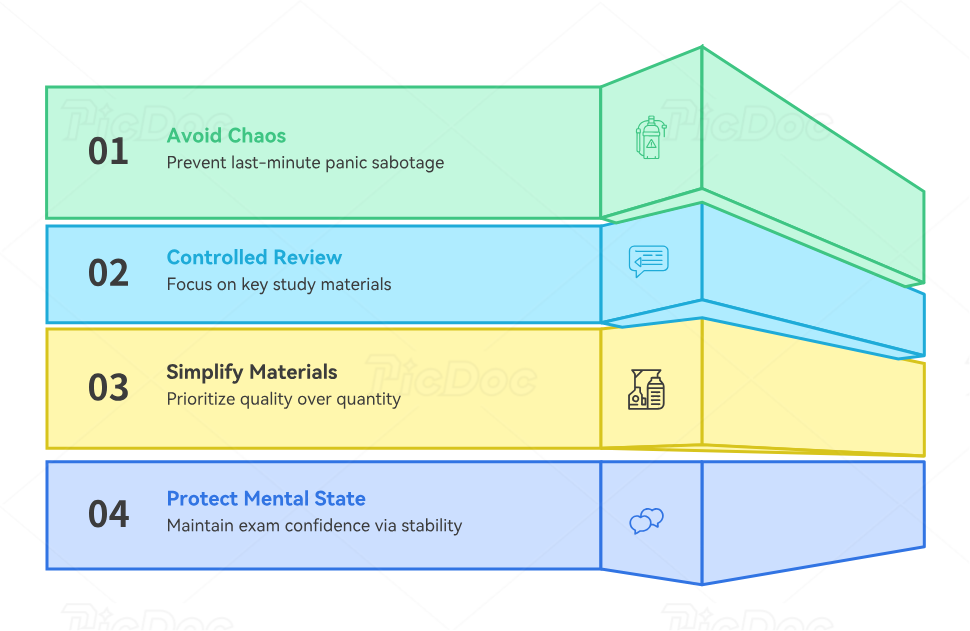
A lot of preparation collapses in the final stretch. Students who studied for weeks suddenly start switching methods, downloading too many new resources, cramming things they never properly learned, sleeping badly, and trying to “cover everything.” That final panic destroys more first-try attempts than most people admit.
Strategy eight is to build a disciplined exam-week system. In the last week, you do not need a flood of new content. You need controlled review. Focus on your compressed notes, your high-yield terms, your previously missed question types, and your weakest categories. Revisit essential study techniques for medical scribe certification success, review complete exam expectations, and keep your practice centered on recall rather than endless reading.
This is also the moment to simplify your materials. One strong review sheet beats six disorganized notebooks. One focused weak-area list beats thirty screenshots. One short set of privacy traps, documentation pitfalls, and charting term confusions is more useful than opening ten new browser tabs hoping something magical will happen.
Strategy nine is to protect your mental state from last-minute chaos. Students often assume confidence is a personality trait. It is not. Exam confidence is evidence-based. It comes from repetition, error correction, and familiarity with the testing feel. If you have been doing timed blocks, mixed-topic retrieval, and careful mistake review, you do not need fake motivation speeches. You need stability.
That means controlling the final 48 hours. Avoid marathon cram sessions that blur your memory. Avoid conversations with panicked classmates who keep inventing new things to fear. Review ACMSO exam day essentials, use a practical routine, and go into the exam with a calm sequence: wake up, prepare, arrive, settle, and start. Every unnecessary decision steals energy.
This point matters because many students are closer to ready than they think, but they sabotage themselves by turning the final days into chaos. They keep chasing one more resource instead of reinforcing what they already know. That is not ambition. That is fear disguised as productivity.
5. Strategy 10: Review Every Mistake Like It Is a Map to Your Passing Score
The tenth strategy is the one that transforms average study into serious study: aggressive mistake review. A practice score means almost nothing by itself. What matters is whether you extract the lesson hiding inside every wrong answer.
When you miss a question, do not just note the correct option and move on. Ask what kind of error occurred. Was it a terminology gap? A privacy rule confusion? A charting logic issue? A specialty vocabulary miss? A time-pressure misread? A trap answer? A careless skip over one key word in the stem? Those patterns matter because students usually do not fail in random ways. They fail in clusters.
For example, if your misses keep landing in privacy questions, go back through top 20 HIPAA terms for medical scribes. If charting language is messy, revisit top 20 EMR and charting terms. If you keep freezing on general vocabulary, go harder on medical terminology mastery. If the problem is broader exam structure, return to complete exam guides, practice exam tools, and insider study secrets.
The students who pass on the first try are rarely the ones who never struggle. They are the ones who turn every struggle into a sharper study plan. They do not protect their ego. They protect their score. They do not say, “I almost had it.” They say, “Why exactly did I miss that, and how do I make sure it never happens again?”
That mentality also helps long after the exam. Strong mistake review builds the kind of thinking that matters in real work: fast correction, pattern recognition, and disciplined improvement. Those same qualities shape stronger careers through resources like how becoming a medical scribe skyrockets your medical career, 5 surprising skills you gain as a medical scribe, and why medical scribing is one of healthcare’s fastest-growing careers.
Passing the ACMSO certification on your first try does not come from luck, and it does not come from piling up random study hours. It comes from using the right strategies in the right order: blueprint-based planning, high-yield term mastery, retrieval practice, early weak-area correction, timed blocks, clinical-context study, trap-pattern recognition, disciplined exam-week review, calm execution, and ruthless mistake analysis. That combination creates the kind of preparation that holds up when the clock starts.
6. FAQs About Passing the ACMSO Certification on Your First Try
-
The biggest reason is disorganized study. Many students spend a lot of time with the material but very little time using a structured system. They reread notes, jump between resources, and avoid weak areas until it is too late. The better path is to follow a clear exam roadmap through the ACMSO certification exam guide, the complete guide to passing your medical scribe certification exam, and targeted study techniques for certification success.
-
Start as early as you can study consistently. A steady study block over several weeks is much better than a panic sprint near the end. The exam tests layered knowledge, not just one memorization burst. Early preparation gives you time to master medical terminology, EMR and charting terms, HIPAA concepts, and specialty-specific content without collapsing into cramming.
-
Practice exams are essential, but they are not enough by themselves. What matters is how you use them. A student who takes ten practice tests and barely reviews mistakes can still fail. A student who takes fewer but analyzes every miss can improve rapidly. Use the interactive medical scribe practice exam and real-life exam question resources, but spend serious time reviewing why your wrong answers happened.
-
Start with the categories that shape everything else: terminology, charting language, HIPAA, documentation accuracy, and common workflow logic. Those domains appear across many question types. Resources like top 20 terms scribes must master, top 20 EMR and charting terms, and top 20 HIPAA terms are strong starting points.
-
Use retrieval instead of rereading. Cover the answer and force yourself to produce it. Study prefixes, suffixes, body systems, abbreviation clusters, and term families instead of isolated words. Then test those terms in context using medical terminology guides and specialty training like cardiology, orthopedics, surgery, and oncology.
-
Stop chasing new resources. Narrow your focus to high-yield review, missed question patterns, compressed notes, timing control, and calm routine building. Review ACMSO exam day essentials and the medical scribe exam breakdown. The final week is for sharpening, not panic-collecting.
