

From Scribe to Physician: Real-Life Journeys of Medical Scribes
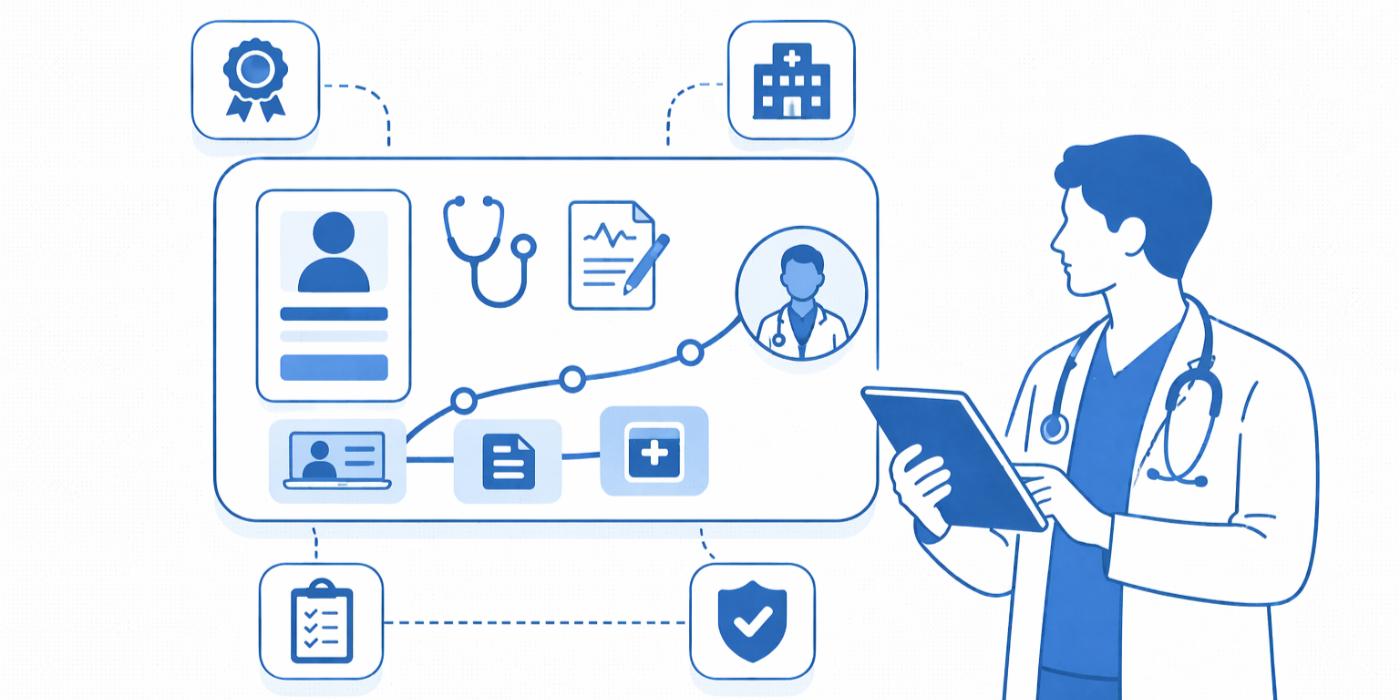
For many future physicians, medical scribing becomes the first place where medicine stops being abstract and starts feeling real. It is where textbook language turns into clinical judgment, where rushed patient encounters expose the difference between memorizing disease and recognizing it in motion, and where documentation reveals how deeply precision shapes care. That is why so many scribes later move into medical school with stronger instincts, sharper clinical language, and a far more realistic view of the profession.
This article breaks down how that transition actually happens, what scribes gain on the path, where the role strengthens a physician trajectory, and what separates a meaningful scribe experience from one that stays shallow.
1. Why the Scribe-to-Physician Path Has Become So Powerful
The journey from medical scribe to physician matters because it builds something pre-med coursework often cannot: applied clinical pattern recognition under real constraints. A future doctor can spend years learning anatomy, physiology, and pathology, yet still remain unprepared for the pace, ambiguity, and communication load of an actual encounter. Scribing compresses all of that into daily exposure.
The role forces early contact with the living structure of care. A scribe hears how a physician narrows a differential, watches which patient details change management, sees how documentation must reflect medical thinking without distorting it, and learns how tiny wording errors can shift the meaning of a chart. That is why the role keeps appearing in conversations around how becoming a medical scribe skyrockets your medical career, 5 surprising skills you gain as a medical scribe beyond documentation, why medical scribing is one of healthcare’s fastest-growing careers, and the broader medical scribe career outlook.
The most important shift happens in how scribes learn to listen. At the beginning, many hear a flood of terms and scramble to type fast enough. Later, they start recognizing structure. They can tell when a physician is establishing chronology, when a patient’s wording hints at severity, when the absence of a symptom matters, and when an assessment is still tentative. Those are not glamorous gains. They are foundational gains. They make future clinical training less shocking and far more usable.
That is also why the path has become especially attractive to pre-med students trying to choose between loosely relevant healthcare exposure and direct clinical immersion. Compared with disconnected volunteer roles, scribing offers closer contact with the logic of medicine. Compared with generic administrative work, it exposes reasoning, documentation, workflow, patient interaction, and care-team coordination all at once. ACMSO’s ecosystem around day in the life of a medical scribe, how scribes improve documentation accuracy by over 90, annual report on enhancing clinical documentation accuracy, and interactive report on reducing physician burnout shows why the role keeps gaining strategic weight.
Still, the title alone does not create value. A scribe who only transcribes words without learning the clinical architecture behind them will gain much less. The real journey begins when the scribe starts asking better internal questions: Why did the physician ask that follow-up? Why did that symptom move from vague complaint to concerning pattern? Why did one chart need precision around onset, timing, and modifiers while another needed priority around risk, follow-up, and disposition? That is where a scribe starts becoming physician material.
| # | Journey Stage | What the Scribe Learns | Why It Matters for Future Physicians | ACMSO Resource Fit |
|---|---|---|---|---|
| 1 | First week shock | Pace, terminology overload, chart structure | Builds clinical listening discipline | Medical terminology quick study guide |
| 2 | Early adaptation | How HPI, ROS, exam, and plan connect | Improves diagnostic storytelling | Top charting terms for scribes |
| 3 | Terminology control | Root words, abbreviations, specialty language | Prepares for medical school vocabulary load | Top 20 documentation terms |
| 4 | Workflow fluency | What happens before, during, after encounters | Makes clinical systems easier to understand | Front desk and intake guides |
| 5 | Accuracy pressure | Hearing precisely and documenting defensibly | Sharpens future note discipline | Documentation accuracy report |
| 6 | EMR mastery | Navigation, shortcuts, information retrieval | Reduces later chart friction | Top 10 EMR shortcuts |
| 7 | Specialty exposure | How cardiology, ER, ortho, oncology differ | Clarifies specialty interests early | Specialty-specific training guides |
| 8 | Patient narrative awareness | How symptoms are described, minimized, or buried | Improves future history-taking sensitivity | Communication and empathy resources |
| 9 | Pertinent negative judgment | What missing symptoms change the picture | Builds clinical logic under uncertainty | Emergency scribing guide |
| 10 | Assessment awareness | Difference between suspicion and diagnosis | Prevents sloppy clinical language | Documentation terms and examples |
| 11 | Physician observation | Different bedside styles and reasoning habits | Shapes professional identity | Real stories from emergency departments |
| 12 | Burnout visibility | What time pressure does to decision fatigue | Creates realistic career expectations | Physician burnout report |
| 13 | Team communication | How nurses, MAs, scribes, admins, physicians align | Builds interprofessional awareness | Collaboration tools and workflow content |
| 14 | Ethics and privacy | HIPAA, access limits, respectful handling | Grounds future professional trust | HIPAA term resources |
| 15 | Confidence jump | Moving from reactive typing to anticipatory thinking | Signals true clinical growth | Certification prep and practice exams |
| 16 | Pre-med storytelling | Translating exposure into mature reflections | Strengthens medical school applications | Career opportunity and exam guides |
| 17 | Specialty curiosity | Which cases feel energizing or draining | Useful long before residency choices | Cardiology, ortho, oncology guides |
| 18 | Emergency thinking | Triage logic, acuity framing, concise note building | Sharpens prioritization instincts | ER scribing training |
| 19 | Outpatient continuity | Follow-ups, chronic disease, pattern review | Develops longitudinal care awareness | Primary care and specialty network directories |
| 20 | Telehealth adaptation | Virtual workflow and communication nuance | Reflects modern physician practice | Telehealth company and platform resources |
| 21 | AI awareness | What automation helps and where humans still matter | Builds future-proof thinking | AI scribe tools and future of documentation |
| 22 | Certification decision | Formalizing skill and employability | Improves credibility and readiness | Scribe certification exam resources |
| 23 | Leadership maturity | Owning accuracy and reliability under pressure | Translates directly into clinical professionalism | Workforce and employer reports |
| 24 | Medical school entry | Starting with real-world clinical context | Makes preclinical learning stick faster | Career and certification pathways |
| 25 | Physician identity formation | Learning what kind of doctor to become | This is the real long-term payoff | Everything above, integrated |
2. What Real Scribes Usually Gain Before They Ever Enter Medical School
The most valuable scribe experiences are rarely dramatic. They are cumulative. A scribe sits in room after room, chart after chart, and eventually starts noticing what separates superficial care from thoughtful care. That type of repeated exposure creates unusually durable preparation for future physicians.
One gain is language discipline. Medical students who scribed often arrive less intimidated by rapid clinical speech. They have already encountered the cadence of top 20 terms medical scribes must master, the logic behind top 20 EMR and charting terms, the importance of mastering medical terminology, and the daily relevance of CPT codes explained and the ICD-10 interactive dictionary. That does not make them physicians early. It does make the early transition into medical training less disorienting.
Another gain is better history-taking awareness. Scribes learn that the right follow-up question can rescue a vague complaint from uselessness. Chest pain means very little without onset, quality, radiation, duration, associated symptoms, triggers, and risk framing. Abdominal pain stays messy until location, progression, bowel changes, fever, vomiting, and prior history start clarifying the shape of the problem. Watching that process repeatedly teaches clinical attention far better than passive shadowing.
The third gain is realism. Scribes see what medicine feels like when schedules back up, charts pile up, a patient is frightened, the physician is pressed for time, and the note still must hold together. ACMSO’s content around interactive guide to mastering emergency room scribing, scribing for orthopedics, 10 essential skills every cardiology medical scribe needs, surgical scribing 101, and advanced oncology scribing matters here because it shows how different clinical environments shape thinking.
Most importantly, scribes learn humility around medicine. They discover how much nuance is hidden inside “routine” care. They see that many patient encounters are not neat. Symptoms conflict, histories are incomplete, workflows interrupt reasoning, and communication failures create downstream harm. That realism often produces stronger future physicians than prestige-heavy but shallow exposure ever could.
3. What the Best Real-Life Scribe-to-Physician Journeys Usually Have in Common
The strongest journeys do not come from merely holding the job for a certain number of months. They come from how the scribe uses the role. The difference is enormous.
First, strong future physicians treat scribing as apprenticeship-level observation. They do not just memorize shortcuts. They study thought patterns. They notice how one physician documents uncertainty, how another builds rapport, how another tightens the assessment when risk is high. They use tools like medical scribe certification exam breakdown, complete guide to passing your medical scribe certification exam, essential study techniques for medical scribe certification success, and the interactive medical scribe practice exam to formalize what they are learning in practice.
Second, they deliberately broaden exposure. A scribe who only sees one narrow clinical flow may still gain a lot, but someone who compares emergency medicine, outpatient follow-up, specialist visits, and possibly telehealth begins to understand the ecosystem of care more deeply. That is where resources like top 100 emergency departments and urgent care chains hiring scribes, top 75 outpatient specialty networks hiring scribes, top 75 primary care networks hiring scribes, and top 100 telehealth companies using medical scribes become especially useful.
Third, they learn to convert exposure into reflection. Medical school admissions does not care that someone sat near physicians. It cares what that exposure changed in the applicant’s understanding of care, responsibility, uncertainty, and patient experience. The best journeys generate specific insights: the weight of precise documentation, the strain of clinical time pressure, the fragility of patient trust, the teamwork required to keep an office or department from collapsing into confusion.
4. The Hard Parts of the Journey That Future Physicians Should Not Romanticize
Scribing helps future physicians. It also exposes limits, frustrations, and difficult truths. Ignoring those realities weakens the value of the experience.
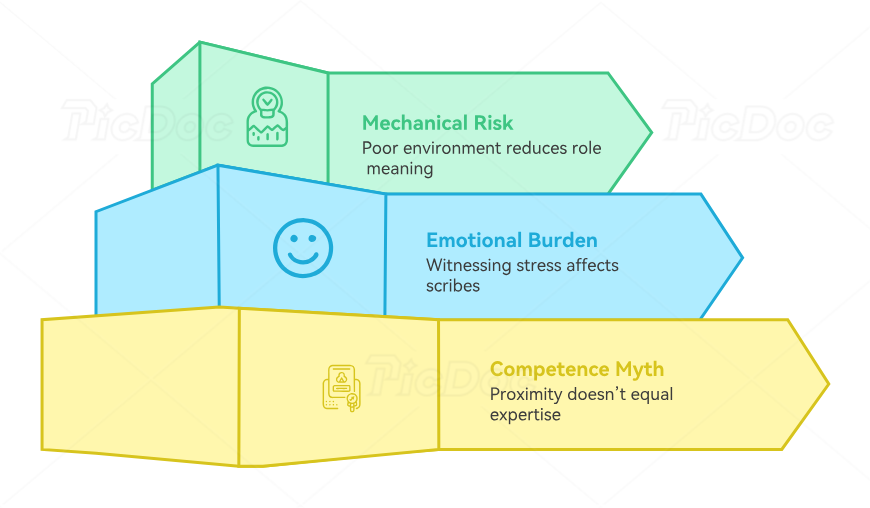
The first hard truth is that the role can become mechanical if the environment is poor. A scribe who is undertrained, thrown into excessive volume, or reduced to blind data entry may gain speed but lose meaning. That is why choosing stronger pathways matters, whether through top 50 medical scribe training courses and certifications, why healthcare facilities prefer certified medical scribes, top 50 medical scribe companies and staffing agencies, or top 75 remote medical scribe employers.
The second is emotional compression. Scribes often witness distress, rushed decisions, patient anger, clinician exhaustion, and the quiet accumulation of administrative burden. Seeing that early can be clarifying. It can also be heavy. This is where materials on de-escalation techniques, effective patient communication, empathy in healthcare administration, patient privacy communication essentials, and active listening techniques help because they reinforce that clinical work is relational, not purely technical.
The third is the temptation to mistake proximity for competence. A scribe may stand inches away from medical reasoning every day and still avoid doing the harder work of understanding. The role creates access. It does not automatically create depth. Depth only comes when the scribe reviews terminology after shifts, studies chart logic, learns from corrections, and keeps building beyond the keyboard.
5. How Aspiring Physicians Can Get the Most Out of a Medical Scribe Role
Anyone aiming to go from scribe to physician should use the role strategically. Start by mastering the obvious basics faster than expected: note structure, terminology, EMR navigation, privacy habits, and encounter flow. That base creates credibility. Once trusted, you begin to notice more.
Use every shift as a study lab. After difficult cases, write down what made them difficult. Was it vague chronology, specialty-specific terminology, weak hearing precision, or confusion between suspected diagnosis and confirmed diagnosis? Then repair that gap with targeted ACMSO resources such as future of medical documentation in an AI-driven world, top 50 AI medical scribe and ambient dictation tools, top 50 voice recognition and dictation software, top 50 EMR/EHR platforms every medical scribe should know, and interactive guide to emerging medical admin technologies.
Also, do not neglect the professional dimension. Networking strategies for medical admin professionals, medical administration conferences and workshops directory, professional organizations directory, online communities and forums for CMAAs, and future-proofing your CMAA career are relevant even for scribes on the physician path because medicine rewards people who understand systems, not only science.
Finally, reflect with specificity. A strong future physician narrative does not say, “Scribing confirmed my passion for medicine.” It says something far more grounded: “Repeatedly documenting chest pain taught me how fragile clinical meaning becomes when timing, severity, and associated symptoms stay vague.” That kind of insight signals maturity.
6. FAQs
-
It can help a great deal when the experience is substantial and reflective. Admissions committees tend to value exposure that demonstrates direct contact with patient care, clinical reasoning, physician workflow, and professional responsibility. Scribing can provide all four. Its real value increases when the applicant can explain what the experience taught them about medicine beyond simple shadowing.
-
The biggest transferable skills are clinical listening, documentation precision, terminology fluency, pattern recognition in patient histories, comfort inside EMRs, and a stronger sense of how care teams function under pressure. Those gains do not replace physician training. They make physician training more grounded from day one.
-
Often, yes, especially for students who need deeper clinical exposure. Volunteering can still matter, particularly for service and patient contact, but scribing usually offers a more direct view into diagnostic thinking, documentation, physician workload, and the structure of encounters. The strongest application profiles often combine both kinds of experience rather than treating them as interchangeable.
-
That depends on the person, but high-volume environments with strong teaching exposure often create rapid growth. Emergency departments can sharpen speed and triage logic. Outpatient specialties can deepen pattern recognition and longitudinal thinking. Primary care can reveal how chronic disease, communication, and continuity interact. The best environment is the one that stretches both attention and judgment.
-
Certification can be useful because it formalizes terminology, charting expectations, workflow knowledge, and documentation standards. It can also strengthen credibility when applying for scribe roles and help the scribe perform at a higher level sooner. Resources like how to ace your medical scribe certification exam, top 10 mistakes students make on the ACMSO exam, exam day essentials, and real-life exam questions and expert answers can support that path.
-
The biggest mistake is treating the job as passive exposure instead of active apprenticeship. The best future physicians study after shifts, learn from corrections, compare specialties, notice how language shapes care, and keep asking what made a case medically meaningful. The role becomes transformative when the scribe uses it to build judgment, not just resume lines.
