

Online Communities & Forums for CMAAs: Interactive Directory
The best online community for a CMAA is not the loudest one. It is the one that helps you solve real problems faster, sharpen judgment, find better workflows, and learn what actually happens inside medical offices before a mistake reaches a patient. That matters because medical administrative work can become isolating fast. You are expected to know scheduling logic, intake flow, portal communication, insurance issues, privacy limits, front-desk diplomacy, and team coordination, often while the phones keep ringing and nobody has time to explain the why behind the process.
That is exactly why strong online communities and forums matter. The right ones give CMAAs practical answers, peer support, role-specific updates, leadership pathways, certification guidance, and better language for handling difficult situations. For ACMSO learners, this topic connects naturally with front desk operations, effective patient communication, appointment scheduling best practices, healthcare portal terms, and future-proofing your CMAA career.
1. Why online communities matter more for CMAAs than most people realize
A CMAA role looks administrative from the outside, but the day-to-day reality is operational, interpersonal, and compliance-heavy. You are constantly translating between patients, providers, schedules, systems, and policies. When that work is done without a peer network, people tend to rely on guesswork, old habits, or whatever one coworker told them years ago. That is dangerous. A strong online community gives you something much more valuable than motivation: pattern recognition. You start seeing how other offices solve referral bottlenecks, patient message backlogs, intake confusion, scheduling friction, and front-desk conflict before those problems harden into “the way we do things here.” That makes communities a career asset, not a hobby. It also reinforces knowledge from insurance verification, patient intake procedures, de-escalation techniques, empathy in healthcare administration, and top 10 skills employers look for in a CMAA.
The strongest communities also reduce a very specific kind of professional frustration: silent uncertainty. Many medical administrative assistants know when something feels off, but they do not always have a safe place to ask, “Is this normal?” or “How are other offices handling this?” That is where association communities, chapter networks, and moderated peer forums become powerful. They create a place to compare workflows, ask for perspective, and see how experienced professionals think through recurring issues. AAMA explicitly offers networking opportunities and state society or chapter connections, MGMA offers a member community for discussion, PAHCOM positions itself around knowledge sharing and networking for medical office management, NAHAM centers its community around patient access professionals, AAHAM points members to local chapters and healthcare administrative management networking, and AMT offers online communities where members can ask questions and share resources.
Another overlooked benefit is career signal strength. The right communities help you think and communicate like someone moving upward, not someone stuck reacting all day. You start learning the vocabulary of operations, access, revenue cycle, leadership, patient flow, standardization, and workflow design. That matters if you want to move from entry-level admin work toward patient access, office leadership, training, coordination, or specialized administration. This is why community participation fits directly with CMAA career roadmaps, why CMAA certification boosts career opportunities, medical admin assistant job market outlook, future healthcare roles for CMAAs, and medical administrative assistants and technology.
2. Best communities and forums for CMAAs, grouped by what they actually help with
The most useful directory is not alphabetical. It is functional. CMAAs do not join communities just to “network.” They join because they need answers, examples, perspective, encouragement, or pathways upward. So the smartest way to think about online communities is by the kind of value they deliver.
For professional identity and serious peer networking, AAMA is one of the strongest starting points. Its national association supports education, certification, and networking; it also maintains state societies and local chapters, which is important because many healthcare careers become more useful once the network becomes local. On top of that, AAMA has an official member-to-member Facebook group built as a forum for sharing questions and experiences, plus a leaders group for leadership-focused discussion. For a CMAA who wants a more grounded professional home than a random social feed, that combination is powerful. It supports both entry-level confidence and longer-term leadership visibility. It also pairs naturally with how to master medical administrative terminology, complete breakdowns of the CMAA exam, essential study tips for CMAA success, real-life success stories from certified medical administrative assistants, and annual CMAA salary report coverage.
For office operations and future management thinking, MGMA and PAHCOM are standout choices. MGMA’s community is explicitly built for connecting with peers and joining discussion, while PAHCOM describes itself as a collaborative association designed for knowledge sharing and networking, particularly for solo and small-group physician practices. That distinction matters. Not every CMAA wants only certification talk. Many want to understand the bigger machine: staffing, operations, workflows, patient flow, policy discipline, communication structure, and office systems. These communities can help a CMAA think beyond task completion and start thinking in terms of operational design. That skill set connects directly with medical office automation trends, why automation is the biggest opportunity for CMAA career growth, interactive guides to the medical office of 2025, virtual medical administration, and how AI will transform medical administrative assistant roles by 2030.
For patient access, registration, and front-end workflow depth, NAHAM is one of the most strategically useful communities. Its site explicitly positions NAHAM as a community for patient access professionals, and public materials point to an Access Forum, a membership directory, networking opportunities, and curated content through NAHAM Connections. This is especially relevant for CMAAs because a large portion of administrative friction lives at the front end: registration accuracy, scheduling logic, intake completeness, communication timing, access variability, and the patient’s first impression of whether the office is organized. A CMAA who learns from patient-access professionals often becomes much stronger in real workflow judgment. That supports skill-building alongside patient intake procedures, healthcare portal terms, appointment scheduling best practices, telehealth platform terms, and predictive insights on telemedicine and virtual healthcare.
For revenue cycle, reimbursement, and healthcare administrative management, AAHAM is a strong specialty community. AAHAM describes itself as the professional organization for healthcare administrative management, and its membership materials emphasize access to local chapters and networking with experts across the country. That is important for CMAAs who are moving toward insurance, patient accounts, registration accuracy, reimbursement-adjacent work, or broader administrative leadership. Even if a CMAA does not intend to specialize in revenue cycle, exposure to these conversations makes everyday office work smarter. It improves how you think about registration quality, documentation completeness, follow-up discipline, and patient-facing communication. Those capabilities reinforce insurance verification, top medical billing terms CMAAs should understand, future healthcare compliance changes, CMAAs and data privacy, and 2026 healthcare administration report insights.
For structured online peer exchange inside a credentialed professional ecosystem, AMT Communities are a strong option. AMT’s official materials say members can engage with colleagues online, ask questions, share resources, and keep up with national and state news and events. That format is useful for people who want community value without relying entirely on open social media. It is also helpful for CMAAs who want to spend time in a slightly broader allied-health environment, because it exposes them to adjacent professional thinking without losing structure. That can support career maturity and broader awareness, especially when combined with future-proof your CMAA career emerging skills, top emerging career specializations for CMAAs, interactive career planners for future healthcare roles, medical administrative assistants and technology, and why certification dramatically boosts opportunities.
3. How to use open forums without getting bad advice
Open forums can be incredibly helpful, but they are where many professionals get misled. Reddit’s r/MedicalAssistant openly describes itself as a place for medical assistants to share advice, school help, and certification discussion. That can be useful because people speak candidly there in ways they often do not inside formal association spaces. You will see burnout conversations, pay concerns, workflow frustrations, school questions, job-search anxiety, and honest takes about what different offices are like. That is valuable because it gives you emotional truth and field reality. But it is not automatically reliable operational guidance. Open forums are best for perspective, not policy. They can tell you what people are experiencing. They should not be your sole source for privacy rules, compliance decisions, or office protocol. This is where ACMSO learners benefit from grounding peer discussion in HIPAA and patient privacy terms, effective patient communication, front desk operations, telehealth regulation changes, and predicting HIPAA updates.
The best way to use open communities is to separate four kinds of value. First, use them for emotional calibration: Are others struggling with the same office chaos, patient behavior, or workload? Second, use them for question-framing: What should I be asking my employer, preceptor, or manager? Third, use them for practical patterns: What systems or habits seem to help people succeed? Fourth, use them for career reconnaissance: What roles, specialties, or settings do people describe as stable, chaotic, growth-friendly, or burnout-heavy? That is all useful. What you should not do is treat anonymous advice as final authority on scope, compliance, privacy, pay norms, or certification policy. For those areas, official associations and structured professional communities carry more weight.
A smart CMAA does not reject open forums. They triangulate them. If Reddit says one thing, an association chapter says another, and your office manual says a third, that tension itself is informative. It tells you where confusion exists. It tells you which topics need verification. It tells you where practice differs from principle. That level of discernment is what separates casual internet browsing from professional development. It also strengthens the kind of judgment employers actually notice in people who advance. This connects closely with future healthcare compliance changes, medical office automation opportunities, new studies on healthcare efficiency, how CMAAs will lead the patient experience revolution, and career progression and promotion data.
4. Best picks by goal: where CMAAs should go first and why
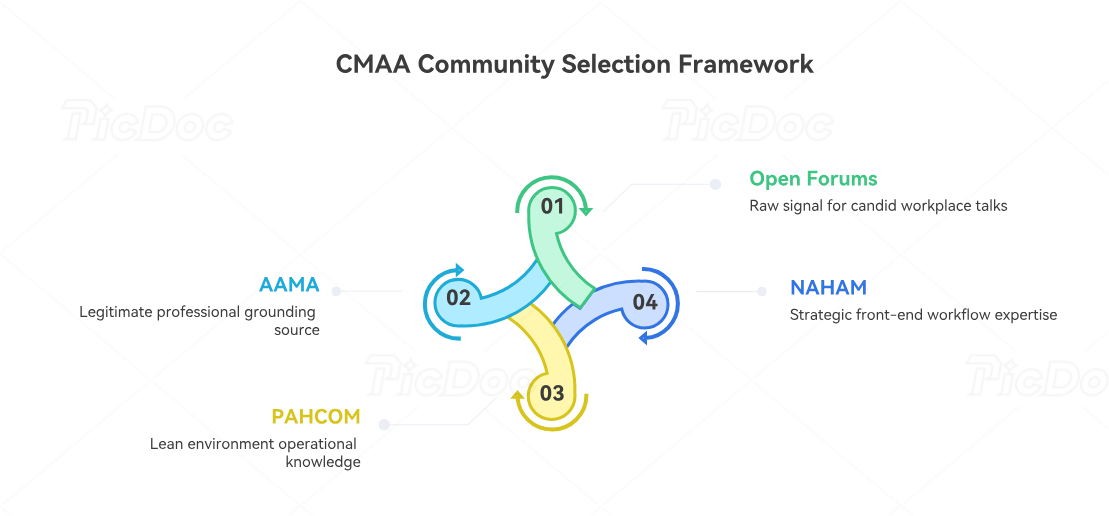
If your goal is broad professional grounding, start with AAMA and its state society or local chapter path. That combination gives you both national identity and local access, which is often the best balance for a working professional. National communities give you standards, language, and perspective. Local communities give you relationships, realism, and opportunities that actually touch your job search or day-to-day support. AAMA’s official member group also adds a more conversational layer, which helps bridge the gap between formal belonging and everyday peer interaction. That makes it one of the strongest all-around starting points for someone who wants a legitimate professional base instead of random internet noise. This fits neatly alongside ultimate CMAA exam guides, CMAA exam mistakes to avoid, interactive CMAA practice exam resources, CMAA exam day checklists, and medical administrative terminology mastery.
If your goal is small-practice operations insight, PAHCOM is a smart early stop. It explicitly serves solo and small-group physician practices and frames itself around knowledge sharing. That matters because many CMAAs work in lean environments where one person handles scheduling, intake, calls, portals, records, and office coordination all in the same hour. In those settings, broad hospital-style advice can feel detached from reality. A small-practice community often gives more usable answers. It also supports growth for CMAAs who want to move from task execution into systems thinking, workflow cleanup, and practice administration. That aligns with medical office automation trends, why automation is a career-growth opportunity, the future of EMR systems, interactive guides to the medical office of 2025, and virtual medical administration.
If your goal is patient access mastery, choose NAHAM. Administrative assistants who become excellent at front-end healthcare workflows are often the ones who understand access better than everyone around them. They know where registration fails, where intake stalls, where scheduling breaks, and where the patient experience starts to feel chaotic. NAHAM’s community framing makes it especially valuable for CMAAs who want stronger discipline around access, flow, and patient-facing operations. It is one of the better communities for people who want to become more than “good at the desk” and start becoming genuinely strategic in how the office runs. That supports learning tied to patient intake procedures, appointment scheduling best practices, healthcare portal terms, telehealth platforms, and future patient experience leadership for CMAAs.
If your goal is uncensored day-to-day honesty, open forums like r/MedicalAssistant can help, as long as you treat them as raw signal rather than final truth. This is where you go for candid conversations about burnout, workplace culture, school stress, job transitions, and what different offices actually feel like. It is one of the better places for emotional realism. Just do not let emotional realism replace professional verification. The best CMAAs use open forums as a listening post, then check what matters against better sources. That habit supports smarter judgment and stronger professionalism over time.
5. How to choose the right community without wasting your time
Do not join ten communities at once. That is how people turn professional development into background scrolling. Instead, match your choice to your immediate pain point. If you need legitimacy, local access, and a stronger professional identity, start with AAMA. If you need systems thinking for a physician office, start with PAHCOM or MGMA. If you are deeply involved in registration, access, intake, or front-end flow, start with NAHAM. If you want broader healthcare administrative management or revenue-cycle-adjacent exposure, start with AAHAM. If you want structured online peer discussion in an association environment, AMT Communities are useful. If you need honesty and emotional calibration, add one open forum like Reddit as a secondary source, not the foundation.
A second smart filter is to ask whether the community makes you sharper or just busier. A good professional community leaves you with better language, better questions, better frameworks, and better decisions. A weak one gives you endless chatter, recycled frustration, and shallow reassurance. You should come away with something operational: a better intake checklist, a better way to think about patient access, a better script for communication, a better idea of what role to pursue next, or a better understanding of what healthy office processes look like. That is why community choice should strengthen the same core skill areas you are already building through front desk operations, effective patient communication, de-escalation techniques, future healthcare compliance readiness, and medical admin career outlooks.
Finally, remember that communities are not only for getting help. They are also where your reputation starts to form. People notice who asks thoughtful questions, who shares practical solutions, who helps others clearly, and who communicates with maturity. Those signals matter more than most new professionals realize. Community participation can quietly become mentorship access, job leads, speaking opportunities, volunteer roles, or leadership pathways. For a CMAA, that is not extra. That is leverage. It is one of the cleanest ways to turn isolated daily work into visible career momentum. That pairs powerfully with career roadmaps from entry-level to manager, salary reports, career opportunities boosted by certification, future-proof specializations, and interactive career planners for future healthcare roles.
6. FAQs
-
For most beginners, AAMA is one of the strongest starting points because it combines professional identity, networking, and a path into state societies or local chapters. Its official member Facebook group also adds a practical peer-discussion layer, which helps new professionals ask questions without relying only on random internet advice. That makes it a more balanced starting point than an open forum alone.
-
They are useful, but not enough by themselves. Open groups can be excellent for candid stories, study motivation, and reality checks, but they are uneven in quality. They work best as a supplement to stronger professional communities where networking, structure, and role-specific context are clearer. Treat them as signal, not final authority.
-
MGMA and PAHCOM are especially useful for CMAAs who want to think beyond daily tasks and start understanding office systems, workflow design, and practice management. They help shift your mindset from “getting through the day” to “understanding how the office actually runs.” That is often the mindset difference behind promotion.
-
NAHAM is one of the strongest options because it centers patient access professionals and highlights community, networking, an Access Forum, and curated content. For CMAAs who spend most of their time on registration, intake, scheduling, and patient-facing workflow, that focus is unusually relevant.
-
Usually two or three is enough. One structured professional community, one role-adjacent specialty community, and optionally one open forum is a smart mix. That gives you credibility, practical depth, and candid peer reality without turning your learning time into scattered scrolling.
