

Medical Administration Conferences & Workshops Directory (2026-27 Edition)
Medical administration professionals do not need more generic motivation. They need sharper systems, cleaner workflows, fewer preventable errors, better patient communication, stronger privacy judgment, and a clearer path to advancement. That is why the right conference matters. In one well-chosen event, you can solve bottlenecks that keep showing up in front-desk operations, tighten weak spots in appointment scheduling, strengthen patient intake procedures, and prepare for changes in medical office automation.
This directory is built for professionals who want practical ROI. Whether you are building fluency in patient privacy, improving insurance verification, learning healthcare portal workflows, expanding your understanding of telehealth platforms, or future-proofing your career through essential skills for 2030, the events below are the ones worth tracking closely in 2026 and 2027.
1. Why conferences still matter for medical administration in 2026-27
Medical administration is no longer a role where you can stay effective by repeating last year’s process. Offices are being squeezed from all sides. Patients expect faster scheduling, clearer digital communication, easier portal use, and cleaner handoffs. Employers expect better metrics, fewer compliance mistakes, and stronger coordination across access, revenue cycle, and documentation. Meanwhile, staff are expected to absorb AI tools, new system upgrades, and evolving regulations without letting quality drop.
That is exactly why targeted conferences and workshops still matter. The best ones compress months of confusion into a few days of real operational clarity. They help attendees understand what high-performing teams are doing differently in patient communication, de-escalation, EMR workflow readiness, data privacy preparation, and regulatory change planning. Official 2026 calendars already show that major organizations are emphasizing operations, patient access, healthcare finance, digital health, quality, and health information governance rather than narrow clerical skills alone.
Before you choose where to invest your time and budget, use this working directory as your shortlist.
| # | Event / Series | Best For | What You’ll Get | 2026-27 Planning Angle |
|---|---|---|---|---|
| 1 | MGMA Operations Conference | Practice operations leaders | Workflow redesign, staffing, access, sustainability | Excellent for admins moving into systems thinking |
| 2 | MGMA conference hub | Broad medical practice management | Event calendar, operations, finance, leadership options | Strong source for 2026-27 planning |
| 3 | NAHAM Annual Conference | Patient access, scheduling, registration teams | Front-end revenue cycle, access quality, patient flow | Best flagship option for access-heavy roles |
| 4 | NAHAM Access Week | Access teams and supervisors | Recognition, internal training, skill refreshers | Useful for in-house development plans |
| 5 | NAHAM webinars / education | Busy admins needing targeted learning | Focused access topics without travel | High-value low-cost option |
| 6 | HFMA Revenue Cycle Conference | Revenue-cycle adjacent admins | Denials, clearance, reimbursement, finance pressure | Ideal for roles tied to registration accuracy |
| 7 | HFMA Leadership Summit | Emerging managers | Leadership, strategy, executive communication | Best for promotion-minded attendees |
| 8 | HFMA Annual Conference | Finance-connected healthcare leaders | Affordability, innovation, systemwide improvement | Top pick for big-picture growth |
| 9 | HFMA events calendar | People planning ahead | Conference and webinar visibility | Helpful for 2027 watchlists |
| 10 | HIMSS26 | Digital health, AI, EMR, portal leaders | Interoperability, AI, health tech strategy | Best for tech-driven offices |
| 11 | HIMSS agenda tracks | Planners comparing session depth | Useful for identifying AI and digital front door content | Best before requesting budget approval |
| 12 | AAPC HEALTHCON 2026 | Coding and compliance crossover roles | Documentation, coding updates, CEUs | Great if your role touches claims language |
| 13 | AHIMA Advocacy Summit | Privacy and information-governance minded professionals | Policy, health data, public affairs insight | Strong for governance-focused growth |
| 14 | AHIMA Member Town Halls | Professionals tracking professional updates | Leadership updates and field issues | Fast, compact virtual learning |
| 15 | AHIMA Data Break webinars | Data quality and reporting roles | Focused health data use cases | Good for teams expanding reporting rigor |
| 16 | AHIMA HIP Week events | Privacy and records awareness | Internal awareness campaigns and refreshers | Useful for office-wide staff development |
| 17 | NAHQ events calendar | Quality-minded admins | Safety, CMS priorities, performance improvement | Best if you support quality initiatives |
| 18 | NAHQ Learning Labs | Operational improvement learners | Focused live skill-building | Good for applying ideas immediately |
| 19 | Becker’s Annual Meeting | Senior admins and ambitious managers | Leadership, AI, workforce, strategy | Strong for macro healthcare trends |
| 20 | Becker’s agenda / speaker lineup | Decision-makers comparing content depth | Lets you validate relevance before booking | Good for manager approval memos |
| 21 | Regional HFMA chapter events | Lower-budget attendees | Closer networking, lower travel costs | Useful bridge between major events |
| 22 | Regional MGMA conferences | Medical group professionals | Localized operations and practice leadership | Often more practical than giant conferences |
| 23 | AHIMA event hub | Health information crossover roles | Governance, advocacy, member programming | Good for privacy-focused planners |
| 24 | NAHAM schedule page | Access professionals | Conference plus year-round education visibility | Easy source for current planning |
| 25 | A focused privacy / compliance webinar track | Admins handling disclosures and records | Fast refreshers on judgment-heavy topics | Often higher ROI than a generic expo |
| 26 | A focused digital workflow / AI workshop | Portal, EMR, telehealth, automation teams | Implementation tactics instead of hype | Critical for 2027 planning cycles |
2. Which events are actually worth your time?
The answer depends on the pain point that is making your work harder right now.
If your headaches live in registration, scheduling bottlenecks, intake friction, and patient access errors, start with events closest to those problems. That makes NAHAM especially strong, because it stays close to the operational reality behind scheduling terminology, patient intake definitions, front-desk workflows, patient communication, and empathy in healthcare administration. When a team is bleeding time at check-in, dealing with reschedules all day, or struggling with unclear scripts, the best event is the one that helps fix throughput and access quality first.
If your stress is more financial, choose events that strengthen the front-end revenue-cycle side of medical administration. HFMA, selected Becker’s tracks, and coding-adjacent education become more valuable when your role touches estimates, authorizations, denials, or reimbursement-sensitive workflows. That learning becomes much more useful when paired with stronger command of insurance verification, medical billing terms, CPT fundamentals, ICD-10 fluency, and technology trends affecting admin work.
If your office is under pressure to adopt AI, improve portals, expand virtual care, or clean up digital workflows, then HIMSS and selected MGMA sessions rise fast. Those environments are far better for learning how technology changes operations, not just software screenshots. Support that with deeper ACMSO reading on telehealth platforms, portal terminology, healthcare CRM systems, AI’s impact on medical administrative roles, and medical-office technology mastery.
The smartest choice is rarely “the biggest conference.” It is the event closest to your most expensive recurring problem.
3. How to choose the right event by career stage
If you are early in your career, choose for skill density. You need sessions that improve the work employers notice immediately: cleaner scheduling, better privacy language, more accurate intake, calmer patient interactions, stronger system awareness, and better judgment under pressure. Smaller workshops and targeted virtual learning can be more valuable than a huge convention floor. Match that with ACMSO resources on top skills employers want in a CMAA, why certification boosts opportunity, medical administrative terminology, study strategies, and real success stories.
If you are mid-career, choose for scope expansion. At that point, it is no longer enough to perform tasks well. You need to improve how work gets done around you. That means sessions on access metrics, staffing, workflow redesign, technology implementation, quality, and communication systems. Reinforce that transition with career roadmaps, future-proof specializations, interactive career planning, patient-experience leadership, and telemedicine transformation insights.
If you are already supervising, managing, or influencing decisions, choose for leverage. You should leave with better frameworks for onboarding, process standardization, KPI review, privacy risk control, automation evaluation, and internal staff development. Current official event pages show those priorities clearly: MGMA emphasizes operations and practice sustainability, HFMA focuses on healthcare finance and leadership, HIMSS centers digital-health innovation, NAHAM remains anchored in patient access transformation, and Becker’s annual meeting focuses on leadership, workforce, AI, and strategy.
4. How to turn one conference into measurable career ROI
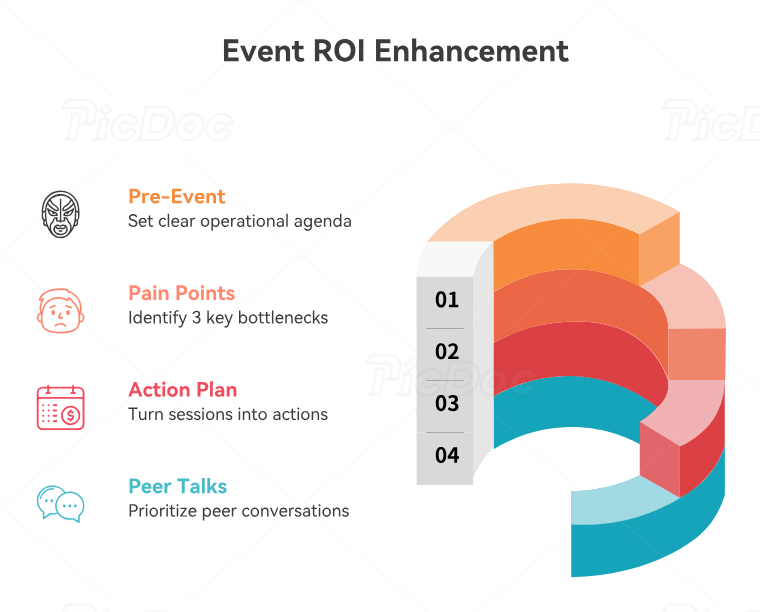
The biggest mistake people make is attending with no operational agenda. They hope inspiration will arrive on its own. That rarely happens. Real ROI starts when you define the exact problems you want to solve before you go.
Bring three pain points. Maybe your team keeps stumbling on patient privacy language. Maybe there is constant friction in portal communication. Maybe appointment scheduling is inconsistent. Maybe de-escalation is weak during high-volume hours. Maybe your office is adding automation and nobody can tell where the risk lives. When you attend with real bottlenecks in mind, sessions become tools instead of noise.
Then translate every session into action. Not notes. Action. Build a post-event memo with four headings: adopt now, test next, stop doing, leadership approval needed. Tie ideas back to your office’s real work in front-desk operations, infection-control workflows, patient communication standards, future compliance shifts, and privacy regulation forecasts.
The other hidden ROI is conversation quality. In healthcare operations, one peer sharing how their office reduced reschedules, improved check-in accuracy, clarified authorizations, or trained new staff faster can be more useful than a polished keynote. That is why smaller workshops, chapter programs, and year-round education channels matter just as much as flagship conferences.
5. The biggest event themes shaping medical administration in 2026-27
The most important pattern across current 2026 calendars is that medical administration is being treated as a high-accountability operational function, not a background support task. Patient access, finance, digital health, policy, and quality are converging.
One theme is the digital front door. HIMSS26 is explicitly centered on health IT and digital transformation, and its agenda positioning makes it one of the clearest choices for teams working through AI adoption, patient portals, interoperability, and workflow redesign. That matters because administrators increasingly need to understand not just where a message goes, but how technology changes staffing, privacy, throughput, and patient expectations. Combine that conference learning with ACMSO guidance on EMR systems, AI transformation, telehealth regulation, portal workflows, and emerging technologies.
Another major theme is financial precision at the front end. HFMA’s event lineup shows how affordability, revenue cycle, and leadership remain central. That is highly relevant for administrative professionals because registration errors, weak estimates, incomplete authorizations, and poor front-end communication create downstream financial damage. The admin who understands that connection becomes much harder to replace. Reinforce that advantage with billing terminology, insurance verification, CPT reference skills, salary and market trends, and efficiency data.
A third theme is governance and trust. AHIMA’s 2026 event programming, including its Advocacy Summit, Member Town Halls, and Data Break webinars, underscores that policy, health data, and information stewardship are central professional issues. That should matter to any medical administration professional whose role touches records, disclosures, portals, forms, or compliance-sensitive communication. Add to that ACMSO resources on HIPAA and patient privacy, data privacy for CMAAs, future compliance changes, effective communication, and medical office automation.
6. FAQs
-
NAHAM is usually the strongest fit because it stays closest to the real operational problems behind patient intake, front-desk workflows, appointment scheduling, and patient communication. If your office lives or dies by access quality, start there.
-
MGMA, HFMA Leadership Summit, and Becker’s are stronger options for promotion-minded attendees. They help you think beyond task completion and into staffing, performance, workflow design, organizational alignment, and change leadership.
-
Yes, especially when the skill gap is specific. A focused webinar on privacy, data quality, Excel, access metrics, or workflow redesign can produce faster real-world improvement than a broad event where only a few sessions are directly useful.
-
Make the request operational, not personal. Tie the event to a measurable problem like scheduling delays, privacy errors, inconsistent intake, staff onboarding quality, or digital workflow confusion. Then promise deliverables: a workflow memo, a short team training, a revised script, or an implementation checklist.
-
AHIMA is one of the strongest choices because its current 2026 programming is explicitly tied to policy, health data, advocacy, and professional updates. That makes it especially relevant for offices where records, disclosures, and governance judgment matter every day.
-
HIMSS is the clearest flagship option, while MGMA and selected operational workshops can help translate technology into daily workflow reality. You want sessions that move past hype and deal with role redesign, privacy, adoption friction, patient messaging, and system impact.
-
For most people, one flagship conference plus a few smaller workshops is the best mix. The flagship gives you strategic visibility. The smaller events give you usable tactics you can apply fast.
-
Look at what changes within 90 days. Did you solve a persistent operational problem? Did leadership trust you with more responsibility? Did you reduce errors, delays, escalations, or confusion? Conference impact usually shows up first in the level of problems you can now solve.
