

Infection Control in Medical Offices: Interactive Dictionary
Infection control in a medical office isn’t a poster on a wall—it’s a daily system that decides whether your clinic becomes a safe care environment or a quiet outbreak engine. The real risk isn’t “someone forgot to sanitize once.” It’s tiny repeatable failures: unclear roles, rushed room turnover, sloppy hand hygiene moments, missed PPE steps, contaminated high-touch surfaces, and documentation gaps that make it impossible to prove you did the right thing. This interactive dictionary gives you the terms that actually matter, plus examples you can apply immediately to reduce exposure, protect patients, and keep workflows audit-ready (tie this operational mindset to facility safety & emergency procedures and frontline reliability in medical office automation trends).
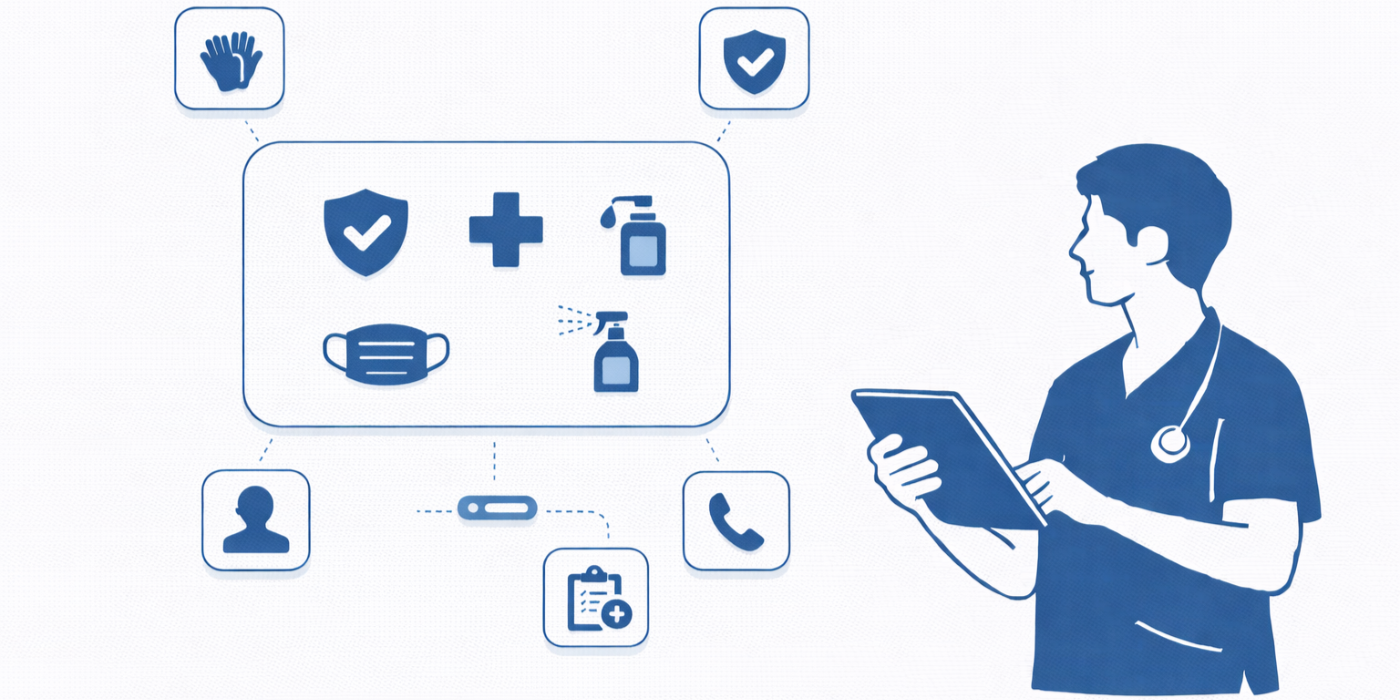
1: Infection Control Where It Really Fails (Not in Policy—In Workflow)
Most offices “know” infection control. What they don’t have is execution under pressure. The failure points are predictable: the moment a patient arrives, the moment the room turns over, the moment supplies run low, and the moment someone thinks “this one quick shortcut won’t matter.” Those shortcuts stack up into exposure events, staff illness, patient complaints, and worst of all—unprovable compliance when leadership asks, “Did we follow protocol?” (documentation discipline parallels the standards in how scribes improve documentation accuracy by over 90 and operational consistency aligns with patient flow management terms).
The 6 office realities that create infection-control mistakes
1) Speed beats memory.
If your system relies on people remembering every step, it will fail during high volume. You need visual cues, staged supplies, and a standard room-turn sequence (workflow thinking pairs well with patient management systems and queue discipline from scheduling software glossary).
2) “Looks clean” becomes “is clean.”
High-touch surfaces can be contaminated even when spotless. Infection control is about contact pathways, not appearance (system safety framing matches facility safety & emergency procedures and workflow precision maps to active listening in healthcare because the same discipline prevents “assumption errors”).
3) PPE misuse is more common than PPE absence.
Gloves worn too long, masks touched constantly, gowns used incorrectly—these create false security (quality culture connects to top 10 skills employers look for in a CMAA and role clarity is reinforced by CMAA career roadmap).
4) Room turnover becomes a contamination relay.
If your wipe-down sequence is random, you re-contaminate surfaces as you go. You need an order: clean to dirty, high-touch first, finish with hand hygiene (turnover discipline is a patient flow problem too—see patient flow management and communication scripts from medical office telephone etiquette for setting wait expectations without crowding).
5) Supply gaps force bad improvisation.
When disinfectant wipes, gloves, or masks run low, staff “makes it work,” and that’s when standards collapse. Inventory is infection control (link the mindset to medical inventory management terms and operations maturity via medical office automation trends).
6) Documentation is treated as optional.
When an exposure happens, your defense is what you can prove: cleaning logs, training completion, incident notes, and consistent protocols (this mirrors defensibility logic in how scribes improve documentation accuracy and the process discipline taught in CMAA exam day checklist).
2: The Infection-Control “Language” You Must Use (Because Words Drive Behavior)
In a medical office, the words you use decide what people do next. If your staff says “wipe it down,” you get random wiping. If you say “disinfect high-touch surfaces and respect dwell time,” you get a repeatable process. Strong infection control is shared vocabulary + shared sequence—the same logic behind reliable clinical documentation and operational consistency (systems thinking aligns with patient management systems and professional standards match top 10 skills employers look for in a CMAA).
1) “Clean” is not a verb—it's two verbs
Clean = remove soil (so disinfectant can work).
Disinfect = kill microbes with correct product and contact time.
If you skip the first when it’s needed, you make the second ineffective—then you think you’re safe while you’re not (this “false certainty” problem is also a documentation problem; see documentation accuracy by over 90 and how systems reduce human error in medical office automation trends).
2) “High-touch” is your real cleaning map
Most contamination spreads via hands → objects → faces. Your cleaning map should follow your touch map: door handles, check-in counters, pens, clipboards, BP cuffs, keyboards, mouse, chair arms, exam light handles. If you only clean exam tables, you’re cleaning the least realistic pathway (waiting-room flow and touch density connect to patient flow management and front-desk behavior ties into medical office telephone etiquette).
3) “Gloves” are not protection if you don’t change tasks
Gloves protect when they are task-specific and removed correctly. The most common contamination relay is: gloves touch patient → gloves touch keyboard → keyboard becomes a fomite → clean hands touch keyboard later → pathogen moves. If you want to stop this, train a simple rule: gloves for dirty tasks, clean hands for clean tasks (role reliability ties to CMAA career roadmap and safety readiness aligns with facility safety & emergency procedures).
4) “Dwell time” is the step people skip (and it matters)
Many disinfectants require the surface to remain wet for a certain time. If staff wipes immediately, they are performing the motion of safety without the effect of safety. The fix is operational: use products suited to your turnover pace, train the idea of “wet time,” and assign the room-turn sequence so it’s doable (workflow design ties into patient flow management and supply reliability belongs in medical inventory management).
3: Interactive Scenarios — What To Do in High-Risk Office Moments
Here are the office moments where infection control fails most—and how to respond with repeatable micro-actions that don’t slow the clinic down.
Scenario 1: Symptomatic patient arrives coughing in a crowded waiting room
Bad reality: they sit down, touch everything, then ask for a mask.
Better workflow: at entry, you trigger respiratory etiquette: provide a mask, offer hand sanitizer, and reduce waiting exposure by routing quickly (your front desk needs clean scripts; see patient flow management, safety escalation in facility safety procedures, and communication precision from active listening scenarios).
Scenario 2: Room turnover is rushed between patients
Bad reality: quick wipe, restock with same gloves, next patient enters.
Better workflow: follow a posted order—trash/linen first, then high-touch, then exam surfaces, then hand hygiene, then restock with clean hands. This prevents cross-contamination and makes your turnover faster because it’s consistent (consistency culture aligns with medical office automation trends and documentation discipline ties to CMAA exam checklist).
Scenario 3: Supplies run low mid-shift (gloves/wipes)
Bad reality: staff ration, reuse, or “borrow” from rooms.
Better workflow: treat this as an inventory control event, not a personal inconvenience—trigger reorder thresholds and stage supplies where they’re used (that systems mindset is exactly what “promotable” admins build; see medical inventory management, operational growth in CMAA career roadmap, and workflow reliability in patient management systems).
Scenario 4: A staff member gets a splash exposure
Bad reality: they “wash quickly” and keep working.
Better workflow: stop, follow immediate decontamination steps, report, document factually, and follow protocol. The key is speed and documentation—exposures become major issues when they’re hidden (safety readiness ties to facility safety & emergency procedures and defensible documentation connects to how scribes improve documentation accuracy).
4: The “Audit-Ready” Infection Control System (So You Can Prove Compliance)
A good office doesn’t just do the right things—it can prove it. Audit-ready doesn’t mean paperwork overload. It means your system leaves simple evidence: training completion, cleaning schedules, supply checks, incident logs, and consistent workflows.
Build three layers of proof
Layer 1: Daily proof (fast, repeatable)
room-turn checklist initialed
high-touch cleaning schedule
supply threshold check
This is operational maturity—exactly the kind of discipline leadership wants in advanced admin roles (connect to medical office automation trends and management track logic in CMAA career roadmap).
Layer 2: Weekly proof (prevents slow drift)
spot audits of high-touch surfaces and PPE steps
short refreshers on glove discipline and dwell time
inventory cycle counts
Operational drift is what makes “good clinics” suddenly have a string of issues (systems literacy aligns with patient management systems and supply control belongs to medical inventory management).
Layer 3: Incident proof (facts over feelings)
When something happens, document only what matters: what occurred, what immediate steps were taken, who was notified, and what follow-up was initiated. Avoid blame language; stick to actions (documentation discipline mirrors how scribes improve documentation accuracy and safety escalation belongs in facility safety procedures).

5: How Infection Control Competence Becomes Career Leverage (CMAAs & Scribes)
Infection control is a leadership signal because it touches patient safety, operations, compliance, and team discipline. If you can run infection control as a system—not a suggestion—you become the person leadership trusts to train others and stabilize chaos.
For CMAAs: you’re not “just following steps”—you’re owning operations
If you can standardize turnover, reduce supply gaps, and keep documentation consistent, you’re doing management work. That’s the exact path from entry-level tasks to office leadership described in CMAA career roadmap and the skills employers value in top 10 CMAA skills.
For scribes: infection control protects documentation quality and clinical flow
When infection control fails, providers get interrupted, rooms get delayed, and documentation becomes messy due to workflow disruptions. Scribes who understand flow and risk help keep visits clean and consistent—especially in high-pressure environments (workflow mastery is trained in interactive guide to mastering ER scribing and accuracy expectations are reinforced in how scribes improve documentation accuracy).
The “raise case” infection control can support
If you can show: fewer turnover delays, fewer supply emergencies, higher checklist compliance, and cleaner incident documentation, you’re saving time and reducing risk—two things leadership pays for. Pair your outcomes with operational credibility messaging using medical office automation trends and workflow metrics mindset from patient flow management.
6: FAQs (High-Value, Practical Answers)
-
Treating gloves like a substitute for hand hygiene. Gloves reduce direct contact, but they create cross-contamination when worn across tasks. The fix is simple: sanitize before gloves, remove after dirty tasks, sanitize again (system discipline matches facility safety procedures and workflow control aligns with patient management systems).
-
Make turnover a sequence, not a vibe: trash/linen → high-touch → exam surfaces → dwell time → hand hygiene → restock. Post it, train it, and audit it lightly (flow logic ties to patient flow management and operational maturity to medical office automation trends).
-
Door handle, chair arms, exam table surfaces, exam light handles, counter edges, keyboard/mouse, BP cuff surfaces, otoscope handle, and any shared device. Don’t guess—map by touch frequency (workflow documentation parallels EMR software terms and consistent process aligns with how scribes improve documentation accuracy).
-
Use calm respiratory etiquette: provide mask and sanitizer at entry, reduce wait time via routing, and clean high-touch areas after high-risk interactions. The key is a practiced script and flow plan (pair with patient flow management and communication discipline via telephone etiquette).
-
Because shortages trigger unsafe improvisation. If wipes, gloves, or masks run low, protocols become optional. A simple threshold system prevents that (connect to medical inventory management and admin leadership growth via CMAA career roadmap).
-
Immediate steps taken, who was notified, and factual details—no blame language. If you can’t prove action, you can’t defend compliance (documentation rigor aligns with how scribes improve documentation accuracy and safety protocol structure in facility safety procedures).
-
Because it’s operational leadership. People who standardize workflows, reduce risk, and keep proof logs become “trusted operators,” which is exactly what management roles require (career path alignment in CMAA career roadmap and employer expectations in top 10 CMAA skills).
