

Medical Scribe vs. Medical Assistant: Which Career is Best for You?
Choosing between medical scribing and medical assisting isn’t a “which is better” question — it’s a fit + leverage question. Both can launch you into healthcare, but they build different types of credibility: scribes develop documentation mastery and clinical reasoning exposure, while assistants build hands-on patient flow and procedural support. If you pick the wrong one for your personality, timeline, and long-term goal, you’ll feel stuck fast: low pay, low growth, high stress, and a resume that doesn’t convert. This guide breaks the decision like a pro — with real tradeoffs, proof metrics, and a path you can commit to.

1. Medical Scribe vs. Medical Assistant: The Real Difference (And Why It Matters for Your Future)
Most people compare these roles using surface-level descriptions, then regret it later. The real difference is what you practice all day — because what you practice becomes your career advantage.
A medical scribe is trained to capture clinical meaning inside the chart: HPI logic, exam structure, assessment clarity, and plan linkage. You learn how clinicians think because your job depends on understanding what matters, not just typing fast. If you want a specialty-driven path and strong downstream options, scribing aligns with demand trends covered in Why Medical Scribing Is One of Healthcare’s Fastest Growing Careers and market movement explained in Medical Scribe Market Trends: Where the Jobs Will Be in the Next 5 Years.
A medical assistant (MA) is trained to keep patient care moving: rooming, vitals, injections (depending on setting), EKGs, specimen handling, sterilization workflows, patient instructions, and clinic throughput. Your “career edge” becomes hands-on clinical operations and patient interaction. That’s powerful — but it’s also a different skill portfolio than scribing. Where scribes build chart mastery and physician support impact (see Interactive Report: How Medical Scribes Reduce Physician Burnout), MAs often build care delivery support.
Here’s the pain point most people don’t admit: they pick based on what sounds prestigious, not what they can sustain. If you hate constant patient-facing interactions, MA can burn you out. If you hate documentation pressure and speed-based accuracy, scribing can crush you. That’s why you need to decide based on your tolerance profile: speed pressure, patient contact intensity, physical tasks, liability risk, and learning style.
Also: don’t confuse Medical Assistant (MA) with Medical Administrative Assistant (CMAA track). Administrative roles focus more on front-office operations, scheduling, patient flow coordination, insurance coordination, and clinic systems. If you’re leaning admin, explore CMAA career pathways in CMAA Career Roadmap: From Entry Level to Medical Office Manager and how remote administration is changing the landscape in Virtual Medical Administration: How Remote Work Is Transforming the Role.
If your goal is to grow fast, the best question isn’t “scribe vs MA.” It’s: Which role builds the strongest proof for the next step you actually want? Scribing tends to create sharper “clinical narrative” proof and specialty exposure (see Scribing for Orthopedics: Comprehensive Interactive Training and Interactive Guide to Mastering ER Scribing). MA tends to create stronger hands-on care support proof and patient-facing competence.
2. Medical Scribe vs. Medical Assistant: Your 90-Day Action Plan (Choose, Train, and Get Hired Faster)
If you want this decision to pay off, you need more than “pick a role” — you need a 90-day plan that converts into competence, confidence, and offers. Most people waste months because they do random learning, apply blindly, and then blame the job market. This plan turns your choice into a measurable build.
Days 1–14: Decide with proof, not vibes
Your first two weeks should be about fit-testing both roles in a way that feels real.
Fit-test for scribing (2–3 sessions per week):
Run timed note drills using short mock visits (10–12 minutes each) and score yourself on:
missing key details
contradictions (HPI vs exam vs plan)
clarity of assessment and plan link
Use Interactive Medical Scribe Practice Exam: Test Yourself Now to simulate time pressure and identify what you consistently miss.
Build terminology speed with The 100 Most Important Terms Every Medical Scribe Must Know (2025 Edition) so you’re not freezing on basic language mid-visit.
If the “chart world” is intimidating, reduce EMR anxiety with EMR Software Terms: Interactive Dictionary & Walkthroughs.
Fit-test for MA (2–3 sessions per week):
Simulate clinic throughput thinking. Ask yourself:
Can I stay calm with constant interruptions?
Can I switch tasks fast without losing accuracy?
Can I handle patient emotions without absorbing it?
Practice professional clinic communication patterns and follow-through habits with:
Decision rule (simple and effective):
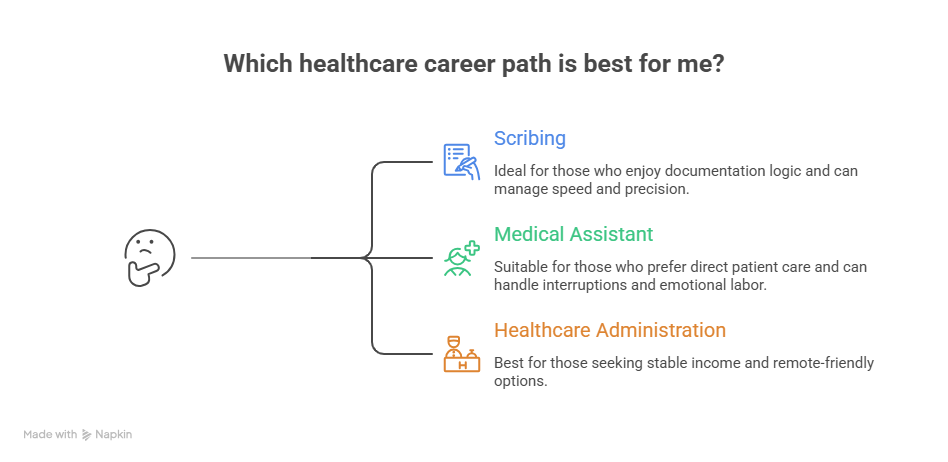
If you enjoy structured thinking, improve quickly in note drills, and can handle speed + precision → scribe wins.
If you enjoy patient interaction, movement, multitasking, and feel energized by hands-on work → MA wins.
If you’re still split: choose based on what you need most for your next step (clinical reasoning exposure vs direct patient care exposure), then commit.
Days 15–45: Build job-ready competence (the phase most people skip)
This is where you stop “learning” and start building hireable evidence.
If you chose scribing:
Choose ONE specialty lane to avoid generic reps:
Track 3 performance KPIs weekly:
edits per note
addenda per shift
same-day chart closure rate (or your closest equivalent)
Start mistake-proofing early using Top 10 Medical Scribe Exam Mistakes (How to Avoid Them) because repeated errors become “provider distrust,” and provider distrust kills your growth.
If you chose MA:
Your goal is structured reliability. You want to become the person a clinic trusts with real tasks.
Build throughput intelligence (so you’re not just “doing tasks,” you’re supporting flow):
Build your patient-facing professionalism stack:
Even as an MA candidate, understanding documentation systems makes you more valuable in interviews — and helps you collaborate with providers and billing.
Days 46–90: Convert skills into offers (resume + targeting + interviews)
This is the conversion phase. Most people have “experience” but can’t sell it.
1) Target the right employers
If you apply randomly, you’ll get random outcomes. Use market intelligence:
For scribing: target cities and settings actively hiring using Interactive Job Market Report: Top Cities Hiring Medical Scribes.
If remote is important: shortlist options using Top 75 Remote Medical Scribe Employers & Programs.
If you want specific environments: explore employers/health systems lists like Top 100 Health Systems Hiring Medical Scribes by State and settings like Top 100 Emergency Departments & Urgent Care Chains.
2) Rewrite your resume in “impact language”
Scribes: frame yourself as a workflow and accuracy asset.
Use value framing from How Scribes Improve Documentation Accuracy and the employer logic in Why Healthcare Facilities Prefer Certified Medical Scribes.
MA candidates: frame yourself as a flow and patient-experience stabilizer.
Talk about multitasking, reliability, patient trust, and system literacy (scheduling/patient management).
3) Interview with a “risk reducer” mindset
Employers hire what feels safe.
Scribes should speak about:
preventing chart contradictions
ensuring laterality accuracy
improving chart closure and reducing provider edits
adapting to specialty workflows
For deeper industry framing, use New Report: The Economic Impact of Medical Scribes and Interactive Report: How Medical Scribes Reduce Physician Burnout.
MA candidates should speak about:
handling patient flow under pressure
maintaining accuracy through interruptions
calm escalation and communication
patient-centered professionalism
4) If certification is your accelerator, commit
If you’re choosing scribing and want stronger employer trust signals, certification can help you stand out and reduce perceived risk:
Build your plan using Complete Guide to Passing Your Medical Scribe Certification Exam.
If you’re in the “I’ll do it later” mindset, you’ll stay average longer than necessary — and average roles don’t “skyrocket” careers.
Bottom line:
Pick the role that matches your daily pressure tolerance and your next-step goal. Then run this 90-day plan with KPIs. In healthcare, the people who grow fastest aren’t the ones with the most intentions — they’re the ones who can prove they’re safe, useful, and improving every week.
3. What You’ll Actually Do All Day: A Reality Check (So You Don’t Pick Wrong)
If you want a professional decision, you need the lived workflow, not job-board bullet points.
Medical scribe day-to-day (what really happens)
Your day is a mix of rapid capture and structured thinking:
Listening to the visit and translating it into chart-ready documentation that matches the provider’s reasoning.
Capturing the “why” behind the plan — not just what the plan is.
Handling contradictions (patient says one thing, exam suggests another) without editorializing.
Navigating the EMR efficiently so the visit doesn’t stall.
This is why scribing can feel intense for beginners: you’re trying to learn medicine while documenting medicine. But that pain is also the advantage — your brain gets trained on clinical pattern recognition faster than most entry roles. If you want to ramp intelligently, use EMR Software Terms: Interactive Dictionary & Walkthroughs to eliminate “getting lost” stress, then build specialty confidence with Surgical Scribing 101 and Advanced Oncology Scribing. For high-volume, high-acuity reps, train your priorities using Interactive Guide to Mastering ER Scribing.
Medical assistant day-to-day (what really happens)
The MA workflow is built around pace, people, and procedures:
Room patients, take vitals, update histories, ensure correct workflow sequencing.
Assist with in-office procedures depending on clinic scope.
Patient instructions, care coordination, and constant switching between tasks.
Managing patient emotions in real-time — which is a skill in itself.
This role can be deeply fulfilling if you like people and movement — but it can also be draining if you’re introverted or hate being interrupted constantly. MAs often become the “glue” that holds the clinic together — which makes you valuable but also means you can be overloaded in understaffed settings.
Here’s the biggest trap: people pick MA thinking it’s automatically better for “clinical hours,” then realize their job is mostly throughput and repetitive tasks in a clinic that doesn’t teach them. People pick scribe thinking it’s “easy computer work,” then get crushed by speed + accuracy standards. Your decision should match your tolerance for these realities.
To do this professionally, decide which daily friction you can handle:
If you can tolerate documentation pressure and love structured thinking, scribing aligns with resources like How Scribes Improve Documentation Accuracy and the performance logic behind Why Healthcare Facilities Prefer Certified Medical Scribes.
If you can tolerate constant patient-facing work and want hands-on tasks, MA may fit better.
4. The “Best Career for You” Framework: Decide in 10 Minutes Like a Pro
Instead of guessing, use a framework that forces clarity.
Step 1: Decide your next-step target (not your fantasy)
Your next step might be:
Med school / PA / NP
Healthcare admin
Health tech
Stable healthcare income now
Remote-friendly healthcare role
Now tie the role to the narrative you’ll need.
If you need a story about how clinicians think, scribing helps because you live in documentation logic daily. Strengthen that pathway using Scribing for Orthopedics, Cardiology Scribe Skills, and the bigger industry angle in Medical Scribe Career Outlook 2026–27.
If you need a story about direct patient care support, MA may fit better because your daily work is face-to-face operational care.
Step 2: Choose your pressure type
Most “career mismatch” pain comes from pressure mismatch:
Scribes fail when they can’t manage speed + precision and keep missing key details.
MAs burn out when they can’t manage constant interruptions + emotional labor.
If you’re unsure, do a simple test:
Try 10 timed micro-notes using Interactive Medical Scribe Practice Exam. If you enjoy it and your accuracy improves, scribing may suit you.
If you hate it and your brain melts under structured capture, consider MA or an admin track like CMAA, then explore Top 10 Skills Employers Look For in a CMAA and Medical Admin Assistant Job Market Outlook.
Step 3: Decide how you want to stand out
This matters because “best for you” also means “best for your resume conversion.”
Scribes stand out by lowering edits, reducing addenda, capturing coherent plans, and making the provider faster. The employer-side logic is reinforced in New Report: Economic Impact of Medical Scribes and How Medical Scribes Impact Hospital Revenue.
MAs stand out by reliability, patient trust, and clinic flow competence — but you must find a clinic that truly teaches you rather than using you as a throughput buffer.
Step 4: If remote matters, don’t ignore reality
Remote-friendly options are simply more available in scribing and medical administration than in hands-on MA roles. If remote is a hard requirement, explore Top 75 Remote Medical Scribe Employers and compare it with the broader remote admin trend in Virtual Medical Administration.
5. How to Win in Either Path (And Avoid the Mistakes That Waste a Year)
Whichever you choose, the difference between “entry-level job” and “career accelerator” is intentional training + proof.
If you choose medical scribing: build a proof pack
Most new scribes lose confidence because they don’t measure progress. Fix that with KPIs:
Edits per note (goal: down)
Addenda per shift (goal: down)
Same-day close rate (goal: up)
Plan tie-back clarity (goal: up)
Use ACMSO training assets to tighten your loop:
Build foundations with The 100 Most Important Terms Every Medical Scribe Must Know.
Practice under pressure using Interactive Medical Scribe Practice Exam and mistake-proof your workflow with Top 10 Medical Scribe Exam Mistakes.
Choose a specialty lane and get reps: ER Scribing, Orthopedics Scribing, Surgical Scribing, Oncology Scribing.
And if you’re worried about AI: don’t hand-wave it. Learn the real positioning in Future of Medical Documentation: How Scribes Fit Into an AI-Driven World — the winners won’t be the fastest typers; they’ll be the best at clinical meaning + quality control.
If you choose medical assisting: protect yourself from “dead-end clinic” risk
The biggest MA failure mode isn’t the role — it’s the setting. Some clinics teach, mentor, and expand scope. Others just extract labor. Your move is to screen employers hard:
Ask what tasks you’ll be trained on in the first 30–60 days.
Ask how performance is evaluated (do they have standards or chaos?).
Ask who trains you and how feedback works.
Even if you go MA, your documentation and systems literacy will still increase your ceiling. That’s why cross-training in healthcare communication and systems language is valuable. Use resources like Patient Flow Management Terms, Active Listening Scenarios, and Medical Office Telephone Etiquette to build professionalism most clinics don’t teach.
6. FAQs: Medical Scribe vs. Medical Assistant
-
It depends on what you lack. If you need clinical reasoning exposure and want to learn how providers think, scribing is often a stronger narrative — especially in specialty settings like ER or orthopedics. If you need hands-on patient care experience, MA can be a better fit — but only if your clinic scope is real and your training is structured.
-
Scribing can accelerate into specialty lanes and documentation-quality roles as systems invest more in scribes (see 2026–27 Industry Report: Hospitals Increasing Investment in Medical Scribes). MA growth often depends on clinic structure and can move into lead/supervisor pathways. If admin leadership is your end goal, you may also want the CMAA pathway via CMAA Career Roadmap.
-
Many introverts thrive in scribing because the work is structured, analytical, and less emotionally draining than constant patient interaction. But scribing has intense speed/accuracy pressure. If you’re introverted but hate documentation, MA may still fit if you like hands-on tasks and can manage people-facing energy.
-
Scribing and medical administration have far more remote options than MA because MA is hands-on. Start with Top 75 Remote Medical Scribe Employers and compare with remote admin trends in Virtual Medical Administration.
-
Stop trying to “type everything.” Learn structure, then measure progress. Build terminology using 100 Most Important Scribe Terms, train speed with Practice Exam, and eliminate recurring errors with Top 10 Exam Mistakes.
-
Yes — if you position yourself correctly. Facilities will still need people who can verify, structure, and ensure documentation accuracy. The future-proof framing is explained in How Scribes Fit Into an AI-Driven World, and the value case is reinforced by outcomes-driven resources like Documentation Accuracy Report and Economic Impact.
