

Medical Terminology Mastery for Scribes: Interactive Tutorials & Tools
Medical terminology is where many scribes either become fast, trusted documentation partners or stay stuck in slow, uncertain charting. The gap rarely comes from effort alone. It usually comes from studying terms in static lists without learning how to decode them inside real notes, real specialties, and real provider workflows. That approach creates recognition without usable command.
This guide is built to fix that. You will learn how to master terminology through interactive tutorials, smarter tools, pattern-based study, and applied chart practice so the language becomes easier to read, faster to recall, and more reliable under pressure. For a strong foundation, also review mastering medical terminology for medical scribes a quick study guide, top 20 terms medical scribes must master for accurate clinical documentation, and top 20 EMR and charting terms medical scribes need to understand clearly.
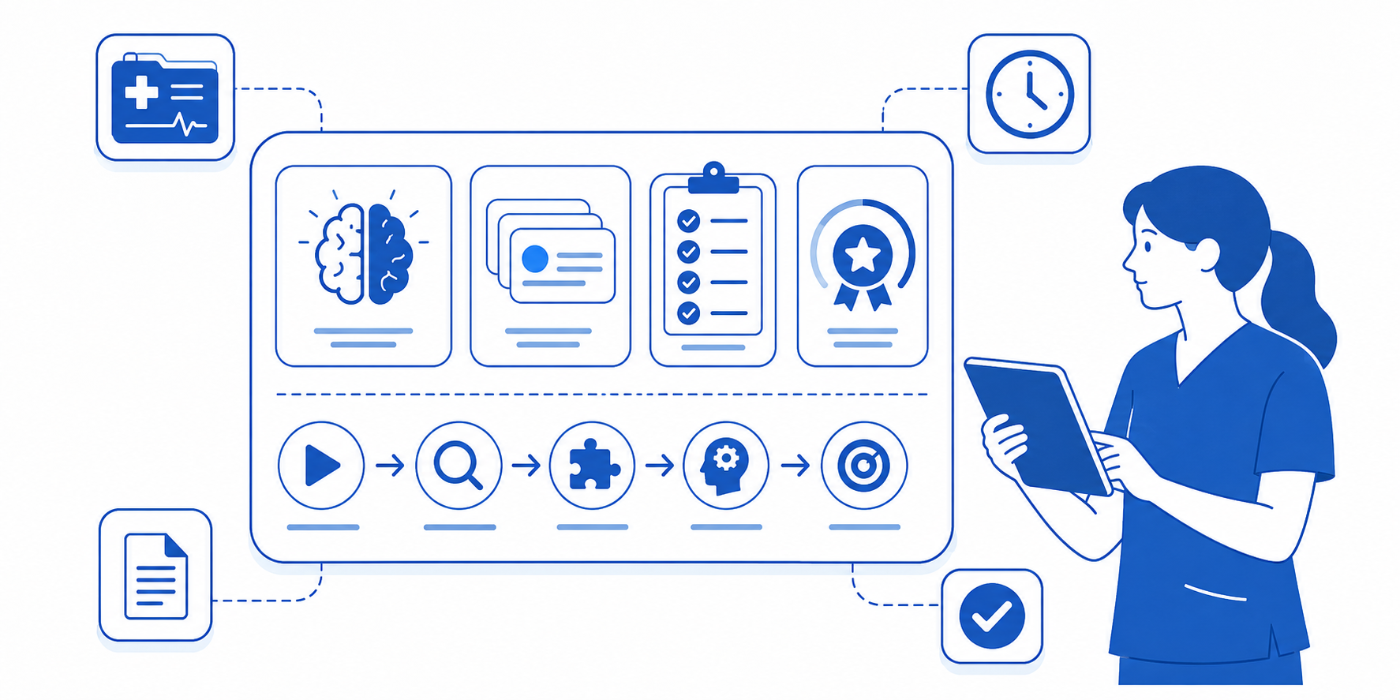
1. Why Medical Terminology Mastery Changes Everything for a Scribe
Terminology is not just a memorization problem. It is a speed problem, a confidence problem, and a documentation quality problem. A scribe who cannot break down unfamiliar terms quickly will lag during patient encounters, misread provider intent, hesitate in note construction, and lose time double-checking basics that should already be automatic. That weakness compounds fast in busy environments, especially when you compare the pace described in day in the life of a medical scribe real stories from emergency departments, the pressure demands in interactive guide to mastering emergency room ER scribing, the specialty demands in 10 essential skills every cardiology medical scribe needs, and the complexity described in advanced oncology scribing how to document complex cases effectively.
Terminology mastery also improves accuracy because it helps scribes hear what providers mean, not merely what the words sound like. That distinction matters when similar-sounding terms carry different implications, when acronyms shift by specialty, or when a provider speaks quickly and assumes the scribe understands the underlying root, suffix, and clinical context. Better terminology command supports stronger note quality, which ties directly into how scribes improve documentation accuracy by over 90, annual report medical scribes role in enhancing clinical documentation accuracy, how medical scribes impact hospital revenue original data analysis, and new report the economic impact of medical scribes on healthcare facilities.
There is also a trust dimension. Providers notice quickly whether a scribe needs every unfamiliar word repeated, whether terminology confusion is creating friction, and whether documentation cleanup is happening after the fact instead of in real time. A scribe with stronger terminology rarely feels invisible. That person becomes easier to rely on. This has career implications beyond one shift or one clinic because stronger medical language fluency also supports growth through why healthcare facilities prefer certified medical scribes, medical scribe career outlook 2026-27 salaries growth and trends, 5 surprising skills you gain as a medical scribe beyond documentation, and how becoming a medical scribe skyrockets your medical career.
Finally, terminology mastery reduces cognitive overload. New scribes often burn energy decoding the language itself instead of focusing on chart structure, visit flow, note logic, and provider style. When core terminology becomes automatic, working memory is freed up for more important tasks. That is one reason terminology work should sit next to, not apart from, resources like interactive training patient record updates and EMR compliance, top 10 EMR shortcuts to boost CMAA productivity instantly, resolving common EMR software issues practical CMAA guide, and top 50 EMR/EHR platforms every medical scribe should know 2025 guide.
| # | Term / Term Part | Meaning | Example in Scribe Work | Best Tutorial / Tool Focus |
|---|---|---|---|---|
| 1 | cardi/o | heart | chest pain, tachycardia, cardiomegaly | root-family drills |
| 2 | neur/o | nerve | neuropathy documentation | audio recall practice |
| 3 | hepat/o | liver | hepatitis follow-up notes | specialty flashcard sets |
| 4 | gastr/o | stomach | gastritis complaint charting | symptom-based quizzes |
| 5 | enter/o | intestine | GI upset documentation | case-based modules |
| 6 | dermat/o | skin | rash, lesion, dermatitis notes | image-assisted matching |
| 7 | oste/o | bone | fracture, osteoporosis notes | orthopedic chart simulation |
| 8 | my/o | muscle | myalgia complaint | voice repetition drill |
| 9 | arthr/o | joint | arthritis follow-up note | root-pair contrast drills |
| 10 | hem/o | blood | hematology references | lab-linked terminology cards |
| 11 | cyt/o | cell | cytology references | visual root family maps |
| 12 | ren/o | kidney | renal failure notes | confusion-set quizzes |
| 13 | nephr/o | kidney | nephrology consult note | comparison flashcards |
| 14 | pulmon/o | lung | SOB, pulmonary edema note | symptom-to-term drills |
| 15 | ot/o | ear | otitis media visit | micro-specialty tutorials |
| 16 | ophthalm/o | eye | vision complaint chart | specialty note walk-throughs |
| 17 | tachy- | fast | tachycardia charting | opposite-pair drills |
| 18 | brady- | slow | bradycardia assessment | timed matching quiz |
| 19 | hyper- | high, excessive | hypertension documentation | contrast quiz with hypo- |
| 20 | hypo- | low, deficient | hypoglycemia note | contrast quiz with hyper- |
| 21 | -itis | inflammation | sinusitis, dermatitis, gastritis | suffix family drills |
| 22 | -ectomy | surgical removal | appendectomy history | procedure-term modules |
| 23 | -algia | pain | myalgia, neuralgia note | symptom-driven flashcards |
| 24 | -megaly | enlargement | cardiomegaly finding | imaging-linked mnemonic training |
| 25 | -oma | tumor or mass | lymphoma mention in HPI | oncology terminology packs |
| 26 | -pathy | disease or disorder | neuropathy, cardiomyopathy | suffix meaning ladders |
| 27 | -scopy | visual examination | colonoscopy history entry | procedure workflow tutorials |
| 28 | -logy | study of / specialty | nephrology consult, cardiology follow-up | specialty map builders |
2. The Best Way To Learn Terminology: Interactive, Layered, and Applied
Most scribes have already experienced the failure of passive study. Reading glossary pages feels productive because it is smooth. It is also deceptive. A term can look familiar and still collapse the moment it appears in a live note, a multiple-choice exam, or a fast provider monologue. That is why terminology mastery should be interactive from the beginning. Stronger learning happens when a scribe has to answer, sort, match, decode, pronounce, and apply terms instead of merely rereading them. This is the same logic that makes interactive medical scribe practice exam test yourself now, medical scribe certification real-life exam questions and expert answers, essential study techniques for medical scribe certification success, and top 10 medical scribe exam mistakes how to avoid them so useful.
The first layer should be structural tutorials. These teach prefixes, roots, combining forms, and suffixes as pieces that can be recombined. A scribe who understands word construction can often decode unfamiliar language on the fly. That skill matters more than memorizing endless isolated vocabulary. Structural training pairs especially well with how to ace your medical scribe certification exam insider study secrets, complete guide to passing your medical scribe certification exam, medical scribe certification exam breakdown everything to expect in 2025, and how to easily memorize complex medical terms for your ACMSO exam.
The second layer should be recognition drills. These include drag-and-drop matches, timed root identification, suffix grouping, opposite pairs like hyper versus hypo, and family clusters like cardiology, cardiomegaly, cardiomyopathy, and tachycardia. Timed work matters because recognition under pressure is different from recognition at leisure. This style of learning also sharpens the instincts needed for interactive guide to mastering emergency room ER scribing, surgical scribing 101 essential techniques and best practices, scribing for orthopedics comprehensive interactive training, and 10 essential skills every cardiology medical scribe needs.
The third layer should be case-based application. This is where many learners finally stop forgetting. Instead of seeing “tachypnea” as a detached word, they see it inside a respiratory complaint note. Instead of learning “hepatomegaly” in a vacuum, they connect it to imaging, abdominal findings, and follow-up planning. That applied layer is what turns terminology from trivia into working skill, which is also the deeper aim of patient intake procedures essential definitions and processes, ICD-10 codes comprehensive interactive dictionary, CPT codes explained interactive reference guide for medical admins, and insurance verification definitive glossary and interactive examples.
A fourth layer should include audio. Providers do not speak in clean textbook pacing. They clip endings, abbreviate familiar language, and move fast when the room is busy. Audio-based tutorials help scribes practice hearing the term correctly, not just reading it cleanly on a screen. That gives an edge in real charting and helps bridge the gap between textbook study and live encounter performance.
3. The Most Valuable Interactive Tutorials and Tools for Scribe Terminology Training
The best tools are the ones that force decisions. A strong terminology tutorial should make a scribe choose the meaning, sort a term family, identify the correct root, or apply a term inside a note fragment. The moment a tool becomes pure browsing, its value drops. That is why quiz engines, flashcard systems with spaced repetition, timed drills, audio transcription practice, and specialty-specific chart simulations tend to outperform static glossaries. They work especially well when combined with top 100 specialty-specific documentation template libraries and cheat sheets for scribes 2025 mega guide, top 50 medical scribe training courses and certifications complete 2025 guide, top 50 voice recognition and dictation software for clinicians and scribes 2025 buyers guide, and top 50 AI medical scribe and ambient dictation tools complete 2025 buyers guide.
One of the best categories is root-family builders. These tools group related words under one core structure so learners stop treating each term as a separate burden. Cardi/o becomes cardiology, cardiomegaly, endocarditis, pericarditis, tachycardia, and bradycardia. That single cluster teaches more than six random flashcards because the mind starts seeing patterns. Similar pattern learning becomes powerful in specialty prep for top 75 orthopedic and sports medicine groups hiring medical scribes 2025 directory, top 75 dermatology and ophthalmology practices hiring medical scribes 2025 directory, top 75 pediatric OB/GYN and womens health networks hiring medical scribes 2025 directory, and top 75 outpatient specialty networks hiring scribes cardiology ortho GI more 2025 directory.
Another valuable tool type is confusion-set training. These tutorials deliberately place similar terms side by side: renal versus nephro, ileum versus ilium, hypo versus hyper, otic versus optic, benign versus malignant, proximal versus distal. Many documentation mistakes come from similarity confusion, not total ignorance. Targeting these pain points directly saves time and embarrassment in real work. That is also why adjacent study resources such as top 20 must-know HIPAA terms for medical scribes clear definitions and examples, patient privacy communication essentials HIPAA guidelines simplified, effective patient communication terms and interactive examples, and de-escalation techniques interactive dictionary and practical tips matter more than they first appear to.
Case simulators are another high-value tool because they train recall in the environment where scribes actually need it. When a learner must fill in missing chart language, choose the right terminology from a short encounter summary, or correct a flawed note, memory becomes more durable. This is closer to actual work than memorizing lists. It is also one of the best bridges from study to employability, especially for candidates exploring top hospitals hiring medical scribes your 2026-27 guide to the best opportunities, top 100 emergency departments and urgent care chains for medical scribe jobs 2025 directory, top 100 physician groups and MSOs hiring medical scribes 2025 directory, and top 100 community health centers FQHCs hiring medical scribes 2025 directory.
Finally, spaced repetition tools deserve a permanent place in the system. Medical terminology is too dense for one-pass learning. Strong tools schedule difficult terms more often, retire mastered ones temporarily, and keep recall active over weeks instead of hours. That repeated exposure is what turns effort into durable skill.
4. How To Build a Terminology Mastery Workflow That Actually Sticks
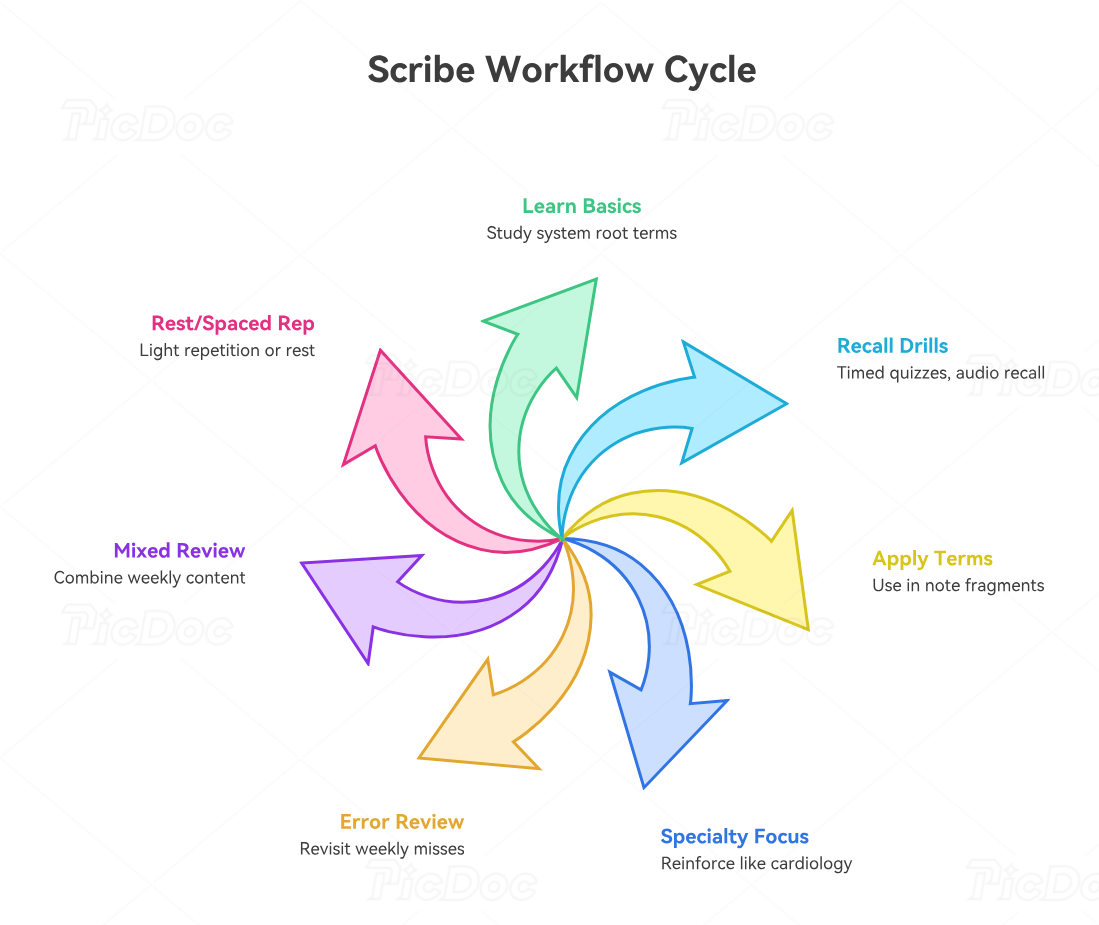
A good tool alone is not enough. Many scribes have access to flashcards, videos, or glossaries and still do not improve because their workflow is weak. The strongest approach is a layered weekly cycle. Start with structural tutorials on one system or specialty. Follow that with recall drills. Then do chart application. Then review errors. This rhythm creates depth instead of random exposure. It pairs naturally with interactive data visualization medical scribe employment trends, interactive infographic medical scribe market demand by specialty, medical scribe market trends where the jobs will be in the next 5 years, and future of medical documentation how scribes fit into an AI-driven world because it prepares scribes for adaptation, not just tests.
A practical weekly structure looks like this. Day one: learn roots, prefixes, and suffixes for one body system. Day two: run timed quizzes and audio recall. Day three: apply the terms in short note fragments. Day four: do specialty reinforcement, such as cardiology or orthopedics. Day five: revisit every miss from the week. Day six: do mixed review. Day seven: rest or use only light spaced repetition. This kind of structure is much more effective than vague promises to “study terminology more.” It also echoes the disciplined prep habits behind ACMSO certification exam your complete step-by-step guide 2025, ACMSO exam day essentials everything you need for success, ultimate guide to passing your CMAA certification exam on the first try, and essential study tips to guarantee your CMAA exam success.
Another important workflow choice is keeping an error log. Every time you confuse a term, mishear a provider phrase, miss a quiz item, or hesitate in a note, capture it. Over time, patterns emerge. Some scribes consistently struggle with suffixes. Others confuse anatomical direction terms. Others are fine reading terminology but weak in audio. Once the weakness is visible, tutorials and tools can be chosen more intelligently. This is also where broader references such as front desk operations terms interactive guide and checklist, appointment scheduling best practices interactive definitions, healthcare portal terms interactive dictionary and use cases, and telehealth platforms key definitions and interactive guide can fill overlooked vocabulary gaps.
You should also study terminology in families tied to real note sections. HPI terms. ROS terms. Physical exam terms. Procedure terms. Assessment language. Follow-up instructions. That organization mirrors how the knowledge is used in practice. A scribe who learns terminology in chart-section clusters usually becomes faster than one who studies alphabetically because the brain retrieves language by workflow context, not dictionary order.
5. Common Mistakes That Keep Scribes From Reaching Terminology Mastery
The first mistake is treating mastery like a vocabulary contest. The goal is not to collect the largest stack of memorized words. The goal is to decode, hear, recognize, spell, and apply medical language accurately in live workflow. That difference matters because passive memorization can look impressive in a notebook while still falling apart in real documentation. Scribes who want practical command should keep grounding their study in interactive guide to mastering emergency room ER scribing, surgical scribing 101 essential techniques and best practices, advanced oncology scribing how to document complex cases effectively, and scribing for orthopedics comprehensive interactive training.
The second mistake is relying on one study mode. Some scribes use only flashcards. Others watch videos without testing themselves. Others read dictionaries without practicing recall. Terminology mastery needs multiple channels: visual, auditory, structural, and applied. When one channel is missing, a blind spot usually follows. For example, a scribe may read “tachypnea” correctly on screen but fail to catch it in speech, or may know “nephro” in isolation but miss it in “nephrolithiasis.” Mixed training prevents this.
The third mistake is separating terminology from EMR and charting work. In real documentation, the term is never alone. It appears inside a note template, a provider shorthand pattern, an assessment statement, an exam finding, or a past medical history line. That is why terminology should always cross-train with top 10 EMR shortcuts to boost CMAA productivity instantly, resolving common EMR software issues practical CMAA guide, EMR integration tools every medical administrative assistant needs, and interactive training patient record updates and EMR compliance.
The fourth mistake is ignoring specialty variation. Terms repeat differently across emergency medicine, cardiology, hospitalist work, dermatology, ophthalmology, orthopedics, oncology, and women’s health. A scribe who studies only generic terminology may feel prepared and still get overwhelmed in a specialty-heavy environment. Specialty adaptation becomes easier when learning is anchored to top 75 hospitalist groups hiring medical scribes nocturnist/day teams 2025 directory, top 75 dermatology and ophthalmology practices hiring medical scribes 2025 directory, top 75 orthopedic and sports medicine groups hiring medical scribes 2025 directory, and top 75 pediatric OB/GYN and womens health networks hiring medical scribes 2025 directory.
The fifth mistake is stopping once terms feel familiar. Familiarity is the most dangerous stage because it creates false confidence. A term only becomes secure when it can be identified quickly, explained clearly, recognized in audio, and used correctly in context. Anything less still needs work.
6. FAQs
-
The fastest improvement usually comes from combining structural term breakdown with interactive recall and chart-based application. Learn prefixes, roots, and suffixes first, then practice them in timed drills, then use them in note scenarios. That combination builds usable recall much faster than reading glossaries alone. It also aligns well with mastering medical terminology for medical scribes a quick study guide, top 20 terms medical scribes must master for accurate clinical documentation, how to easily memorize complex medical terms for your ACMSO exam, and interactive medical scribe practice exam test yourself now.
-
Timed quizzes, spaced repetition flashcards, audio terminology drills, and note simulation tools tend to work best because they mimic the conditions where scribes actually need the language. The best tools force decisions, not passive review. To strengthen that practice, pair them with interactive guide to mastering emergency room ER scribing, top 100 specialty-specific documentation template libraries and cheat sheets for scribes 2025 mega guide, top 50 EMR/EHR platforms every medical scribe should know 2025 guide, and top 10 EMR shortcuts to boost CMAA productivity instantly.
-
A practical target is 15 to 25 terms or term parts per day if the review includes active recall and repetition. More can work, but only if the learner is still applying, revisiting, and testing the material. High volume without retrieval usually creates shallow familiarity. Stronger progress comes from consistent daily cycles than occasional cramming.
-
That usually means your training has been too visual and not auditory enough. You may recognize the term when reading it, but live encounters require hearing it, parsing it quickly, and mapping it to the right concept under pressure. Audio drills, dictation-style practice, and case simulations can close this gap much faster than rereading notes. This is also why top 50 voice recognition and dictation software for clinicians and scribes 2025 buyers guide, future of medical documentation how scribes fit into an AI-driven world, interactive training patient record updates and EMR compliance, and resolving common EMR software issues practical CMAA guide are useful complements.
-
Start with high-frequency general terminology so the language framework becomes stable. After that, move quickly into specialty clusters based on your work setting or target role. General knowledge gives structure, while specialty language gives practical speed. This becomes especially useful when preparing for settings reflected in top hospitals hiring medical scribes your 2026-27 guide to the best opportunities, top 100 emergency departments and urgent care chains for medical scribe jobs 2025 directory, top 75 outpatient specialty networks hiring scribes cardiology ortho GI more 2025 directory, and top 75 hospitalist groups hiring medical scribes nocturnist/day teams 2025 directory.
-
Yes. It improves chart speed, documentation accuracy, provider trust, note cleanup efficiency, specialty adaptability, and long-term career mobility. It also makes training on new systems, new clinics, and new workflows much easier. That is one reason terminology mastery supports not just exams but broader career growth through why healthcare facilities prefer certified medical scribes, medical scribe career outlook 2026-27 salaries growth and trends, 5 surprising skills you gain as a medical scribe beyond documentation, and how becoming a medical scribe skyrockets your medical career.
