

Comprehensive Guide to HIPAA Compliance for Medical Scribes
HIPAA compliance for medical scribes begins with one daily truth: every chart action has privacy weight. Scribes hear diagnoses, medications, family details, insurance clues, mental health context, and provider reasoning in real time. That makes clean documentation inseparable from clean privacy habits. This guide gives scribes a practical workflow for HIPAA terms for medical scribes, accurate clinical documentation, EMR charting discipline, and medical scribe certification readiness. The HIPAA Privacy Rule protects medical records and other individually identifiable health information, while the Security Rule focuses on electronic protected health information safeguards.
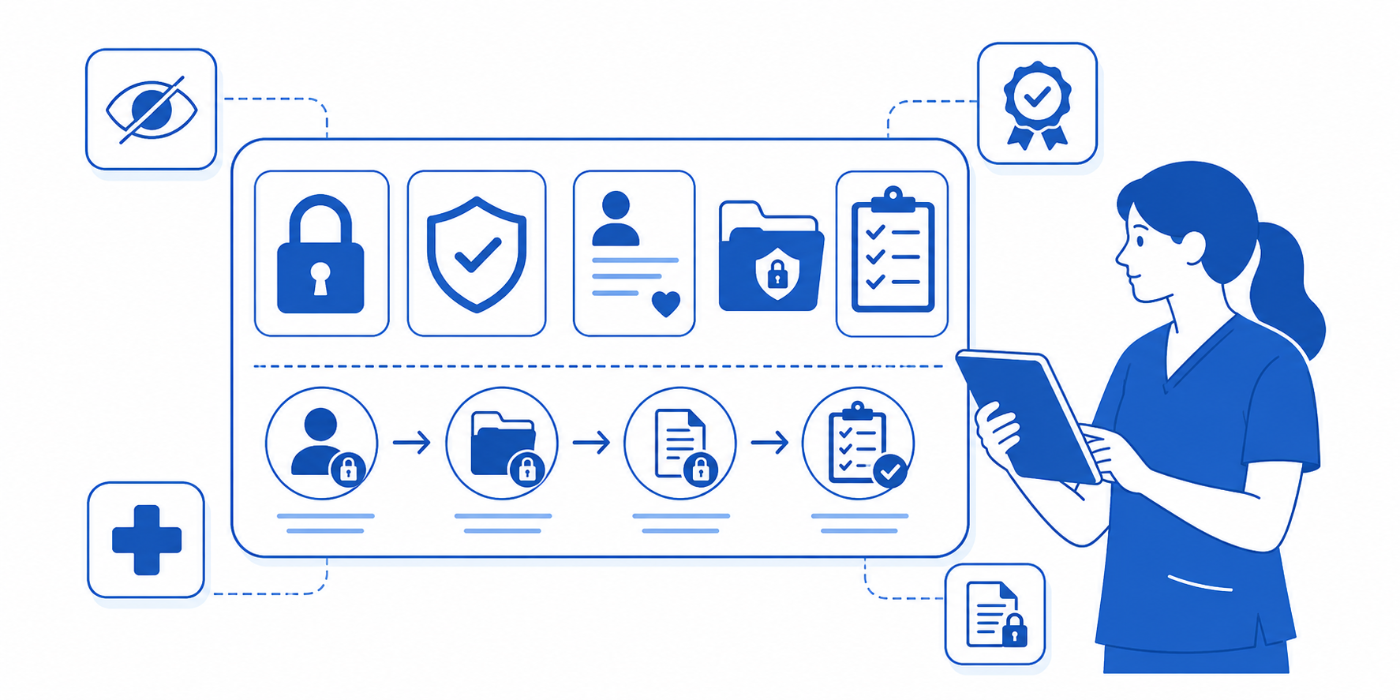
1. Why HIPAA Compliance Matters So Much for Medical Scribes
A medical scribe sits close to the point where private patient information becomes a permanent clinical record. That creates a serious trust burden. A provider may speak quickly, a patient may share something sensitive, the EMR may show old diagnoses, and the scribe must still document only what belongs in the assigned encounter. Scribes who understand medical scribe documentation accuracy, patient privacy communication, medical terminology for scribes, and clinical documentation terms are better prepared to protect both the patient and the provider’s note.
HIPAA matters because scribe mistakes can travel farther than ordinary workplace mistakes. A casual hallway comment can expose a patient’s condition. Opening the wrong chart can create an access trail. Leaving a screen visible can reveal protected health information to someone nearby. Copying forward the wrong detail can damage chart integrity. These problems are especially risky in high-volume settings such as emergency department scribing, urgent care scribe jobs, telehealth scribing, and remote medical scribe roles.
The best scribe mindset is “assigned access, verified documentation, quiet professionalism.” Assigned access means entering only the chart needed for your assigned work. Verified documentation means recording confirmed clinical details instead of assumptions. Quiet professionalism means keeping patient information away from public spaces, personal devices, social conversations, and curiosity browsing. HHS describes “minimum necessary” as a Privacy Rule protection built around limiting unnecessary PHI use or disclosure. That principle should shape how scribes approach EMR platforms, patient record updates, medical abbreviations, and provider workflow support.
Hello, World!
| # | Scribe Situation | HIPAA Risk | Best Practice | Training Connection |
|---|---|---|---|---|
| 1 | Opening a chart before the provider enters the room. | Wrong-patient access. | Confirm patient identifiers and assigned encounter before charting. | Patient intake procedures |
| 2 | Hearing sensitive family history during HPI. | Over-documenting private details. | Capture clinically relevant context only. | Documentation terms |
| 3 | Using a shared workstation. | Visible PHI or open session misuse. | Lock the screen whenever stepping away. | EMR platform awareness |
| 4 | Provider discusses another patient nearby. | Incidental exposure and poor space control. | Keep voice low and move conversations to appropriate areas. | Privacy communication |
| 5 | Remote scribe hears background audio at home. | Household exposure to PHI. | Use a private room, headset, and secure setup. | Remote scribe market |
| 6 | Copying forward old chart content. | Incorrect or stale PHI in current note. | Verify relevance before carrying information forward. | Documentation accuracy |
| 7 | Texting a provider about a patient. | Unapproved communication channel. | Use only employer-approved secure systems. | Healthcare portal terms |
| 8 | Looking up a friend or family member. | Unauthorized access. | Access charts only for assigned work duties. | HIPAA terms |
| 9 | Printing patient material for provider review. | Unsecured paper PHI. | Retrieve immediately and dispose through approved shredding bins. | Front desk operations |
| 10 | Documenting uncertain diagnosis language. | Changing clinical meaning. | Separate impressions, rule-outs, and confirmed diagnoses accurately. | ICD-10 context |
| 11 | Working during a fast emergency visit. | Missing key negatives or plan details. | Use structured note sections and clarify gaps promptly. | ER scribing |
| 12 | Using screenshots for later reference. | Local PHI storage. | Avoid screenshots unless policy explicitly permits secure capture. | Scribe exam mistakes |
| 13 | Discussing an unusual case after shift. | Social disclosure of identifiable details. | De-identify only when permitted and avoid casual storytelling. | Patient communication |
| 14 | Leaving notes on a personal notebook. | Paper PHI leaving controlled space. | Use approved scratch process and destroy notes securely. | EMR charting terms |
| 15 | Hearing behavioral health details. | Highly sensitive disclosure risk. | Document clinically necessary information with extra discretion. | Empathy in healthcare |
| 16 | Using autofill in the wrong chart. | Wrong-patient documentation. | Confirm chart, encounter date, provider, and section before saving. | EMR issue resolution |
| 17 | Taking a call near the waiting room. | Patient overhears PHI. | Move to a private location or lower volume as required. | De-escalation techniques |
| 18 | Asking another scribe about a patient. | Unnecessary internal disclosure. | Share only what is needed for assigned patient care support. | Active listening |
| 19 | Charting in a specialty template. | Default text creates inaccurate PHI. | Remove irrelevant findings and verify each populated section. | Template libraries |
| 20 | Using voice recognition output. | Transcription errors with PHI impact. | Review names, medications, laterality, and negations carefully. | Voice recognition tools |
| 21 | Working in telehealth visits. | Audio, screen, and home-network exposure. | Follow secure telehealth and remote-work policies exactly. | Telehealth platforms |
| 22 | Handling patient portal messages. | Message sent to wrong patient or channel. | Verify recipient, template, and provider instruction before sending. | Healthcare CRM terms |
| 23 | Documenting family member statements. | Attribution confusion. | Attribute history source clearly when provider confirms it. | Complex documentation |
| 24 | Correcting a provider-requested note change. | Untracked or unsupported edit. | Follow edit history and provider approval workflows. | EMR compliance |
| 25 | Working with an AI or ambient dictation tool. | Unverified output becoming the record. | Review generated text against the encounter and provider confirmation. | AI scribe tools |
| 26 | Finishing charting after shift. | Fatigue-related documentation and privacy errors. | Use approved workflow, secure environment, and provider review process. | Day in the life of a scribe |
| 27 | Suspecting a privacy incident. | Delayed reporting. | Report immediately through the employer’s compliance process. | Real-life scribe questions |
2. PHI, Access, and Minimum Necessary Rules Scribes Must Understand
Protected health information, or PHI, includes individually identifiable health information in a covered healthcare context. For scribes, PHI can appear in the obvious places, such as diagnoses, medications, test results, and visit notes. It can also appear in appointment details, portal messages, insurance information, phone notes, referral documents, demographic data, and even the combination of a patient’s name with the reason for visit. HHS explains that protected health information must be individually identifiable and maintained by a covered healthcare provider, health plan, or clearinghouse. A scribe preparing through insurance verification terms, patient intake procedures, medical billing terms, and CPT reference skills should treat administrative details with the same seriousness as clinical details.
Access control is where many scribe privacy habits are tested. The right chart for the right patient at the right time is the baseline. A scribe should avoid curiosity access, avoid searching charts outside assignment, and avoid using another employee’s login. Shared passwords and borrowed sessions create accountability problems because the system audit trail should reflect the actual user. This matters for in-person scribes, remote medical scribes, telehealth scribe teams, hospital scribe programs, and physician groups using scribes.
The “minimum necessary” habit should influence how scribes speak, search, print, message, and document. In practical terms, use the information needed for the assigned clinical task and keep every other detail out of view, out of conversation, and out of unnecessary note sections. The standard described by HHS focuses on limiting most uses, disclosures, and requests to the minimum PHI needed for the intended purpose. For a scribe, this connects directly to specialty documentation templates, EMR shortcuts, patient record compliance, and clinical documentation accuracy.
Scribes also need to understand workforce status and outsourced scribe arrangements. HHS guidance explains that covered entities include healthcare providers, health plans, and healthcare clearinghouses in defined circumstances, and business associates perform certain services involving PHI for covered entities. Many scribes operate under workforce policies, while third-party scribe companies may involve business associate obligations at the organizational level. The individual scribe’s safest move is consistent: follow employer training, sign required acknowledgments, use assigned systems only, and escalate questions through compliance leadership. That mindset supports medical scribe companies, health systems hiring scribes, academic medical centers using scribes, and community health center scribe roles.
3. Privacy Rule Habits During Real Clinical Documentation
Privacy compliance during live documentation depends on micro-habits. Confirm the patient before opening the chart. Keep only the current encounter visible. Avoid copying irrelevant history into the note. Attribute patient statements and family statements correctly. Keep uncertain terms flagged for provider clarification. Close the session when finished. These habits make charting safer across ER scribing, cardiology scribing, orthopedic scribing, and surgical scribing.
The most dangerous documentation errors often look small. A missed “no” before chest pain changes the clinical picture. A copied diagnosis can make an unconfirmed condition appear active. A wrong laterality can affect downstream care. A family history detail may be too sensitive or too irrelevant for the current note. Scribes need enough medical knowledge to understand the privacy and safety impact of their words. That is why medical terminology mastery, ICD-10 reference skills, medical abbreviations, and medical scribe practice exams are HIPAA-adjacent skills, even when they look purely academic.
Scribes should also protect privacy in how they communicate with providers. If a provider needs clarification, use the approved method for that setting. Some offices allow secure EMR messages, some use in-room clarification, and some use end-of-visit review. Personal texting, unsecured screenshots, and casual hallway summaries create risk. This discipline is especially important for telehealth platforms, healthcare portal workflows, patient communication apps, and secure patient scheduling tools.
A strong privacy culture also includes patient-facing discretion. Patients notice when staff whisper, stare at screens, repeat sensitive details too loudly, or seem casual with records. Scribes rarely lead the clinical conversation, yet their presence still affects patient trust. Professional body language, quiet keyboarding, limited screen exposure, and calm response to sensitive disclosures matter. These habits fit directly with empathy in healthcare administration, effective patient communication, active listening techniques, and de-escalation techniques.
4. Security Rule Habits for EMR, Devices, Remote Work, and AI Tools
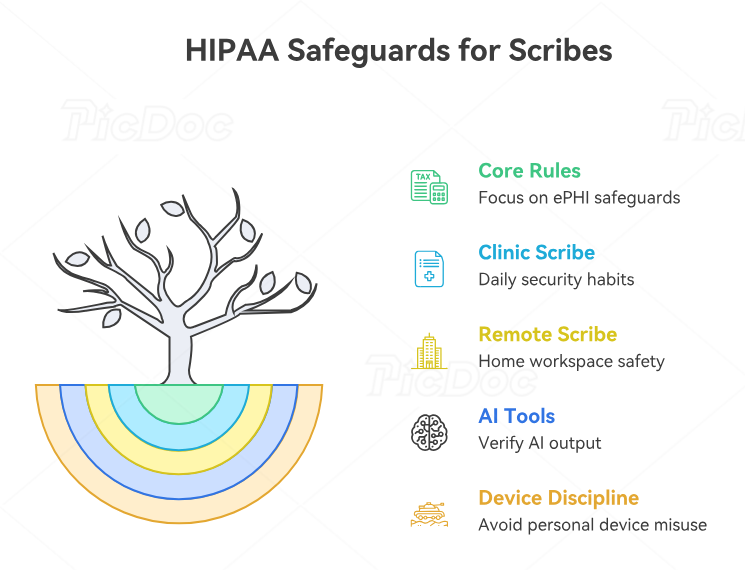
The HIPAA Security Rule focuses on electronic protected health information and requires safeguards that address confidentiality, integrity, and availability. HHS describes administrative, physical, and technical safeguards as core parts of protecting ePHI. For medical scribes, that becomes a daily checklist: use your own login, protect your screen, secure your workstation, follow approved device rules, avoid unapproved storage, and report technical problems quickly. These habits strengthen EMR integration workflows, EMR troubleshooting, patient record updates, and medical office automation awareness.
Remote scribing adds another layer of risk because the workspace is outside the clinic. A remote scribe should work from a private room, use headphones, prevent household members from hearing visit audio, keep screens away from windows or shared spaces, and avoid writing PHI on personal paper. Stable internet matters, yet secure behavior matters more. A remote scribe preparing for work-from-home scribe employers, remote scribe market growth, telehealth documentation, and virtual medical administration should practice explaining these safeguards in interviews and training.
AI and ambient dictation tools also demand sharp HIPAA thinking. A generated draft can contain the wrong patient details, missed negations, invented phrasing, or sensitive information that belongs outside the note. Scribes should treat AI output as a draft requiring verification under provider workflow, not as a final clinical record. This is especially important as healthcare teams adopt AI medical scribe tools, voice recognition software, future medical documentation systems, and AI automation in medical administration.
Device discipline is simple to say and hard to maintain during a busy shift. Keep personal phones away from PHI. Avoid photos, screenshots, copy-paste into unapproved apps, cloud notes, personal email, and messaging platforms outside policy. Lock screens before walking away. Log out at the end of the session. Verify that printed material reaches the right destination. These habits protect medical records release workflows, healthcare data security terms, front desk operations, and medical admin collaboration tools.
5. Breach Prevention, Reporting, and the Scribe Compliance Checklist
A suspected HIPAA incident should trigger fast reporting, not quiet self-correction. If a scribe opens the wrong chart, sends information through the wrong channel, loses paper notes, sees PHI on a personal device, or realizes someone unauthorized may have heard patient information, the safest action is to follow the employer’s reporting process immediately. Delay makes the problem harder to assess. This is the same professional maturity tested in medical scribe interview questions, real-life scribe exam questions, top scribe exam mistakes, and ACMSO exam day essentials.
The best prevention checklist starts before the first patient. Confirm login access. Confirm assigned provider. Confirm workstation privacy. Confirm the correct clinic location or virtual room. Review specialty templates. Know how to ask for clarification. Know where to report issues. During the encounter, capture only confirmed details, avoid unnecessary PHI exposure, and protect screen visibility. After the encounter, review chart sections, clear temporary notes through approved processes, and close the session. This workflow supports medical scribe certification, medical scribe study techniques, medical scribe practice exams, and medical scribe exam breakdowns.
Managers also value scribes who can talk about HIPAA in practical terms. During an interview, a strong answer might sound like this: “I protect patient information by accessing only assigned charts, using approved communication systems, keeping screens secure, avoiding personal devices, and reporting suspected privacy issues immediately. In documentation, I avoid guessing and make sure sensitive details are clinically relevant and provider-confirmed.” That answer is concise, mature, and tied to real workflow. It fits preparation for hospital scribe jobs, physician group hiring, outpatient specialty scribe roles, and pediatric and women’s health scribe roles.
HIPAA competence also protects career growth. Employers prefer scribes who reduce risk while improving documentation flow. A scribe who constantly needs privacy reminders slows the provider down and creates compliance anxiety. A scribe who can document cleanly, keep PHI secure, and communicate gaps calmly becomes valuable quickly. That professional edge matters across medical scribe salary comparison, certified versus non-certified scribe salary analysis, medical scribe career outlook, and healthcare facilities preferring certified scribes.
6. FAQs
-
HIPAA means scribes must protect patient information while supporting clinical documentation. In daily practice, that means accessing only assigned charts, using approved systems, keeping screens private, avoiding personal-device storage, documenting provider-confirmed information, and reporting suspected privacy issues through the employer process. A scribe can build this foundation through HIPAA terms for scribes, patient privacy communication, EMR charting terms, and medical scribe certification prep.
-
A scribe should access charts connected to assigned work duties and approved workflow. Curiosity access, family-member lookup, friend lookup, celebrity lookup, and browsing old charts outside assignment create serious privacy risk. Strong access habits are easier when scribes understand EMR platforms, patient record compliance, healthcare portal workflows, and front desk operations.
-
One of the biggest mistakes is treating fast charting as permission to skip privacy checks. New scribes may open the wrong chart, forget to lock a screen, over-document sensitive details, or use an unapproved communication channel. The fix is a repeatable workflow: verify patient, verify encounter, document only confirmed details, use approved systems, and report concerns quickly. Practice with real-life scribe questions, scribe exam mistakes, interactive practice exams, and documentation accuracy training.
-
Remote scribes should work in a private room, use a headset, protect screen visibility, lock sessions when away, keep PHI off personal notebooks, avoid screenshots, and use only approved platforms. They should also prepare for audio, internet, and device issues without exposing PHI. This is essential for remote medical scribe employers, telehealth companies using scribes, telehealth platform terms, and remote scribe market growth.
-
Handwritten notes depend on employer policy and setting. Some workflows allow temporary scratch notes, while others restrict paper use because loose paper can expose PHI. When temporary notes are allowed, they should stay controlled, contain minimal necessary information, and be destroyed through approved secure disposal. This connects to medical records release tools, patient intake workflows, medical admin time tracking, and medical office operations.
-
AI scribe tools can support documentation, yet output still needs careful review under approved policy. Scribes should verify patient identity, clinical accuracy, negations, medication names, laterality, and sensitive details before text becomes part of the record. Teams using AI medical scribe tools, voice recognition software, future documentation systems, and AI automation in medical administration need strong verification habits.
