

Prior Authorization: Step-by-Step Interactive Guide & Definitions
Prior authorization can slow down care, frustrate patients, overwhelm front-desk teams, and create denial risk when one field, code, payer rule, or clinical note detail is missing. This guide turns the process into a practical workflow for medical admin professionals, billing teams, scribes, and clinic coordinators who need cleaner submissions, fewer avoidable delays, and stronger documentation habits using resources like insurance verification, CPT code guidance, ICD-10 support, patient communication, and denial management.
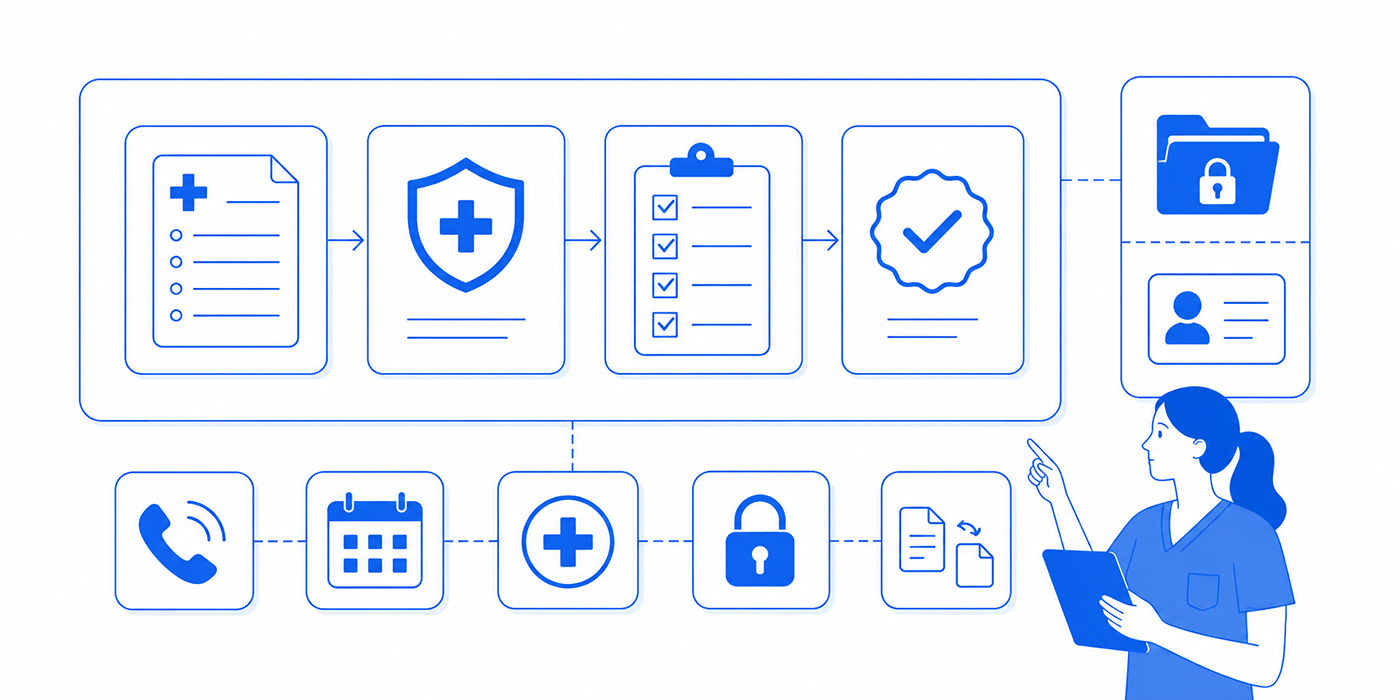
1. What Prior Authorization Means and Why It Creates So Many Workflow Breakdowns
Prior authorization is the payer review process used to decide whether a medication, procedure, imaging study, referral, device, therapy, or service meets the plan’s coverage rules before it is provided or paid. In daily clinic life, it sits between the provider’s plan and the patient’s access to care, which means one weak handoff can turn into a delayed MRI, a canceled procedure, a confused patient, or a preventable denial. Teams that understand insurance verification, patient intake procedures, front desk operations, medical billing terms, and CPT code basics usually catch problems before the request reaches the payer.
The pain point is rarely “authorization exists.” The real problem is fragmented information. The provider documents medical necessity in one section, the diagnosis code sits somewhere else, the payer portal asks for a different wording, the patient’s insurance changed last month, and the scheduled appointment is already close. A strong process connects ICD-10 code selection, CPT code explanation, EMR charting terms, patient record updates, and risk management into one clean trail.
Medical administrative assistants, scribes, and billing coordinators should treat prior authorization as a documentation-quality test. The payer wants proof that the requested service matches the patient’s diagnosis, symptoms, failed conservative treatment, duration of condition, test results, provider rationale, and plan-specific criteria. When the chart lacks that proof, the request can stall even when the care is appropriate. This is where medical terminology mastery, top documentation terms for scribes, EMR integration tools, healthcare portal terms, and legal responsibilities for CMAAs become directly useful.
| # | Prior Authorization Term | Plain-English Meaning | Admin Action | Common Mistake to Prevent |
|---|---|---|---|---|
| 1 | Prior authorization | Payer approval requested before a service, medication, test, or procedure moves forward. | Confirm payer rules before scheduling or dispensing. | Assuming coverage equals approval. |
| 2 | Eligibility verification | Checking whether the patient’s plan is active on the service date. | Verify active coverage, plan type, and payer contact route. | Using old insurance from a previous visit. |
| 3 | Medical necessity | Clinical reason showing why the requested care is appropriate for this patient. | Match symptoms, diagnosis, history, and provider rationale. | Submitting a request with a thin note. |
| 4 | CPT code | Procedure or service code tied to what is being requested. | Confirm the requested service code before submission. | Submitting a code that does not match the order. |
| 5 | ICD-10 code | Diagnosis code explaining why the service is requested. | Check specificity, laterality, chronicity, and clinical match. | Using a broad diagnosis when payer criteria require detail. |
| 6 | Payer portal | Online system used to submit, track, and update authorization requests. | Save confirmation numbers and upload correct records. | Losing portal proof after submission. |
| 7 | Clinical criteria | Plan rules used to decide whether the request qualifies. | Read criteria before sending records. | Uploading everything except the required proof. |
| 8 | Supporting documentation | Notes, labs, imaging, therapy records, medication history, or prior treatment proof. | Attach only relevant, complete records. | Sending missing pages or unrelated chart sections. |
| 9 | Turnaround time | Expected payer review time for the request. | Track dates against appointment timing. | Waiting until the day before service. |
| 10 | Urgent request | Expedited review when delay could create clinical risk. | Use only when urgency criteria are supported. | Marking routine cases as urgent without documentation. |
| 11 | Pending status | Request is under review or waiting for more information. | Check whether the payer needs records, forms, or clarification. | Assuming pending means nothing needs action. |
| 12 | Additional information request | Payer asks for more clinical or administrative details. | Respond quickly with the exact missing item. | Resending the same incomplete packet. |
| 13 | Authorization number | Approval reference tied to the authorized service. | Record it in the correct chart, claim, and scheduling notes. | Approving service verbally without storing the number. |
| 14 | Authorization date range | Time window when the approval is valid. | Check service date against approval window. | Scheduling after the authorization expires. |
| 15 | Approved units or visits | Number of treatments, sessions, visits, or services allowed. | Track usage before every follow-up appointment. | Assuming approval covers unlimited visits. |
| 16 | Peer-to-peer review | Provider discussion with payer reviewer after concern or denial. | Schedule promptly and prepare missing clinical points. | Letting the peer-to-peer window expire. |
| 17 | Denial | Payer refuses authorization or payment for the request. | Read reason, deadline, appeal path, and missing criteria. | Reacting emotionally instead of analyzing the denial reason. |
| 18 | Appeal | Formal request to reconsider a denial. | Submit stronger documentation before the deadline. | Appealing with the same weak evidence. |
| 19 | Retro authorization | Authorization requested after service, when payer rules allow it. | Check payer policy before relying on it. | Treating retro authorization as a safety net for every case. |
| 20 | Referral requirement | Plan rule requiring primary care or network referral before specialty care. | Confirm referral status before specialty scheduling. | Confusing referral approval with prior authorization. |
| 21 | Step therapy | Requirement to try preferred treatments before another option is approved. | Document failed medications, duration, side effects, and outcomes. | Leaving out what was already tried. |
| 22 | Formulary exception | Request for a medication outside normal covered drug rules. | Attach intolerance, failure, contraindication, or clinical rationale. | Submitting brand preference without clinical support. |
| 23 | Out-of-network authorization | Approval for care outside the plan’s usual provider network. | Confirm network status and medical reason. | Missing network documentation. |
| 24 | Claim denial | Payment refusal after service, often tied to coding, authorization, or coverage issues. | Compare claim, authorization, code, date, and documentation. | Fixing only the claim while ignoring the authorization trail. |
| 25 | Coverage limitation | Plan restriction on what is covered, how often, or under what criteria. | Check frequency limits, age rules, diagnosis rules, and site-of-care rules. | Missing a limit hidden in plan policy. |
| 26 | Site-of-care rule | Payer requirement about where the service may be performed. | Confirm facility, office, outpatient, or hospital setting rules. | Authorizing the service in the wrong location. |
| 27 | Documentation audit trail | Record of what was submitted, when, by whom, and what payer responded. | Store dates, names, confirmation numbers, and outcomes. | Depending on memory during a denial review. |
| 28 | Patient financial notice | Communication explaining possible patient responsibility or coverage uncertainty. | Use approved office language and document the conversation. | Promising approval before payer confirmation. |
2. Step-by-Step Prior Authorization Workflow From Intake to Approval
Step one is insurance and demographic verification. Before anyone touches the authorization form, confirm the patient name, date of birth, member ID, group number, plan type, effective date, payer contact route, ordering provider, rendering provider, facility, and service date. Many authorization failures begin with basic mismatch: wrong plan, wrong payer portal, old coverage, missing referral, inactive eligibility, or incorrect provider information. Use insurance verification examples, patient intake procedures, healthcare portal terms, front desk operations, and appointment scheduling best practices to build a clean front-end checkpoint.
Step two is service identification. The admin team must know exactly what is being requested: medication, imaging, surgery, therapy, injection, diagnostic test, durable medical equipment, specialist visit, hospital-based service, or outpatient procedure. Then the team must connect the service to the correct CPT or HCPCS-style service description, diagnosis, provider order, place of service, date range, and expected units. The highest-risk mistake is submitting a general request while the payer needs precise information. Strengthen this stage with CPT codes explained, ICD-10 dictionary support, top billing terms, CPT code training, and insurance claims training.
Step three is clinical documentation review. Check whether the chart contains the story the payer needs to see: symptoms, duration, severity, exam findings, prior treatments, failed medications, imaging results, lab values, functional limitations, contraindications, conservative therapy, and provider rationale. If the note says “pain continues” while the policy asks for six weeks of documented conservative care, the request is exposed. If the diagnosis code lacks specificity, the payer may miss the clinical connection. Resources like medical terminology mastery, documentation terms for scribes, specialty template libraries, patient record update training, and EMR charting terms help prevent thin submissions.
Step four is payer criteria matching. Every payer has its own requirements, and the authorization team should read the criteria before uploading records. Look for diagnosis rules, age limits, tried-and-failed therapy, medication alternatives, imaging prerequisites, lab thresholds, provider specialty rules, visit limits, frequency limits, and site-of-care requirements. Then create a mini checklist inside the tracking note. That simple habit reduces blind resubmissions and messy follow-up calls. Build payer-navigation skill with healthcare CRM terms, patient communication apps, secure scheduling tools, medical records release tools, and legal responsibilities.
Step five is submission and tracking. Submit through the correct payer route, upload only relevant records, document the authorization reference number, date submitted, expected turnaround, payer representative name when available, portal confirmation, and next follow-up date. If the case is pending, ask what is pending. If more information is needed, record the exact missing item. If the payer gives a decision, save the approval number, dates, units, service location, provider, and any restrictions. A strong tracker pairs naturally with time management for medical admins, medical admin time tracking tools, medical office organization, office policies and procedures, and denial management solutions.
3. Definitions Every Prior Authorization Team Should Know by Heart
Medical necessity is the central definition because it connects the provider’s plan to payer approval logic. A request with strong medical necessity shows why this service is appropriate now, why alternatives may be inadequate, and how the patient’s chart supports the decision. It may include failed conservative treatment, test results, abnormal findings, worsening symptoms, functional decline, medication intolerance, or disease progression. Admin teams that understand ICD-10 code specificity, CPT code requirements, medical terminology, clinical documentation terms, and risk management can spot gaps before payers do.
Eligibility, benefits, referral, authorization, and claim approval belong in separate mental boxes. Eligibility says the patient has active coverage. Benefits explain what the plan may cover. A referral may allow access to a specialist. Prior authorization reviews a specific service before care. Claim approval happens after billing review. Confusing these terms creates ugly patient conversations because staff may say “you’re approved” when only eligibility was verified. Prevent that with insurance verification, front desk terms, appointment scheduling terms, claims management training, and patient privacy communication.
Pending, approved, denied, partially approved, and no authorization required also need precise handling. “No authorization required” should still be documented with payer source, date, representative or portal proof, and service details. A partial approval may cover fewer visits, fewer units, a shorter date range, a different site of care, or a modified service. A denial requires the denial reason, appeal deadline, peer-to-peer option, missing criteria, and patient scheduling decision. Use denial management, handling patient complaints, difficult conversations with patients, effective patient communication, and de-escalation techniques when decisions affect appointments or expected costs.
Peer-to-peer review and appeal should be treated as urgent workflow events. A peer-to-peer call usually needs provider availability, case number, payer contact details, denial reason, clinical highlights, and deadline awareness. An appeal requires stronger evidence than the original packet, organized around the payer’s reason for denial. The worst appeal is a bulky upload that forces the reviewer to hunt for the point. Prepare clean packets using medical records release tools, EMR troubleshooting, EMR integration tools, patient record compliance, and medical office productivity.
4. How to Prevent Prior Authorization Denials Before They Happen
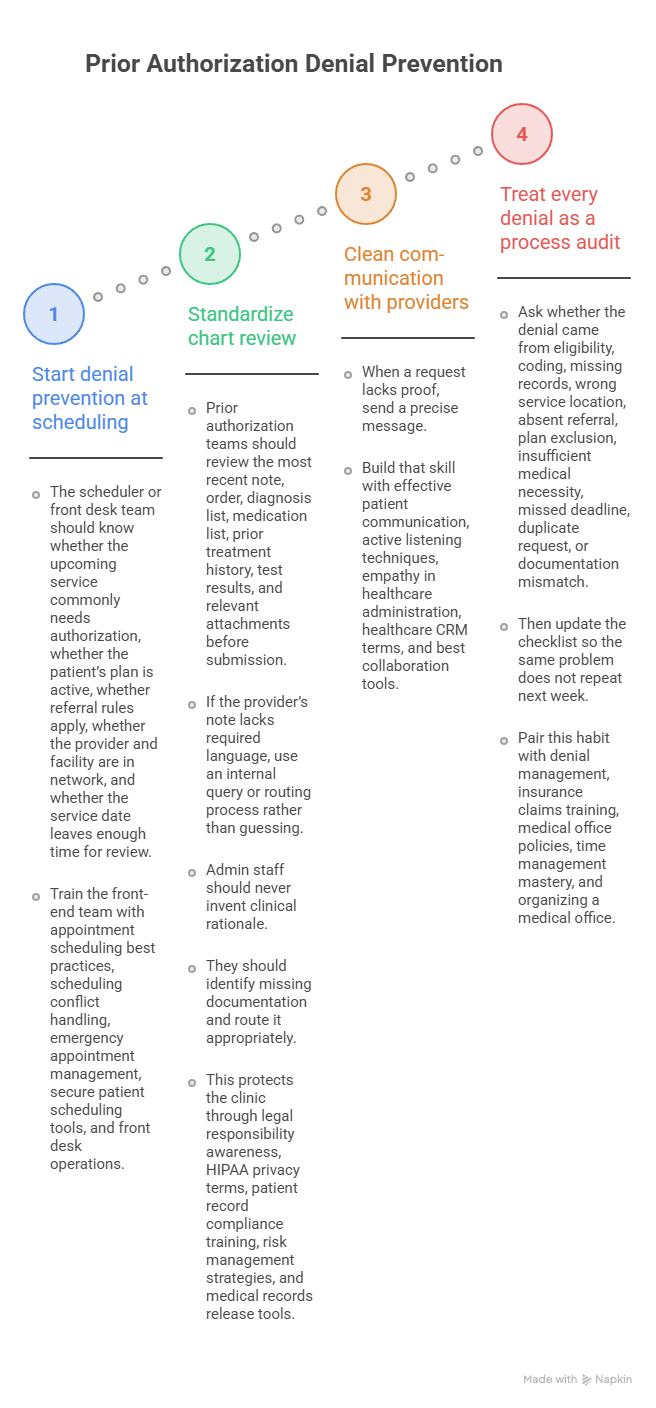
Start denial prevention at scheduling. The scheduler or front desk team should know whether the upcoming service commonly needs authorization, whether the patient’s plan is active, whether referral rules apply, whether the provider and facility are in network, and whether the service date leaves enough time for review. A last-minute authorization request creates pressure, and pressure creates missed fields. Train the front-end team with appointment scheduling best practices, scheduling conflict handling, emergency appointment management, secure patient scheduling tools, and front desk operations.
Next, standardize chart review. Prior authorization teams should review the most recent note, order, diagnosis list, medication list, prior treatment history, test results, and relevant attachments before submission. If the provider’s note lacks required language, use an internal query or routing process rather than guessing. Admin staff should never invent clinical rationale. They should identify missing documentation and route it appropriately. This protects the clinic through legal responsibility awareness, HIPAA privacy terms, patient record compliance training, risk management strategies, and medical records release tools.
Denial prevention also depends on clean communication with providers. When a request lacks proof, send a precise message: “Payer requires documented duration of symptoms and failed conservative therapy before approval for this imaging request. Current note includes pain location and severity but does not list treatment duration or prior therapy outcome.” That kind of message saves time because it tells the provider exactly what is missing. Build that skill with effective patient communication, active listening techniques, empathy in healthcare administration, healthcare CRM terms, and best collaboration tools.
Finally, treat every denial as a process audit. Ask whether the denial came from eligibility, coding, missing records, wrong service location, absent referral, plan exclusion, insufficient medical necessity, missed deadline, duplicate request, or documentation mismatch. Then update the checklist so the same problem does not repeat next week. That is how prior authorization becomes a learning system rather than a permanent fire drill. Pair this habit with denial management, insurance claims training, medical office policies, time management mastery, and organizing a medical office.
5. Prior Authorization Scripts, Checklists, and Office Best Practices
A strong patient script reduces confusion without promising a payer decision. Say: “Your plan may require prior authorization for this service. Our team will submit the required information, track the request, and contact you if the payer asks for more information or if the appointment timing needs adjustment.” This language protects trust because it explains the next step without suggesting guaranteed approval. Train staff with patient communication examples, patient privacy communication, handling complaints professionally, de-escalation techniques, and difficult conversation guidance.
A provider message script should be short, specific, and evidence-based. Say: “Payer criteria require documentation of failed conservative treatment, duration, and functional limitation. The current note confirms pain and exam findings, but the prior treatment history is missing. Please advise whether the chart can be updated based on the encounter.” This keeps the admin team inside its proper role while helping the provider resolve the gap. Strengthen the wording through documentation terminology, medical terminology mastery, EMR charting terms, record update training, and HIPAA compliance for scribes.
Your daily checklist should include active insurance, referral requirement, authorization requirement, CPT/service code, ICD-10 diagnosis, ordering provider, rendering provider, facility, date of service, units or visits, payer criteria, clinical notes, test results, prior treatment proof, submission route, confirmation number, next follow-up date, patient communication status, and final decision. Use shared systems where possible, because sticky notes and scattered inboxes collapse under volume. Build the workflow with medical admin time tracking tools, staff scheduling tools, collaboration tools, EHR integration tools, and EMR issue resolution.
The best offices assign ownership. One person may verify benefits, another may gather records, another may submit requests, and another may handle denials, but every case needs a visible owner and a next-action date. Patients become upset when nobody can answer what stage the request is in. Providers become frustrated when the chart is returned repeatedly for vague reasons. Revenue teams suffer when claims deny after care has already happened. Prevent that with creating medical admin policies, office productivity systems, regulatory changes for CMAAs, medical admin professional organizations, and medical administration conferences.
6. FAQs: Prior Authorization Definitions and Workflow
-
Prior authorization is the payer’s review of a requested service, medication, test, referral, or procedure before approval or payment. The payer checks whether the request fits the plan’s rules and whether the chart supports medical necessity. For admin teams, the safest workflow begins with insurance verification, then moves through CPT code review, ICD-10 diagnosis support, patient intake accuracy, and denial prevention.
-
Most requests need patient demographics, active insurance, member ID, ordering provider, rendering provider, facility, service date, CPT or service code, diagnosis code, clinical notes, medical necessity rationale, relevant labs or imaging, prior treatment history, requested units or visits, and payer-specific forms. A clean submission depends on front desk accuracy, medical billing terms, record update compliance, EMR platform familiarity, and medical records release tools.
-
Common reasons include inactive coverage, missing referral, wrong code, insufficient medical necessity, absent clinical notes, mismatched provider or facility, service outside plan rules, missed deadline, duplicate request, unsupported urgency, or incomplete prior treatment history. The fix begins with reading the denial reason rather than resubmitting blindly. Build a stronger correction path with denial management, claims training, risk management, legal responsibilities, and CPT code mastery.
-
Use a tracker that includes patient name or approved internal identifier, payer, service, CPT code, diagnosis, ordering provider, facility, submission date, confirmation number, status, expected turnaround, next follow-up date, decision, approval number, approved units, authorization date range, and patient communication status. A reliable tracker pairs well with time management tools, medical office organization, collaboration tools, EMR integration tools, and office policy creation.
-
Staff should explain the current status, next step, expected timing when known, and whether the office is waiting on the payer, provider documentation, patient information, or scheduling confirmation. Avoid promising approval, exact coverage, or final cost unless verified through the correct process. Better patient conversations come from effective communication, patient privacy communication, complaint handling, de-escalation techniques, and difficult conversation steps.
-
A referral usually directs a patient to another provider or specialist under plan rules, while prior authorization reviews whether a specific service, medication, test, or procedure meets coverage criteria. Some plans may require both, which is why front-desk teams must check plan rules carefully before the visit. Avoid confusion by using insurance verification, appointment scheduling terms, front desk operations, healthcare portal terms, and patient intake procedures.
