

Medical Office Triage: Key Terminology & Practical Scenarios
Medical office triage determines how quickly a patient concern reaches the person qualified to address it. A missed escalation, vague message, buried portal request, or poorly documented callback can turn an ordinary workflow problem into delayed care and serious liability. Effective triage combines front-desk operations, patient communication, active listening, EMR documentation, and disciplined escalation. This guide explains the language, boundaries, scenarios, documentation controls, and performance measures medical administrative professionals need to route concerns safely.
1. What Medical Office Triage Means and Where Administrative Authority Ends
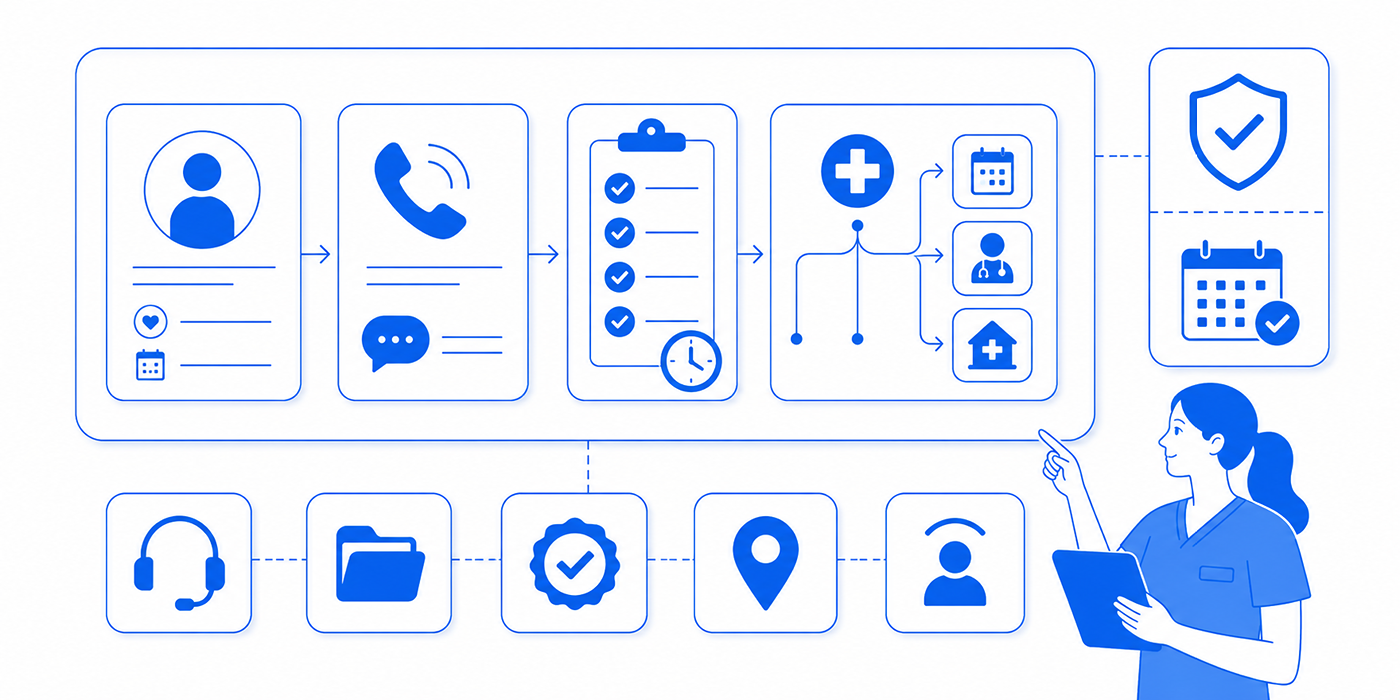
Medical office triage is the structured process used to identify the nature and apparent urgency of an incoming patient concern, route it to the appropriate resource, and document what happens next. Requests may arrive through telephone calls, walk-ins, voicemail, secure messages, referrals, telehealth systems, or a healthcare patient portal. The workflow must account for each channel because a well-managed telephone queue cannot protect a high-risk message left unread inside an unmanaged inbox.
A crucial distinction exists between administrative screening and clinical triage. Administrative employees may verify identity, capture the patient’s exact concern, ask questions approved by organizational policy, identify protocol-defined escalation phrases, and transfer the information. Clinical triage involves professional assessment, interpretation, prioritization, and care guidance performed by appropriately qualified personnel under applicable law, scope-of-practice requirements, and organizational policy.
An administrative employee should never improvise a diagnosis, minimize symptoms, recommend treatment, or decide that a patient is medically safe to wait. The employee’s responsibility is to recognize that the concern meets an escalation criterion, activate the approved pathway, and create a complete record. That boundary should be reinforced through legal responsibility training, risk-management education, medical terminology instruction, and written medical office policies.
Telephone and remote triage create particular risk because the decision-maker cannot directly observe everything that might be visible during an in-person assessment. AHRQ patient-safety resources associate safer telephone triage with trained clinical decision-makers, clear protocols, reliable information exchange, and access to relevant electronic records. Poor documentation, weak call-handling protocols, and faulty triage have also appeared as contributing factors in malpractice cases involving telephone communication.
A dependable triage workflow contains six operational controls:
A defined intake channel: Staff know where calls, portal messages, voicemails, walk-ins, and after-hours requests are received. Approved patient communication applications should feed visible, monitored queues rather than isolated personal inboxes.
Identity verification: The employee confirms the correct patient record before documenting sensitive information. Appropriate identifiers and patient-record update procedures reduce duplicate charts, wrong-patient messages, and accidental disclosure.
Structured information capture: Staff document the patient’s concern, relevant timing, callback details, current location when required by policy, and any exact statements that trigger escalation. Accurate clinical documentation terminology helps preserve meaning without adding assumptions.
Role-based routing: Scheduling questions move through appointment scheduling workflows, clinical concerns reach qualified clinical personnel, billing questions enter the appropriate financial queue, and emergencies follow the office’s approved emergency procedure.
A response target: Each priority category has a defined response expectation, backup owner, after-hours route, and escalation threshold. Medical admin time tracking can reveal when demand exceeds available coverage.
Closed-loop completion: The practice records whether the message was received, reviewed, acted upon, communicated back to the patient, and formally closed. “Sent to nurse” proves transmission. It does not prove completion.
| # | Medical Triage Term | Operational Meaning | Practical Use | Common Failure to Prevent |
|---|---|---|---|---|
| 1 | Chief concern | The primary problem or request described by the patient or caller. | Record the concern in the patient’s own words before categorizing the message. | Replacing the patient’s statement with an unsupported interpretation. |
| 2 | Onset | The reported time at which the concern began. | Capture timing when required by the approved intake script or clinical protocol. | Using vague language such as “recently” when the caller gave a specific time. |
| 3 | Symptom description | The caller’s description of what they are experiencing. | Document exact language and route it to qualified clinical personnel. | Translating ordinary language into a diagnosis. |
| 4 | Red flag | A protocol-defined statement, finding, or circumstance requiring accelerated escalation. | Activate the office’s emergency or urgent pathway immediately. | Relying on personal judgment instead of the approved escalation rule. |
| 5 | Acuity | The apparent severity or clinical complexity determined by qualified clinical personnel. | Use the clinician-assigned category to determine the required response pathway. | Allowing unqualified staff to independently determine medical severity. |
| 6 | Urgency | The time sensitivity assigned to a concern under an approved triage system. | Connect the concern with a response target and escalation deadline. | Treating urgency as a vague label without an action time. |
| 7 | Priority level | An organization-specific category used to order triage work. | Sort queues into emergency, immediate-review, prompt, and routine categories as defined locally. | Assuming that priority labels are universal across organizations. |
| 8 | Scope of practice | The legal and professional boundary defining which tasks a person may perform. | Assign assessment and advice only to personnel authorized to provide them. | Allowing staffing shortages to expand an employee’s authority informally. |
| 9 | Standing protocol | A formally approved instruction governing predictable triage situations. | Provide consistent questions, routing rules, deadlines, and escalation steps. | Using an outdated script that conflicts with current policy. |
| 10 | Decision support | A tool that helps authorized personnel follow an approved triage protocol. | Present required questions and disposition options within the EMR. | Treating software suggestions as replacements for professional judgment. |
| 11 | Portal triage | Review and routing of health concerns submitted through a patient portal. | Monitor inboxes, identify escalation language, and document response status. | Assuming patients understand that portals may lack real-time monitoring. |
| 12 | Telephone triage | Remote assessment and disposition performed by qualified personnel using telephone communication. | Connect callers with the correct level and timing of care under protocol. | Giving advice without enough information or without documenting the call. |
| 13 | Telehealth triage | Routing and clinical assessment conducted through remote communication technology. | Determine whether the concern can follow a remote workflow or requires another route. | Overlooking technology failure, privacy, location, or emergency limitations. |
| 14 | Administrative screening | Collection of approved information used to direct a request. | Verify identity, callback details, reason for contact, and escalation phrases. | Allowing scripted screening to become an unauthorized clinical assessment. |
| 15 | Clinical assessment | Professional evaluation of patient information by authorized clinical personnel. | Determine severity, recommended response, and disposition. | Confusing message collection with clinical decision-making. |
| 16 | Warm transfer | A live handoff in which the sending employee connects the caller and provides essential context. | Use for high-priority concerns when policy requires direct transfer. | Sending the patient to an unattended voicemail box. |
| 17 | Read-back | Repeating critical information to confirm that it was heard or recorded correctly. | Verify names, phone numbers, addresses, instructions, and critical messages. | Allowing a small communication error to corrupt the entire handoff. |
| 18 | Closed-loop communication | A communication process that confirms receipt, understanding, action, and completion. | Track the message until the patient receives the approved response. | Closing the task immediately after forwarding it. |
| 19 | Response-time target | The maximum expected interval before review or action. | Attach deadlines to priority categories and measure compliance. | Promising every caller an immediate response regardless of capacity or policy. |
| 20 | Coverage rule | A plan identifying who monitors triage work during breaks, absences, and after hours. | Assign primary, backup, and escalation owners for every operating period. | Leaving queues unmonitored when one employee becomes unavailable. |
| 21 | On-call provider | The clinician designated to receive eligible concerns outside normal coverage arrangements. | Route after-hours messages according to the current on-call schedule. | Using an outdated schedule or contacting the wrong clinician. |
| 22 | Callback queue | A tracked list of concerns awaiting an outbound response. | Sort callbacks by priority, deadline, owner, and escalation status. | Managing callbacks through handwritten notes or individual memory. |
| 23 | Abandoned call | A call disconnected before the caller reaches the appropriate resource. | Measure abandonment patterns and use available caller information for approved follow-up. | Ignoring repeated disconnects during periods of unsafe queue congestion. |
| 24 | Failed contact attempt | An unsuccessful attempt to reach the patient or responsible party. | Record the time, method, result, next attempt, and escalation requirement. | Documenting only “no answer” without a follow-up plan. |
| 25 | Minimum necessary | A privacy principle limiting certain PHI uses, requests, and disclosures to what is reasonably needed. | Share the information required for the triage purpose through approved channels. | Placing excessive clinical detail in voicemail or unsecured communication. |
| 26 | Identity verification | Confirmation that staff are communicating with the correct patient or authorized person. | Use approved identifiers before discussing protected information. | Relying only on caller ID or familiarity with the caller’s voice. |
| 27 | Language access | Provision of appropriate communication support for patients with language needs. | Use the organization’s approved interpreter pathway during triage. | Using a child, unverified person, or unreliable translation for critical communication. |
| 28 | Proxy caller | A family member, caregiver, or other person contacting the practice on the patient’s behalf. | Verify identity, authority, patient involvement, and permitted disclosure. | Assuming a close relationship automatically authorizes full disclosure. |
| 29 | De-escalation | Communication and safety techniques used to reduce agitation and preserve control. | Use calm language while activating security or clinical support when required. | Continuing an argument after threats or unsafe behavior appear. |
| 30 | Infection-control triage | Early identification and separation procedures for potentially transmissible illness. | Apply current facility screening, source-control, placement, and notification procedures. | Allowing symptomatic patients to remain in crowded common areas unnecessarily. |
| 31 | Escalation threshold | The predefined condition requiring transfer to a higher level of authority or expertise. | Trigger clinical, managerial, emergency, security, or privacy review. | Waiting for certainty when policy requires escalation based on a warning sign. |
| 32 | Disposition | The resulting action selected by authorized personnel after review. | Record the approved outcome, instructions, responsible person, and timing. | Using “handled” without stating what action occurred. |
| 33 | Time stamp | The recorded date and time of a triage event. | Document receipt, escalation, review, contact attempt, response, and closure. | Entering one retrospective time for a sequence of separate actions. |
| 34 | Audit trail | A system record showing who accessed, changed, sent, reviewed, or closed information. | Reconstruct the triage sequence during quality review or investigation. | Using systems that allow silent changes without visible history. |
| 35 | Under-triage | Assignment of a response level lower or slower than the concern required. | Review delayed escalations, adverse outcomes, and misclassified messages. | Measuring speed while ignoring unsafe prioritization. |
| 36 | Over-triage | Assignment of a more intensive or urgent response than required under the approved system. | Study resource use while maintaining safety as the primary constraint. | Pressuring staff to reduce escalation without a clinically governed review. |
2. How Triage Priority, Escalation, and Disposition Work Together
A triage system should connect three separate decisions: how quickly the concern requires review, who has authority to review it, and what action follows that review. Weak systems collapse all three into a label such as “urgent.” That label creates confusion when one employee interprets it as “before lunch,” another interprets it as “within an hour,” and a third assumes someone else has already called the patient.
The priority framework should be defined locally through approved administrative policies and procedures, clinical governance, applicable law, staffing capacity, and the organization’s service model. Categories may include emergency activation, immediate clinical review, same-day review, prompt follow-up, and routine handling. These examples are operational categories rather than universal medical classifications.
Each category requires five attached controls:
The qualifying criteria: Staff need clear instructions describing which patient statements, circumstances, or system findings trigger the level. Employees should receive scenario-based training through medical terminology tutorials, clinical documentation education, and realistic scribe questions.
The qualified recipient: The workflow must name the person or role authorized to determine clinical disposition. “Send to the back” creates no accountability. “Warm-transfer to the designated triage nurse; use the backup clinician after two unanswered attempts within the policy-defined interval” creates an executable process.
The response target: Response expectations should appear directly inside the queue. A high-priority message without a visible timer can age beside routine paperwork. EMR integration tools, medical administration time tracking, and team collaboration platforms can make approaching deadlines visible.
The escalation ladder: Every level needs a primary recipient, backup recipient, after-hours route, and final escalation point. The ladder should address unanswered calls, unavailable clinicians, EMR outages, disconnected patients, uncertain locations, and situations in which the caller’s condition appears to change while staff are communicating.
The closure standard: A triage task should remain active until the required action is documented. Forwarding, paging, or leaving voicemail may represent intermediate steps. Closure might require confirmed clinician review, documented disposition, successful patient contact, approved failed-contact escalation, or transfer to another active workflow.
Safety-netting also belongs in the clinical triage process. It means providing the patient with approved instructions about what to do if the concern changes, worsens, or cannot wait for the planned response. These instructions should come from authorized personnel or a formally approved protocol. Administrative staff should communicate them exactly, use read-back when required, and document the language delivered through the EMR charting workflow.
Privacy controls must continue during urgent communication. HHS explains that covered healthcare providers may communicate electronically with patients when reasonable safeguards are applied. HIPAA also permits healthcare-related messages at home, although providers should limit the information disclosed and accommodate reasonable confidential-communication requests. Practices should incorporate these requirements into HIPAA communication procedures, patient privacy terminology, and portal communication standards.
3. Practical Medical Office Triage Scenarios and Correct Workflow Responses
Scenario 1: A caller uses language covered by the office’s emergency protocol
The administrative employee should stop routine scheduling questions, verify essential contact and location information required by policy, preserve the caller’s exact words, and activate the emergency escalation pathway. The employee should avoid placing the caller into a routine callback queue, interpreting the seriousness independently, or promising that an office clinician will call before the patient takes further action.
The approved procedure may require a warm transfer, emergency-service activation, immediate clinician involvement, or specific scripted instructions. The employee follows that procedure, records every time-sensitive action, and maintains the connection when policy requires it. Emergency appointment management, active listening skills, risk-management controls, and legal responsibility training should reinforce this pathway.
Hospital emergency-department obligations under EMTALA are specific. CMS states that Medicare-participating hospitals offering emergency services must provide an appropriate medical screening examination when an individual comes to the emergency department requesting examination or treatment for a possible emergency medical condition. Independent medical offices should follow their own legal obligations and emergency-transfer policies rather than assuming that every aspect of EMTALA applies identically to every outpatient setting.
Scenario 2: A patient asks for a routine appointment but mentions a new symptom
The scheduling request and clinical concern should become separate workflow components. The scheduler may gather approved information and offer appointments within established rules. The symptom concern should reach the qualified triage resource using the required priority and response target.
A dangerous failure occurs when the scheduler handles only the appointment transaction and leaves the symptom buried in free text. Another occurs when the scheduler independently reassures the patient because an appointment is available soon. The safer record shows the patient’s statement, the clinical message created, its priority under protocol, the receiving person, the appointment action, and the patient communication.
This separation can be built into scheduling software workflows, secure scheduling platforms, appointment-conflict procedures, and front-desk checklists.
Scenario 3: A medication refill request contains a possible adverse-effect concern
The administrative employee should create a refill request according to policy and route the reported concern through the clinical triage workflow. Combining both issues into a generic “needs refill” message strips away the information that may affect urgency. The record should distinguish the medication requested, the patient’s exact concern, timing information collected under protocol, callback details, and any escalation language.
Staff should avoid suggesting that the patient continue, stop, increase, reduce, or substitute medication unless an authorized clinician or approved protocol supplies that instruction. Accurate medical terminology, EMR charting knowledge, clinical documentation standards, and medical scribe HIPAA training help preserve a reliable message.
Scenario 4: A portal message with urgent wording has waited several hours
The first task is to escalate the patient concern through the active clinical pathway. Staff should document when the message entered the system, when it was first reviewed, why the delay occurred, what escalation followed, and whether contact was established. Quietly editing the receipt time or omitting the delay destroys information needed for patient care and quality improvement.
The operational investigation should examine queue ownership, alert configuration, staffing coverage, message categories, response targets, and after-hours warnings. The patient-facing portal should clearly explain that some channels are unsuitable for emergencies, while internal systems must still include monitoring and escalation controls for high-risk language that patients submit anyway.
Useful improvements include dedicated healthcare portal terminology, better patient communication applications, stronger EMR integrations, and formal medical office workflow procedures.
Scenario 5: A coughing patient arrives in a crowded waiting room
The front-desk employee should activate the facility’s current infection-control triage procedure. That may involve promptly notifying designated personnel, applying the facility’s source-control process, moving the patient to an appropriate area, reducing exposure in common spaces, and documenting relevant operational actions.
CDC core practices advise separating patients with respiratory symptoms from others as soon as possible when space permits. Current CDC respiratory-pathogen guidance also recommends measures that reduce crowding and encourages symptomatic individuals to sit away from other patients, with separate placement where feasible.
The practice should prepare this response before the waiting room is full. Infection-control terminology, appointment scheduling controls, front-desk procedures, and telehealth administration can reduce unnecessary congestion and exposure.
Scenario 6: An upset patient becomes threatening during a triage delay
The employee should use calm, direct language while following the workplace safety plan. Personal safety, nearby staff, other patients, escape access, security support, and emergency assistance take priority. The employee should avoid arguing, matching the person’s volume, making promises outside their authority, or continuing a conversation after policy requires disengagement.
OSHA recognizes workplace violence as a healthcare-industry hazard that includes threats, harassment, intimidation, verbal abuse, and physical assault. Its healthcare resources emphasize staff training, reporting, prevention controls, and recognition of potentially violent behavior.
After the immediate situation is controlled, staff should document objective behavior, words used, actions taken, witnesses, notifications, and any effect on patient care. Teams can strengthen this response through de-escalation techniques, difficult-conversation scripts, legal complaint handling, and medical office risk management.
4. How to Build a Safe Triage Workflow From First Contact to Closure
A safe workflow begins by mapping every channel through which a patient can communicate. Include live calls, voicemail, secure portal messages, appointment notes, telehealth platforms, faxed concerns, walk-ins, referral messages, automated forms, and after-hours services. Each channel requires an owner, monitoring frequency, backup plan, and emergency notice.
Step 1: Define administrative intake questions. Create a controlled script that gathers the information required for routing without asking administrative employees to conduct an independent medical assessment. The script may cover approved identifiers, callback number, current concern, reported onset, location when required, communication needs, and exact protocol-defined escalation statements.
Avoid scripts so rigid that employees ignore information volunteered outside the boxes. The workflow should explain how to document unexpected details and whom to contact. Training can combine patient communication examples, active listening techniques, medical terminology mastery, and CMAA exam preparation.
Step 2: Build a role-boundary matrix. List every triage action and identify who may perform it. Actions may include receiving a call, asking scripted intake questions, assigning an administrative category, conducting a clinical assessment, selecting a disposition, providing clinical advice, activating emergency assistance, leaving messages, and closing the case.
The matrix should cite local law, licensure requirements, organizational policy, and approved supervision. NCSBN materials emphasize working within legal scope of practice and following organizational policies and procedures. Regular regulatory training, CMAA legal education, scribe compliance guidance, and HIPAA instruction should support the matrix.
Step 3: Create priority-linked routing rules. Every priority level should automatically identify its destination, response target, backup, and escalation point. Reduce manual searching by embedding current contact schedules and protocol links inside the workflow. Medical staff scheduling tools, collaboration systems, and EMR shortcuts can shorten the time between recognition and action.
Step 4: Standardize the triage message. A useful message contains the verified patient, callback information, caller relationship when relevant, exact concern, reported timing, approved questions and answers, escalation triggers, actions already completed, message priority, receiving person, and required response time.
Avoid vague entries such as “patient feels bad,” “please call ASAP,” or “possible emergency.” The person receiving the message needs enough information to act while remaining free from unsupported conclusions. Strong documentation practices can be reinforced through EMR terminology, clinical documentation terms, medical scribe terminology, and patient record compliance.
Step 5: Design failed-contact rules. A disconnected call or unanswered callback does not erase the underlying concern. Define how many attempts occur, which channels may be used, what may be included in voicemail, when the emergency contact may become relevant, and when the issue must escalate.
The appropriate response will vary with the concern, clinician instructions, patient preferences, and law. Every attempt should record its time, method, result, next action, and owner. Patient privacy communication, HIPAA terminology, virtual patient management, and telehealth administration should shape these rules.
Step 6: Test breakdown scenarios. Run simulations involving an unavailable clinician, full voicemail box, wrong callback number, portal outage, language-access need, angry caller, unattended queue, respiratory symptoms at arrival, and an emergency phrase mentioned during a routine scheduling call. A workflow that succeeds only when every employee and system behaves normally offers little protection.

5. Documentation Standards, Quality Metrics, and Triage Training Controls
Triage documentation should reconstruct what the practice knew, when it knew it, what it did, who made each decision, and whether the patient received the approved response. A note overloaded with copied text can remain less useful than a concise, chronological record with clear ownership and timestamps.
A complete triage record commonly includes:
Verified patient identifiers and caller relationship
Callback number and communication preferences
Date and time the concern was received
Channel through which it arrived
Patient’s exact chief concern
Information collected under the approved protocol
Priority or routing category
Person or queue receiving the message
Time of transfer or escalation
Clinical disposition and author
Contact attempts and outcomes
Instructions communicated
Read-back or understanding confirmation when required
Final closure status and time
Information should be objective. “Patient was difficult” gives little operational value. “Caller raised their voice, used the quoted threat, declined transfer, and disconnected at 10:42 a.m.; supervisor and security notified under policy” supports review. De-escalation documentation, patient complaint handling, risk-management procedures, and legal administrative guidance provide useful training contexts.
Quality measurement should examine safety and reliability alongside speed:
Time to first review measures how long a new concern waits before an authorized person examines it.
Time to clinical disposition measures elapsed time from receipt to the documented clinical decision.
Response-target compliance shows the percentage of concerns completed within their assigned window.
Unassigned-message count identifies work sitting without visible ownership.
Callback completion rate measures whether required patient contact occurred.
Failed-contact escalation compliance tests whether staff followed the next-step policy when the patient could not be reached.
Under-triage review rate tracks concerns later found to have received an insufficient response level.
Handoff defect rate counts messages returned because essential information was missing.
Reopened-message rate identifies tasks closed before the patient’s underlying concern was resolved.
Abandoned-call rate can reveal staffing shortages, routing problems, technical failure, or excessive hold times.
Metrics should be segmented by time of day, intake channel, location, team, priority, and reason. An acceptable daily average can conceal severe delays during lunch coverage or after 4:30 p.m. Medical administrative analytics, time-management systems, medical office organization, and staff scheduling directories can help teams connect performance with capacity.
Training should use realistic scenarios rather than vocabulary quizzes alone. Employees should practice recognizing escalation phrases, staying within role boundaries, performing warm transfers, documenting failed contacts, handling proxy callers, using interpreter resources, responding during system outages, and escalating threatening behavior.
Competency testing should require the employee to complete the entire workflow. Recognizing a warning sign provides limited protection when the employee cannot find the on-call schedule, chooses the wrong queue, or closes the message prematurely. Teams can build capability through CMAA exam scenarios, medical scribe exam preparation, medical terminology tutorials, and 30-day certification study plans.
6. FAQs About Medical Office Triage
-
A medical administrative assistant can perform administrative screening, information capture, identity verification, protocol-based routing, and escalation tasks permitted by law and organizational policy. Clinical assessment, interpretation, advice, and disposition belong to professionals authorized to provide them.
The practice should maintain a written role-boundary matrix rather than relying on informal habits. Staff shortages, a busy waiting room, or an unavailable nurse do not automatically expand an employee’s authority. CMAA legal responsibilities, regulatory-change guidance, risk-management training, and medical office procedures should define the local boundary.
-
The employee should collect only the information required by the approved intake process. Common elements include patient identifiers, callback number, caller relationship, exact concern, reported timing, current location when policy requires it, language-access needs, and answers to authorized screening questions.
The employee should preserve the patient’s words, avoid diagnostic labels, and document volunteered information that affects routing. The practice’s script should connect directly with active listening techniques, patient communication terminology, EMR charting standards, and clinical documentation terms.
-
“ASAP” should be replaced by a defined priority and response time. The label creates no shared expectation and cannot be measured consistently. A useful message states the assigned priority, required review interval, receiving person, backup route, and escalation deadline.
The system should display approaching and missed deadlines rather than depending on employees to remember them. Medical admin time-tracking tools, EMR productivity shortcuts, team collaboration platforms, and medical office organization can improve visibility.
-
A message can be closed when its policy-defined completion criteria have been satisfied. Forwarding it, leaving one voicemail, or placing it in another inbox may represent progress while leaving the concern unresolved.
Closure may require clinician review, documented disposition, patient notification, confirmed transfer, completed failed-contact escalation, or movement into another actively owned workflow. Closed-loop patient communication, virtual patient management, patient portal controls, and EMR compliance training help establish reliable closure.
-
The organization needs an after-hours policy identifying which channels are monitored, who provides coverage, which concerns reach the on-call resource, how patients receive emergency instructions, how failed transfers are handled, and how overnight activity enters the permanent record.
The practice should audit whether website text, voicemail greetings, portal notices, answering services, and telehealth systems give consistent directions. Telehealth platform terminology, telehealth administration guidance, patient communication applications, and emergency appointment procedures support this coverage design.
-
Staff should verify the patient, identify the caller, determine the caller’s relationship and authority, apply applicable privacy rules, and disclose only information permitted for the situation. Urgency does not eliminate the need for disciplined identity and privacy controls.
HHS guidance allows certain communication with family members, friends, and others involved in a patient’s care or payment under defined circumstances, including situations where the patient agrees, does not object, or the provider uses professional judgment as permitted by the Privacy Rule. Staff should follow current law and their organization’s HIPAA communication policy, patient privacy terminology, legal responsibility guidance, and complaint-handling procedures.
