

Revenue Cycle Management: Terms, Definitions & Interactive Examples
Revenue cycle management connects every financial step from appointment scheduling to the final zero balance. Assistants who understand medical billing terminology, insurance claim workflows, denial management, EMR integration, and patient communication can prevent errors before they become unpaid claims. The goal is operational control: accurate patient information, defensible documentation, correct coding, clean claim submission, precise payment posting, and timely resolution of every remaining balance.
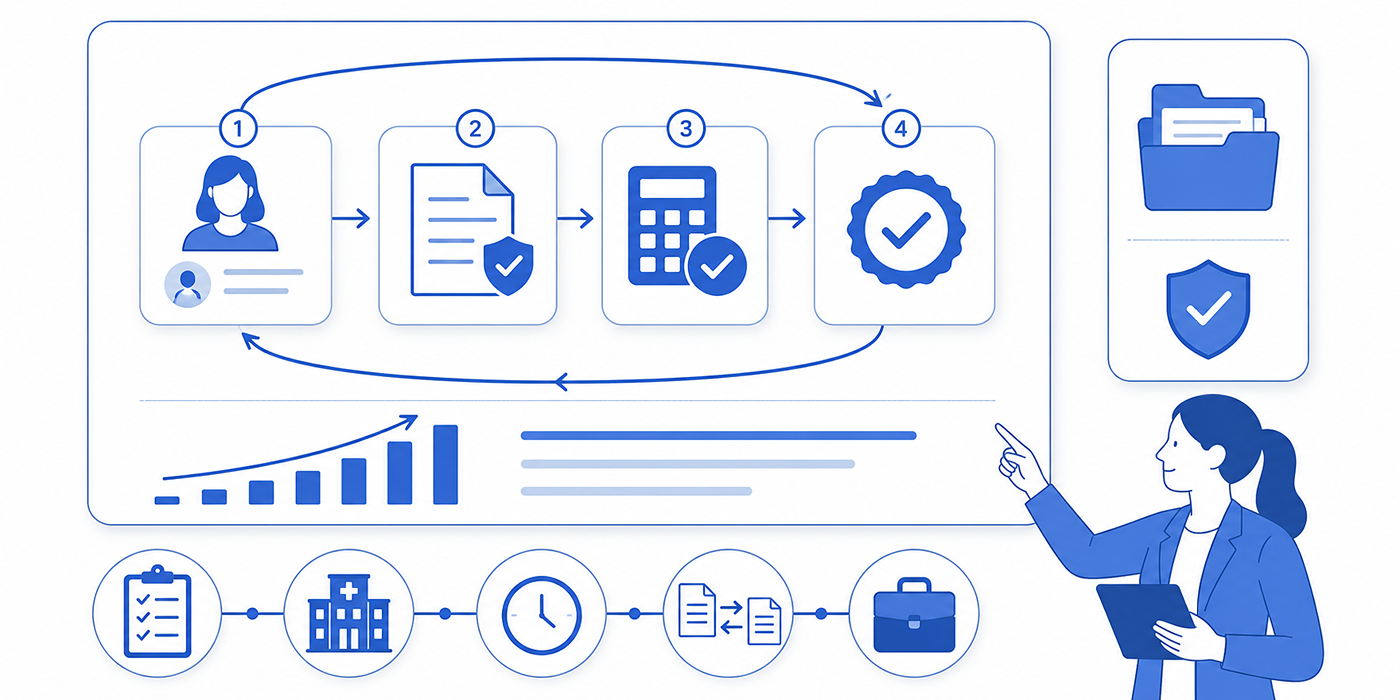
1. How the Healthcare Revenue Cycle Works From Registration to Final Payment
Revenue cycle management, commonly abbreviated RCM, is the connected set of clinical, administrative, and financial processes used to obtain payment for healthcare services. The cycle usually begins before the patient receives care, when staff complete appointment scheduling, demographic collection, insurance verification, referral review, and authorization checks. It continues through clinical documentation, charge capture, coding, claim submission, payment posting, denial resolution, patient billing, and collections. The AMA describes registration, benefit verification, care delivery, claim submission, and reimbursement as core components of the revenue cycle.
The front end includes activities completed before or during patient check-in. A misspelled name, outdated insurance plan, incorrect member number, missing referral, or unconfirmed authorization can damage the claim before the clinician enters the room. Strong front-desk operations, secure scheduling systems, patient portal workflows, healthcare CRM knowledge, and appointment-conflict management help assistants capture accurate information while there is still time to correct it.
The mid-cycle converts the patient encounter into billable data. Providers document the services delivered, coders assign diagnosis and procedure codes, staff capture charges, and claim-editing systems test the information against payer rules. This stage depends on medical terminology mastery, EMR charting knowledge, CPT training, HIPAA-compliant documentation, and patient-record accuracy. CPT codes describe medical procedures and services, while HCPCS Level II codes identify many supplies, products, equipment, and services outside the CPT code set.
The back end begins when the payer receives and processes the claim. Staff monitor claim status, interpret remittance information, post payments and adjustments, correct rejections, investigate denials, submit appeals, bill patients, and reconcile outstanding balances. Effective work requires insurance-claim expertise, denial-resolution skills, time-management discipline, collaboration tools, and risk-management procedures. Medicare sends an electronic remittance advice or standard paper remittance after adjudication, with claim-level decisions and adjustment reasons.
RCM problems often spread across departments. A registration error can trigger a rejection. Incomplete documentation can produce an unsupported code. A coding mismatch can cause a denial. Incorrect payment posting can leave a false patient balance. Weak follow-up can push a recoverable claim beyond its filing or appeal deadline. Assistants should therefore understand the complete cycle alongside medical office organization, administrative policies, staff time-tracking, EMR troubleshooting, and legal administrative responsibilities.
| # | RCM Term | Clear Definition | Interactive Workplace Example | Assistant’s Required Action |
|---|---|---|---|---|
| 1 | Patient Access | The scheduling, registration, insurance, authorization, and check-in activities that open the revenue cycle. | A patient requests an MRI appointment but has supplied no insurance card or authorization information. | Collect the missing data and verify requirements before confirming the service. |
| 2 | Pre-registration | Collecting and validating patient information before the appointment date. | The portal displays an insurance plan that terminated three months ago. | Contact the patient, obtain current coverage, and update the structured fields. |
| 3 | Eligibility | Confirmation that the patient’s health plan coverage is active for the service date. | Coverage is active today but will terminate before next month’s procedure. | Verify eligibility for the planned date of service rather than relying on today’s status. |
| 4 | Benefits Verification | Checking the plan’s coverage, limitations, cost sharing, exclusions, and authorization rules. | A patient has active coverage, but the requested service falls outside the plan’s covered benefits. | Document the benefit response and communicate the next approved financial step. |
| 5 | Prior Authorization | A payer’s advance review of whether a requested service meets specified coverage requirements. | The procedure is scheduled, but the authorization request still shows “pending.” | Track the decision, expiration date, approved units, and matching service details. |
| 6 | Referral | A formal direction from one healthcare professional or plan to another provider or service. | The patient has a referral, but it names a different specialist location. | Confirm that the provider, facility, service, date range, and visit count are valid. |
| 7 | Medical Necessity | The clinical support showing that a service is reasonable and appropriate under applicable coverage criteria. | The order requests advanced imaging but contains no symptoms, findings, or failed conservative treatment. | Route the documentation gap to qualified clinical staff before submission. |
| 8 | Financial Clearance | Confirmation that coverage, authorization, estimates, and payment arrangements are ready before service. | Eligibility is active, yet the deductible and required deposit remain unaddressed. | Complete the estimate and approved collection process before the appointment. |
| 9 | Charge Capture | Recording every billable service, procedure, supply, and medication supported by the encounter. | A procedure appears in the note but never reaches the billing work queue. | Reconcile documentation, orders, charge tickets, and posted charges. |
| 10 | Superbill | A document or electronic encounter form summarizing services, diagnoses, and provider information for billing. | The superbill lists a procedure that cannot be located in the signed note. | Hold the unsupported charge and request clarification through the approved process. |
| 11 | ICD-10-CM | The diagnosis classification system used to report diseases, conditions, symptoms, and reasons for encounters. | The diagnosis code describes the left side, while the clinical note identifies the right side. | Escalate the laterality conflict before claim submission. |
| 12 | CPT | A standardized code set used to report medical procedures and professional services. | The selected service level lacks the required documentation elements. | Return the encounter for compliant review instead of inventing support. |
| 13 | HCPCS Level II | Codes used for many supplies, products, equipment, ambulance services, and other items outside CPT. | A supply was used during treatment but was recorded without quantity details. | Confirm the item, units, date, documentation, and payer reporting rules. |
| 14 | Modifier | An additional code element that communicates a relevant circumstance about a reported service. | Two services appear together, and staff add a modifier solely to bypass an edit. | Confirm that documentation and official coding rules support the modifier. |
| 15 | NCCI Edit | A coding edit designed to prevent improper reporting of incompatible or overlapping services. | The claim scrubber flags two procedure codes that generally should not be reported together. | Review the edit, coding guidance, documentation, and any valid exception. |
| 16 | Claim Scrubber | Software that checks claims for missing, inconsistent, or potentially noncompliant information. | The scrubber identifies a missing rendering provider identifier. | Correct the source data and regenerate the claim before transmission. |
| 17 | Clearinghouse | An intermediary that validates, formats, and routes electronic claims between providers and payers. | The practice system shows “sent,” while the clearinghouse reports a formatting rejection. | Use the clearinghouse acknowledgment as the operational source for correction. |
| 18 | 837P | The standard electronic transaction commonly used to submit professional healthcare claims. | A physician-office claim fails because a required electronic data segment is incomplete. | Correct the underlying billing data and resubmit the transaction. |
| 19 | 837I | The standard electronic transaction commonly used for institutional claims. | A hospital claim contains an invalid type-of-bill combination. | Route the error to the institutional billing team with the exact rejection detail. |
| 20 | CMS-1500 | The standard paper claim form used for many professional services. | The service address and billing-provider address were entered in the wrong fields. | Correct the fields according to current claim-form instructions. |
| 21 | UB-04 | The standard paper institutional claim form used by hospitals and many facilities. | The claim lacks a required revenue code for a facility charge. | Validate the service, revenue code, charge, and supporting documentation. |
| 22 | Clean Claim | A claim containing sufficient valid information for processing without external development. | The claim passes registration, coding, payer, provider, and formatting edits on first submission. | Monitor acknowledgment and adjudication rather than assuming payment. |
| 23 | Claim Rejection | A claim returned before full adjudication because required information or formatting is invalid. | The payer cannot identify the subscriber because the member number is incorrect. | Correct the error and resubmit promptly as an accepted claim. |
| 24 | Claim Denial | An adverse payment decision made after the payer processes or reviews the claim. | The payer processes the claim and denies it because authorization was absent. | Determine whether correction, reconsideration, appeal, or contractual adjustment applies. |
| 25 | Adjudication | The payer’s process for evaluating coverage, coding, pricing, responsibility, and payment. | The payer applies the contract, deductible, coinsurance, and payment rules. | Compare the outcome with the contract and submitted claim. |
| 26 | Allowed Amount | The maximum amount recognized for a covered service under the payer arrangement. | The provider charges $250, while the contracted allowed amount is $180. | Post payment and adjustments according to the remittance and contract. |
| 27 | Contractual Adjustment | The difference between the provider’s charge and the amount accepted under a payer contract. | A $250 charge has a $180 allowed amount, creating a $70 contractual adjustment. | Use the correct adjustment category and avoid billing the patient for it. |
| 28 | Patient Responsibility | The portion assigned to the patient after claim adjudication and applicable financial rules. | The payer assigns $60 of the $180 allowed amount to deductible and pays $120. | Transfer only the supported $60 to the patient account. |
| 29 | ERA / 835 | The electronic remittance transaction reporting payment and claim-adjustment information. | The electronic payment total matches the deposit, but one claim contains an unexpected reduction. | Post the batch and route the discrepancy for contract or denial review. |
| 30 | CARC | A standardized Claim Adjustment Reason Code explaining why an amount changed. | The remittance identifies an adjustment associated with deductible responsibility. | Interpret the code together with the group code, remark code, and payer policy. |
| 31 | RARC | A Remittance Advice Remark Code that supplies additional explanation about processing. | The CARC identifies missing information, and the RARC specifies which detail is absent. | Use the combined message to choose the correct corrective action. |
| 32 | Coordination of Benefits | The process used to determine payment order when more than one health plan may be responsible. | The claim was sent to the secondary plan before the primary payer processed it. | Verify payer order and submit the primary adjudication information correctly. |
| 33 | Timely Filing Limit | The payer’s deadline for receiving an initial claim or specified follow-up submission. | A rejected claim remains untouched until the filing deadline has passed. | Work rejected and unsubmitted claims through deadline-based queues. |
| 34 | Accounts Receivable | Money owed to the organization for services already provided. | A payer claim has remained unresolved for 78 days without documented follow-up. | Assign ownership, investigate status, and document the next action. |
| 35 | A/R Aging | Grouping unpaid balances according to the time elapsed since billing or service. | Balances appear in 0–30, 31–60, 61–90, 91–120, and over-120-day categories. | Prioritize approaching deadlines, high values, and correctable balances. |
| 36 | Appeal | A formal request asking a payer to reconsider an adverse claim decision. | Clinical records support the service, but the payer denied it for medical necessity. | Submit the required evidence, argument, form, and proof of timely delivery. |
| 37 | Underpayment | Payment below the amount expected under the applicable contract or payment policy. | The contract allows $180, while the payer processes only $145 without a supported reason. | Validate the contract and dispute the $35 variance through the payer process. |
| 38 | Credit Balance | A negative account balance indicating that payments or adjustments exceed current charges. | The patient and payer both paid the same deductible amount. | Research the source and process the appropriate refund or correction promptly. |
| 39 | Recoupment | Recovery of a payment that the payer later determines was excessive or incorrect. | A future remittance subtracts an earlier overpayment from the current deposit. | Match the offset to the original claim and review dispute rights and deadlines. |
| 40 | Zero Balance | The account state reached after all valid payments, adjustments, transfers, refunds, and write-offs are resolved. | The system displays $0, but an unsupported adjustment erased an appealable payer balance. | Confirm that every transaction is valid before treating the account as complete. |
2. Front-End RCM Terms That Prevent Registration and Authorization Failures
Eligibility answers whether coverage is active, while benefits verification examines what that coverage may provide for the planned service. An active insurance card never guarantees that every procedure, specialist, location, or service category is covered. Assistants should use appointment scheduling controls, front-desk checklists, healthcare portal tools, and secure patient scheduling to verify the patient, plan, service date, provider, facility, network status, and service-specific requirements. CMS eligibility transactions can return coverage and benefit information used to prepare accurate claims and assess beneficiary responsibility.
Consider a patient whose electronic eligibility response shows active coverage. The assistant schedules a specialist consultation and assumes the financial review is complete. The payer later denies the claim because the plan required a referral from the patient’s primary-care provider. The missing referral represents a benefit-rule failure, while the active policy represents successful eligibility verification. Training in insurance claims, denial management, patient communication, difficult conversations, and risk management helps assistants explain the issue accurately without promising payer outcomes.
Prior authorization requires the provider or supplier to request and receive a payer decision before the service is delivered when the policy requires advance review. Pre-claim review follows a different timing structure: the service may occur before the review request, while the decision is received before claim submission. CMS explicitly distinguishes these two processes. Assistants should record the authorization number, approved service, procedure details, dates, units, location, servicing provider, status, and expiration information within the EMR workflow, medical office procedures, administrative task tracker, and collaboration system.
An authorization number alone provides weak protection when it approves a different service, provider, site, date range, or quantity. For example, an insurer may authorize one imaging study at an outpatient center, while the patient receives a different study at a hospital department. The authorization exists, yet the delivered service falls outside its approved scope. A strong assistant compares the authorization with the order, scheduled appointment, provider, location, code family, and planned units. This discipline strengthens medical office organization, scheduling-software mastery, legal compliance, and patient-record accuracy.
Financial clearance brings the front-end checks together. A financially cleared account has completed the required demographic, insurance, eligibility, benefit, referral, authorization, estimate, and collection steps defined by the organization. The assistant should document unresolved issues instead of marking the account complete because one automated check returned successfully. Useful controls include healthcare CRM fields, medical administrative workflows, appointment conflict protocols, emergency scheduling procedures, and patient privacy communication.
3. Mid-Cycle Terms That Protect Coding, Documentation, and Clean Claims
Charge capture links the services documented in the medical record with the charges entered into the billing system. Lost charges can occur when procedures remain unsigned, supplies fail to cross an interface, orders stay incomplete, or staff close an encounter before all services appear. Duplicate charges can arise when both an interface and a manual process transmit the same item. Assistants can reduce these errors through EMR integration controls, record-update training, EMR shortcut knowledge, software troubleshooting, and office productivity systems.
Diagnosis coding communicates the patient’s condition, symptom, injury, or reason for care. Procedure coding communicates the service or procedure delivered. The documentation should support the reported specificity, relationship, laterality, encounter status, service level, and other required details. Staff should avoid selecting a diagnosis because it produces payment or copying a procedure from a previous encounter without verifying the current record. Medical terminology training, clinical documentation terms, EMR charting vocabulary, CPT education, and scribe exam preparation build the required precision.
A modifier adds meaningful information about the circumstances of a service. Its presence should follow documentation and coding rules. Adding a modifier automatically because a claim-editing system flags two codes can create compliance exposure. CMS uses National Correct Coding Initiative procedure-to-procedure edits to prevent inappropriate payment for services that generally should not be reported together, while medically unlikely edits address potentially incorrect units of service. CMS updates relevant edit files periodically, so practices should use current resources.
A claim scrubber should operate as a preventive control rather than a substitute for staff judgment. It can identify missing identifiers, invalid code combinations, demographic inconsistencies, incomplete fields, and payer-specific problems. It cannot create missing clinical support or guarantee payment. A claim may pass electronic edits and later fail medical review, authorization review, benefit rules, or contractual requirements. Effective teams combine the scrubber with billing-term fluency, insurance-claim training, HIPAA compliance, risk-management controls, and regulatory awareness.
After claim generation, the practice sends the transaction directly or through a clearinghouse. Electronic submission creates several statuses: generated, transmitted, received by the clearinghouse, accepted by the clearinghouse, received by the payer, accepted by the payer, and adjudicated. “Sent” describes only one step. Assistants should retain acknowledgment data, rejection information, submission dates, and control numbers through medical admin time tracking, collaboration platforms, EMR issue management, and administrative policy controls. CMS electronic billing guidance covers professional and institutional claims, claim acknowledgments, remittance advice, status transactions, and eligibility exchanges.
Which revenue cycle problem drains the most money from your practice?
4. Back-End RCM Terms for Payments, Rejections, Denials, and Appeals
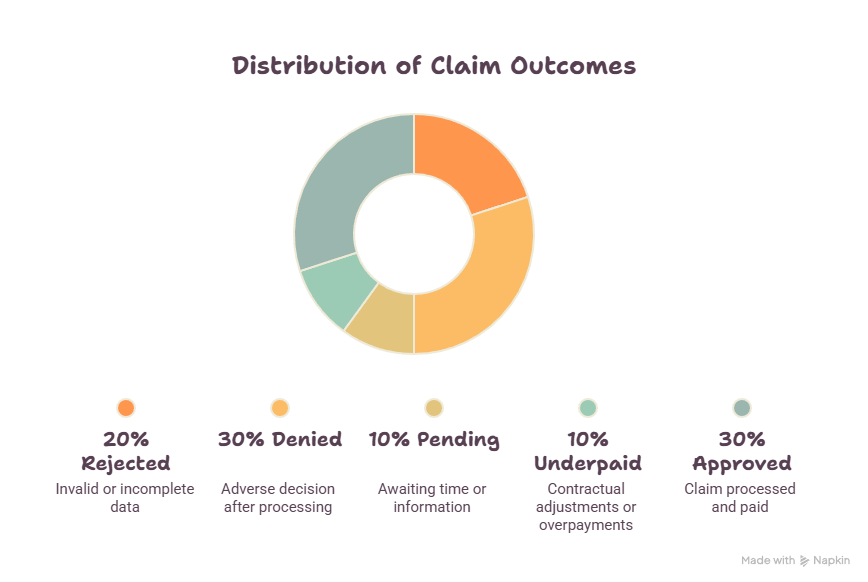
A rejection usually means the claim failed before full adjudication because of invalid or incomplete data. Common examples include an incorrect member number, missing provider identifier, invalid format, or absent required field. The team typically corrects the source information and resubmits the claim. A denial follows payer processing or review and reflects an adverse decision involving coverage, coding, authorization, medical necessity, filing limits, duplication, or another rule. CMS explains that an unprocessable submission does not qualify as a denied claim and therefore does not carry the same appeal rights.
Treating every unpaid claim as a denial hides the proper solution. A rejected claim may need demographic correction. A denied claim may need corrected billing, documentation, reconsideration, or appeal. A pending claim may need time or requested information. An underpaid claim may require contract analysis. Assistants should classify each account through denial-management procedures, insurance-claims training, medical billing terminology, administrative time management, and medical office workflows.
Adjudication applies the payer’s coverage, pricing, contract, coding, and patient-responsibility rules. The resulting electronic remittance advice, often associated with the 835 transaction, explains what happened to each claim or line. CARCs explain adjustment reasons, while RARCs provide additional detail. Payers covered by applicable HIPAA administrative-simplification requirements use standardized adjustment and remark codes in remittance transactions. Staff should interpret these messages alongside the claim record, payer contract, billing rules, and supporting documentation.
Consider a $250 provider charge with a contracted allowed amount of $180. The contract removes $70 through a contractual adjustment. The payer applies $60 to the patient’s deductible and pays $120. Correct posting produces four connected values: $250 original charge, $70 contractual adjustment, $120 insurance payment, and $60 patient responsibility. The account balance becomes $60. Billing the patient for $130 would wrongly include the $70 contractual adjustment. Posting only the $120 payment would leave an inaccurate $130 balance. Precise billing knowledge, claims training, risk management, and patient communication protect the practice and patient.
Coordination of benefits determines which plan pays first when multiple plans may cover the same claim. The primary payer processes first, and the secondary payer evaluates the remaining eligible amount according to its rules. CMS describes COB as the process used to identify available benefits, determine payment order, and ensure that the correct payer pays first. Assistants should verify payer order during pre-registration, preserve the primary remittance, update patient records, and follow claim-submission procedures.
An appeal needs a precise argument supported by the denial reason. Fr a missing-information denial, staff should supply the requested information. For an authorization dispute, they should include the authorization evidence and service match. For medical necessity, the package may require clinical documentation and payer-specific criteria. For a filing denial, proof of original timely submission may become decisive. Strong appeals depend on clinical terminology, accurate documentation, legal responsibility, collaboration tools, and deadline management.
5. Revenue Cycle Metrics and Controls Every Assistant Should Understand
Clean claim rate or first-pass acceptance rate measures the proportion of claims accepted without needing initial correction. The organization should define the denominator carefully because a clearinghouse acceptance, payer acceptance, and first-pass payment represent different milestones. A high initial acceptance rate can coexist with authorization, documentation, medical necessity, or underpayment problems. Assistants should connect metric definitions with claims-management workflows, denial prevention, EMR integration, and office productivity controls.
Denial rate measures denied claims or dollars against a defined claim population. A single total percentage gives limited operational direction. Useful denial reporting separates registration, eligibility, authorization, referral, coding, documentation, medical necessity, duplicate claim, coordination-of-benefits, filing, and payer-processing causes. Each category should have an owner, prevention control, correction route, financial value, deadline, and trend. This structure strengthens risk management, administrative policies, time-tracking systems, team collaboration, and regulatory compliance.
Accounts receivable aging shows how long balances remain outstanding. Aging buckets commonly separate newer accounts from balances over 30, 60, 90, or 120 days, though organizations can configure different categories. Staff should avoid working solely from oldest to newest. A younger claim approaching a strict correction deadline may need attention before an older balance with no immediate deadline. Effective prioritization weighs age, filing limit, appeal limit, dollar value, denial type, payer behavior, patient impact, and likelihood of recovery. Time-management mastery, medical office organization, staff scheduling tools, and collaboration systems support this approach.
Days in accounts receivable estimates how long the organization takes to convert charges into collected revenue. Net collection rate compares collected amounts with collectible amounts after contractual adjustments. Gross collection rate compares collections with gross charges and can be heavily influenced by the organization’s charge structure. Underpayment rate tracks shortfalls against expected payer reimbursement. Each metric requires consistent definitions, accurate posting, and trustworthy contract data. Assistants strengthen that data through billing terminology, claims follow-up, denial resolution, and EMR compliance.
Claim-status work should also use efficient electronic controls. CMS supports standardized electronic claim-status requests and responses, commonly called 276 and 277 transactions. These transactions can reduce manual payer calls and allow automated follow-up on submitted claims. Practices can combine electronic status information with administrative time tracking, healthcare CRM tools, EMR integrations, and collaborative work queues.
A strong RCM dashboard should lead to action. It should show which claim requires attention, why it requires attention, who owns it, which deadline applies, what evidence is missing, how much money is at risk, and what prevention change is needed. A colorful report with vague categories creates visibility without control. Assistants who understand medical administrative workflow, patient record management, insurance claims, denial management, and office policies can turn reporting into measurable financial improvement.
6. Frequently Asked Questions About Revenue Cycle Management
-
Medical billing focuses on converting documented services into claims, submitting those claims, posting payments, resolving billing problems, and collecting valid balances. Revenue cycle management covers the wider process beginning with appointment scheduling, registration, insurance verification, authorization, documentation, coding, billing, payment posting, denials, patient statements, refunds, and reporting. Understanding medical billing terms, EMR workflows, and office productivity allows an assistant to see how early administrative decisions affect later reimbursement.
-
Eligibility confirms whether a patient’s coverage is active for a relevant date. Benefits verification examines service-level details such as coverage rules, exclusions, cost sharing, referrals, authorization, network requirements, and benefit limitations. A patient can be eligible while the requested service remains excluded or requires additional approval. Assistants should document both results through front-desk procedures, scheduling tools, portal workflows, and patient communication. CMS eligibility transactions support inquiries about enrollment, coverage, and benefit information.
-
A rejected claim fails initial validation or processing because the data or format is incomplete or invalid. It usually requires correction and resubmission. A denied claim has undergone payer adjudication or review and received an adverse payment decision. It may require a corrected claim, reconsideration, documentation submission, or appeal. Accurate classification protects filing and appeal deadlines. Assistants can strengthen this skill through denial-management training, insurance-claim tutorials, billing terminology, and time-management systems. CMS distinguishes unprocessable claims from denied claims and their associated appeal rights.
-
A clean claim contains complete, valid information and can move through normal processing without outside prepayment investigation or additional development. Clean-claim preparation includes accurate demographics, current insurance, correct payer order, valid provider information, supported diagnoses and procedures, required authorization details, correct formatting, and timely submission. A claim can pass basic electronic edits and later encounter coverage or medical-review problems, so clean submission never guarantees payment. CPT knowledge, documentation accuracy, EMR compliance, and billing expertise support cleaner claims.
-
The authorization may cover a different procedure, provider, facility, date range, or number of units. The service may also change after authorization, or the payer may require documentation that never reaches the claim-review team. Assistants should compare the approved details against the scheduled and completed service, then retain the decision and supporting records. Strong authorization tracking, patient-record updates, collaboration tools, risk management, and administrative policies reduce these mismatches. CMS describes prior authorization as advance review against applicable coverage, payment, and coding requirements.
-
CARCs are standardized codes explaining why a payer adjusted a claim or service-line amount. RARCs add detail about the processing decision, missing information, policy, or corrective requirement. Staff should interpret them together with the claim-adjustment group code, payer policy, submitted claim, contract, and clinical record. The code pair should lead to a specific next action rather than a generic “insurance did not pay” note. Denial-management skills, billing-term knowledge, claim tutorials, and medical documentation make remittance review more accurate.
