

Medical Claims Processing: Terms, Workflow & Interactive Examples
Medical claims processing converts a documented patient encounter into a structured request for payer reimbursement. Every stage—patient intake, insurance verification, coding, claim submission, adjudication, and denial management—depends on accurate data and accountable handoffs. One incorrect member ID, modifier, service date, or authorization number can delay payment for weeks. This guide explains the terminology, workflow, financial logic, and troubleshooting methods medical administrative professionals need to process claims accurately, protect patient balances, and strengthen the entire revenue cycle.
1. Medical Claims Processing: Definition, Purpose, and Core Structure
A medical claim is a request sent to a health plan for payment or benefit determination after a patient receives healthcare services. The claim translates information from the clinical encounter into standardized administrative data, including patient identifiers, provider details, diagnosis codes, procedure codes, service dates, units, charges, place of service, and authorization information. CMS describes a claim as a request for payment of benefits or services received by a patient.
Medical claims processing is the complete workflow through which that request is created, validated, transmitted, reviewed, paid, reduced, rejected, denied, or assigned for further action. The process begins before the appointment through eligibility verification, appointment scheduling, and prior authorization. It continues through clinical documentation, CPT code selection, ICD-10 assignment, claim scrubbing, electronic submission, payer adjudication, remittance posting, and patient billing.
Most electronic professional, institutional, and dental claims use an ASC X12 837 transaction. The 837P supports professional claims, the 837I supports institutional claims, and the 837D supports dental claims. HHS adopted Version 5010 of the ASC X12N 837 standard for health claim and equivalent encounter information, while CMS identifies the 837P as the standard electronic format used by healthcare professionals and suppliers.
Paper forms remain relevant in limited circumstances. The CMS-1500 is the standard paper claim form for eligible non-institutional providers and suppliers, while the CMS-1450, commonly called the UB-04, supports eligible institutional paper billing. Electronic submission requirements, payer rules, and permitted exceptions determine when paper claims can be used.
A claim travels through several systems. The provider’s EMR or practice management platform creates or exports the claim. A clearinghouse may translate the file, check formatting, apply payer-specific edits, and route it to the correct insurer. The payer then evaluates coverage, coding, contracts, medical policy, cost-sharing, coordination of benefits, and supporting documentation. This chain makes EMR integration, reliable medical office workflows, and disciplined record updates essential.
Three outcomes must remain separate during claim follow-up:
A rejected claim failed an early submission, format, or data validation and usually requires correction before adjudication.
A denied claim reached payer adjudication and received an adverse payment or coverage decision.
A pending claim remains under review, awaiting information, coordination, documentation, or payer action.
Confusing these statuses wastes staff time. Resubmitting a pending claim can create a duplicate. Appealing a clearinghouse rejection bypasses the correction it needs. Billing a patient immediately after a denial can violate contractual or regulatory requirements when the provider still owns the correction. Effective teams combine claims management procedures, legal responsibility training, patient communication standards, and clear escalation rules.
| # | Claims Term | Operational Meaning | Common Failure Point | Required Action |
|---|---|---|---|---|
| 1 | Encounter | The patient visit or episode that generates billable services. | The scheduled visit and documented encounter fail to match. | Reconcile the schedule with the clinical record. |
| 2 | Subscriber | The person who holds the insurance policy. | Subscriber and dependent information becomes reversed. | Confirm during patient intake and eligibility verification. |
| 3 | Member ID | The plan identifier connecting the patient to coverage. | Staff use an expired card or transpose characters. | Validate through the payer portal and update the patient record. |
| 4 | Eligibility | Confirmation that coverage is active for the relevant service date. | Verification occurs too early and is never refreshed. | Repeat benefit verification under an approved daily checklist. |
| 5 | Prior authorization | Payer approval required for designated services under a plan. | The approval covers another code, provider, date, or location. | Match every element using the authorization workflow and contact log. |
| 6 | Referral | A plan-required direction from one provider to another. | The referral expires or excludes the treating specialist. | Verify during scheduling and resolve gaps through conflict management. |
| 7 | Charge capture | Conversion of performed services into billable charges. | A documented service never reaches the billing queue. | Reconcile documentation through the administrative workflow and revenue cycle. |
| 8 | ICD-10-CM code | A diagnosis code communicating conditions, symptoms, or reasons for care. | The code lacks support from the provider’s documentation. | Use the ICD-10 dictionary and accurate medical terminology. |
| 9 | CPT code | A code describing a professional medical service or procedure. | The code fails to reflect the documented service. | Review the CPT guide and complete CPT training. |
| 10 | HCPCS code | A code used for supplies, products, services, and selected procedures. | Units or supporting descriptions are missing. | Review documentation under the documentation framework and compliance rules. |
| 11 | Modifier | Additional code information explaining circumstances surrounding a service. | The modifier is missing, unsupported, or sequenced incorrectly. | Validate against procedure guidance and the specialty documentation template. |
| 12 | Place of service | The setting where the patient received the service. | The claim reports an office setting for a telehealth encounter. | Compare the encounter with telemedicine terminology and platform records. |
| 13 | NPI | The National Provider Identifier used in covered administrative transactions. | Billing and rendering provider identifiers are misplaced. | Confirm provider setup through billing procedures and risk controls. |
| 14 | Clean claim | A complete, accurate claim that can proceed through payer processing. | Staff equate clearinghouse acceptance with guaranteed payment. | Apply a pre-submission checklist and monitor through claims tracking. |
| 15 | Claim scrubber | Software that checks claim data against configured edits. | Rules are outdated or payer-specific edits are absent. | Maintain the system through integration controls and automation oversight. |
| 16 | Clearinghouse | An intermediary that validates, formats, and routes claims. | Rejected files remain untouched in a work queue. | Assign queue ownership through team collaboration and time management. |
| 17 | 837 transaction | The standard electronic transaction used to submit healthcare claims. | The wrong claim type or payer routing information is used. | Confirm configuration through EMR integration and software troubleshooting. |
| 18 | 999 acknowledgment | A response indicating implementation-level acceptance or rejection of a transaction set. | Staff treat syntax acceptance as payer adjudication. | Continue monitoring through the claims workflow and payer portal. |
| 19 | 277CA acknowledgment | A claim acknowledgment reporting acceptance or rejection of claim data. | Rejected claim-level records receive no correction. | Route errors through work-queue controls and follow-up tracking. |
| 20 | Adjudication | The payer’s evaluation of coverage, pricing, payment, and responsibility. | Staff assume every unpaid amount belongs to the patient. | Review through revenue cycle rules and legal safeguards. |
| 21 | Allowed amount | The amount recognized under the payer’s plan or provider contract. | Cost-sharing is calculated from the submitted charge. | Reconcile using billing terminology and benefit information. |
| 22 | Contractual adjustment | The reduction required under a payer-provider agreement. | The adjustment becomes an improper patient balance. | Post under approved office policies and financial controls. |
| 23 | Deductible | An eligible amount assigned toward the member’s plan-year deductible. | Earlier benefit estimates are treated as final adjudication. | Verify the EOB and use clear communication with active listening. |
| 24 | Coinsurance | A percentage of the eligible amount allocated to the member. | The percentage is applied before contractual adjustment. | Recalculate with billing definitions and confirm through payer records. |
| 25 | Copayment | A fixed member amount associated with a covered service. | A collected copay remains missing from the ledger. | Match the front-desk receipt with daily reconciliation. |
| 26 | CARC | A Claim Adjustment Reason Code explaining a financial adjustment. | The code is read without its group code or remark code. | Interpret within the denial workflow and claim history. |
| 27 | RARC | A Remittance Advice Remark Code adding explanation to an adjustment. | The supplemental instruction is overlooked. | Record the message in the CRM note and assign a follow-up deadline. |
| 28 | 835 transaction | The electronic payment and remittance advice transaction. | Automated posting creates an unmatched adjustment or payment. | Reconcile through system integration and payment controls. |
| 29 | 276/277 transaction | The standard electronic claim-status inquiry and response exchange. | Staff resubmit a claim before checking its current status. | Check status through the payer portal and follow-up process. |
| 30 | Coordination of benefits | The process establishing payment order when multiple plans cover a patient. | A secondary plan receives the claim before primary adjudication. | Update coverage records and follow the secondary claims workflow. |
Electronic transaction references follow the claim, acknowledgment, status, and remittance standards described by HHS, CMS, and X12. :contentReference[oaicite:3]{index=3}
2. Step-by-Step Medical Claims Processing Workflow
Step 1: Register the patient accurately. Claims quality begins with demographic and coverage data. Staff must capture the patient’s legal name, date of birth, address, relationship to the subscriber, member ID, group number, payer name, and coverage order. A small registration error can prevent the payer from matching the claim to an active member. The strongest workflow combines structured patient intake procedures, compliant privacy practices, accurate record updates, and a documented front-desk checklist.
Step 2: Verify eligibility and benefits. Eligibility confirms whether coverage is active for the service date. Benefits provide additional information about network rules, deductibles, copays, coinsurance, exclusions, and service-specific requirements. The HIPAA-standard 270/271 transaction supports eligibility and benefit inquiries and responses. Verification should capture the source, date, reference number, effective dates, benefit details, and any limitations disclosed by the payer.
Eligibility responses support planning, although final payment depends on the submitted claim and payer adjudication. A portal showing active coverage cannot cure a missing authorization, invalid provider enrollment, excluded service, or coding conflict. Teams need a layered workflow connecting insurance verification, appointment scheduling controls, prior authorization tracking, and secure patient scheduling tools.
Step 3: Confirm authorization and referral requirements. Staff must match the approved patient, provider, facility, procedure, service date range, units, and authorization number to the planned encounter. An authorization can exist and still fail because it applies to a different code or location. Escalation should happen before the service whenever operationally possible. This requires dependable scheduling software, clear team collaboration, documented emergency appointment rules, and consistent medical office procedures.
Step 4: Complete clinical documentation. The record must support the services later reported on the claim. Documentation should establish the reason for the encounter, relevant history, assessment, services performed, findings, orders, and plan according to the provider’s role and applicable requirements. Coding teams cannot safely create specificity absent from the record. Strong documentation depends on medical terminology mastery, accurate scribe documentation terms, reliable specialty templates, and appropriate HIPAA compliance.
Step 5: Capture charges and assign codes. Charge capture connects the documented service to the billing system. The claim may require diagnosis codes, procedure or supply codes, modifiers, units, service dates, place of service, provider identifiers, and charge amounts. Every code must reflect the documentation and applicable coding rules. The claim should also show valid relationships between diagnoses and services. Useful safeguards include the ICD-10 interactive dictionary, CPT reference guide, CPT training exercises, and a controlled medical billing glossary.
Step 6: Scrub the claim before submission. A claim scrubber checks for missing fields, invalid formats, coding conflicts, payer requirements, inactive identifiers, duplicate services, and other configured edits. Human review remains necessary for exceptions, unusual services, high-dollar claims, authorization-sensitive procedures, and recurring rejection patterns. A scrubber can only apply the rules loaded into it. Teams should maintain EMR integration tools, document software issue resolution, supervise administrative automation, and audit medical office workflows.
Step 7: Submit the claim and monitor acknowledgments. Electronic professional claims commonly leave the billing system as an 837P, while institutional claims use the 837I. A clearinghouse may validate and route the file. The submitter must then review acknowledgment reports. CMS identifies the 999 implementation acknowledgment and the 277CA claim acknowledgment among current Medicare fee-for-service EDI transactions.
A successful file transmission confirms only the stage covered by that acknowledgment. Staff should verify whether the transaction set passed implementation checks and whether each claim entered the payer’s processing system. Claims accepted by the clearinghouse can still fail payer edits. Each rejected item needs a named owner, correction deadline, and resubmission record. Reliable operations use medical admin time tracking, collaboration platforms, office organization controls, and detailed claims follow-up.
Step 8: Allow payer adjudication to occur. During adjudication, the payer evaluates member coverage, provider status, claim data, coding, medical policy, authorization, contract terms, coordination of benefits, and patient cost-sharing. Possible outcomes include full payment, partial payment, denial, suspension, request for information, or transfer of an allowed amount to the patient’s deductible, copay, or coinsurance. Staff must read the complete result before assigning financial responsibility.
Step 9: Check claim status at the correct interval. The HIPAA-standard 276/277 exchange supports electronic claim-status requests and responses. CMS confirms that providers can submit a 276 request and receive a 277 response for Medicare claim status.
Status checks should follow payer-specific processing windows and internal aging rules. A claim that remains absent from the payer’s system may require proof of submission or resubmission. A pending claim may require documentation or coordination-of-benefits information. A processed claim requires remittance review. Organized teams use the payer portal, a structured healthcare CRM, efficient time-management methods, and consistent claims management procedures.
Step 10: Post the remittance and reconcile the account. The 835 transaction communicates electronic claim payment and remittance information. Adjustments on an ERA may be reported using group codes, Claim Adjustment Reason Codes, and Remittance Advice Remark Codes.
Payment posting must reconcile the payer payment, contractual adjustments, deductible, copay, coinsurance, denied amounts, prior patient collections, and secondary coverage. Automated posting exceptions need manual review. A zero payment can still contain crucial adjudication information. The final ledger should align with the remittance before a patient statement is released. This stage depends on revenue cycle controls, accurate billing terminology, strong risk management, and professional patient communication.
3. Claim Statuses, Financial Logic, and Interactive Processing Examples
A claims team needs to know where a claim failed and what the current data permits. Front-end rejection, payer rejection, pending status, denial, partial payment, and full payment trigger different workflows. Status language can also vary between clearinghouses and payers, so the associated report, error message, reason code, remark code, and claim history must be reviewed together.
Interactive Example 1: Demographic rejection
A professional claim for an office visit carries a $185 charge. The clearinghouse rejects it because the member ID contains one incorrect character.
Claim stage: Pre-adjudication
Payment decision: None
Correct action: Verify the member ID, correct the claim, and resubmit
Incorrect action: Appeal the rejection or bill the patient
Prevention: Compare the insurance card, eligibility response, and registration record before submission
This failure belongs to patient intake, insurance verification, record maintenance, and front-desk quality control. The correction should preserve the original claim history and transmission dates.
Interactive Example 2: Clean adjudication with deductible and coinsurance
A provider submits a $500 charge. The payer’s allowed amount is $300, creating a $200 contractual adjustment. The payer applies $100 to the deductible. The remaining $200 is subject to 20% coinsurance, producing $40 in coinsurance and a $160 plan payment.
The account should show:
Billed charge: $500
Contractual adjustment: $200
Allowed amount: $300
Deductible: $100
Coinsurance: $40
Payer payment: $160
Total patient responsibility: $140
The financial equation balances:
$500 charge − $200 adjustment − $160 payer payment = $140 patient responsibility
A copay already collected at check-in must be credited against the final patient balance when applicable. Staff should reconcile the result through medical billing definitions, revenue cycle procedures, front-desk payment records, and accurate patient communication.
Interactive Example 3: Authorization-related denial
A diagnostic procedure claim reaches adjudication and receives an authorization-related denial. The account contains an authorization number, yet the approval covers a different service code.
Claim stage: Adjudicated
Immediate owner: Authorization or billing team
Required review: Approved code, provider, location, dates, and units
Possible remedy: Corrected claim, reconsideration, appeal, or contractual adjustment depending on the verified facts
Patient billing status: Hold while responsibility is determined
The presence of an authorization number provides incomplete proof. The approval must match the billed service. A strong response uses the prior authorization guide, claims management tutorial, denial resolution process, and documented legal safeguards.
Interactive Example 4: Diagnosis-procedure conflict
A claim is denied because the payer reports that the diagnosis does not support the procedure under its processing rules. Staff should compare the submitted claim with the provider’s documentation, the diagnosis sequence, the procedure code, applicable modifiers, and current payer policy. The record may support a corrected claim, additional documentation, or an appeal. Any code change must accurately represent the documented encounter.
The safe review path combines the ICD-10 dictionary, CPT reference, medical terminology training, and clinical documentation standards. Payment pressure cannot justify unsupported coding.
Interactive Example 5: Duplicate claim risk
A claim has remained pending for 18 days. A staff member resubmits it without checking payer status. The payer later processes the original submission and rejects the second as a duplicate.
This creates extra work without accelerating payment. The correct process is to check the payer portal, review the submission acknowledgment, use the available claim-status transaction, and record the outcome. CMS recognizes the 276/277 transaction for claim-status inquiry and response, supporting status verification before unnecessary resubmission.
4. How to Troubleshoot Rejections, Denials, and Payment Errors
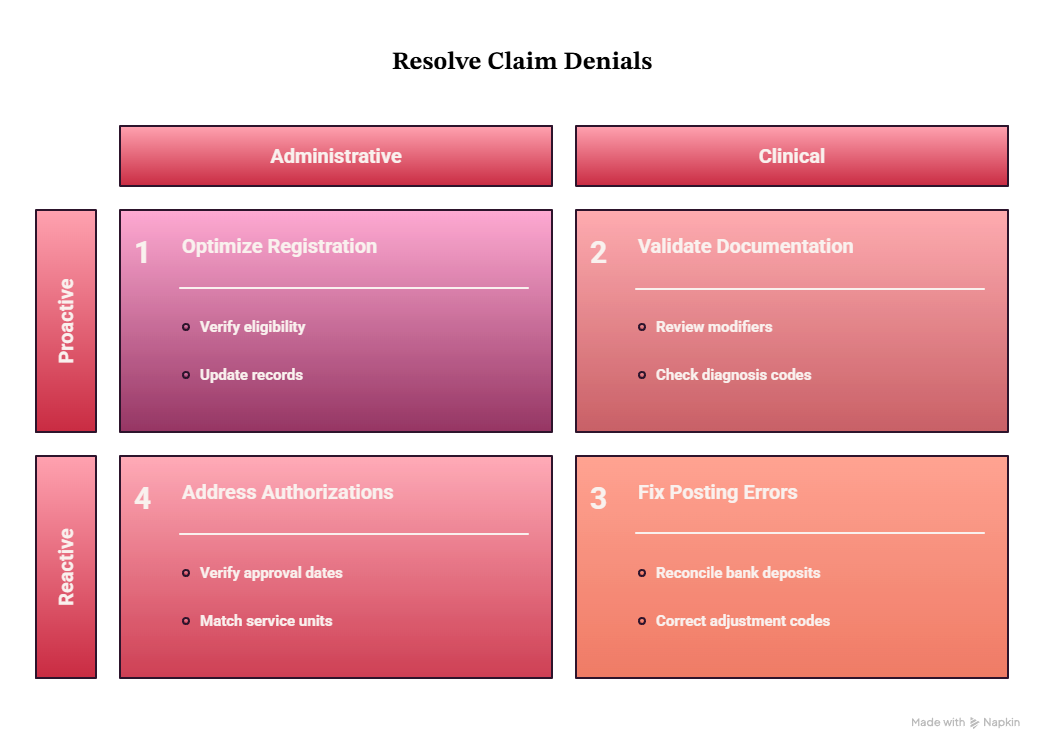
Start by identifying the exact processing layer. A clearinghouse edit, 999 rejection, 277CA rejection, payer front-end rejection, adjudicated denial, and remittance posting error require different corrective actions. Staff should record the claim number, clearinghouse reference, payer control number, submission date, service date, status, error message, CARC, RARC, amount, current owner, and next deadline. CMS explains that the 277CA reports the data-content status of submitted 837 claims, while the 999 addresses implementation-level acknowledgment.
For registration rejections, compare the submitted patient and subscriber data with the insurance card and current eligibility response. Look for misspelled names, reversed relationships, outdated member IDs, invalid dates of birth, and incorrect payer routing. Update the master record before rebuilding the claim so the same error does not recur. This correction should follow patient intake procedures, insurance verification rules, EMR record controls, and secure HIPAA communication.
For provider-data rejections, verify the billing provider, rendering provider, referring provider, NPI, taxonomy, service location, enrollment, and payer-specific configuration. A provider may be credentialed under one entity or location while the claim reports another. Review the practice management setup before editing individual claims. Repeated provider errors point toward a configuration problem requiring EMR troubleshooting, integration review, updated office procedures, and formal risk management.
For coding denials, retrieve the submitted diagnosis codes, procedure codes, modifiers, units, place of service, and clinical documentation. Determine whether the claim contains a transcription error, incomplete modifier, unsupported service, sequencing issue, payer edit, or documentation gap. Route clinical interpretation to the appropriate qualified reviewer. Use the CPT code guide, ICD-10 dictionary, documentation terminology, and specialty-specific template resources.
For authorization denials, reconstruct the complete authorization timeline. Confirm when approval was requested, what information was supplied, which service was approved, who issued the decision, the effective dates, approved units, facility, provider, and reference number. Then compare every element with the claim. Use the prior authorization workflow, healthcare CRM record, appointment scheduling data, and documented claims follow-up.
For timely-filing issues, locate the original submission report, acknowledgment, clearinghouse acceptance record, payer receipt date, corrected-claim history, and any evidence that the claim was previously received. Filing limits vary by payer, contract, plan, claim type, and correction status. Internal teams should maintain earlier submission targets that leave enough time to resolve rejections before the payer’s deadline. This requires dependable time-tracking tools, clear workflow ownership, structured office checklists, and organized team collaboration.
For remittance and posting errors, compare the 835 or paper remittance with the bank deposit, payment batch, contractual adjustments, patient-responsibility categories, prior payments, refunds, recoupments, and secondary claims. CMS states that ERA adjustments may occur at line, claim, or provider level and may use standard adjustment-code sets.
An unexplained balance should remain under review until the financial path is clear. A payment could be present in the bank while missing from the patient ledger. An automated contractual adjustment could use the wrong code. A reprocessed claim could reverse an earlier patient balance. The correction should use revenue cycle controls, billing terminology, denial management, and professional patient complaint handling.
5. Claims Controls, Performance Metrics, and Career-Ready Skills
Claims performance improves when practices measure each processing stage separately. A single overall collection percentage cannot show whether revenue is leaking through registration, authorization, coding, submission, payer follow-up, or posting. Useful operational measures include first-pass acceptance rate, clearinghouse rejection rate, payer rejection rate, clean-claim rate, denial rate, days from service to charge entry, days from charge entry to submission, unresolved claim inventory, days in accounts receivable, appeal success rate, underpayment recovery, and patient-balance accuracy.
Each metric needs a clear numerator, denominator, data source, owner, reporting period, and target. For example, a first-pass acceptance rate should define whether “acceptance” means clearinghouse acceptance, 277CA acceptance, or payer front-end acceptance. Mixing those stages makes the figure unreliable. Teams can support consistent measurement through medical admin time tracking, predictive analytics, appropriate collaboration tools, and organized staff scheduling.
A denial dashboard should group problems by root cause instead of payer wording alone. Valuable categories include registration, eligibility, authorization, referral, coding, documentation, provider enrollment, duplicate submission, coordination of benefits, timely filing, medical policy, contract pricing, and payment posting. Each category should connect to the department able to prevent recurrence. This turns denial management into workflow improvement supported by office policies, risk controls, and practical team training.
Privacy and security also belong inside claims operations. Claims contain individually identifiable health and financial information. The HIPAA Privacy Rule establishes national standards for protecting medical records and other individually identifiable health information and applies to health plans, clearinghouses, and covered providers conducting specified electronic transactions.
Staff should use approved systems, role-based access, secure document exchange, verified caller procedures, controlled record release, and minimum-necessary practices appropriate to their responsibilities. Claims should stay out of personal email, unsecured messaging, open spreadsheets, and unapproved storage. These safeguards connect HIPAA terminology, patient privacy communication, efficient records-release tools, and documented legal responsibilities.
For a medical administrative assistant, claims knowledge demonstrates far more than data-entry ability. It shows an understanding of payer logic, documentation dependencies, coding relationships, financial reconciliation, patient responsibility, compliance, and cross-department communication. Candidates can strengthen this skill through CMAA terminology study, CMAA exam preparation, focused interview preparation, and a clear career roadmap.
6. Frequently Asked Questions About Medical Claims Processing
-
A rejected claim usually fails before full payer adjudication because of formatting, missing data, invalid identifiers, or front-end edits. A denied claim has reached adjudication and received a payment or coverage decision. Rejections generally require correction and resubmission. Denials require analysis of the payer decision, claim facts, documentation, contract, and available remedy. Teams should use separate claims workflows, denial procedures, time-tracking controls, and legal safeguards.
-
A clean claim contains complete and accurate information needed for payer processing and passes relevant submission requirements without preventable defects. It should include correct patient, subscriber, provider, service, coding, charge, authorization, and routing data. Clearinghouse acceptance provides one quality checkpoint, while payer adjudication still evaluates coverage and payment rules. Practices can strengthen clean-claim performance through insurance verification, CPT training, ICD-10 resources, and daily office checklists.
-
The 837 carries healthcare claim or equivalent encounter information from the submitting organization toward the payer. The 835 carries claim payment and remittance information from the payer toward the provider or designated receiver. HHS adopted Version 5010 of the ASC X12N 837 for claim information, and CMS describes standardized adjustment coding within electronic remittance advice.
Operationally, the 837 begins the electronic payment request, while the 835 explains the payer’s financial response. Both require reliable EMR integration, accurate billing knowledge, controlled payment posting, and structured software troubleshooting.
-
Clearinghouse acceptance confirms that the claim passed the checks performed at that stage. The payer can still reject the claim, request information, reduce payment, assign cost-sharing, or deny a service during adjudication. Staff should monitor subsequent acknowledgments, payer status, and remittance records. CMS states that an acknowledgment report is generated following successful electronic transmission, supporting continued tracking after submission.
Use the payer portal, claims management workflow, healthcare CRM, and time-management system to track each stage.
-
First confirm the payer ID, submission date, claim file, clearinghouse report, 999 response, 277CA response, and payer control information. Check claim status before recreating the claim. The standard 276/277 transaction supports electronic claim-status inquiry and response.
When the payer confirms no record, resubmit according to payer instructions and retain proof of the earlier attempt. Document the representative, reference number, date, action, and follow-up deadline. Use claims tracking, office organization, collaboration tools, and formal billing policies.
-
Responsibility depends on the denial reason, payer contract, plan terms, authorization history, documentation, applicable notices, and whether the provider can correct or appeal the claim. A contractual adjustment, provider-caused error, or correctable coding issue may remain the provider’s responsibility. Place uncertain balances under review before patient billing. Use denial management, legal responsibility guidance, risk-management procedures, and compliant patient communication.
