

Interview Preparation Guide for Medical Admin Roles
Medical admin interviews rarely go badly because the candidate is careless. They go badly because the candidate sounds generic, gives soft answers about “being organized,” and fails to prove they can protect schedules, patient trust, provider time, documentation quality, and front-desk flow under pressure. Hiring managers are listening for operational judgment.
This guide is built for that reality. It will help you prepare sharper answers, anticipate tough interview angles, speak with more authority about workflow and compliance, and show that you can handle the daily pressure points that make or break a medical office.
1. What Hiring Managers Are Actually Evaluating in Medical Admin Interviews
A medical admin interview is never just about whether you can answer phones or book appointments. Employers are trying to figure out whether you can keep the office moving when patients arrive upset, schedules collapse, authorizations are delayed, messages pile up, and documentation errors start creating downstream problems for billing, compliance, and patient satisfaction. That is why smart preparation starts with understanding the real scorecard behind the interview.
Most hiring managers are screening for five things at once: communication, judgment, workflow discipline, accuracy, and discretion. A candidate who understands front-desk operations terms, appointment scheduling best practices, insurance verification, patient privacy communication essentials, and effective patient communication sounds more employable than someone repeating vague claims about multitasking.
They also want proof that you understand how one small mistake can spread. A wrong demographic entry can delay claims. A poor message handoff can create clinical risk. A weak intake process can frustrate patients before the provider even walks in. That is why strong candidates sound operational. They talk about appointment accuracy, message routing, prior authorizations, record release workflows, chart updates, patient check-in bottlenecks, and privacy safeguards with confidence. Studying interactive training for patient record updates and EMR compliance, EMR integration tools every medical administrative assistant needs, top 10 EMR shortcuts to boost CMAA productivity instantly, resolving common EMR software issues, and top 20 HIPAA and patient privacy terms helps you answer at that level.
Another thing interviewers are testing is whether you understand the role beyond task execution. Can you calm a patient without promising what you cannot guarantee? Can you explain delays clearly without sounding defensive? Can you protect provider time while still keeping patients informed? These are not “soft skills” in the abstract. They are daily survival skills in healthcare administration. Reviewing active listening techniques for medical admin professionals, de-escalation techniques, step-by-step guidance for managing difficult conversations with patients, empathy in healthcare administration, and the interactive guide to handling appointment scheduling conflicts gives you language that sounds grounded in real practice.
Finally, many employers are quietly testing whether you are future-ready. Can you work with digital tools, remote workflows, portal messaging, and changing office systems without becoming the bottleneck? Candidates who understand AI and automation in medical administration, interactive emerging medical admin technologies, medical office automation trends, virtual medical administration, and future-proofing your CMAA career present as people the office can grow with rather than merely train around.
| # | Interview Topic | What Interviewers Want to Hear | Weak Answer Pattern | Stronger Preparation Angle |
|---|---|---|---|---|
| 1 | Patient check-in | Accuracy, speed, identity confirmation, insurance capture | “I greet patients nicely.” | Explain how you verify demographics, insurance, copays, and visit purpose without slowing flow. |
| 2 | Scheduling | Template discipline, urgency recognition, conflict resolution | “I can book appointments fast.” | Show how you protect provider time and route urgent cases correctly. |
| 3 | Phone handling | Triage judgment, documentation, professionalism | “I am good on calls.” | Describe structured call handling, message capture, and escalation thresholds. |
| 4 | Insurance verification | Coverage checks, authorization awareness, patient communication | “I know insurance is important.” | Discuss verification timing, payer details, and preventing day-of-service surprises. |
| 5 | EMR use | Navigation, chart hygiene, efficiency, privacy | “I learn software quickly.” | Mention chart updates, task queues, message routing, and audit-conscious behavior. |
| 6 | HIPAA/privacy | Discretion, minimum necessary access, secure communication | “I keep things confidential.” | Give examples involving screens, calls, records, and portal messaging. |
| 7 | Difficult patients | Calm tone, de-escalation, boundaries, empathy | “I stay polite.” | Show how you acknowledge frustration while protecting policy and workflow. |
| 8 | Provider support | Anticipation, accuracy, follow-through | “I help wherever needed.” | Talk about reducing friction for providers through preparation and clean handoffs. |
| 9 | Multitasking | Prioritization, not chaos tolerance | “I can handle many things.” | Describe how you rank tasks by patient safety, urgency, and revenue impact. |
| 10 | Time management | Queue control, deadline reliability, workflow batching | “I am organized.” | Explain real methods for callbacks, inboxes, forms, and follow-up tracking. |
| 11 | Record requests | Accuracy, authorization checks, turnaround discipline | “I send records when asked.” | Show understanding of release workflows and privacy checks. |
| 12 | Referral coordination | Completeness, documentation, payer awareness | “I can send referrals.” | Discuss collecting needed documentation and preventing referral rework. |
| 13 | Teamwork | Reliable handoffs, non-dramatic collaboration | “I work well with others.” | Share how you keep teammates informed and reduce duplicate work. |
| 14 | Mistake recovery | Honesty, correction, prevention | “I try not to make mistakes.” | Explain how you escalate, fix, document, and prevent recurrence. |
| 15 | Patient portals | Response judgment, message routing, tech comfort | “I can use online systems.” | Show how you separate admin requests from clinical issues safely. |
| 16 | No-show management | Policy consistency, schedule recovery | “I remind patients.” | Describe reminder systems, rescheduling logic, and documentation. |
| 17 | Front desk pressure | Composure, accuracy under volume | “I do fine under stress.” | Give a concrete example of staying precise during peak hours. |
| 18 | Communication style | Clarity, warmth, brevity, professionalism | “I am a people person.” | Show how you adapt to anxious, confused, and rushed patients. |
| 19 | Billing awareness | Basic revenue cycle literacy | “Billing is another department.” | Prove you understand how admin errors create claim delays or denials. |
| 20 | Urgent add-ons | Clinical sensitivity and schedule protection | “I fit them in.” | Explain escalation, provider approval, and patient communication. |
| 21 | Documentation | Complete notes, precise messages, accountability | “I leave notes in the system.” | Describe writing notes others can act on without guessing. |
| 22 | Remote/admin tools | Digital readiness and workflow adaptability | “I can work from home too.” | Connect remote workflows to communication discipline and data security. |
| 23 | Career motivation | Stability, seriousness, healthcare commitment | “I just need a job.” | Link the role to patient care, operations, and professional growth. |
| 24 | Learning new systems | Adaptability without helplessness | “Someone can teach me.” | Show your method for learning tools fast and asking smart questions. |
| 25 | Conflict with coworkers | Maturity, discretion, solution focus | “I avoid conflict.” | Explain respectful resolution and escalation only when needed. |
| 26 | End-of-day follow-up | Task closure, accountability, continuity | “I finish what I can.” | Talk about inbox cleanup, pending items, and clean handoff processes. |
| 27 | Career growth | Ambition tied to competence | “I want to move up fast.” | Frame growth around mastering workflow, compliance, and team value first. |
2. How To Build Answers That Sound Competent Instead of Generic
The fastest way to weaken your interview is to rely on personality adjectives. “Hardworking,” “friendly,” “organized,” and “good under pressure” sound empty unless you attach them to specific actions that matter in a medical office. Strong answers follow a simple structure: situation, action, judgment, result. That structure lets you prove competence instead of claiming it.
For example, when answering a question about multitasking, do not say you can handle many tasks at once. Explain how you prioritize. You might say you handle in-person patients first, then urgent provider requests, then time-sensitive phone messages, then administrative follow-up. That kind of answer shows operational thinking. Learning from medical admin time tracking tools, directory of staff scheduling tools, best collaboration tools for medical office teams, patient communication apps every CMAA should use, and secure patient scheduling tools can give you more specific workflow language.
When they ask about handling a difficult patient, employers are listening for emotional control and boundary-setting. A strong answer shows that you can acknowledge frustration, restate the issue clearly, explain next steps, avoid arguing, and escalate appropriately when needed. That is far stronger than saying, “I stay calm.” If you have reviewed de-escalation techniques, active listening techniques, patient communication essentials, privacy communication guidelines, and managing difficult conversations, your answer will sound disciplined rather than emotional.
Interviewers also use scenario questions to expose whether you understand healthcare-specific risk. If they ask what you would do after noticing incorrect patient information in the chart, they want to hear: verify, correct per protocol, notify the right person if needed, document appropriately, and protect patient safety. That answer signals maturity. Reviewing patient intake procedures, healthcare portal terms, insurance verification terms, EMR compliance training, and front-desk operations guidance sharpens that instinct.
A great interview answer also sounds aware of downstream impact. Medical admin professionals who understand that scheduling errors affect provider pacing, that missing insurance details affect reimbursement, and that poor note quality creates rework present themselves as force multipliers. You can strengthen that perspective by studying top 20 medical billing terms all CMAAs should understand, CPT codes explained, ICD-10 codes interactive dictionary, new study on certified medical administrative assistants improving healthcare efficiency, and 2026 healthcare administration report.
3. The Questions You Are Most Likely To Face and How To Prepare for Them
Most medical admin interviews circle around a predictable set of categories. That is good news. It means you do not need perfect improvisation. You need deliberate preparation.
The first category is role fit. Expect questions like: “Why do you want to work in medical administration?” or “Why this role?” Your answer should connect the job to patient experience, operational reliability, and your interest in healthcare workflows. A smart way to deepen that answer is to show that you understand the career path through CMAA career roadmap, why CMAA certification dramatically boosts career opportunities, top 10 skills employers look for in a CMAA, medical admin assistant job market outlook, and annual CMAA salary report.
The second category is workflow management. Be ready for questions such as: “How do you handle a busy front desk?” “What do you do when several patients arrive at once?” “How do you manage conflicting priorities?” Your preparation should include a system for prioritizing rather than a vague claim about staying calm. Use examples involving arrivals, calls, schedule checks, task queues, portal messages, and urgent requests. Support that thinking with scheduling software mastery, emergency appointment management, interactive guide to scheduling conflicts, appointment scheduling best practices, and medical appointment scheduling tools ranked by ease of use.
The third category is technology and documentation. Employers may ask which software you have used, how quickly you learn new systems, how you handle chart corrections, or how you protect accuracy while moving quickly. Even when you have limited direct experience, you can still answer well by explaining how you learn workflows, verify entries, use templates carefully, and flag inconsistencies early. Reviewing EMR shortcuts, EMR issue resolution, healthcare CRM terms, telehealth platform definitions, and interactive guide to emerging admin technologies makes you sound far more current.
The fourth category is behavior and professionalism. Expect questions about mistakes, conflict, upset patients, confidentiality, or feedback. These are danger zones for underprepared candidates because weak answers make them sound defensive or naïve. Use examples that show accountability, emotional steadiness, and respect for policy. Build those answers with insights from top 20 scheduling and appointment terms, top 20 HIPAA terms for medical administrative assistants, patient privacy communication essentials, online communities and forums for CMAAs, and networking strategies for medical admin professionals.
4. How To Practice for the Interview So Your Answers Sound Natural Under Pressure
Preparation is not reading sample questions once. Preparation is building recall under pressure. The goal is to make your answers sound clear and steady even when the interviewer interrupts, changes direction, or asks for a real example.
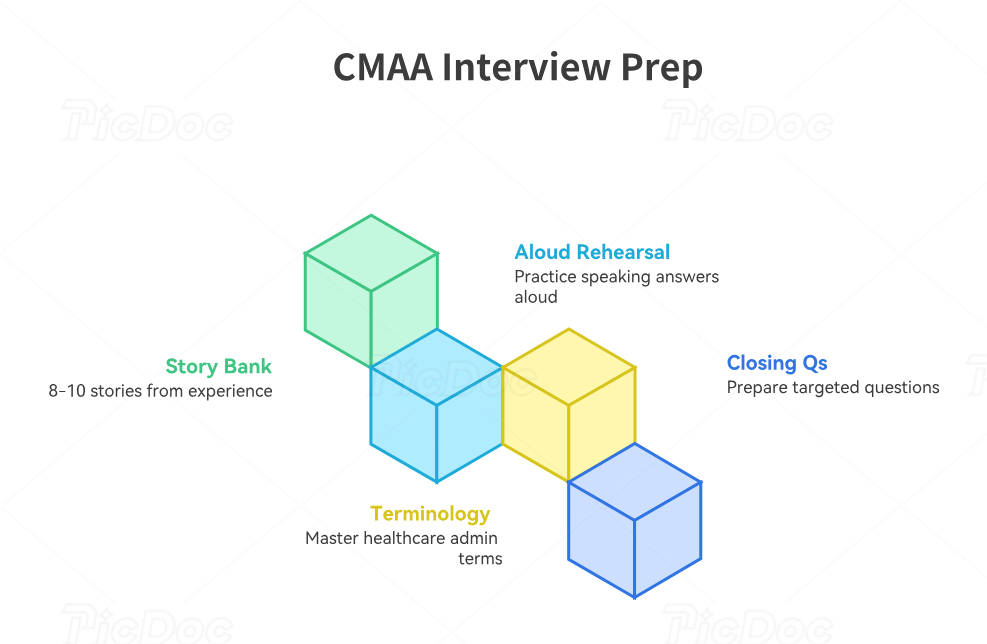
Start by building a bank of eight to ten stories from your experience, training, externship, or transferable work. You need stories about handling volume, calming a difficult person, fixing an error, learning a new system, protecting confidentiality, improving a process, supporting a team member, and managing competing priorities. These examples will carry most of your interview. If your background is thin, lean into training, simulated tasks, volunteer work, customer-facing roles, or coursework connected to ultimate guide to passing the CMAA certification exam, essential study tips for CMAA exam success, how to master medical administrative terminology, complete breakdown of what is included in the CMAA exam, and interactive CMAA practice exam.
Next, rehearse aloud. Many candidates think they are prepared because their answers sound fine in their head. Then the real interview starts, and they ramble, repeat themselves, or lose the point halfway through. Speaking aloud exposes weak structure fast. Practice keeping answers focused: opening point, real example, key action, clear result. That rhythm matters more than memorized wording.
You also need to practice terminology until it feels natural. Interviewers lose confidence in candidates who hesitate badly around common healthcare admin language. Get comfortable discussing prior authorizations, patient demographics, copays, referrals, portals, chart messaging, templates, no-shows, record requests, HIPAA safeguards, intake workflows, and payer verification. Resources like how to ace your medical scribe certification exam, medical scribe exam questions and expert answers, top 20 terms medical scribes must master for accurate clinical documentation, top 20 EMR and charting terms, and mastering medical terminology for medical scribes help build that fluency, even if your target role is administrative rather than scribing-heavy.
Finally, prepare your closing questions. This is where strong candidates separate themselves. Ask about training, appointment volume, provider expectations, EMR systems, cross-training, patient population, performance metrics, and the biggest operational pressure points in the role. Those questions show seriousness. Reading medical administration conferences and workshops directory, professional organizations directory, future-proof your CMAA career, interactive salary calculator for medical administrative assistants, and real-life success stories from certified medical administrative assistants can also help you ask better career questions with confidence.
5. Mistakes That Cost Candidates Interviews for Medical Admin Roles
One of the biggest mistakes candidates make is sounding too general. They say they are passionate about healthcare, love helping people, and enjoy staying organized. None of that tells the interviewer whether they can manage a real clinic day. Employers need specifics. They want to know whether you can protect patient privacy, keep the schedule from collapsing, document correctly, and communicate without creating confusion.
Another costly mistake is answering from a retail or office lens without adapting to healthcare risk. Medical admin roles involve confidentiality, documentation discipline, payer realities, clinical sensitivity, and patient vulnerability. Candidates who fail to translate their experience into that setting sound less ready. That is why reviewing medical office automation trends, interactive industry report on medical administration job demand by specialty, medical admin assistant job market outlook, new study on CMAs improving healthcare efficiency, and future-proofing your CMAA career is so useful before interviews.
Candidates also sabotage themselves by giving weak mistake answers. Saying “I am a perfectionist” or pretending you never make mistakes damages credibility. A far better answer is one that shows mature recovery: identify the issue, correct it quickly, tell the right person, protect the patient or workflow, and change the process that allowed the mistake. In medical administration, honesty plus corrective action is stronger than image management.
Another common problem is failing to show comfort with tools. You do not need to be an expert in every platform, but you do need to sound teachable, precise, and digitally competent. Employers want to avoid hiring someone who turns every system change into a slowdown for the team. Reviewing emr integration tools, healthcare portal terms, telehealth platform guide, patient communication apps, and virtual medical administration helps you speak more comfortably about modern workflows.
The last major mistake is forgetting that the interview starts before the first question and continues after the last one. Your professionalism shows up in timing, attire, email communication, how you speak to the receptionist, how concise your answers are, and whether your follow-up message sounds thoughtful. Healthcare employers notice all of it.
6. FAQs
-
Focus on the employer, the role, and your examples. Review the practice’s specialty, services, location, patient population, and likely workflow pressures. Then review your answers for scheduling, confidentiality, difficult patients, multitasking, EMR comfort, and mistake recovery. Finally, refresh your understanding of HIPAA terms, insurance verification, patient intake procedures, front-desk operations, and appointment scheduling best practices.
-
Translate adjacent experience into healthcare-relevant skills. Customer service can become patient communication. Calendar coordination can become scheduling discipline. Data entry can become chart accuracy. Conflict handling can become de-escalation. Then show that you have been actively learning through CMAA exam prep, medical administrative terminology study, CMAA certification career opportunities, top employer skills for CMAAs, and career roadmap guidance.
-
Accuracy, communication, prioritization, professionalism, discretion, and follow-through. Hiring managers value people who can keep patient-facing operations steady without creating rework for providers, billing staff, or supervisors. Back these qualities with examples connected to patient communication, active listening, EMR compliance, staff scheduling tools, and medical office efficiency trends.
-
Ask what a strong first 90 days looks like, which systems the office uses, what patient volume is typical, how responsibilities are split across the team, what the hardest part of the role is, and how performance is measured. You can also ask whether the role includes cross-training in referrals, authorizations, or records release. These questions show operational interest rather than passive curiosity.
-
Yes. Mention it as evidence of commitment and professional direction. Explain what you are studying and how it is strengthening your knowledge of terminology, scheduling, compliance, and office workflow. That instantly makes you sound more serious than a candidate who says they will “learn on the job someday.” Useful support points come from ultimate guide to passing your CMAA certification exam on the first try, top exam mistakes to avoid, study techniques for exam success, exam day checklist, and interactive practice exam.
-
Aim for answers that are concise but complete. Most strong responses land in the 30 to 90 second range unless the interviewer asks for greater detail. Open with your main point, give one focused example, explain the action you took, and end with the outcome or lesson. That structure keeps you clear and prevents rambling.
