

How to Negotiate Your CMAA Salary Successfully
Most CMAAs do not lose salary negotiations because they are unqualified. They lose them because they walk in with vague value claims, no market framing, no proof of operational impact, and no plan for the moment an employer says, “That is outside our range.” In medical administration, pay is tied to far more than experience. It is tied to scheduling complexity, front-desk volume, privacy risk, EMR fluency, denial-prevention habits, patient communication quality, and how much friction you remove from the daily workflow.
Salary negotiation becomes much easier when you stop treating it like a confidence test and start treating it like a documentation exercise. The strongest CMAA candidates do not simply ask for more money. They show exactly why their work protects revenue, reduces rework, improves patient experience, supports compliance, and makes busy offices run better under pressure.

1. Know What Employers Actually Pay For in a CMAA
A weak salary negotiation starts with titles. A strong one starts with operational value. Employers do not raise pay because a candidate says, “I work hard.” They raise pay when they believe that candidate will protect the schedule, reduce no-shows, improve chart accuracy, keep patient communication clean, support compliant workflows, and make the office easier to manage.
That matters because many CMAAs underprice themselves by focusing only on generic duties such as answering phones, greeting patients, and scheduling appointments. Those are baseline tasks. Pay increases when you can prove you handle those tasks at a level that improves throughput, consistency, and risk control. A practice does not care only that you know front desk operations terms. It cares whether you can apply them fast during a chaotic morning without creating downstream problems for clinical staff, billing teams, or patients.
For example, a CMAA who understands appointment scheduling best practices, uses secure patient scheduling tools, and can resolve conflicts using an interactive guide to handling appointment scheduling conflicts is more valuable than someone who only books open slots. The first person is protecting provider time, patient satisfaction, and daily production.
The same principle applies across the role. A CMAA who knows patient privacy communication essentials, understands top 20 HIPAA and patient privacy terms, and avoids careless disclosure errors carries real financial value. A CMAA who can navigate EMR integration tools, use top 10 EMR shortcuts, and fix common issues through practical EMR troubleshooting saves staff time every single shift.
When you negotiate, anchor your salary request to four employer priorities:
Revenue protection
Compliance and privacy protection
Workflow efficiency
Patient experience and retention
That is the frame. Once you use it, your compensation conversation stops sounding like a personal request and starts sounding like a business case.
| # | CMAA Skill or Result | Why Employers Value It | How to Use It in Salary Negotiation |
|---|---|---|---|
| 1 | Accurate appointment scheduling | Reduces idle provider time and front-desk confusion | State how you improved fill rates, reduced double-booking, or handled high-volume schedules cleanly |
| 2 | Insurance verification accuracy | Prevents delays, claim issues, and patient frustration | Explain how your verification habits prevented avoidable check-in and payment problems |
| 3 | EMR speed and fluency | Cuts admin time and reduces workflow drag | Show that you can learn systems fast and keep documentation moving |
| 4 | HIPAA-safe communication | Protects the practice from privacy failures | Connect your communication discipline to lower compliance risk |
| 5 | Patient intake efficiency | Improves throughput and reduces bottlenecks | Describe how you kept intake accurate during rush periods |
| 6 | Handling difficult conversations | Protects patient trust and reduces escalation | Use examples where you calmed tense situations without losing control of the workflow |
| 7 | Phone triage discipline | Prevents misinformation and missed follow-up | Frame yourself as someone who protects accuracy under pressure |
| 8 | Reduced no-show rates | Protects revenue and schedule stability | Mention reminder workflows or patient communication improvements you supported |
| 9 | Template and workflow standardization | Improves consistency across staff | Show you are not just task-based; you improve systems |
| 10 | Patient portal communication support | Improves access and reduces call burden | Explain how you reduced back-and-forth and improved response flow |
| 11 | Scheduling conflict resolution | Prevents daily disruption | Show your judgment in prioritizing urgent needs without wrecking the rest of the day |
| 12 | Time tracking and workload control | Improves staffing visibility and productivity | Present yourself as someone who works with operational discipline |
| 13 | Cross-training across admin functions | Creates staffing flexibility | Use this to justify pay above entry-level range |
| 14 | Billing term familiarity | Supports cleaner handoff to revenue-cycle work | Show that you understand the business side of the office |
| 15 | Patient empathy under pressure | Improves experience during delays and frustration | Tie this to retention and fewer escalations |
| 16 | Emergency appointment handling | Supports safe prioritization | Show you can make fast, appropriate admin decisions during high-stakes moments |
| 17 | Clean patient record updates | Reduces mistakes that create downstream problems | Emphasize accuracy habits, not just speed |
| 18 | Team collaboration | Keeps front desk, clinical staff, and admin aligned | Position yourself as someone who reduces friction between roles |
| 19 | Technology adoption | Helps practices modernize faster | Use examples of learning new systems or supporting workflow change |
| 20 | High-volume call management | Maintains access without chaos | Show you can preserve quality when pace increases |
| 21 | Referral and records coordination | Prevents delays in care and administrative fallout | Connect this to patient continuity and office reliability |
| 22 | Professional certification | Signals commitment and baseline standards | Use certification as leverage, then strengthen it with concrete outcomes |
| 23 | Workflow problem-solving | Reduces repeated inefficiencies | Describe a bottleneck you helped fix and what changed after |
| 24 | Reliable attendance and consistency | Critical in access-heavy roles | Use this when your dependability is stronger than peers with similar titles |
| 25 | Patient communication clarity | Reduces repeat calls and confusion | Frame yourself as someone who prevents avoidable misunderstandings |
| 26 | Documentation precision in admin workflows | Supports audit readiness and cleaner operations | Show that your accuracy improves trust in your work product |
| 27 | Adaptability across specialties | Expands deployment options for the employer | Use this to justify stronger offers when the organization needs flexibility |
2. Build a Salary Case With Proof, Not Hope
Most candidates prepare for negotiation by rehearsing what they want to say. Smart candidates prepare by gathering what they need to prove. That difference changes outcomes.
Before you discuss compensation, build a short evidence file around your value. Include the systems you use, the types of patients or providers you support, the volume you manage, the processes you improved, and the problems you solve consistently. If you worked on patient intake procedures, use that. If you became stronger in active listening techniques for medical admin professionals, effective patient communication terms, or de-escalation techniques, use those. Employers pay more readily when your examples sound like real office work instead of interview filler.
Your proof can include:
Reduced registration errors
Fewer scheduling conflicts
Better same-day add-on handling
Faster check-in flow
Better use of patient communication tools
Stronger EMR accuracy
Better privacy discipline
Reliable cross-coverage when staffing is thin
This is where many CMAAs get stuck. They think, “I did not directly generate revenue, so I have nothing measurable.” That is false. Administrative efficiency has financial impact all over a medical office. A broken schedule, poor insurance verification, inaccurate records, privacy mistakes, and repeat patient callbacks all cost money. Employers know that. Your job is to connect your work to those outcomes clearly.
For example, instead of saying, “I am detail-oriented,” say:
“I managed high-volume scheduling while maintaining accurate patient information, reducing avoidable rescheduling and helping providers stay on time during peak clinic days.”
Instead of saying, “I am good with patients,” say:
“I handled difficult front-desk conversations calmly, explained next steps clearly, and reduced repeat confusion around paperwork, scheduling, and follow-up instructions.”
Instead of saying, “I am good with software,” say:
“I became a reliable point person for common workflow issues by learning scheduling software mastery, using medical admin time tracking tools, and resolving basic system problems before they disrupted the day.”
Notice what changes. The language becomes operational, credible, and expensive to replace.
You should also use career positioning assets that signal market seriousness. A candidate who has studied the CMAA career roadmap, reviewed top 10 skills employers look for in a CMAA, and understands why CMAA certification dramatically boosts career opportunities walks into the negotiation with stronger framing than someone who only says they want growth.
The more your negotiation sounds like workflow intelligence instead of personal desire, the stronger your leverage becomes.
3. Research the Right Salary Range Before You Say a Number
Many CMAAs fail salary negotiations before the conversation even starts because they anchor to the wrong number. Some go too low from fear. Some go too high without enough context. Both mistakes signal weak preparation.
You need a target range, not a single figure. That range should reflect your certification status, years of experience, specialty exposure, location, software familiarity, patient volume, and the complexity of the office you are joining. Someone supporting a small primary care clinic has a different negotiation case than someone handling specialty scheduling, referrals, high patient call loads, or multi-provider workflows.
Your research should come from role-specific resources, not random salary chatter. Review the interactive salary calculator for medical administrative assistants, the annual CMAA salary report, and the medical admin assistant job market outlook. Pair that with the broader 2026 healthcare administration report and interactive industry report on medical administration job demand by specialty. This lets you see where the market is rewarding stronger admin talent and where employers may be underpaying people who carry more than a standard front-desk workload.
Once you research the range, choose three numbers:
Your ideal number
Your realistic target
Your walk-away floor
That protects you from freezing in the moment. It also keeps you from accepting a low offer out of surprise or pressure.
There is another crucial point here. Salary is only one part of compensation. If the employer has limited room on base pay, you can negotiate for training support, early review cycles, title adjustments, remote flexibility where appropriate, cross-training opportunities, or faster progression paths. A CMAA who gains access to better systems, certifications, and growth lanes may create a much stronger earnings path over the next 12 to 24 months than someone who takes a slightly higher starting number with no development path.
That is why it helps to understand the bigger field. Study future-proofing your CMAA career, AI and automation in medical administration, and the interactive guide to emerging medical admin technologies. Employers often pay more for people who can grow with operational change instead of resisting it.
4. Learn the Exact Language That Makes Employers Take You Seriously
Negotiation is not just about what you ask for. It is about whether your language makes you sound replaceable or strategically useful.
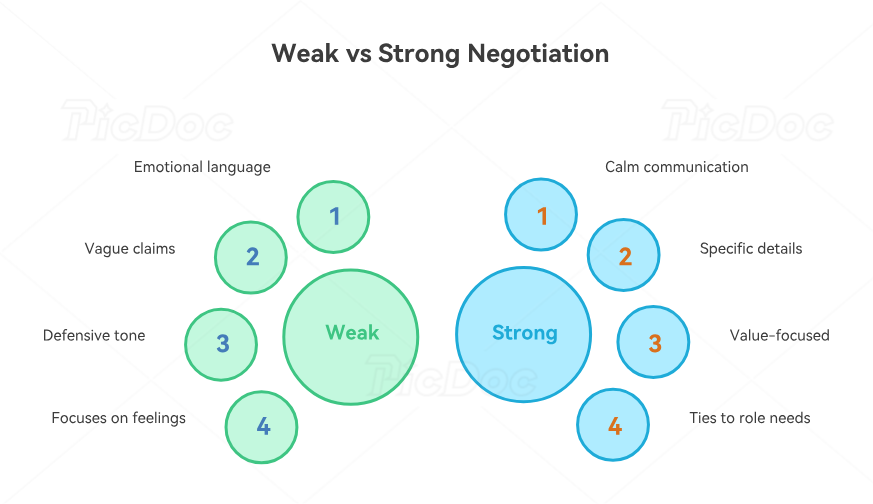
Bad negotiation language is emotional, vague, or defensive. Good negotiation language is calm, specific, and tied to role value. That matters in healthcare administration because employers hear a lot of generic hiring language. They remember candidates who sound like they already understand the real pressures inside a medical office.
Here is a weak example:
“I was hoping for more because I have worked really hard and I know I can do this job well.”
Here is a stronger version:
“Based on my certification, experience supporting front-desk and scheduling workflows, and the value I bring in patient communication, EMR accuracy, and daily workflow support, I was targeting a range closer to X to Y.”
That works because it points to business value, not feelings.
A second weak example:
“I really need a better offer.”
A stronger version:
“I am very interested in the role. I also want to make sure the compensation reflects the level of responsibility involved, especially where scheduling accuracy, patient coordination, privacy discipline, and system reliability are concerned.”
This becomes even more effective when you support it with role knowledge. You can reference familiarity with insurance verification definitions and examples, patient communication apps every CMAA should use, directory of medical admin staff scheduling tools, and best collaboration tools for medical office teams. This signals that your value is grounded in modern workflow realities.
You also need a response when the employer says one of the following:
“That is outside our budget.”
Try: “I understand budget constraints. Is there flexibility based on experience, certification, or cross-functional capability, or room to revisit compensation after a defined performance period?”
“This is our standard range.”
Try: “That makes sense. Given the responsibilities in scheduling, patient communication, EMR work, and administrative coordination, I would be interested in understanding what distinguishes candidates who enter at the higher end of that range.”
“We usually do not negotiate this role.”
Try: “I appreciate that. I would still like to discuss whether my background and readiness for the scope of the role support stronger placement within the range.”
“We can talk after you start.”
Try: “I am open to performance-based progression. I would just want that path defined clearly, including what outcomes or milestones would trigger a compensation review.”
That last part is critical. Never accept vague future promises. If an employer wants to delay compensation movement, ask for specifics: timeline, review structure, measurable expectations, and who approves the change.
Strong negotiation also requires self-control. Do not apologize for negotiating. Do not fill silence with nervous over-explaining. Do not start walking back your number before the employer responds. Deliver your case, stop talking, and let the conversation work.
Candidates who master this skill often improve their leverage across the rest of their career. That is one reason resources like the ultimate guide to passing your CMAA certification exam on the first try, essential study tips for CMAA exam success, and the ACMSO certification exam guide matter so much. Better preparation creates better skill signaling, and better skill signaling supports stronger compensation conversations.
5. Handle Pushback, Counteroffers, and Low Offers Without Folding
The hardest part of salary negotiation usually comes after the first “no,” not before it. Many CMAAs prepare a good opening ask, then collapse the second they hear resistance. That is where compensation gets left on the table.
Employers often test how serious you are. They may offer a lower number first, emphasize their internal range, or redirect the conversation toward culture, benefits, and mission. Those things matter, but they should not distract you from evaluating whether the role is paying fairly for the workload and expectations.
When you get a low offer, slow the conversation down. Thank them. Reaffirm interest. Then ask thoughtful questions.
Ask:
What responsibilities make someone successful in the first 90 days?
Which parts of the role are most operationally demanding?
How is performance evaluated?
How quickly can pay be reviewed?
Are there training or cross-functional opportunities that affect progression?
Is there room for a sign-on adjustment, review milestone, or title alignment?
These questions do two things. First, they give you better information. Second, they show the employer you think in terms of contribution, not just pay.
You should also watch for red flags. A role may be underpaying if it expects you to manage phones, referrals, prior authorizations, patient escalation, scheduling, records, portal communication, office coordination, and basic billing support all at once while still labeling the job “entry-level.” That is exactly why CMAAs need to understand top 20 medical billing terms, healthcare CRM terms, healthcare portal terms, and the broader shift toward medical office automation trends. Offices often expand responsibilities faster than compensation. You need to catch that early.
If the employer cannot move on salary, negotiate the structure around it. You might ask for:
A written compensation review in 90 or 120 days
Paid certification support
Better onboarding and systems training
Expanded title reflecting broader responsibility
Clear advancement criteria
Additional flexibility or schedule stability
And if the final offer still does not reflect the workload, you need the discipline to decline professionally. Accepting a badly underpaid role creates two problems. It hurts your immediate earnings, and it can also anchor future compensation lower than it should be. One weak starting point can follow you longer than people realize.
The strongest CMAAs treat negotiation as part of career management, not a one-time event. That is why career-building resources like networking strategies for medical admin professionals, medical administration conferences and workshops, medical admin assistant professional organizations, and online communities and forums for CMAAs matter. Better networks and stronger market awareness make it easier to negotiate from strength instead of desperation.
6. FAQs About Negotiating Your CMAA Salary Successfully
-
The strongest point is after the employer has decided they want you but before you formally accept. That is when your leverage is highest. During early screening, the organization is still comparing candidates. After they make the offer, they have invested time and started picturing you in the role. That is the right window to discuss compensation, responsibilities, review cycles, and growth terms.
-
It depends on how prepared you are. If you have done serious research using resources such as the interactive salary calculator for medical administrative assistants and the annual CMAA salary report, giving a well-supported range can help anchor the conversation. If you are unsure of the employer’s budget or local pay norms, ask for the range first. The key is to avoid naming a number that is too low because you were underprepared.
-
Use certification, transferable workflow skills, and readiness for operational complexity. If you studied with the complete breakdown of what is included in the CMAA exam, worked through interactive CMAA practice exam material, and strengthened terminology through how to master medical administrative terminology for your CMAA exam, emphasize that preparation. Then connect it to specific office needs such as scheduling accuracy, patient communication, privacy compliance, and fast system learning.
-
Ask whether compensation can be reviewed after a specific performance period and what exact outcomes would support that review. Also explore other items such as certification reimbursement, structured training, schedule flexibility, or title alignment. A supposedly fixed offer can still have room around timing, growth path, and total compensation structure. You want details, not vague reassurance.
-
Yes, and you should still do it professionally. Needing the job does not erase the value of your skills. The goal is not to create conflict. The goal is to make sure the compensation reflects the actual scope of work. Keep the tone calm, appreciative, and evidence-based. Even a small upward adjustment or defined review milestone can make a meaningful difference.
-
The biggest ones are under-researching pay, speaking vaguely about value, negotiating emotionally, accepting the first number too fast, and failing to connect daily work to business impact. Another major mistake is describing the role only in task language. Employers pay more for people who improve workflow reliability, reduce patient friction, support compliance, and make the office easier to run. That is the level you need to present.
-
Use calm, specific, business-focused language. Thank the employer for the offer. State your interest. Then explain your target range using certification, role scope, systems knowledge, and workflow contribution. Confidence in negotiation comes from preparation. When you understand your market, your skills, and your value to office operations, your tone becomes naturally stronger.
-
Yes, especially when it is paired with evidence that you can perform in real workflows. Certification alone is useful. Certification plus applied skill is much stronger. Employers are more responsive when they see both credibility and execution. That is why resources like why CMAA certification dramatically boosts your career opportunities, real-life success stories from certified medical administrative assistants, and new study on how certified medical administrative assistants improve healthcare efficiency are so useful for framing your long-term career value.
