

Medical Coding Errors: Comprehensive Dictionary & Scenarios
Medical coding errors often begin several steps before a coder selects a diagnosis or procedure code. Missing clinical specificity, copied-forward diagnoses, disconnected charge capture, outdated payer rules, and rushed claim review can all convert an otherwise valid encounter into a denial, underpayment, overpayment, or compliance exposure. A dependable prevention strategy connects clinical documentation accuracy, ICD-10 knowledge, CPT code selection, claims processing, and payer-specific validation before submission. CMS and the HHS Office of Inspector General identify inaccurate coding, insufficient documentation, unbundling, and upcoding as recurring claim-compliance risks.
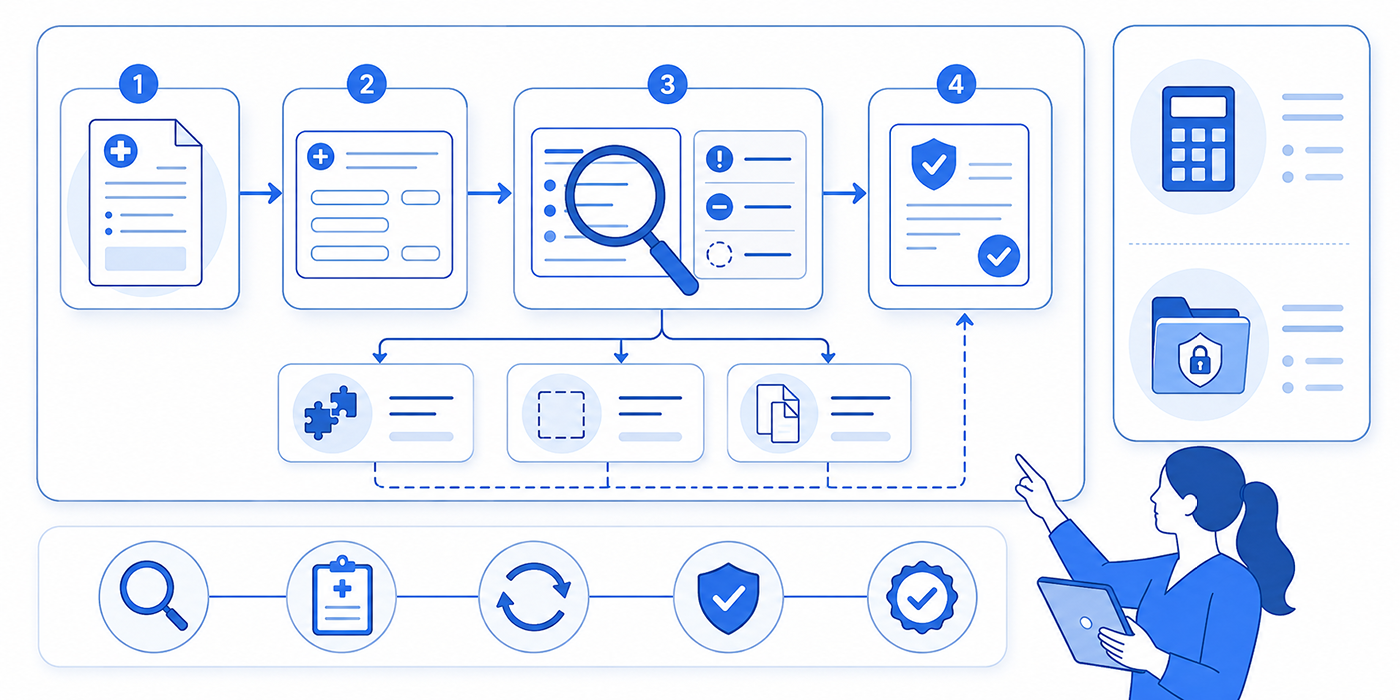
1. Medical Coding Errors: Definitions, Causes, and Financial Consequences
A medical coding error occurs when the codes, modifiers, units, sequencing, or claim details submitted for an encounter fail to represent the documented service accurately under the applicable code set and payer rules. The mistake may originate in patient intake procedures, the provider’s note, EMR charting, charge entry, code assignment, claim editing, or payer configuration.
The phrase covers much more than selecting the wrong ICD-10-CM code. A technically accurate diagnosis can still produce a defective claim when the coder assigns incorrect sequencing, omits a required seventh character, chooses the wrong laterality, overlooks an Excludes note, or links the diagnosis to an unrelated procedure. The same principle applies to CPT coding, medical billing terminology, and insurance claim management.
CMS uses the National Correct Coding Initiative to promote correct coding and reduce improper payment caused by incompatible code combinations, excessive units, and other coding conflicts. Its procedure-to-procedure edits and medically unlikely edits should form part of every organization’s claims-processing controls, especially when high-volume departments rely heavily on automated charge capture.
Errors, denials, and fraud require different responses
A genuine coding error can result from misunderstanding documentation, overlooking an update, choosing the wrong code family, or entering data incorrectly. A denial is the payer’s decision to reject, reduce, or suspend payment, and it may arise from coding, eligibility, authorization, filing, contractual, or documentation issues. Denials management therefore requires a root-cause process that separates coding failures from insurance verification problems, missing prior authorization, and registration defects.
Fraud involves knowledge or intent that changes the compliance analysis. The OIG identifies upcoding as using a code representing greater severity or a more expensive service than the care actually supports. A discovered error needs correction, documentation, refund analysis when applicable, and process improvement. A pattern involving deliberate inflation requires immediate compliance escalation.
Why coding errors spread across departments
Most recurring errors come from workflow design. Providers may document “ankle injury” without laterality or encounter status. Coders may receive incomplete operative notes. Front-desk staff may select an outdated insurance plan. Clinical teams may miss medical-record updates. Billing staff may resubmit a corrected claim as a new claim, creating a duplicate.
These handoff failures become expensive because each team sees only one part of the encounter. Strong medical administrative workflows connect registration, appointment scheduling, documentation, coding, charge reconciliation, claim generation, clearinghouse edits, payer responses, and appeal outcomes. The organization gains a traceable error trail instead of a denial queue filled with unexplained rework.
| # | Error Term | Practical Definition | Typical Trigger | Likely Impact | First Control to Apply |
|---|---|---|---|---|---|
| 1 | Upcoding | Assigning a code that represents greater complexity, severity, or expense than the documentation supports. | Unsupported E/M level, inflated diagnosis severity, or aggressive code selection. | Overpayment, audit exposure, repayment obligations, and possible false-claim concerns. | Compare every billed element with the signed note and current legal responsibilities. |
| 2 | Downcoding | Selecting a lower-level code even though the documentation supports a higher level. | Coder caution, missed data, weak documentation review, or payer pressure. | Underpayment, distorted utilization data, and lost revenue. | Use structured documentation templates and internal second-level review. |
| 3 | Unbundling | Reporting separate component codes when a comprehensive code includes those services. | Failure to review NCCI edits or misunderstanding procedural relationships. | Denials, overpayments, and compliance investigations. | Run code pairs through current NCCI and CPT guidance. |
| 4 | Overbundling | Using one inclusive code when separately reportable services are supported. | Excessive caution or incomplete review of distinct procedural work. | Underpayment and inaccurate procedure reporting. | Verify separate sites, sessions, lesions, and documented clinical purpose. |
| 5 | Wrong Diagnosis Code | Reporting a diagnosis that differs from the documented condition. | Search-result selection errors, copied codes, or terminology confusion. | Medical-necessity denials and inaccurate patient data. | Trace the code through the Alphabetic Index, Tabular List, and medical terminology. |
| 6 | Unspecified-Code Overuse | Choosing an unspecified diagnosis when the record contains reportable specificity. | Coder stops searching after finding the correct category. | Denials, risk-adjustment distortion, and weak clinical data. | Check laterality, anatomy, acuity, stage, cause, and encounter details. |
| 7 | Unsupported Specificity | Assigning detail that the provider never documented. | Coder inference from medication, test results, or prior history. | Audit findings and inaccurate severity reporting. | Use a compliant provider query instead of independently creating clinical meaning. |
| 8 | Sequencing Error | Placing diagnoses or procedures in an order that conflicts with official guidance or encounter circumstances. | Confusion over principal, first-listed, underlying, and manifestation conditions. | DRG changes, denials, and incorrect quality reporting. | Validate sequencing against the current ICD-10 reference. |
| 9 | Laterality Error | Reporting right, left, bilateral, or unspecified status incorrectly. | Conflicting note sections or incomplete provider documentation. | Claim rejection and corrupted longitudinal records. | Reconcile the assessment, procedure note, imaging, and operative site. |
| 10 | Encounter-Character Error | Using an incorrect seventh character for initial, subsequent, or sequela care. | Confusing treatment phase with the patient’s first visit to the practice. | Diagnosis rejection and inaccurate injury reporting. | Determine whether active treatment, routine healing, or residual-effect care occurred. |
| 11 | Modifier Omission | Leaving off a modifier needed to explain a service’s circumstances. | Distinct service, professional component, laterality, or repeat procedure overlooked. | Bundling denial or reduced reimbursement. | Review the operative context and relevant CPT training. |
| 12 | Modifier Misuse | Adding a modifier without documentation that meets its purpose. | Automatic use of modifier 25 or 59 to bypass edits. | Overpayment recovery and targeted payer review. | Require a written rationale tied to distinct documented work. |
| 13 | Duplicate Billing | Submitting the same service more than once without a valid repeat-service basis. | Resubmitting a claim instead of correcting or replacing it. | Duplicate denial, overpayment, and refund workload. | Search claim history before using the clearinghouse workflow. |
| 14 | Incorrect Units | Reporting more or fewer service, drug, supply, or time units than provided. | Decimal errors, package-size confusion, or missed time conversion. | Large overpayments, underpayments, and MUE edits. | Reconcile source documentation, administered quantity, discarded amount, and billing units. |
| 15 | Diagnosis–Procedure Mismatch | Linking a procedure to a diagnosis that fails to explain its medical purpose. | Claim-line linkage defaults or incorrect diagnosis pointers. | Medical-necessity denial. | Review each claim line within the complete revenue-cycle context. |
| 16 | Outdated Code | Using a deleted, revised, or inactive code for the service date. | Old superbills, frozen favorites, or delayed software updates. | Front-end claim rejection. | Update the chargemaster, favorites, templates, and superbills by effective date. |
| 17 | Wrong Code-Set Year | Applying a code version that does not match the relevant date of service or discharge. | Midyear reference confusion or delayed system configuration. | Invalid-code denials and inaccurate reporting. | Attach code-set versions to effective-date logic in the billing system. |
| 18 | Place-of-Service Error | Reporting the wrong setting for the service. | Telehealth, hospital, office, home, and facility distinctions missed. | Payment reduction, denial, or recoupment. | Reconcile scheduling, encounter, and telehealth-platform records. |
| 19 | Provider-Identifier Error | Submitting the wrong rendering, billing, ordering, referring, or supervising provider. | Template defaults, reassignment issues, or roster failures. | Enrollment denial and credentialing edits. | Validate provider roles through the credentialing record. |
| 20 | Time-Based Coding Error | Using a time-dependent code without enough qualifying documented time. | Confusing total time, face-to-face time, unit thresholds, and overlapping time. | Downcoding, denial, or repayment. | Document qualifying activities, total minutes, and date-specific time rules. |
| 21 | Copied-Forward Diagnosis | Billing a historical or resolved condition as though it were actively evaluated or treated. | Problem-list clutter and cloned assessment sections. | Risk-score inflation and unsupported claims. | Perform active-problem reconciliation during record updates. |
| 22 | Missing Add-On Code | Leaving out a qualifying add-on service supported by the primary procedure. | Charge capture fails to recognize additional work. | Underpayment and incomplete utilization data. | Build code-family prompts into EMR integration tools. |
| 23 | Invalid Add-On Code | Reporting an add-on code without an eligible primary service. | Independent code selection or incorrect claim splitting. | Claim rejection or recoupment. | Validate every add-on code against its approved primary-code relationship. |
| 24 | Global-Period Error | Billing postoperative or related services separately when global rules include them. | Missing surgery history or inappropriate modifier selection. | Bundling denial and overpayment risk. | Check procedure date, global status, relationship, and documented exception. |
| 25 | Assistant-at-Surgery Error | Reporting assistant services when the procedure, credential, or documentation does not qualify. | Automatic modifier assignment or incomplete operative documentation. | Denial and compliance review. | Validate procedure eligibility, provider status, and operative involvement. |
| 26 | Medical-Necessity Error | Reporting a service without documentation and diagnosis support for payer coverage requirements. | Coverage rules ignored or diagnosis pointers assigned incorrectly. | Denial, appeal burden, and patient-balance disputes. | Integrate payer policies with insurance verification. |
| 27 | Charge-Capture Omission | Failing to transfer a documented billable service into the claim workflow. | Manual handoff, missing interface, or unsigned encounter. | Lost revenue and understated workload. | Run daily encounter-to-charge reconciliation through an office procedure checklist. |
| 28 | Diagnosis Pointer Error | Connecting a claim line to the wrong diagnosis position. | Claim software default or reordered diagnosis list. | Line-level medical-necessity denial. | Review diagnosis linkage after every claim edit or code reorder. |
| 29 | Transposed Data Error | Entering digits, dates, units, or identifiers in the wrong order. | Manual entry under production pressure. | Rejection, wrong-patient posting, or payment delay. | Use field validation and targeted double-checks during high-volume periods. |
| 30 | Corrected-Claim Error | Using the wrong frequency indicator, original claim reference, or replacement process. | Staff treat a correction as a new submission. | Duplicate denial and unresolved overpayment. | Create payer-specific corrected-claim instructions within written policies and procedures. |
2. How to Detect Medical Coding Errors Before Claim Submission
Effective error detection begins with a clear distinction between documentation validation, coding validation, and claim validation. Combining all three into one vague “billing review” creates blind spots because a clean claim format can still contain an unsupported code, while correct codes can still fail because of registration or authorization defects.
Start with documentation sufficiency
The reviewer should confirm that the signed record identifies the reason for the encounter, clinically relevant findings, assessment, treatment, ordered services, and follow-up plan. Specialty-specific elements also matter. Orthopedic documentation may need laterality, exact anatomy, displacement, encounter phase, and healing status. Cardiology records may need rhythm, acuity, associated conditions, and diagnostic interpretation. These distinctions require strong medical terminology mastery, reliable clinical documentation skills, and disciplined EMR charting practices.
A coder should never manufacture specificity from laboratory values, medication lists, imaging results, or personal clinical assumptions. Ambiguous documentation belongs in a compliant provider-query workflow. The query should present the relevant clinical indicators, avoid directing the provider toward a financially advantageous response, and preserve the provider’s authority over the diagnosis.
Validate the complete code, not only the category
A common error pattern occurs when the coder finds a familiar diagnosis family and stops before reviewing the full Tabular List. The complete review should include inclusion terms, instructional notes, code-first requirements, use-additional-code instructions, laterality, placeholder use, seventh characters, and applicable Excludes notes. The interactive ICD-10 dictionary, medical terminology tutorials, and ACMSO exam study strategies can strengthen this habit.
The FY 2026 ICD-10-CM guidelines emphasize use of the full code and adherence to official conventions and sequencing instructions. Coders should also ensure that the code version aligns with the relevant service or discharge date.
Test procedure-code relationships
Procedure coding review should evaluate code descriptors, parenthetical instructions, add-on requirements, component relationships, modifiers, units, time thresholds, and payer edits. A code-pair edit creates a decision point: the reviewer must determine whether one service is included in another or whether the documentation supports a legitimate exception.
Modifiers should communicate supported circumstances. They should never function as automatic denial-release buttons. Repeated use of modifier 25 or 59 across a provider’s claims deserves focused review, especially when documentation uses identical wording. Teams can strengthen consistency through interactive CPT training, a controlled documentation-template library, and written risk-management procedures.
Run a claim-level consistency check
Before transmission, compare the claim against the full encounter:
Does the patient identity match the record?
Does the payer match the verified coverage?
Does the service date match the documentation?
Does the place of service reflect where and how care occurred?
Does the rendering provider match the signed or authenticated service?
Does each procedure line point to a clinically relevant diagnosis?
Do units match administered quantities, time, or repeated services?
Does the claim require authorization, referral, or supporting documentation?
Is the submission an original, replacement, or void claim?
This step connects front-desk operations, appointment-scheduling records, insurance verification, prior authorization, and coding. A claim cannot survive payer review when these systems disagree.
Use edits as diagnostic tools
Clearinghouse and payer edits should feed an internal learning loop. A rejection caused by an invalid diagnosis is different from a denial based on medical necessity. A duplicate edit requires claim-history research. An NCCI denial requires code-pair and modifier analysis. A provider-enrollment rejection belongs with credentialing. Strong clearinghouse knowledge, denial-management skills, and medical claims training prevent staff from correcting the visible edit while leaving the original workflow defect untouched.
3. Medical Coding Error Scenarios and Defensible Corrections
Scenario 1: Unsupported high-level office visit
A provider documents a stable chronic condition, a brief review, continuation of the existing treatment, and routine follow-up. The claim contains a high-level E/M code because the appointment lasted longer than expected and the patient asked several questions.
The coding problem is the unsupported level. Waiting time, conversational length, and administrative difficulty do not independently establish a higher code. The reviewer should apply the current E/M framework, determine whether medical decision-making or qualifying documented time supports the selected level, and correct the code when it does not. The provider may improve future records by documenting addressed problems, data reviewed, risk, and qualifying time activities where time is used. Effective patient communication still matters during a long visit, though conversational complexity should remain separate from coding complexity.
Scenario 2: Specific fracture details buried in the record
The assessment says “wrist fracture,” while the imaging report identifies the exact bone, side, fracture pattern, and displacement. The coder selects a highly specific fracture code based solely on the imaging report.
The coder has created a documentation-authority problem. The imaging provides clinical evidence, yet the treating provider’s diagnostic statement remains incomplete. The correct action is a compliant clarification query. After provider clarification, the coder can apply the appropriate code, laterality, and encounter character. This scenario shows why active listening with providers, medical-record updates, and orthopedic scribing knowledge directly affect coding quality.
Scenario 3: Modifier 25 added to every same-day visit
A clinic performs a minor procedure and reports an office-visit code on the same date. Staff automatically add modifier 25 because the payer otherwise bundles the visit.
The modifier requires documentation of a significant, separately identifiable E/M service above the work normally associated with the procedure. The reviewer should isolate the additional assessment and management work, confirm its clinical significance, and remove the E/M code or modifier when the note supports only routine pre-procedure activity. Automated modifier use creates a measurable audit pattern. The prevention plan should combine CPT code education, compliance training, and provider-specific feedback.
Scenario 4: Drug units multiplied incorrectly
The record shows a drug dose of 40 mg. The billing code represents 10 mg per unit. Staff report 40 units after copying the administered dose into the units field.
The claim reports ten times the supported quantity. The correct unit count is four, assuming the code descriptor and documentation contain no other qualifying considerations. Drug-unit errors can produce substantial overpayments and often originate in a mismatch between clinical measurement, package size, and billing-unit definition. Prevention requires a conversion field, second-person review for high-cost drugs, reconciliation of administered and discarded quantities, and monitoring of medically unlikely edits. CMS explains that MUEs help reduce errors involving clerical entries, code descriptors, anatomy, service nature, and claims data.
Scenario 5: Active diagnosis copied from an old note
A resolved infection remains in the problem list and flows into every visit assessment. The provider addresses unrelated hypertension management, yet the infection code appears on the claim.
The coding defect comes from copied-forward clinical content. The reviewer should remove the unsupported diagnosis from the current claim and request problem-list reconciliation. Repeated historical diagnoses can alter medical-necessity logic, risk scores, quality measures, and future clinical decisions. Better controls include EMR shortcuts used carefully, regular record-update training, and resolution of common EMR problems.
Scenario 6: Telehealth claim carries office defaults
A virtual follow-up is completed through an approved platform. The claim inherits the office place of service and omits payer-required telehealth information because the scheduling template still classifies the appointment as an office visit.
The team should verify the current payer requirements, actual patient and provider locations, service modality, place of service, and any required modifier. The correction may involve a replacement claim rather than a fresh submission. Long-term prevention requires synchronization between telehealth platforms, virtual patient management, secure scheduling tools, and the billing system.
Scenario 7: Separate components billed with a comprehensive procedure
A claim contains several component services that appear separately reportable in the chargemaster. An NCCI edit indicates that the services are included in a comprehensive code. Staff append a modifier without reviewing the procedure note.
The correction depends on the documented relationship between the services. The reviewer should examine the anatomical sites, session, encounter, procedural purpose, and applicable edit rationale. The comprehensive code should stand when the components represent the usual work of the procedure. A supported distinct service may justify an appropriate modifier under current rules. CMS states that NCCI tools are designed to help providers avoid coding errors and resulting denials.
4. Building a Coding-Error Prevention Workflow
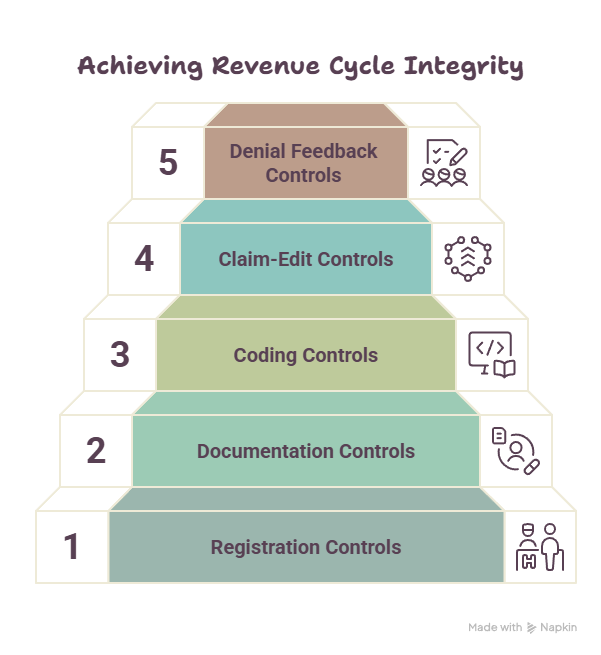
A durable prevention system places controls at the point where each error begins. Sending every claim through a final coding audit creates delay and still misses upstream defects. The stronger approach assigns responsibility across the entire revenue cycle.
Registration controls
Registration staff should validate patient identity, demographic accuracy, active coverage, payer order, subscriber details, referral requirements, and authorization status. A wrong member ID can resemble a coding denial after the claim reaches the payer. Reliable front-desk operations, appointment scheduling, and insurance-verification procedures prevent coders from wasting time repairing administrative errors.
Documentation controls
Providers need concise prompts tied to their specialty’s highest-risk details. A universal “document more” message rarely changes behavior. Orthopedic prompts should address site, side, encounter phase, and healing. Wound-care prompts should address location, stage, dimensions, and tissue involvement. Procedure notes should capture technique, anatomy, findings, devices, specimens, complications, and distinct services.
Clinical teams can use specialty documentation templates, medical-scribe terminology training, and HIPAA-compliant documentation practices. Access to protected health information should remain limited to what staff need for their assigned role and purpose under the HIPAA minimum-necessary standard.
Coding controls
Every coding team needs a controlled reference environment. Current code books, digital tools, payer policies, NCCI files, local coverage rules, query procedures, and internal guidance should have named owners and effective dates. Personal spreadsheets and saved code lists become dangerous when updates occur without centralized maintenance.
High-risk code families should receive targeted validation. Examples include time-based services, critical care, drug units, preventive services, global surgery, modifier 25, modifier 59, prolonged services, telehealth, and risk-adjusted diagnoses. Monitoring should focus on variation, sudden changes, repeated edits, high-dollar claims, and provider outliers.
Claim-edit controls
A strong claim-edit system uses layers:
Format edits catch invalid fields, missing identifiers, and inactive codes.
Clinical edits identify diagnosis-to-procedure conflicts and unsupported medical necessity.
Coding edits evaluate code pairs, modifiers, units, age, sex, and frequency.
Administrative edits validate authorization, credentialing, filing limits, and payer configuration.
Behavioral edits flag unusual provider patterns, repeated modifier use, and rapid utilization changes.
These layers should connect with EMR integration tools, collaboration platforms, staff scheduling systems, and time-tracking tools so that unresolved work receives ownership before timely-filing limits create irreversible revenue loss.
Denial feedback controls
Each denial should receive a standardized root-cause category. Useful categories include provider documentation, coder interpretation, registration, authorization, credentialing, payer configuration, clearinghouse setup, timely filing, duplicate submission, and payer processing error.
The organization should track the original error source, correction, responsible department, appeal outcome, recovered amount, preventability, and recurrence. This converts denial management into an operational intelligence system. Teams can then distinguish a staff-training problem from a software defect, payer-policy change, or provider-documentation pattern.
5. Auditing, Correcting, and Preventing Repeated Coding Failures
Coding audits should answer specific operational questions. “Is our coding accurate?” produces a broad result with limited corrective value. A focused audit can determine whether modifier 25 use is supported, whether drug units are calculated correctly, whether fracture encounter characters are accurate, or whether copied-forward diagnoses appear on current claims.
Choose audit samples based on risk
Random sampling measures general performance. Targeted sampling investigates known exposure. High-value targets include:
High-dollar claims
Newly introduced services
New providers or coders
Frequent modifier use
Rapid changes in code distribution
High denial or appeal volume
Services with complex time rules
Diagnoses affecting risk adjustment
Claims previously identified by payers
Code families changed in the current year
CMS medical-review programs examine compliance with coverage, coding, billing, and documentation rules. Internal audits should therefore evaluate the full claim support trail rather than code selection in isolation.
Measure more than accuracy percentage
A department reporting 96% coding accuracy may still carry severe risk when the remaining 4% consists of high-dollar unit errors or repeated unsupported modifiers. A useful scorecard tracks:
Code accuracy
Modifier accuracy
Unit accuracy
Diagnosis sequencing
Documentation sufficiency
Query rate and query reason
Preventable denial rate
Coder-to-provider variation
Financial impact
Repeat-error rate
Correction turnaround time
Appeal overturn rate
These measures support predictive analytics in medical administration, future-ready administrative skills, and stronger medical-office productivity.
Correct discovered errors through a controlled process
The correction workflow should identify the affected claim, confirm the error, determine whether payment occurred, calculate the financial difference, preserve the original and corrected coding rationale, follow payer-specific replacement or void procedures, and evaluate whether an overpayment refund is required. Staff should document who approved the correction and whether related claims need review.
A single discovered error may justify a broader lookback when the same template, interface, coder instruction, or provider habit affected other claims. Organizations should involve compliance or legal leadership when the issue is material, systematic, intentional, or connected to government-program claims. OIG guidance explains that knowingly submitting false claims can create substantial civil exposure.
Train around decisions instead of memorization
Effective education uses actual decision points:
Which documentation element changes the code?
Which note section created the conflict?
Which edit should have stopped the claim?
Which team owned the missing information?
Which query wording would resolve the ambiguity?
Which corrected-claim process applies?
Which control prevents recurrence?
Coders and administrators can strengthen these skills through CMAA terminology training, realistic certification questions, medical-scribe exam preparation, and medical coding interview preparation. Managers should also use professional organizations, medical administration conferences, and online CMAA communities to identify emerging payer and technology issues.
The strongest coding culture rewards questions, documented reasoning, timely escalation, and correction transparency. Production quotas that punish clarification encourage silent assumptions. Provider pushback that blocks compliant queries transfers uncertainty directly into the claim. Leadership should treat query volume, denial causes, and audit findings as system signals rather than individual embarrassment.
6. Frequently Asked Questions About Medical Coding Errors
-
Incomplete or inconsistent documentation is one of the most persistent causes because coders can only assign codes supported by the authenticated health record. Additional causes include outdated references, incorrect units, modifier misuse, registration defects, diagnosis-pointer mistakes, copied-forward content, and weak payer-rule maintenance. Organizations should analyze their own denial-management data, claims-processing workflow, and medical-chart audits before assuming one universal cause.
-
Coders should follow setting-specific official guidelines and organization policy. A laboratory result, imaging finding, medication, or clinical indicator should not automatically become a provider diagnosis. When the record supports possible additional specificity or contains a conflict, a compliant provider query usually provides the defensible route. Strong clinical documentation improvement, medical terminology knowledge, and chart-audit procedures help staff identify these situations.
-
An unintentional mistake, knowledge gap, data-entry defect, or reasonable interpretation issue does not automatically establish fraud. The response should still include correction, repayment analysis when needed, education, and process improvement. Evidence of deliberate inflation, concealed overpayments, falsified documentation, or continued submission after a known defect requires immediate compliance escalation. OIG distinguishes common coding errors from knowingly false claims and identifies upcoding and unsupported services as major compliance concerns.
-
Upcoding uses a code representing greater severity, complexity, or expense than the documented service supports. Unbundling reports component services separately when an inclusive code covers them. Both can produce overpayments and audit exposure. Reviewers should use CPT guidance, current NCCI resources, risk-management procedures, and the complete clinical record before correcting the claim.
-
Audit frequency should reflect risk, claim volume, staff changes, service complexity, payer activity, and prior findings. A practical structure combines routine random reviews with targeted audits triggered by new services, code-set changes, denial spikes, unusual modifier use, high-dollar claims, or identified overpayments. Teams should document the audit scope, sampling method, findings, financial effect, corrective action, and re-audit date through formal medical office policies.
-
The coder should pause code assignment, identify the specific conflict, review the complete authenticated record, and follow the organization’s query or escalation process. Selecting whichever statement creates the highest reimbursement carries serious risk. Consistent patient-record updates, controlled documentation templates, and provider education can reduce repeated contradictions.
