

Denials Management: Interactive Dictionary & Scenarios
Denials management is the disciplined process of identifying unpaid claims, interpreting payer responses, correcting recoverable defects, appealing unsupported decisions, and preventing the same failure from returning. Effective teams connect every denial with the correct revenue cycle stage, insurance claims workflow, coding reference, and accountable owner. This dictionary and scenario guide helps medical administrators turn vague payer messages into precise actions while protecting reimbursement, staff time, patient communication, and regulatory compliance.
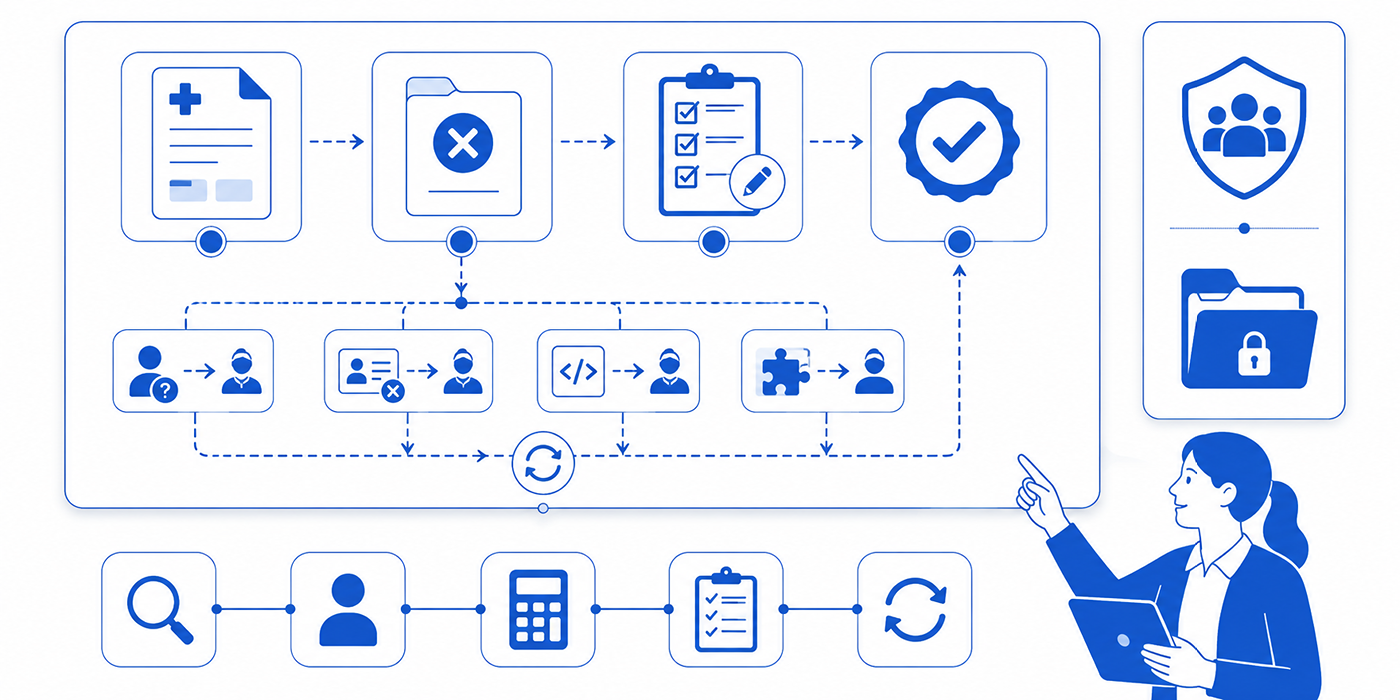
1. What Denials Management Means in Medical Administration
A claim denial occurs when a payer processes a submitted claim or service line and refuses payment for all or part of the billed amount. The payer’s response may point to eligibility, authorization, coding, medical necessity, documentation, filing limits, provider enrollment, coordination of benefits, or another payment rule. Medical administrators must interpret that response through the organization’s medical administrative workflow, compare it with insurance verification records, inspect the relevant patient intake information, and determine whether correction, appeal, write-off, transfer, or escalation is appropriate.
Operationally, many billing teams distinguish a rejection from a denial by asking whether the claim entered adjudication. A rejected transaction usually fails an early validation rule, such as an invalid identifier, missing field, or incorrect electronic format. A denied claim has generally reached payer adjudication and received an unfavorable payment decision. Both require fast action, although their correction pathways differ. Rejections often return to claim preparation, while denials require interpretation of the remittance response, payer policy, documentation, and appeal rights. Staff can strengthen this distinction through medical billing terminology, EMR integration knowledge, claims-management training, and established denial-management procedures.
The electronic or paper remittance supplies the first structured explanation. CMS explains that Claim Adjustment Reason Codes provide the overall reason for an adjustment, Remittance Advice Remark Codes add more specific information, and group codes indicate financial responsibility for the unpaid amount. A strong analyst reads those elements together instead of treating one code as a complete answer. The analyst then compares the payer response with CPT coding rules, the documented ICD-10 diagnosis, applicable prior authorization requirements, and the provider’s enrollment status.
Denials management also requires prevention. Recovering one claim creates temporary value; correcting the workflow defect protects every future claim exposed to the same risk. A recurring eligibility denial may trace back to rushed front-desk operations. Repeated authorization denials may reveal weak appointment scheduling controls. Coding denials may expose gaps in medical terminology training. Missing-documentation denials may require stronger EMR compliance procedures. The denial team’s highest-value output is therefore a measurable workflow correction.
| # | Term | Clear Definition | What Staff Should Inspect | First Administrative Action |
|---|---|---|---|---|
| 1 | Claim denial | Payer decision refusing payment for a complete claim or service line. | Remittance codes, payer message, documentation, policy | Categorize the denial and calculate the response deadline. |
| 2 | Claim rejection | Transaction failure caused by invalid, incomplete, or improperly formatted submission data. | Clearinghouse report, required fields, identifiers | Correct the submission defect and retransmit promptly. |
| 3 | Clean claim | Claim containing the information required for processing without additional investigation. | Demographics, coverage, coding, provider data | Submit through the approved claim pathway. |
| 4 | Adjudication | Payer review that determines coverage, allowable amount, responsibility, and payment. | Benefit rules, coding edits, contract terms | Compare the result with the submitted claim. |
| 5 | Remittance advice | Payer statement explaining claim payment, reduction, adjustment, or denial. | Claim status, codes, allowed amount, responsibility | Post the decision and route exceptions. |
| 6 | Electronic Remittance Advice | Electronic transaction communicating payment and adjustment information. | Payer file, posting results, unmatched claims | Reconcile electronic posting with the claim record. |
| 7 | Explanation of Benefits | Member-facing explanation of how the payer processed healthcare services. | Allowed amount, payer payment, member responsibility | Compare it with the provider remittance and patient account. |
| 8 | CARC | Claim Adjustment Reason Code explaining the broad reason for an adjustment. | Code description and related group code | Translate the code into a work category. |
| 9 | RARC | Remittance Advice Remark Code providing supplemental explanation. | Missing information, policy detail, requested action | Read it with the CARC and payer message. |
| 10 | Group code | Code identifying the category of financial responsibility for an adjustment. | CO, PR, OA, PI, payer contract | Confirm whether the balance can be transferred. |
| 11 | Contractual obligation | Adjustment generally assigned to the provider under contractual or payment rules. | Contract, fee schedule, coding decision | Validate the adjustment before writing it off. |
| 12 | Patient responsibility | Amount assigned to the patient under benefit-processing rules. | Deductible, coinsurance, copayment, noncovered service | Verify accuracy before patient billing. |
| 13 | Eligibility denial | Denial arising from inactive, mismatched, or unavailable coverage. | Service-date eligibility and subscriber information | Reverify coverage for the exact service date. |
| 14 | Authorization denial | Denial connected to absent, invalid, expired, or mismatched prior approval. | Authorized code, provider, units, dates, location | Compare the authorization with the delivered service. |
| 15 | Medical-necessity denial | Payer decision that submitted information does not establish coverage criteria for the service. | Clinical note, diagnosis, policy criteria, test results | Conduct a documentation and policy review. |
| 16 | Coverage denial | Denial stating that the service falls outside the member’s covered benefits. | Plan document, exclusions, benefit limitations | Confirm the benefit rule and appeal rights. |
| 17 | Timely-filing denial | Denial indicating that the claim or appeal reached the payer after its deadline. | Submission proof, payer receipt, contract deadline | Locate acceptance reports and transmission evidence. |
| 18 | Duplicate denial | Denial indicating that the payer identified a previously submitted matching service. | Original claim, corrected claim indicator, payment history | Find the original transaction before resubmission. |
| 19 | Bundling denial | Denial stating that one service is included within another reported service. | Code pair, documentation, modifier eligibility | Review the relevant coding edit. |
| 20 | NCCI PTP edit | Procedure-to-procedure edit addressing code combinations that generally should not be reported together. | Column-one code, column-two code, modifier indicator | Confirm whether documentation supports separate reporting. |
| 21 | Medically Unlikely Edit | Unit-of-service edit designed to identify unlikely quantities for a code. | Reported units, code definition, clinical record | Reconcile units with documented services. |
| 22 | Modifier denial | Denial caused by a missing, invalid, incompatible, or unsupported modifier. | Clinical circumstances and modifier requirements | Verify documentation before changing the code. |
| 23 | Diagnosis-procedure mismatch | Denial arising when the diagnosis does not support the billed procedure under payer rules. | Diagnosis pointer, note, medical policy | Confirm documented diagnosis specificity. |
| 24 | Provider-enrollment denial | Denial connected to provider participation, credentialing, identifier, or effective-date problems. | Rendering provider, billing provider, NPI, enrollment date | Escalate to credentialing or enrollment staff. |
| 25 | Coordination of benefits | Process determining payment order when more than one plan may cover the patient. | Primary payer, secondary payer, other coverage | Confirm payer order for the service date. |
| 26 | Corrected claim | Replacement transaction submitted to correct information on a previously processed claim. | Original claim number, frequency type, corrected fields | Follow the payer’s replacement-claim instructions. |
| 27 | Appeal | Formal request asking the payer to reconsider an unfavorable decision. | Denial rationale, evidence, appeal level, deadline | Build a reason-specific appeal packet. |
| 28 | Reconsideration | A subsequent review level available under certain payer or program processes. | Prior decision, administrative record, new argument | Follow the applicable escalation pathway. |
| 29 | Underpayment | Payment below the amount expected under applicable contract and claim rules. | Allowed amount, contract, units, multiple-procedure rules | Calculate the variance and dispute it when supported. |
| 30 | Root-cause analysis | Structured investigation identifying the workflow condition that produced recurring denials. | Trend, source department, payer, code, provider | Assign a preventive correction with measurable ownership. |
2. Essential Denial Codes, Categories, and Ownership Rules
The CARC describes the broad adjustment, the RARC adds context, and the group code helps identify financial responsibility. Reading only the CARC can produce the wrong action. A missing-information adjustment may concern a provider identifier, referral number, diagnosis detail, attachment, modifier, or another claim element. Staff should inspect the entire remittance, claim image, payer portal, and clearinghouse trail before editing the account. CMS states that remittance advice explains claim payments and adjustments, with CARCs and RARCs supplying structured reasons. This review belongs within claims-management training, medical billing education, CPT code mastery, and ICD-10 code review.
Ownership should follow the underlying cause. Registration owns incorrect names, dates of birth, subscriber relationships, and payer details. Scheduling or authorization staff own missing referrals and approval mismatches. Clinical teams own unresolved documentation questions. Coding staff own code selection, modifiers, units, and diagnosis pointers within their authorized scope. Credentialing teams own enrollment and effective-date problems. Billing teams own claim construction, submission, posting, follow-up, and appeal assembly. This map should appear in front-desk checklists, appointment scheduling procedures, medical office policies, and team collaboration systems.
Group codes also require careful handling before transferring balances to patients. CMS identifies CO as contractual obligation and PR as patient responsibility; the group code helps explain who is financially responsible for the unpaid portion. Staff should still compare the adjustment with the payer contract, benefit information, prior notices, and applicable billing rules. Automatic balance transfers can produce incorrect statements, complaints, refund work, and compliance exposure. A safe process combines patient privacy communication, effective patient communication, complaint-handling procedures, and documented legal responsibilities.
The denial category should be specific enough to support prevention. “Coding” provides little diagnostic value. “Unsupported modifier,” “procedure-to-procedure edit,” “incorrect units,” and “diagnosis-pointer mismatch” show different defects and owners. CMS explains that NCCI procedure-to-procedure edits address code combinations that generally should not be reported together, while Medically Unlikely Edits focus on units of service. Teams should connect these categories with CPT coding guidance, documentation terminology, EMR charting education, and denial prevention training.
3. How to Investigate and Route a Denied Claim
Begin with the complete claim history. Record the patient account, payer, claim number, service date, billed amount, denied amount, denial date, CARC, RARC, group code, filing deadline, appeal deadline, and current owner. Then confirm whether the issue affects the full claim or one service line. This prevents staff from changing correctly paid lines or submitting unnecessary replacements. A disciplined intake process should connect with medical admin time tracking, daily office checklists, medical workflow terminology, and approved collaboration platforms.
Next, compare the denial rationale with the original source records. Eligibility denials require service-date coverage evidence, insurance card details, subscriber information, and coordination-of-benefits status. Authorization denials require the approval number, authorized service, units, provider, facility, and date range. Coding denials require the authenticated clinical note, procedure code, modifier, units, diagnosis, and payer edit. Documentation denials require the payer request, transmission proof, submitted records, and receipt confirmation. Staff can organize this review through insurance verification procedures, prior authorization workflows, patient-record compliance, and medical-record release tools.
Choose the response pathway only after identifying the verified defect. Corrected claims address inaccurate claim data according to payer replacement rules. Appeals challenge decisions when the original claim was accurate or when supporting evidence establishes payment. Reconsideration may provide a higher review level under applicable programs; CMS describes Medicare reconsideration as an independent review of the administrative record following redetermination. Staff should confirm payer-specific levels and deadlines through insurance claims training, risk-management controls, legal responsibility guidance, and documented office procedures.
Prior authorization decisions deserve especially precise tracking. Under CMS’s interoperability and prior authorization final rule, impacted payers must provide a specific reason for denied prior authorization decisions beginning in 2026, with the cited provision excluding drug prior authorizations. A reason such as “clinical criteria unmet” should trigger a comparison between the request, submitted records, payer criteria, and denial explanation. It should never remain a vague status in the account. Teams should link this analysis with medical office triage terminology, telemedicine administration, patient communication guidance, and de-escalation techniques.
4. Denial Scenarios and Resolution Playbooks
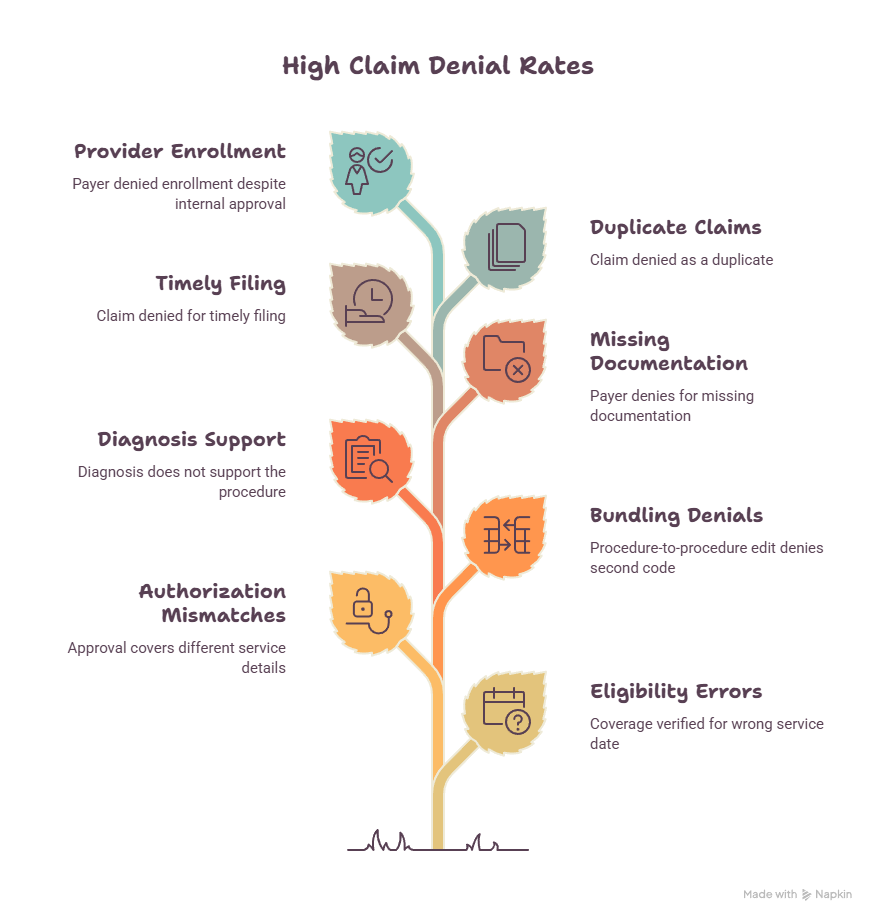
Scenario 1: Coverage Was Verified, Yet the Claim Says the Patient Was Ineligible
The front desk checked coverage on the appointment date, while the service occurred several days later. The denial analyst should reverify eligibility for the exact date of service, confirm the patient’s legal name, date of birth, member ID, group number, subscriber relationship, and payer order. The team should also inspect whether the plan changed retroactively or whether another insurer held primary responsibility. The resolution may involve correcting payer information, billing the correct primary plan, updating coordination of benefits, or appealing with verification evidence. Prevention requires stronger patient intake procedures, service-date insurance verification, accurate front-desk operations, and controlled patient-record updates.
Scenario 2: Prior Authorization Exists, Yet the Service Was Denied
The account contains an authorization number, although the approval covers a different procedure, provider, facility, unit quantity, or date range. Staff should compare every authorization field with the delivered service rather than relying on the presence of a reference number. Contact the payer when the approval notice is ambiguous, save the call reference, and determine whether modification, retroactive review, corrected claim submission, or appeal is permitted. Prevention requires an authorization hard stop before scheduling and a second comparison before claim release. Useful controls include prior authorization training, appointment scheduling practices, scheduling-conflict management, and secure scheduling technology.
Scenario 3: Two Procedures Trigger a Bundling Denial
The payer identifies a procedure-to-procedure edit involving two codes billed for the same patient and service date. CMS explains that NCCI PTP edits can deny the column-two code unless an allowed, clinically appropriate modifier is supported and reported. The analyst should inspect the operative or clinical note for separate encounters, anatomical sites, sessions, lesions, or other documented circumstances relevant to distinct reporting. Adding a modifier solely to obtain payment creates coding and audit risk. The safer pathway combines CPT reference guidance, CPT code training, clinical documentation terminology, and medical office risk management.
Scenario 4: The Diagnosis Does Not Support the Procedure
The submitted diagnosis may be too vague, linked to the wrong service line, or unsupported by the authenticated note. Review the provider’s documented assessment, diagnosis specificity, diagnosis pointer, procedure description, and payer medical policy. Administrative or coding staff should never replace the diagnosis through inference. A provider clarification may be required when the record lacks the detail needed to determine correct coding. The response may involve a corrected claim, additional documentation, or a reason-specific appeal. Prevention depends on an updated ICD-10 dictionary, reliable medical terminology training, strong EMR charting knowledge, and accurate medical scribe documentation.
Scenario 5: Records Were Sent, Yet the Payer Denied for Missing Documentation
The medical office has a fax confirmation or portal screenshot, while the payer reports that no records were received. The analyst should locate the original request, exact due date, requested date range, transmitted documents, destination, confirmation page, and payer receipt status. Confirm that the package included the correct patient, claim number, service date, and requested content. An appeal should contain transmission proof and the relevant records when payer instructions permit. Prevention requires a centralized request queue instead of individual inboxes. Staff can support it through medical-record release tools, HIPAA communication procedures, collaboration platforms, and administrative time tracking.
Scenario 6: The Payer Denies for Timely Filing
First determine which deadline applies to the claim type, payer contract, and service. Then inspect clearinghouse acceptance reports, payer acknowledgments, transmission dates, prior claim numbers, corrected-claim records, and evidence of earlier submission. A claim created inside the billing system may never have reached the payer. A clearinghouse acceptance may also differ from payer acceptance. The appeal should explain the timeline and include strong receipt evidence when available. Prevention requires queue monitoring for unacknowledged claims, submission aging reports, and escalations well before filing limits. These controls belong in insurance claims management, medical admin workflow design, time-management systems, and EMR integration procedures.
Scenario 7: The Claim Is Denied as a Duplicate
Repeated submission without reviewing the original claim can multiply confusion. Search the payer portal and billing system by patient, service date, procedure, billed amount, and claim control number. Determine whether the original claim remains pending, was paid under another number, was denied, or requires a formal replacement transaction. A corrected claim should carry the payer-required reference to the original claim. A new claim may trigger another duplicate response. Prevention requires staff to inspect the full claim history before rebilling and to distinguish status inquiries from resubmissions. The process should align with denial-management training, medical billing terminology, claims-processing education, and daily office checklists.
Scenario 8: The Provider Was Approved Internally, Yet the Payer Denied Enrollment
Internal credentialing approval, clinical privileges, payer contracting, and payer enrollment can hold different effective dates. The analyst should confirm the rendering provider, billing provider, NPI, taxonomy, service location, network status, and payer enrollment effective date. Claims for services delivered before payer activation may require escalation under contract or enrollment rules. Scheduling staff need clear payer-specific status rather than one general “approved” field. Prevention connects provider onboarding with revenue cycle management, medical office scheduling, EMR integration, and legal responsibility controls.
5. How to Build a Denial-Prevention System
Start with a denial inventory that preserves operational detail. Record the payer, plan, facility, department, provider, specialty, service date, procedure, diagnosis, denial amount, CARC, RARC, category, subcategory, source department, correction method, appeal outcome, days to resolution, and final financial disposition. Broad labels erase the pattern needed for prevention. A precise inventory can reveal that one location repeatedly misses subscriber relationships, one procedure frequently exceeds unit edits, or one payer rejects claims tied to a particular enrollment date. This intelligence supports predictive analytics, AI and automation planning, emerging medical admin technology, and future-proof CMAA skills.
Measure denial rate alongside financial and operational impact. A low-volume denial category can deserve immediate attention when it involves high-value services, imminent filing deadlines, patient harm, or compliance exposure. Useful indicators include first-pass acceptance, denial rate by payer, denial dollars, preventable-denial percentage, appeal success, overturn amount, average resolution time, aging by category, documentation response time, and recurrence after corrective action. These measures should appear in leadership reviews, medical office policies, administrative productivity systems, medical admin time-tracking tools, and professional collaboration workflows.
Corrective actions need named ownership and a verification date. “Retrain staff” gives leadership no proof that the defect changed. A stronger plan might require registration staff to verify subscriber relationships, configure a mandatory field, audit 20 accounts after implementation, and report the new error rate within 30 days. A coding correction might add an edit for incompatible code pairs, deliver scenario-based education, and review the next 25 affected claims. These controls can draw from scheduling software mastery, EMR shortcut training, medical terminology education, and medical office procedure checklists.
Patient communication also belongs inside the prevention framework. Patients may receive an EOB showing a denial before the practice completes its investigation. Staff should explain the account status, identify what the office is reviewing, avoid promising an outcome, and prevent premature collection activity when responsibility remains uncertain. Sensitive discussions should follow patient privacy communication, active-listening techniques, de-escalation guidance, and professional patient complaint procedures. Trust deteriorates quickly when a patient receives conflicting explanations from billing, reception, and the payer.
6. FAQs About Denials Management
-
Capture the full payer response before making account changes. Record the claim number, denied service line, CARC, RARC, group code, denial date, amount, response deadline, and payer explanation. Compare those details with the original claim, clinical documentation, eligibility response, and authorization record. This intake standard should be embedded in claims-management procedures, revenue cycle workflows, denial-management training, and medical office checklists.
-
A corrected claim replaces inaccurate information from an earlier transaction according to the payer’s replacement-claim rules. An appeal challenges a payer decision using policy, documentation, contract language, or other supporting evidence. Sending a corrected claim when the original data was accurate may create duplicate or processing problems. Appealing an obvious data-entry error wastes appeal time. Staff should choose the pathway through medical billing terminology, CPT code training, insurance claims guidance, and payer-specific instructions.
-
The group code, payer determination, contract, benefit rules, prior patient notices, and applicable law should be reviewed before transferring a balance. CMS explains that group codes help assign financial responsibility and identifies PR as patient responsibility and CO as contractual obligation. Medical offices should validate the adjustment through legal responsibility guidance, patient privacy procedures, risk-management controls, and professional patient communication.
-
Review the denial explanation, payer policy, authenticated clinical note, diagnosis, procedure, diagnostic findings, prior treatment, and any submitted records. Determine whether the documentation satisfies the cited coverage criteria and whether the payer reviewed the complete record. The appeal should address the payer’s exact rationale and attach relevant evidence. Staff should use ICD-10 guidance, CPT references, clinical documentation terminology, and controlled medical-record release systems.
-
A strong appeal identifies the claim and disputed service, states the denial reason, explains why reconsideration is justified, cites the relevant evidence or rule, includes organized supporting records, and meets the payer’s submission deadline. Unfocused record dumps force the reviewer to discover the argument. A concise evidence index can improve clarity. Appeal preparation should follow medical administrative workflows, insurance claims procedures, time-management controls, and legal responsibility standards.
-
Eligibility mismatches, missing authorizations, invalid patient information, absent provider identifiers, duplicate submissions, avoidable filing delays, and incomplete documentation responses often originate in controllable administrative workflows. Coding and medical-necessity denials require more detailed review, although recurring patterns can still reveal preventable documentation or configuration gaps. Prevention depends on insurance verification, appointment scheduling controls, EMR integration, and structured denial-management processes.
