

Patient Confidentiality: Key Terms & HIPAA Interactive Guide
Patient confidentiality depends on hundreds of small decisions: confirming a caller’s identity, lowering a voice at reception, selecting the correct portal recipient, restricting EHR access, and releasing only authorized records. A single careless click can expose diagnoses, damage patient trust, trigger breach analysis, and create legal risk. Medical scribes and administrative teams need practical command of HIPAA terminology, patient privacy communication, medical-record handling, and EHR compliance.
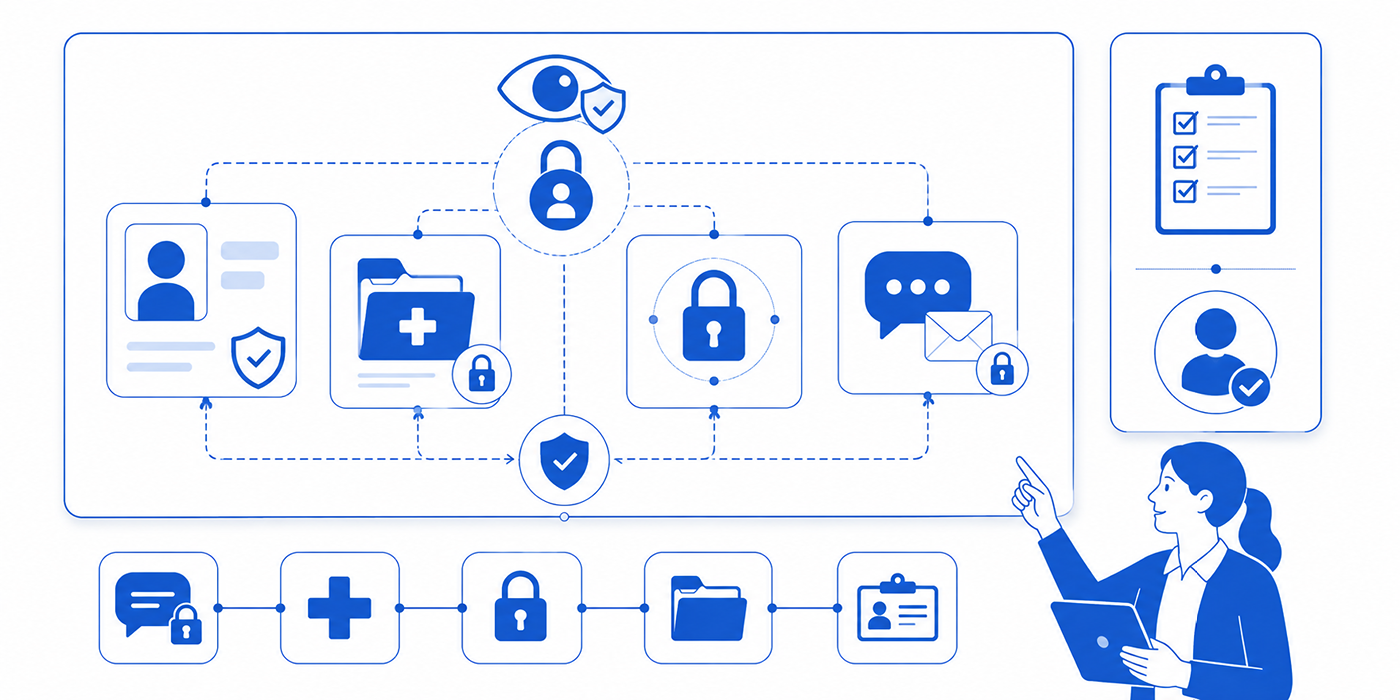
1. Patient Confidentiality, Privacy, and Security: The Essential Distinctions
Patient confidentiality is the professional and operational duty to protect information learned through the healthcare relationship. It shapes how employees discuss patients, open records, answer calls, route messages, send documents, and communicate with relatives.
Privacy concerns the patient’s rights and the rules governing how protected information may be used or disclosed. The HIPAA Privacy Rule protects individually identifiable health information in electronic, written, and oral forms when that information is held or transmitted by covered entities or their business associates.
Security concerns the safeguards used to protect electronic protected health information, or ePHI. The HIPAA Security Rule requires appropriate administrative, physical, and technical safeguards that preserve the confidentiality, integrity, and availability of ePHI. These concepts influence EMR integration, secure scheduling systems, healthcare portals, and telehealth administration.
These three concepts overlap during routine work. A receptionist who discusses a diagnosis where other patients can hear may create a confidentiality problem. An employee who opens a celebrity’s chart without a work-related reason creates an access and privacy problem. A clinic that leaves an unencrypted laptop containing patient information in an unlocked vehicle creates a security risk that may require breach evaluation.
HIPAA applies to covered healthcare providers that conduct specified electronic transactions, health plans, and healthcare clearinghouses. Business associates can also carry direct obligations when they create, receive, maintain, or transmit PHI while performing services for a covered entity. Every healthcare worker should therefore understand clearinghouse functions, claims processing, medical billing terminology, and legal responsibilities for CMAAs.
HIPAA does not make every health-related conversation unlawful. Providers may communicate for legitimate treatment purposes and may share relevant information with people involved in a patient’s care under applicable conditions. Reasonable safeguards, identity verification, appropriate purpose, patient preferences, and organizational policy determine how those communications should occur.
A confidentiality failure often begins with a familiar shortcut:
An employee discusses a patient in an elevator.
A voicemail includes more clinical detail than necessary.
A fax number is selected from an outdated contact list.
A portal message is attached to the wrong chart.
Records are released before the authorization is validated.
A shared login prevents reliable auditing.
A scribe copies sensitive information into the wrong encounter.
A staff member photographs a workstation screen with a personal phone.
Preventing these failures requires integrated knowledge of effective patient communication, front-desk operations, clinical documentation standards, and risk-management strategies.
| # | Key Term | Practical Meaning | Common Confidentiality Failure | Best Control or ACMSO Resource |
|---|---|---|---|---|
| 1 | Protected Health Information | Individually identifiable health information protected by the HIPAA Privacy Rule when held by a regulated entity. | Staff assume names and diagnoses are the only details that can identify a patient. | Study the HIPAA privacy terms for CMAAs. |
| 2 | Electronic PHI | Protected health information created, received, stored, or transmitted electronically. | Patient information is downloaded to an unmanaged computer, phone, drive, or cloud account. | Apply the controls in the HIPAA compliance guide for scribes. |
| 3 | Covered Entity | A covered healthcare provider, health plan, or healthcare clearinghouse subject to HIPAA. | Employees assume HIPAA duties belong solely to hospitals and insurers. | Connect privacy responsibilities with the medical administrative workflow. |
| 4 | Business Associate | A person or organization performing certain services involving PHI for a covered entity. | A clinic gives a vendor PHI before reviewing the relationship, safeguards, and contract. | Include vendor controls in medical administrative policies. |
| 5 | Business Associate Agreement | A written contract establishing permitted PHI uses, safeguards, reporting duties, and other obligations. | Staff treat a software subscription agreement as sufficient privacy protection. | Evaluate BAAs before deploying patient communication applications. |
| 6 | Minimum Necessary | The principle of reasonably limiting many PHI uses, disclosures, and requests to what the purpose requires. | An entire chart is released when one report or date range would satisfy the request. | Use the medical-record release directory. |
| 7 | Treatment | Care provision, coordination, consultation, and related clinical activity. | Employees disclose information without confirming that the recipient participates in care. | Strengthen verification through active listening techniques. |
| 8 | Payment | Activities involving reimbursement, eligibility, billing, utilization review, and claim administration. | More clinical information is sent to a payer than the payment task requires. | Review insurance verification terminology. |
| 9 | Healthcare Operations | Specified operational activities such as quality assessment, training, auditing, and business management. | Employees use the phrase “operations” as a blanket justification for curiosity-based access. | Define responsibilities through daily office procedure checklists. |
| 10 | Authorization | A HIPAA-compliant written permission used for disclosures requiring patient authorization. | A vague, incomplete, expired, or improperly signed form is accepted. | Build validation into front-desk procedures. |
| 11 | Consent | Permission that may apply in specific clinical, organizational, or state-law contexts. | Staff assume a general consent form authorizes every possible disclosure. | Clarify communication boundaries through HIPAA communication guidance. |
| 12 | Notice of Privacy Practices | A notice explaining privacy practices, permitted uses, patient rights, and complaint procedures. | Patients sign an acknowledgment without receiving meaningful access to the notice. | Incorporate the notice into patient intake procedures. |
| 13 | Confidential Communication | A communication delivered through a reasonable alternative method or location requested by a patient. | Staff continue calling a shared home number after the patient requested another method. | Configure preferences in healthcare portal workflows. |
| 14 | Restriction Request | A patient request to limit certain uses or disclosures of PHI. | The restriction is accepted verbally and never entered where other departments can see it. | Use structured patient-record update procedures. |
| 15 | Personal Representative | A person with authority under applicable law to act for the patient regarding relevant healthcare decisions. | A relative receives information based solely on family status. | Use scripts from the patient communication guide. |
| 16 | Identity Verification | The process of confirming that a requester, caller, patient, or representative is who they claim to be. | Staff disclose information after verifying only a name or telephone number. | Embed verification in patient intake controls. |
| 17 | Role-Based Access | EHR permissions assigned according to legitimate job responsibilities. | Employees retain broad access after moving to another role or department. | Review access during medical office organization. |
| 18 | Audit Trail | A record of who accessed, changed, printed, downloaded, or transmitted information. | Shared credentials prevent the organization from identifying the actual user. | Connect audits with CMAA risk management. |
| 19 | Incidental Disclosure | A limited secondary disclosure that can occur despite reasonable safeguards during an otherwise permitted activity. | Teams use the concept to excuse avoidable conversations in public areas. | Improve privacy through thoughtful office organization. |
| 20 | De-Identification | The removal or treatment of identifiers so information meets applicable de-identification requirements. | Names are removed while dates, locations, photographs, or rare conditions still reveal identity. | Address these risks in AI and automation governance. |
| 21 | Limited Data Set | A defined form of PHI that excludes specified direct identifiers and requires appropriate controls. | Employees describe any partially anonymized spreadsheet as a limited data set. | Add review checkpoints to privacy policies and procedures. |
| 22 | Data Use Agreement | An agreement governing permitted use and disclosure of a limited data set. | Data is shared for analysis without confirming restrictions, recipients, or safeguards. | Pair agreements with predictive analytics governance. |
| 23 | Breach | An impermissible PHI use or disclosure that meets the applicable breach standard after evaluation. | Staff independently decide an incident is harmless and fail to report it internally. | Use formal risk-management escalation. |
| 24 | Unsecured PHI | PHI that has not been rendered unusable, unreadable, or indecipherable through recognized methods. | A password-protected file is automatically assumed to satisfy every encryption requirement. | Include technical review in EMR integration decisions. |
| 25 | Risk Assessment | An evaluation of an impermissible use or disclosure using required breach-risk factors. | The organization measures embarrassment while ignoring data sensitivity and actual access. | Build a structured response through CMAA legal training. |
| 26 | Mitigation | Practical action taken to reduce harm from an improper use or disclosure. | An incorrect email is deleted from the sender’s account while the recipient remains uncontacted. | Create response steps in daily procedure checklists. |
| 27 | Amendment | A patient’s request to correct or supplement information believed to be inaccurate or incomplete. | Staff overwrite the original record or promise that every requested change will be accepted. | Follow controlled EHR amendment workflows. |
| 28 | Accounting of Disclosures | A patient right to receive information about certain disclosures made by a covered entity. | Every release is treated identically without checking whether it belongs in the accounting process. | Coordinate accounting with records-release tools. |
| 29 | Psychotherapy Notes | Separate notes recorded by a mental health professional documenting or analyzing counseling conversations. | They are treated like the ordinary clinical record during access or release processing. | Escalate sensitive requests under established legal procedures. |
| 30 | 42 CFR Part 2 Records | Records involving certain substance use disorder programs that may carry additional federal protections. | Employees assume ordinary HIPAA handling automatically resolves every Part 2 requirement. | Add specialized review to patient privacy workflows. |
2. How HIPAA Terms Control Everyday Confidentiality Decisions
Knowing a definition helps only when the employee can convert it into the correct action. The hardest privacy decisions often involve legitimate work performed through an unsafe process.
Protected Health Information and Patient Identifiers
PHI can include far more than a diagnosis attached to a full name. Demographic details, medical-record numbers, contact information, appointment data, billing records, images, dates, and other information may identify a patient directly or indirectly when connected with health information.
A seemingly harmless message such as “Your oncology appointment has been moved” reveals both identity and healthcare context when sent to the wrong recipient. Staff should therefore apply confidentiality checks throughout appointment scheduling, patient portal messaging, insurance verification, and virtual patient management.
Minimum Necessary and Purpose-Based Access
The minimum-necessary principle generally requires reasonable efforts to limit many uses, disclosures, and requests to the amount of PHI needed for the intended purpose. Covered entities must develop policies that restrict internal access according to workforce roles. The standard has defined exceptions, including disclosures to or requests by healthcare providers for treatment.
A scheduler may need appointment type, provider, location, preparation instructions, and approved alerts. That role may have little reason to open an entire specialist note. A billing employee may need documentation supporting a claim, while access to unrelated historical records could exceed the task.
Effective access design links the employee’s responsibilities with the medical administrative workflow, revenue cycle process, claims tutorial, and staff scheduling structure.
Consent and Authorization
A general treatment consent and a HIPAA authorization serve different functions. HHS guidance explains that a consent document does not substitute for a valid authorization when the Privacy Rule requires authorization.
Before processing an authorization, staff should verify:
The patient or authorized representative
The recipient
The information covered
The purpose, when applicable
The expiration date or event
The signature and date
The representative’s authority
Any applicable revocation
Sensitive-record requirements
Organization-specific validation rules
The authorization should then be matched with the actual release. A valid authorization for laboratory results does not automatically support releasing complete psychotherapy, billing, surgical, and imaging records. This matching step should appear in records-release workflows, legal CMAA procedures, office policies, and EHR update training.
Confidential Communications and Restrictions
Patients may request communications through alternative means or at alternative locations. A provider must accommodate a reasonable confidential-communications request, while a health plan has a related duty when the individual states that another form of communication could endanger them.
This right matters when a patient shares a telephone, mailing address, insurance policy, or portal account with another person. Privacy preferences should be documented in visible, structured fields and carried into front-desk procedures, patient scheduling tools, communication applications, and telehealth workflows.
A preference buried in an old scanned document provides weak protection. The EHR should alert authorized users at the point where addresses, calls, messages, statements, or appointment reminders are generated.
Family Members, Friends, and Personal Representatives
A family member’s involvement does not always make that person the patient’s legal representative. HIPAA may permit relevant disclosures to a family member, friend, or other person involved in care or payment under appropriate circumstances, including situations where the patient agrees, does not object, or professional judgment supports a limited disclosure.
A personal representative occupies a different legal position. A person authorized under applicable law to make relevant healthcare decisions generally exercises the patient’s corresponding HIPAA rights within the scope of that authority. The authority may be broad or limited, and state or other applicable law helps determine its reach.
Staff should avoid relying on statements such as “I am her husband,” “I pay the bill,” or “I always manage his appointments.” They should follow a defined verification pathway, document authority accurately, and use communication skills from the difficult-conversations guide, de-escalation dictionary, active-listening guide, and patient complaint procedures.
3. Where Patient Confidentiality Breaks Down Across the Healthcare Workflow
Confidentiality failures rarely announce themselves as major incidents. They often appear as ordinary work completed with one missing safeguard.
Reception and Check-In
Reception areas combine conversation, computer screens, paper forms, payment details, family members, and crowded waiting rooms. Reasonable safeguards can include speaking quietly, positioning screens away from public view, avoiding unnecessary clinical discussion, controlling printed schedules, and moving sensitive conversations to a private location. HHS recognizes that incidental disclosures may occur during permitted activities when reasonable safeguards are in place.
A patient should not have to announce a sensitive diagnosis across a busy desk to correct an appointment. Staff can use neutral prompts, invite the patient to write information, or continue the conversation privately. These techniques strengthen patient intake, front-desk operations, empathy in healthcare administration, and patient communication.
Telephone and Voicemail
The caller may know the patient’s name, date of birth, physician, and address. Those details can come from social media, discarded paperwork, insurance documents, or previous conversations. Identity verification should match the sensitivity of the requested action.
A call about office hours requires little verification. A request for results, password reset, records release, pharmacy change, or contact-detail update deserves stronger controls. Staff should follow scripts, avoid leading questions, document failed verification attempts, and escalate suspicious activity.
Voicemail content should follow patient preferences and office policy. A neutral request to return a call may protect confidentiality more effectively than a message naming the specialty, test, diagnosis, or medication. These practices support appointment conflict management, emergency appointment procedures, active listening, and HIPAA communication essentials.
Email, Portals, Text Messages, and Telehealth
HIPAA permits electronic communication with patients when reasonable safeguards are applied. HHS guidance specifically highlights precautions such as confirming email addresses before sending information. Electronic PHI transmitted across open networks must receive appropriate protection based on the organization’s Security Rule analysis and documented decisions.
The sender should confirm the patient, recipient, message thread, attachment, and minimum content before clicking send. Autocomplete creates speed and danger simultaneously. A correct email address with the wrong attachment can disclose an entire record in seconds.
Telehealth adds privacy concerns involving physical surroundings, platform access, recording, shared devices, interpreters, and portal invitations. HHS confirms that covered entities may use remote communication technologies, including audio-only services, while complying with the HIPAA Rules.
Organizations should connect telehealth platform selection, virtual patient management, medical scribes and telemedicine, and secure scheduling with privacy risk assessments.
Clinical Documentation and Medical Scribing
Scribes work close to highly sensitive information. Their confidentiality duties extend beyond keeping diagnoses secret. They must open the correct chart, remain within assigned encounters, use approved devices, avoid personal notes, protect login credentials, and follow provider authentication procedures.
Copy-forward errors can expose another patient’s history inside the current chart. Dictation software can capture background conversations. A screenshot used for training can retain names, dates, or record numbers. A copied note placed in an unapproved messaging application may create uncontrolled PHI.
Scribes should combine medical documentation terms, EMR and charting concepts, medical terminology mastery, and HIPAA terms for scribes.
Records, Claims, and Revenue Cycle
Claims require patient identifiers, diagnoses, procedures, insurance data, and provider information. Confidentiality safeguards must remain active as data moves among the practice, billing team, payer, clearinghouse, and approved vendors.
A billing purpose does not justify releasing unrelated clinical history. A records request from an insurer should be matched with the claim, authorization, contract, applicable permission, and minimum information required. Teams should understand CPT codes, ICD-10 codes, superbills, and denial management.
Which confidentiality risk creates the most anxiety during your daily healthcare workflow?
4. HIPAA Privacy Incident and Breach Response: An Interactive Action Plan
A privacy incident needs immediate containment and structured review. Front-line employees should report facts quickly rather than attempting to decide whether the incident legally qualifies as a breach.
The HIPAA Breach Notification Rule generally treats an impermissible use or disclosure as a presumed breach unless the covered entity or business associate demonstrates a low probability that PHI was compromised through an appropriate risk assessment. The assessment considers the nature and extent of the PHI, the unauthorized recipient, whether the information was acquired or viewed, and the extent of mitigation.
Step 1: Stop Further Disclosure
Contain the event without altering evidence. Actions may include recalling an email, disabling a link, retrieving a printout, contacting an unintended recipient, locking an account, disconnecting a lost device, or stopping an incorrect fax transmission.
The employee should avoid deleting audit-relevant messages, changing the chart to conceal activity, or asking the recipient to provide an informal promise of silence. Follow the organization’s risk-management process, legal responsibility guide, office policies, and records-release controls.
Step 2: Report Through the Approved Channel
Notify the privacy officer, supervisor, compliance team, security team, or other designated contact immediately. HIPAA-covered entities must designate privacy personnel, train relevant workforce members, apply appropriate sanctions, mitigate harmful effects where practicable, and maintain required privacy policies and documentation.
A useful initial report includes:
Date and time discovered
Date and time the event occurred
Patient or patients affected
Information involved
Intended recipient
Actual recipient
Communication method or device
Whether information was viewed
Containment actions completed
People already notified
Fast reporting supports time-management discipline, medical office collaboration, daily office checklists, and staff accountability.
Step 3: Preserve Accurate Facts
Document what happened without speculation. “Email sent to [email protected] at 2:14 p.m. with one attached laboratory report” is useful. “The patient will probably be fine” provides little value.
Preserve system logs, email headers, fax confirmations, portal records, access histories, screenshots created through approved procedures, and recipient communications. Strong factual documentation allows the privacy team to evaluate the event consistently.
Step 4: Support the Formal Risk Assessment
The privacy or legal team may need to determine the sensitivity of the information, identification risk, recipient duties, evidence of access, and effectiveness of mitigation. A disclosure to another regulated healthcare provider who promptly confirms deletion presents a different risk profile from a public social-media post containing names and diagnoses.
Employees should provide information and follow instructions without making independent promises to the patient or recipient. The formal review may involve EHR audit trails, patient communication records, claims information, and healthcare CRM records.
Step 5: Complete Required Notifications and Corrective Action
When a breach of unsecured PHI triggers notification duties, covered entities must notify affected individuals and HHS, with media notification required in certain larger events. Individual notification must occur without unreasonable delay and no later than 60 days after discovery. Business associates must notify covered entities of qualifying events occurring at or by the business associate.
Corrective action should address the mechanism that allowed the event:
Redesigning release verification
Restricting EHR permissions
Updating outdated fax numbers
Reconfiguring portal routing
Encrypting devices
Removing shared accounts
Improving screen privacy
Retraining specific roles
Revising vendor controls
Auditing similar past transactions
The goal is measurable prevention. A generic reminder to “be more careful” leaves the original weakness intact.

5. A Practical Patient-Confidentiality Playbook for Medical Teams
Use a Purpose–Identity–Scope Pause
Before viewing, discussing, sending, printing, or releasing PHI, ask three questions:
Purpose: What approved healthcare task am I completing?
Identity: Have I confirmed the patient and recipient?
Scope: How much information does this task require?
This pause protects patient intake, insurance claims, appointment scheduling, and records release.
Create Verification Levels
Use stronger verification as the sensitivity and potential harm increase.
A low-risk scheduling confirmation may use ordinary identifiers. Clinical results, portal resets, representative access, pharmacy changes, address changes, and record releases should trigger stronger verification and documentation. Staff should receive scripts through patient communication training, de-escalation practice, difficult-conversation guidance, and front-desk checklists.
Protect Every Communication Channel
For verbal communication, control volume, location, participants, and detail. For email, verify the address, patient, subject line, and attachment. For fax, confirm the number and recipient. For portals, verify the correct chart and proxy access. For paper, control printing, transport, storage, and destruction.
For telehealth, confirm who is present, whether the patient has privacy, which platform is approved, and how documentation will enter the chart. These controls belong within telehealth administration, portal management, collaboration tools, and secure scheduling platforms.
Apply Privacy to Technology Procurement
A product’s claim of being “HIPAA compliant” provides limited operational detail. Healthcare organizations should examine how the product handles access controls, authentication, logging, encryption, backups, data export, subcontractors, incident reporting, deletion, and business associate agreements.
HHS guidance on online tracking technologies explains that a privacy notice or cookie banner does not independently authorize a disclosure of PHI to a tracking vendor. Relevant relationships, permissions, safeguards, and BAAs must be evaluated.
This review should apply to healthcare CRM platforms, communication applications, EMR integrations, and emerging medical technologies.
Control AI Use Around Patient Information
AI can summarize notes, draft messages, suggest codes, organize schedules, and analyze workflow. Patient information should enter an AI tool only through an approved process supported by appropriate privacy, security, contractual, and technical review.
Employees should never paste PHI into a public chatbot, personal writing assistant, unauthorized transcription tool, or consumer image generator. Deleting the conversation afterward may leave data-retention, access, or vendor-processing concerns unresolved.
Healthcare teams should link AI and automation education, future documentation skills, predictive analytics training, and future-proof CMAA skills.
Train Through Scenarios and Audit the Outcome
Annual slides cannot prepare staff for every caller, portal error, family disagreement, urgent request, lost device, or misdirected document. Scenario-based training should require employees to make decisions and explain their reasoning.
Useful exercises include:
A spouse requesting results
A parent requesting a minor’s records
A police officer seeking information
A patient requesting confidential billing communication
A fax sent to an outdated number
A portal proxy requesting account access
A staff member opening a neighbor’s chart
A lost work phone
A research request for patient data
An urgent records request with an incomplete authorization
Training should connect with CMAA exam preparation, medical scribe certification, medical terminology mastery, and medical admin professional organizations.
Audit whether behavior changes. Measure inappropriate access, misdirected communications, incomplete authorizations, unresolved incidents, shared-account use, uncollected printouts, and repeat errors. Training value appears in safer performance.
6. Frequently Asked Questions About Patient Confidentiality and HIPAA
-
Patient information becomes PHI under HIPAA when it involves individually identifiable health information held or transmitted by a covered entity or business associate in a regulated context. HIPAA protects qualifying information in electronic, paper, and oral forms.
Workforce members should protect information throughout clinical documentation, patient intake, medical billing, and portal communication.
-
HIPAA permits appropriate information sharing for treatment. The identity of the recipient, treatment relationship, communication method, organizational policy, and sensitivity of the information still deserve attention. The minimum-necessary standard generally does not apply to disclosures to or requests by healthcare providers for treatment, though other privacy rules and professional safeguards may remain relevant.
Staff should use approved collaboration tools, secure EMR integrations, controlled telehealth platforms, and reliable patient communication systems.
-
Marriage alone does not automatically grant unrestricted access to a patient’s complete record. A spouse may receive information under circumstances permitted by HIPAA, including relevant involvement in care or payment, patient agreement, or valid personal-representative authority. The disclosure should match the permitted purpose and scope.
Staff should verify authority through patient communication procedures, privacy guidance, active listening, and legal escalation pathways.
-
HIPAA generally gives patients the right to inspect and receive copies of medical and billing records maintained by covered providers and health plans, subject to limited exceptions. Psychotherapy notes kept separately from the medical record receive distinct treatment, and patients generally lack a HIPAA access right to those notes.
Access requests should move through controlled records-release procedures, EHR compliance workflows, office policies, and patient portal processes.
-
A patient may request an amendment when they believe information is inaccurate or incomplete. The provider or health plan must respond. When a request is denied, the patient may have the right to submit a statement of disagreement for inclusion in the record.
Employees should preserve the integrity of the original record and follow approved patient-record update training, EMR charting rules, documentation terminology, and risk-management procedures.
-
HIPAA permits electronic and telephone communication when covered entities apply reasonable safeguards. Appropriate precautions include confirming contact details, honoring communication preferences, controlling message content, using approved systems, and addressing transmission security.
Organizations should coordinate patient communication apps, secure scheduling tools, healthcare portals, and telehealth administration.
