

Medical Chart Audits: Terms & Interactive Checklist Guide
Medical chart audits expose the documentation gaps that quietly trigger denials, coding errors, privacy concerns, weak care coordination, and preventable compliance risk. A strong audit examines far more than whether fields were completed; it tests whether the record tells a coherent, clinically defensible story that supports the services delivered. For medical scribes and administrative teams, understanding clinical documentation terminology, EMR charting standards, HIPAA requirements, and medical claims processing turns auditing into a practical quality-improvement system.
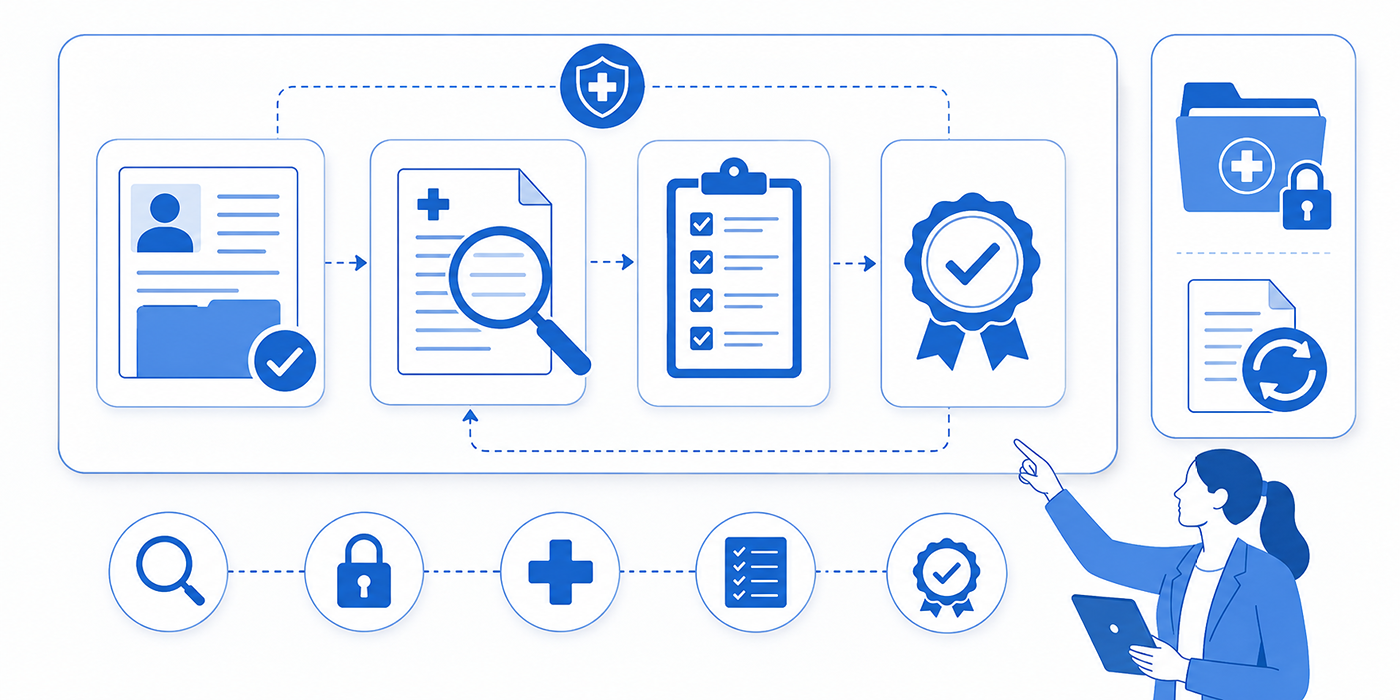
1. What Medical Chart Audits Actually Examine
A medical chart audit is a structured review of patient records against predetermined clinical, documentation, coding, billing, privacy, and organizational criteria. The auditor determines whether each chart accurately represents the encounter, supports the reported diagnoses and services, protects patient information, and provides enough continuity for the next person involved in care.
The strongest audits examine the relationship between chart elements. A technically completed history cannot rescue an assessment that fails to explain the provider’s clinical reasoning. A valid ICD-10 code still creates risk when the documented diagnosis lacks sufficient specificity. A correctly selected CPT code remains vulnerable when the note does not support the service level, procedure, time, or medical necessity. Effective auditing therefore tests internal consistency rather than counting filled fields.
CMS advises that medical records should be complete and legible and should document the reason for the encounter, relevant clinical information, assessment or diagnosis, rationale for ancillary services, plan of care, date of service, and the identity of the person providing the service. CMS also emphasizes complete, accurate, and timely encounter documentation.
Chart audits usually address six connected dimensions:
Clinical completeness asks whether the chart includes the information needed to understand the patient’s condition, decisions, treatment, and follow-up. This includes specific history, pertinent findings, diagnostic interpretation, medication changes, referrals, precautions, and unresolved issues. Teams can strengthen this dimension through medical terminology mastery, reliable documentation templates, and disciplined patient intake procedures.
Clinical consistency examines whether the sections agree with one another. Common contradictions include a review of systems denying a symptom described in the HPI, an exam copied from a different encounter type, a diagnosis unsupported by the assessment, or a plan discussing a medication absent from the medication list. These errors often emerge from rushed workflows, uncontrolled copy-forward practices, and unresolved EMR software problems.
Coding support tests whether diagnoses, procedures, modifiers, and service levels are substantiated by the record. The auditor follows the documentation through the revenue cycle workflow, checks its relationship to the superbill, and confirms that the submitted claim reflects the encounter. This catches both unsupported coding and lost revenue caused by incomplete documentation.
Operational reliability examines signatures, attestations, result review, order completion, referral closure, record amendments, and message follow-up. A chart may describe excellent care while still exposing the organization to risk when no one can prove that an abnormal result was reviewed or that a referral reached the intended specialist. Clear medical administrative workflows, defined ownership, and accurate patient record updates prevent these silent failures.
Privacy and access control evaluates whether protected information was viewed, shared, amended, printed, transmitted, and released appropriately. Teams need working knowledge of HIPAA and patient privacy terminology, patient privacy communication, and secure medical-record release procedures.
Corrective-action effectiveness determines whether earlier findings were fixed at their source. Repeated errors usually indicate that the organization responded with reminders instead of redesigning the workflow. Sustainable improvement requires an assigned owner, a measurable action, a deadline, proof of implementation, and a scheduled re-audit.
| # | Audit Checkpoint | Evidence of a Passing Chart | High-Risk Failure Signal | Corrective Action |
|---|---|---|---|---|
| 1 | Patient identity | Required identifiers match throughout the encounter, orders, results, and attached documents. | Records, results, or messages appear under the wrong patient or duplicate chart. | Strengthen patient intake verification and duplicate-record escalation. |
| 2 | Date, location, and rendering provider | The date of service, encounter setting, provider identity, and department are accurate. | The note is attributed to the wrong provider, location, or encounter date. | Standardize encounter-opening checks within the medical administrative workflow. |
| 3 | Reason for encounter | The chief concern or service purpose is specific and consistent with the assessment and plan. | A vague complaint gives reviewers no clear explanation for the service performed. | Use structured prompts from reliable documentation templates. |
| 4 | History of present illness | Onset, location, duration, severity, context, modifying factors, and associated symptoms appear when clinically relevant. | The HPI contains generic text that cannot support complexity, diagnosis, or medical necessity. | Reinforce the clinical documentation terms used to capture precise histories. |
| 5 | Past, family, and social history | Relevant histories are current, attributable, and connected to the clinical decision. | Copied histories remain unchanged despite new diagnoses, exposures, procedures, or risk factors. | Add ownership and verification steps to patient record updates. |
| 6 | Review of systems and exam | Documented findings are pertinent, internally consistent, and appropriate for the encounter format. | Template text contradicts the HPI, visit type, patient status, or provider observations. | Remove unnecessary defaults and train staff through EMR charting standards. |
| 7 | Assessment specificity | Each condition is described to the highest clinically supported level of specificity. | Symptoms, suspected conditions, confirmed diagnoses, and historical problems are used interchangeably. | Align assessment language with the ICD-10 reference framework. |
| 8 | Diagnosis-to-evidence linkage | History, findings, tests, and clinical reasoning support every actively managed diagnosis. | A diagnosis appears only in the code list without supporting narrative or management. | Require a diagnosis-evidence cross-check before finalizing the claims workflow. |
| 9 | Medical necessity | The record explains why the service, test, treatment, or level of evaluation was reasonable for the patient’s condition. | The billed service appears more extensive than the documented problem and management. | Connect clinical reasoning to the revenue cycle process. |
| 10 | Orders and test rationale | Orders identify the test, indication, priority, responsible party, and follow-up pathway. | Tests are ordered without a documented indication or review plan. | Create order-review checkpoints within daily office checklists. |
| 11 | Results review and communication | The chart records who reviewed the result, when it was reviewed, what it meant, and how the patient was informed. | Abnormal results remain in the chart without documented acknowledgment or action. | Use closed-loop patient communication procedures. |
| 12 | Medication reconciliation | Active medications, discontinued therapies, doses, adherence concerns, and changes are clearly recorded. | The plan references medications that conflict with the active medication list. | Assign reconciliation ownership and reinforce accurate medical terminology use. |
| 13 | Allergies and adverse reactions | The allergen, reaction, severity, and verification status are distinguishable when known. | “No known allergies” conflicts with narrative documentation or earlier records. | Add allergy reconciliation to the front-desk and clinical handoff checklist. |
| 14 | Problem-list integrity | Active, resolved, historical, and duplicate problems are accurately classified. | Outdated problems influence coding, alerts, risk adjustment, or current treatment. | Schedule focused cleanup using safe EMR productivity techniques. |
| 15 | Plan of care | Each assessed problem has a clear treatment, monitoring, counseling, referral, or follow-up decision. | The plan contains vague instructions such as “continue” without identifying what continues or who monitors it. | Use action-oriented wording from the medical office triage framework. |
| 16 | Follow-up instructions | Timing, purpose, responsible clinician, precautions, and escalation conditions are documented. | “Follow up as needed” leaves clinically important next steps undefined. | Integrate instructions with appointment scheduling best practices. |
| 17 | Referrals and authorizations | The indication, destination, urgency, authorization status, and completion pathway are traceable. | A referral is placed without confirmation that it was authorized, scheduled, or completed. | Coordinate the referral with the prior authorization workflow. |
| 18 | Preventive and quality measures | Eligibility, exclusions, completion status, counseling, and patient decisions are documented accurately. | A quality measure is credited or omitted without supporting chart evidence. | Build measure-specific prompts into medical administrative policies. |
| 19 | Time-based services | Required time, qualifying activities, participants, and service date are documented where applicable. | Time-dependent coding appears without sufficient time or activity documentation. | Align documentation with the applicable CPT requirements. |
| 20 | Signature and authentication | The appropriate author signs or authenticates the entry within the required organizational timeframe. | Unsigned notes, unidentified initials, or missing attestations undermine record validity. | Add authentication controls to CMAA legal-responsibility procedures. |
| 21 | Scribe identification and attestation | The record identifies the scribe and contains the required provider review or attestation under policy. | The note obscures who entered information or who validated its accuracy. | Train staff through a formal medical scribe compliance program. |
| 22 | Late entries and amendments | Corrections preserve the original content, identify the author, show the date, and explain the change appropriately. | Original text is overwritten, backdated, or changed without a visible amendment trail. | Apply formal risk-management procedures for record corrections. |
| 23 | Copy-forward control | Reused information is reviewed, updated, and relevant to the current encounter. | Old symptoms, findings, dates, ages, laterality, or plans appear in the new note. | Revise templates and address recurring EMR workflow issues. |
| 24 | Template relevance | Only clinically relevant sections remain, and all populated content reflects the current visit. | Excessive default text hides meaningful findings and creates contradictions. | Refine specialty-specific charting templates and cheat sheets. |
| 25 | ICD-10 accuracy | Diagnosis codes reflect documented specificity, status, laterality, acuity, and encounter context. | The claim uses unsupported specificity or defaults to an unspecified code despite available detail. | Validate diagnoses with the interactive ICD-10 dictionary. |
| 26 | CPT and service-level support | The documented work supports the selected procedure or evaluation-and-management service. | The service level depends on assumptions, unrelated history, or unsupported complexity. | Use structured CPT coding training for identified weak points. |
| 27 | Modifier support | The chart clearly documents the circumstances that justify each reported modifier. | A modifier is added from billing habit without encounter-specific support. | Include modifier validation in the medical billing terminology review. |
| 28 | Claim-to-chart concordance | Patient, provider, date, diagnosis, procedure, units, place of service, and authorization data align. | The claim contains services, units, or diagnoses absent from the final record. | Trace discrepancies through the insurance claims process. |
| 29 | Privacy, consent, and disclosure | Access, consent, communication, and disclosure decisions follow applicable policy and authorization requirements. | Protected information is shared through an unauthorized recipient, channel, or workflow. | Reinforce HIPAA privacy communication essentials. |
| 30 | Finding closure and re-audit | Every material finding has an owner, root cause, corrective action, deadline, evidence, and re-audit date. | The same error appears repeatedly after education or policy reminders. | Connect findings to enforceable policies and procedures with measurable follow-through. |
2. Essential Medical Chart Audit Terms and How to Use Them
Audit terminology determines how findings are classified, communicated, and corrected. Imprecise labels create arguments between clinical, coding, billing, and compliance teams. A shared vocabulary allows reviewers to distinguish a minor documentation weakness from a finding that could affect patient safety, payment integrity, or privacy.
Audit scope defines what the review will cover. A scope might include one provider, specialty, service line, payer, diagnosis group, procedure, location, documentation element, or date range. Scope should be narrow enough to produce actionable evidence. Combining coding accuracy, privacy compliance, insurance verification, and clinical quality into one undifferentiated score makes root-cause analysis difficult.
Audit universe means the complete population eligible for review. Examples include all emergency department charts finalized during one month, every claim containing a specific modifier, or all records created by newly trained scribes. The universe must be defined before sampling so reviewers do not unconsciously select charts that confirm an expected result.
Sample means the records selected from the audit universe. A random sample estimates broader performance, while a targeted sample investigates a known risk. A focused review might examine denials identified through denial-management analysis, claims passing through a specific healthcare clearinghouse, or encounters affected by an EMR integration issue.
Audit criterion is the measurable requirement used to judge a record. “Documentation is good” cannot be scored consistently. “The note identifies who reviewed the abnormal result, the review date, patient-notification method, and follow-up action” gives reviewers an objective standard. Criteria should come from current laws, payer rules, coding guidance, organizational policy, contractual requirements, and specialty-specific practice standards.
Denominator is the number of applicable opportunities. When 50 charts are reviewed and only 30 require a medication-reconciliation element, the reconciliation denominator is 30. Using all 50 would distort performance. This distinction is especially important when auditing telemedicine documentation, prior authorization, procedure-specific consent, and time-based services.
Error rate is the number of failed applicable criteria divided by the total applicable opportunities. A raw error rate treats every failure equally. A weighted error rate assigns more importance to failures with greater patient-safety, financial, legal, or privacy consequences. A missing optional internal field should carry less weight than an unsupported diagnosis, unreviewed abnormal result, or unauthorized disclosure.
Overcoding occurs when the reported code exceeds the level or specificity supported by documentation. Undercoding occurs when the record supports a reportable service or diagnosis that was omitted or coded below the substantiated level. Both require investigation. Overcoding can create repayment and compliance exposure, while undercoding can conceal documentation weaknesses, reduce revenue, and distort utilization data. Reviewers should compare the note, superbill fields, claim, remittance information, and Explanation of Benefits.
False positive describes a finding initially marked as an error that passes after clarification or secondary review. False negative describes an actual problem that the audit method failed to detect. High disagreement between reviewers signals weak criteria, insufficient training, or an unreliable scoring tool.
Reviewer calibration is the process of having auditors independently score the same test charts and resolve differences before reviewing the full sample. Calibration is essential when terms such as “sufficient,” “pertinent,” “timely,” or “clinically appropriate” appear in the criteria. It improves consistency across medical scribes, coders, clinicians, and medical administrative assistants.
Root cause is the underlying condition that allowed the error to occur. “The scribe forgot” describes the visible event. A useful root-cause analysis examines unclear ownership, confusing templates, inadequate training, excessive workload, delayed provider review, conflicting policies, or a poorly designed medical office workflow.
Corrective action plan, often shortened to CAP, defines how a validated problem will be contained, corrected, prevented, measured, and rechecked. A complete CAP identifies the finding, affected population, immediate remedy, long-term intervention, accountable owner, completion date, evidence of completion, success metric, and re-audit date.
3. How to Conduct a Defensible Medical Chart Audit
Begin with a precise audit question. “Are our charts accurate?” is too broad. “Do cardiology follow-up notes completed during the second quarter contain sufficient evidence for the diagnoses and service levels submitted?” creates a defined population, period, specialty, and risk. The question should reflect an operational pain point such as recurring denials, inconsistent medical terminology, delayed signatures, conflicting templates, incomplete insurance claims, or missed patient follow-up.
Next, document the authority behind every criterion. Identify the policy, coding rule, payer instruction, contractual obligation, clinical protocol, or legal requirement used. Record its effective date and version. Teams that rely on memory often apply obsolete rules, especially when regulatory changes, medical scribe compliance updates, and payer requirements evolve.
Select the sample according to the audit purpose. Random sampling is useful for estimating routine performance. Targeted sampling is stronger for investigating a specific signal such as one modifier, denial reason, provider outlier, or high-risk procedure. Stratified sampling ensures that meaningful subgroups—locations, clinicians, payers, service types, or new employees—receive representation. A convenience sample made from easily accessible charts usually produces misleading reassurance.
CMS describes medical reviews as clinical examinations of records and related information used to determine whether services satisfy coverage, coding, billing, and medical-necessity requirements. Its Targeted Probe and Educate process uses focused claim review and individualized education to address identified errors.
Create a data dictionary before reviewing live charts. Define exactly what “pass,” “partial,” “fail,” “unable to determine,” and “not applicable” mean for every criterion. Clarify whether one contradiction fails the whole chart, whether missing information may be found in another authenticated record, and how amendments will be treated. This prevents auditors from inventing standards mid-review.
Calibrate reviewers using several representative charts. Each reviewer scores the same records independently, compares results, and documents the final interpretation. Recurring disagreement usually means that the criterion needs refinement. Training should include realistic examples from medical scribe practice questions, CMAA exam scenarios, medical office triage cases, and specialty-specific documentation.
During review, capture evidence rather than impressions. Record the exact chart location, relevant wording, criterion failed, potential impact, and whether the problem is isolated or systemic. Avoid copying more patient information than the audit requires. Audit workbooks, screenshots, exports, and shared files can create a second privacy exposure when teams neglect HIPAA safeguards or use unsecured collaboration tools.
Validate consequential findings before reporting them. A second qualified reviewer should confirm errors involving coding changes, repayment exposure, privacy concerns, patient-safety risk, or possible misconduct. The validation process should allow the responsible provider or department to supply missing context without rewriting history.
Analyze patterns at several levels: criterion, provider, location, specialty, payer, encounter type, template, shift, and workflow stage. A 10% overall error rate reveals little when one template has a 45% contradiction rate and all other templates perform well. Pair quantitative results with examples that expose the mechanism behind the failures.
End the audit with decisions. Identify which findings require immediate containment, individual correction, broader chart review, coding adjustment, patient follow-up, policy revision, template repair, focused training, or legal and compliance review. Every material action should flow into a trackable risk-management process, rather than disappearing into meeting notes.
4. Turning Audit Findings Into Corrective Action
An audit creates value when findings change behavior, workflows, templates, controls, or accountability. A polished report with no implementation path simply documents the organization’s exposure. The most damaging pattern occurs when the same weakness appears quarter after quarter while managers continue issuing reminder emails.
Classify each validated finding by impact. Critical findings may involve immediate patient-safety concerns, unauthorized disclosure, altered records, substantial unsupported billing, or failures requiring urgent legal or compliance evaluation. High-risk findings can materially affect payment, continuity of care, privacy, or regulatory obligations. Moderate findings reveal recurring process weaknesses with limited immediate harm. Low-risk findings involve minor formatting or administrative defects that still deserve trend monitoring.
A severity label should drive a predefined response. Critical issues may require immediate containment, leadership notification, preservation of evidence, expanded review, and expert consultation. High-risk issues may require claim correction, provider feedback, focused training, policy revision, or a larger audit sample. Lower-risk patterns can enter routine quality-improvement work, especially when they relate to time-management pressures, inefficient front-desk operations, or confusing scheduling workflows.
Separate correction from prevention. Correction addresses the affected record, claim, communication, order, disclosure, or patient follow-up. Prevention changes the conditions that created the failure. Correcting one unsigned note resolves one case. Repairing the authentication queue, escalation process, and provider notification rule reduces recurrence.
Match the intervention to the cause. A knowledge deficit may require targeted training. A memory-dependent task may require an EMR prompt or work queue. Conflicting instructions require policy alignment. Excessive workload requires staffing, prioritization, or task redistribution. A faulty template requires redesign. Poorly defined responsibility requires a named role and escalation route. These distinctions prevent organizations from treating every finding as a training problem.
Feedback should identify the standard, show the evidence, explain the potential impact, and define the expected future behavior. Personal criticism generates defensiveness and weakens reporting culture. Use techniques from professional difficult-conversation management, active listening, and de-escalation practice when findings are disputed.
The HHS Office of Inspector General describes auditing and monitoring as important components of healthcare compliance programs. OIG guidance is voluntary and should be adapted to the organization’s size, resources, activities, and risk profile.
A corrective-action record should include:
The exact finding and affected criterion
The confirmed root cause
The immediate containment step
Records, claims, patients, or departments requiring review
The preventive intervention
The accountable owner
The completion deadline
Evidence proving implementation
The performance metric
The re-audit date and sample
The escalation path when improvement falls below target
Measure the behavior that caused the problem. When the finding involves delayed result review, track the percentage reviewed within the required timeframe and the rate of completed patient notification. When the finding involves diagnosis specificity, track unsupported-code frequency and denial outcomes through claims processing. When it involves privacy, examine access patterns and healthcare portal controls.
Re-audit the same risk using the same or more precise criteria. Changing the scoring method after intervention can create artificial improvement. A successful re-audit should show that the error rate declined, the change was sustained, and the issue did not move into another workflow stage.

5. Role-Specific Responsibilities During a Chart Audit
Medical chart audits work best when responsibilities follow expertise. Assigning every issue to “the audit team” blurs accountability and encourages departments to assume someone else will resolve the problem.
Medical scribes should understand how the auditor evaluates chronology, specificity, attribution, internal consistency, and provider authentication. Scribes can identify inaccurate terminology, contradictory templates, missing pertinent negatives, weak HPI detail, and incomplete plan elements. Their role remains tied to documentation support and organizational policy. Strong preparation comes from medical scribe terminology training, HIPAA education, and structured medical scribe certification preparation.
Providers validate clinical reasoning, diagnoses, medical necessity, orders, treatment decisions, and the final accuracy of authenticated documentation. Audit feedback should give providers concise encounter-level evidence and pattern-level data. Overloaded scorecards and generic reminders obscure the specific behavior requiring correction.
Coders and billing specialists evaluate code assignment, service-level support, modifiers, units, diagnosis sequencing, claim edits, and payer-specific requirements. Their findings should connect documentation defects to financial consequences found in denial management, clearinghouse edits, and EOB analysis.
Certified medical administrative assistants often coordinate patient identity, registration, insurance verification, authorization, scheduling, referral tracking, record release, and communication. Their audit responsibilities may include verifying insurance information, resolving appointment conflicts, confirming secure scheduling procedures, and documenting patient contact accurately.
Compliance and privacy personnel assess legal risk, patterns of noncompliance, repayment questions, access concerns, disclosures, and the sufficiency of corrective action. The HIPAA Security Rule’s audit-controls requirement addresses mechanisms that record and examine activity in systems containing electronic protected health information. This system-activity review complements content-focused chart auditing.
Health information management and IT teams manage record integrity, retention, amendments, access permissions, audit logs, interface behavior, duplicate records, template governance, and data extraction. They are central when auditors identify problems involving EMR integrations, telehealth platforms, automated documentation, or emerging medical technologies.
Managers and operational leaders convert findings into staffing, training, workflow, policy, and accountability decisions. They should receive a scorecard that shows total charts reviewed, applicable opportunities, failure counts, severity, recurring themes, responsible owners, overdue actions, and re-audit results. A single overall compliance percentage hides too much. Managers need enough detail to identify where the workflow breaks and enough prioritization to act.
As artificial intelligence becomes more involved in transcription, summarization, coding support, and administrative work, audit programs should test hallucinated details, omitted qualifiers, incorrect speaker attribution, template contamination, and overreliance on generated text. Staff preparing for AI in medical administration, the future of medical documentation, and evolving medical scribe roles need audit skills that detect plausible-looking inaccuracies before they enter the permanent record.
6. Frequently Asked Questions About Medical Chart Audits
-
The appropriate sample depends on the audit question, population size, expected error rate, risk level, subgroup analysis, and desired confidence. A small focused review can identify obvious workflow failures, while broader conclusions require a larger and properly selected sample. CMS’s Targeted Probe and Educate program has historically used rounds involving 20–40 claims per provider, item, or service, though that structure should not be treated as a universal internal-audit benchmark.
Start with enough records to detect patterns across relevant providers, locations, payers, and encounter types. Expand the sample when findings are severe, concentrated, disputed, or potentially systemic. Link sampling decisions to the organization’s risk-management strategy and revenue cycle priorities.
-
Use a risk-based schedule. High-volume, high-dollar, high-denial, privacy-sensitive, newly introduced, or historically problematic services deserve more frequent review. Audit new clinicians, scribes, templates, coding rules, software integrations, and workflow changes soon after implementation. Stable low-risk areas can move to periodic monitoring.
A practical program combines continuous automated checks, monthly or quarterly focused reviews, annual risk assessment, and event-triggered audits after denials, complaints, incidents, or regulatory changes. Coordinate the schedule with medical office policies, daily procedure checklists, and documented compliance priorities.
-
A trained medical scribe can audit elements within their competence, such as terminology, note structure, attribution, chronology, template accuracy, internal consistency, and completion of required documentation fields. Coding determinations, legal conclusions, clinical appropriateness, privacy investigations, and repayment decisions may require qualified specialists.
Define the scribe’s authority, escalation pathway, confidentiality obligations, and review limits in writing. Development through medical scribe certification, specialty documentation training, and HIPAA compliance education strengthens audit reliability.
-
Failure occurs when an applicable criterion is unmet. Examples include unsupported diagnoses, missing medical necessity, contradictory findings, absent signatures, incomplete attestations, unreviewed results, unclear follow-up, inaccurate codes, unauthorized disclosure, or an amendment that obscures the original record.
The scoring method should distinguish chart-level failure from criterion-level failure. One serious privacy or patient-safety finding may justify a critical chart-level result, while several minor administrative defects may receive separate lower-risk scores. Clear definitions prevent inconsistent judgments across medical documentation reviews and billing audits.
-
An EHR audit log records system activity such as access, creation, modification, printing, exporting, or transmission events. A medical chart audit examines the content, support, consistency, coding relationship, and operational completeness of the patient record. Organizations often use both methods during privacy reviews, record-integrity investigations, and amendment analysis.
The HIPAA Security Rule requires regulated entities to implement mechanisms that record and examine activity in systems containing electronic protected health information. Staff should understand both healthcare portal terminology and HIPAA privacy concepts.
-
Records may be corrected through the organization’s approved late-entry, addendum, or amendment process. The correction should preserve record integrity, identify the person making the change, show when it was made, and avoid creating a misleading impression about when information became known. Never overwrite original content or backdate an entry.
Escalate corrections that could affect patient care, claims, disclosures, or legal obligations. Connect the amendment process to EMR compliance training, legal responsibilities for CMAAs, and organizational policy.
