

Interactive Future Trends Report: Medical Scribing Opportunities
Medical scribing is moving from “type what the provider says” into a higher-value support role built around accuracy, specialty fluency, workflow judgment, compliance awareness, and technology confidence. The next opportunities will favor scribes who can protect documentation quality while adapting to telehealth expansion, AI medical scribe tools, changing HIPAA expectations, and stronger employer demand for certified medical scribe careers.

1. Future Medical Scribing Opportunities Will Belong to Scribes Who Can Protect Clinical Accuracy Under Pressure
The strongest future opportunity for medical scribes comes from a simple operational problem: providers need faster documentation, but speed becomes dangerous when the note loses clinical precision. A scribe who understands top medical scribe documentation terms, can navigate EMR and charting terms, and knows how to support clinical documentation accuracy becomes more valuable than someone who only types quickly.
The next generation of scribing work will reward documentation judgment. That means knowing when a symptom belongs in the HPI, when a pertinent negative affects medical decision-making, when a provider impression needs clear wording, and when vague language can create coding, compliance, or continuity problems. This is why employers keep connecting scribe value to data accuracy, documentation compliance standards, and healthcare administration impact.
Future opportunities will also split by setting. Emergency departments need scribes who can survive speed, interruptions, acuity changes, and fast provider handoffs, which makes emergency department scribe roles a strong path for candidates who want high-pressure experience. Telehealth teams need scribes who can capture remote encounters cleanly, especially as telehealth medical scribe demand grows and virtual visits require sharper listening, patient identity awareness, and portal-based follow-up clarity.
Scribes who want to stay employable should stop thinking only in job titles and start thinking in proof. Can you document a complex visit without flattening it? Can you handle a rushed provider without losing medical necessity? Can you recognize when a note supports care coordination? The scribes who can answer those questions with examples, training, and certification will compete better in medical scribe hiring surges, top hospital opportunities, and broader medical scribe job growth.
2. The Biggest Opportunity Is Specialty Scribing, Because Generic Documentation Skills Are Getting Easier to Replace
The future scribe market will place more pressure on specialization. General note-taking ability still matters, but specialty documentation is where candidates can build stronger defensibility. A cardiology scribe who understands chest pain history, risk factors, echo references, medication changes, and follow-up language brings a different value than a beginner who only knows basic chart sections. The same logic applies to orthopedic scribe opportunities, dermatology and ophthalmology practices, primary care networks, and pediatric medical scribing.
Specialty scribing creates value because every specialty has hidden documentation traps. In pediatrics, the note often needs caregiver context, developmental details, immunization relevance, and age-appropriate symptom language. In orthopedics, laterality, injury mechanism, range-of-motion findings, imaging references, and procedure follow-up can affect clarity. In dermatology, vague lesion language weakens the record. In OB/GYN, privacy, sensitive history, and precise follow-up wording matter deeply. This is where specialty-specific documentation templates and medical terminology training become practical career tools.
Specialty knowledge also helps scribes handle provider speed. Busy providers often speak in compressed clinical shorthand: “likely viral,” “rule out pneumonia,” “continue conservative management,” “follow up if worsening,” or “negative red flags.” A trained scribe hears the difference between impression, diagnosis, plan, patient instruction, and safety-net language. That distinction matters when supporting documentation compliance, patient care coordination, and revenue-related documentation impact.
Candidates should treat specialty exposure like a portfolio. Instead of saying “I want a scribe job,” a stronger candidate can say they are prepared for urgent care pace, primary care complexity, pediatric sensitivity, telehealth documentation, or specialty clinic templates. That kind of positioning connects directly to top hospitals hiring scribes, urgent care and retail clinic brands, top telehealth companies using scribes, and medical scribe staffing agencies.
3. AI Will Change Medical Scribing, But It Will Also Create a New Accuracy-Review Role
AI and ambient documentation tools will keep changing how notes are drafted, but the practical opportunity for medical scribes is quality control. Tools can capture words, summarize conversations, and generate drafts, yet clinical notes still need accuracy, context, omissions review, privacy discipline, and provider preference alignment. Scribes who learn how to review output from AI medical scribe systems, understand voice recognition software, and work confidently inside EHR platforms can become more useful, especially in high-volume settings.
The pain point is simple: an AI-generated note can sound polished while still missing the detail that matters. It may blur timing, weaken severity, omit a pertinent negative, overstate certainty, miss a medication change, or place follow-up instructions in the wrong section. A human scribe with strong clinical documentation accuracy, medical terminology understanding, and EMR charting knowledge can catch those weaknesses before they become provider frustration.
This creates a future path that looks different from traditional live scribing. A scribe may review ambient drafts, clean up structure, flag unclear sections for provider confirmation, standardize template use, prepare charts for provider sign-off, and support documentation quality checks. That role fits the direction of medical scribe efficiency tools, technology trends in medical administration, and wider predictive analytics in healthcare administration.
The best way to prepare is to build an “AI-resilient” skill stack: know chart structure, understand clinical language, master privacy rules, practice specialty terminology, and learn how to explain errors clearly. A scribe who can say, “The draft missed onset, confused the provider’s impression with a confirmed diagnosis, and buried the follow-up plan,” sounds ready for the next version of the role. That skill set also strengthens candidates preparing through medical scribe training courses, ACMSO certification study schedules, and first-try certification strategies.
4. Remote and Telehealth Scribing Will Reward Candidates Who Can Work Cleanly Without Being Physically Present
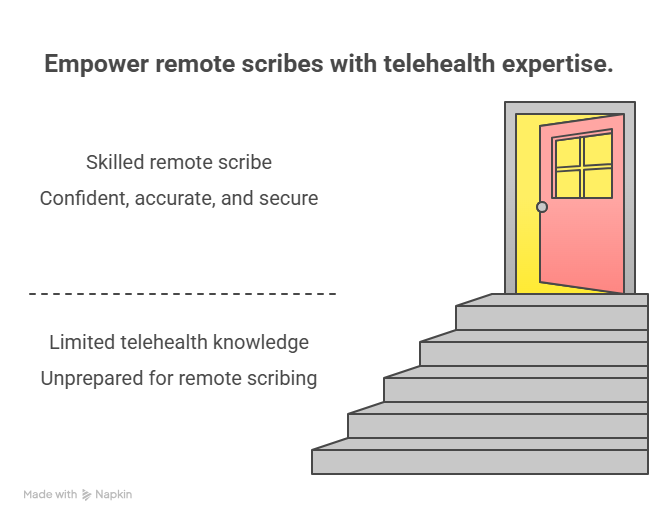
Remote scribing sounds flexible, but it creates a higher standard for attention. In a clinic room, a scribe may read body language, see exam flow, and catch context from the environment. In remote and telehealth work, the scribe depends on audio quality, encounter structure, provider cues, and secure digital workflows. That is why future candidates should study telehealth administration, telehealth platform terms, virtual patient management, and patient portal terminology.
Remote scribes need sharper discipline around patient identifiers, connection issues, visit transitions, and privacy. A telehealth note can fall apart when the patient’s complaint is captured vaguely, the provider’s follow-up is missed, the medication history is incomplete, or the documentation fails to reflect that the encounter occurred virtually. Candidates who understand patient privacy communication, HIPAA terms for scribes, and legal responsibilities for medical administrative professionals will feel more trustworthy to remote employers.
The future remote scribe will also need technology maturity. That means stable setup, secure access habits, clean communication with the provider, and comfort with workflow tools. A remote scribe may need to coordinate with schedulers, use internal messaging, review templates, update patient records, and support follow-up documentation. That connects scribing to broader medical office systems such as EMR integration tools, patient communication apps, secure patient scheduling tools, and medical records release tools.
Remote opportunity also changes how candidates should prepare for interviews. Employers will want evidence that you can stay accurate without direct supervision, handle interruptions, maintain confidentiality, ask clarification questions appropriately, and recover from audio uncertainty. Strong preparation through medical scribe interview questions, active listening techniques, and effective patient communication terms can turn remote work from a risky aspiration into a credible career direction.
5. The Best Career Strategy Is to Build a Scribe Skill Stack That Leads Somewhere
Medical scribing becomes more powerful when it serves a larger career plan. Some candidates use scribing as a bridge to medical school, PA school, nursing, clinical research, healthcare administration, coding, compliance, or operations. The mistake is treating the job like passive observation. The stronger approach is to convert every shift into proof: proof that you understand provider workflow, proof that you can handle patient stories responsibly, proof that you can support accurate records, and proof that you can improve with feedback. That mindset strengthens candidates exploring scribe-to-physician journeys, clinical research site pathways, and healthcare administration workforce trends.
A future-ready scribe skill stack should include five layers. The first is terminology, because every chart becomes harder when basic language is shaky. The second is EMR fluency, because speed and accuracy depend on system confidence. The third is compliance, because privacy mistakes damage trust quickly. The fourth is specialty awareness, because high-value roles require context. The fifth is career communication, because candidates must explain their skills clearly in resumes and interviews. ACMSO resources such as ICD-10 reference support, CPT code explanations, insurance verification terms, and medical billing terms can also help scribes understand the downstream impact of documentation.
The strongest candidates also know how to talk about mistakes. Every scribe will mishear a term, miss a detail, misunderstand a provider preference, or need correction. Employers care about recovery behavior: did you ask, fix, document the correction, and prevent the pattern from repeating? That is why training in risk management strategies, handling patient complaints professionally, difficult patient conversations, and de-escalation techniques can support the professionalism behind the chart.
Career planning should also include compensation awareness. Scribes who understand the difference between entry-level exposure, certified readiness, specialty experience, remote work, and promotion paths can make smarter decisions. Use medical scribe salary comparisons, CMAA salary reporting, certification earnings analysis, promotion rate reporting, and salary negotiation guidance to evaluate opportunity with more maturity.
6. FAQs: Medical Scribing Opportunities and Future Trends
-
The biggest opportunity is moving from basic transcription support into accuracy-focused documentation support. Scribes who understand clinical documentation standards, can work with AI scribe tools, and can adapt to telehealth scribing workflows will have a stronger long-term profile.
-
AI will change the work, especially in clinics adopting ambient dictation, but it also creates demand for review, correction, workflow support, and quality control. A scribe who can identify missing HPI details, unclear diagnoses, weak plan language, and privacy-sensitive errors can remain useful in teams using ambient documentation technology and voice recognition software.
-
Strong future areas include emergency medicine, urgent care, primary care, orthopedics, dermatology, ophthalmology, pediatrics, OB/GYN, hospital medicine, and telehealth. Candidates can explore emergency and urgent care scribe roles, primary care scribe networks, and pediatric and women’s health scribe opportunities to compare paths.
-
A beginner should start with terminology, chart structure, HIPAA, EMR basics, and specialty exposure. The fastest path is to combine medical terminology mastery, EMR charting terms, HIPAA compliance for scribes, and structured medical scribe certification preparation.
-
Remote scribing can be a strong path for candidates who can protect privacy, follow virtual workflows, handle audio-based documentation, and communicate clearly with providers. Preparation should include remote medical scribe employer research, telehealth platform knowledge, virtual patient management, and patient privacy communication.
-
Scribing builds exposure to clinical reasoning, provider workflow, patient communication, documentation standards, and specialty care patterns. That experience can support pathways into medicine, PA school, nursing, clinical research, healthcare administration, revenue cycle, or compliance when the candidate turns daily work into evidence. Strong next steps include studying scribe-to-physician journeys, clinical research scribe-to-CRC tracks, and career progression reporting.
