

Medical Records Management: Key Terms & Interactive Video Guide
Medical records management governs how health information is created, verified, classified, accessed, corrected, disclosed, retained, and eventually destroyed. A weak process produces duplicate charts, missing documents, privacy breaches, delayed care, failed audits, and denied claims. A disciplined process gives every authorized team member the right information at the right moment while preserving accuracy, traceability, and confidentiality. This guide explains the essential terminology, maps the complete record lifecycle, and provides an interactive video-learning framework for medical scribes, administrative assistants, and health information teams.
1. What Medical Records Management Actually Includes
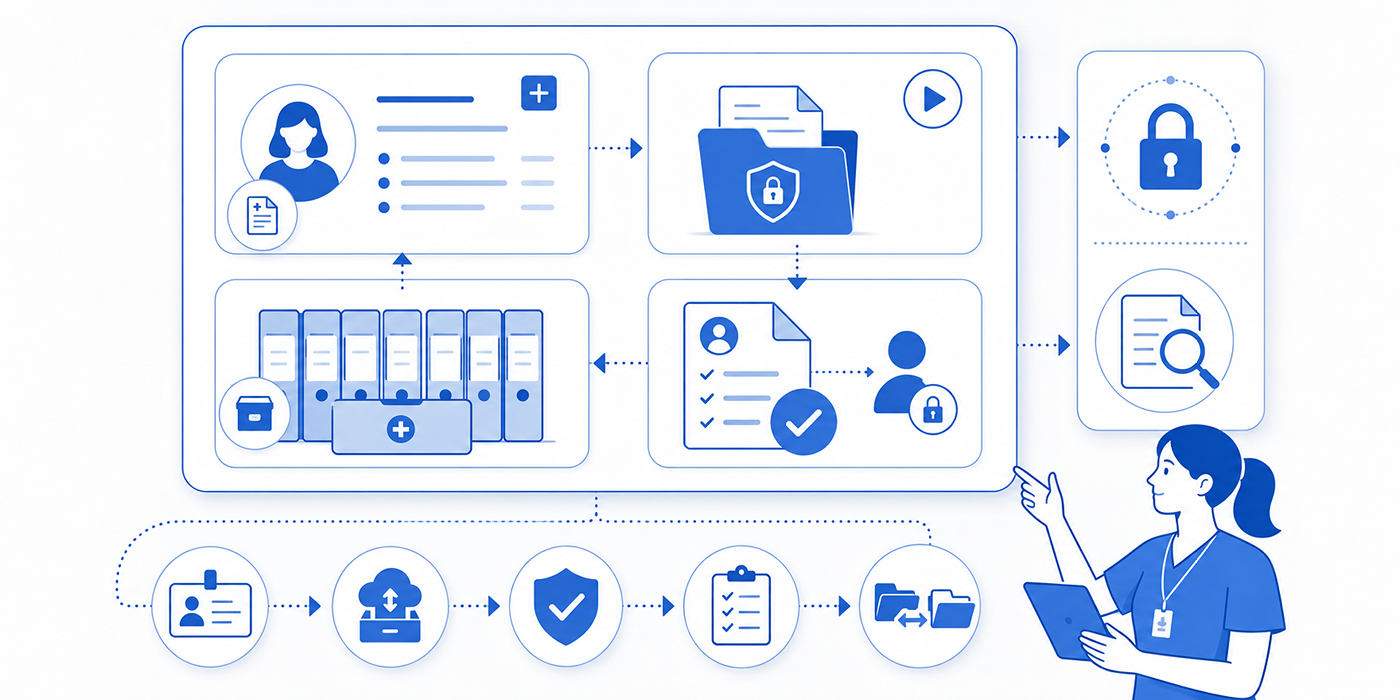
Medical records management covers far more than storing files inside an EHR. It is an operational control system that protects the clinical, administrative, financial, and legal value of every patient record. The process begins during patient intake, continues through documentation and EMR charting, and remains active when information is amended, released, audited, archived, or destroyed.
A medical record may contain demographic information, consent forms, histories, examination findings, diagnoses, medication lists, laboratory results, imaging reports, clinical notes, procedure documentation, billing data, correspondence, and external records. Each component may enter the organization through a different channel. The record may be typed directly into an EHR, imported through an interface, scanned from paper, received through a healthcare portal, dictated through documentation software, or transferred from another provider.
That complexity creates several dangerous failure points. A scanned report may be attached to the wrong patient. A document may enter the correct chart under the wrong category. A provider may copy outdated information into a new note. A staff member may disclose more information than an authorization permits. A correction may overwrite the original content instead of preserving the audit history. These failures directly affect documentation accuracy, patient confidentiality, claims integrity, and clinical decision-making.
The distinction between an EHR and a medical records management program is especially important. An EHR is a technology platform. Records management is the combination of governance, policies, role assignments, workflows, access controls, retention schedules, quality checks, and staff behavior surrounding that platform. Even sophisticated systems fail when organizations neglect EMR integration, inconsistent naming conventions, unresolved duplicate charts, or poorly trained users.
Medical records management also intersects with the revenue cycle. Diagnosis documentation supports ICD-10 coding, procedure details support CPT coding, and verified coverage information supports insurance verification. When the record lacks specificity, payers may request documentation, reduce payment, deny the claim, or recoup previously issued reimbursement.
The strongest programs assign responsibility across the record lifecycle. Front-desk teams validate identity and demographics. Clinical staff document care. Scribes support accurate note capture. Providers authenticate clinical entries. Coding and billing teams interpret documented services. Health information management teams govern release, amendments, retention, and record integrity. Compliance teams monitor privacy and security. Technology teams maintain system access, interfaces, backups, and availability.
| # | Key Term | Operational Meaning | Primary Risk | Practical Control |
|---|---|---|---|---|
| 1 | Legal Health Record | The official information set an organization recognizes as its record of patient care. | Inconsistent responses to audits, subpoenas, and patient requests. | Define included systems, documents, formats, and data sources in policy. |
| 2 | Designated Record Set | Records used to make decisions about an individual, subject to applicable access rules. | Incomplete patient access responses. | Maintain an inventory of systems and departments holding decision-related records. |
| 3 | Master Patient Index | The system that links each patient to a unique identity across the organization. | Duplicate, overlaid, or mismatched records. | Use standardized identity matching and duplicate-resolution workflows. |
| 4 | Medical Record Number | The organization-specific identifier assigned to a patient record. | Attaching documents to the wrong chart. | Verify multiple identifiers before chart selection or document import. |
| 5 | Record Overlay | Information from two different patients combined in one record. | Severe patient-safety and privacy consequences. | Escalate immediately and quarantine affected information during investigation. |
| 6 | Duplicate Record | Two or more records created for the same patient. | Fragmented history, allergies, results, and billing activity. | Search thoroughly before registration and route suspected duplicates for controlled merging. |
| 7 | Source Document | The original location or artifact from which record information is derived. | Loss of provenance and inability to verify accuracy. | Preserve origin, date, author, and import metadata. |
| 8 | Metadata | Information describing a document, including author, date, type, status, and location. | Documents becoming difficult to locate or interpret. | Require standardized document types and indexing fields. |
| 9 | Indexing | Assigning a document to the correct patient, encounter, category, date, and provider. | Clinicians overlooking relevant information. | Use controlled document categories and post-scan quality checks. |
| 10 | Authentication | Confirmation that an entry was completed or approved by its responsible author. | Unsigned or legally questionable documentation. | Monitor incomplete signatures, attestations, and co-signatures. |
| 11 | Attestation | A statement confirming review, accuracy, authorship, or supervisory approval. | Unclear responsibility for the final note. | Use approved attestation language tied to authenticated users. |
| 12 | Amendment | An authorized addition or correction made after an entry is finalized. | Destruction of the original record or hidden changes. | Preserve original content, reason, author, date, and amended information. |
| 13 | Addendum | Additional information entered after the original note to clarify or complete it. | Late entries appearing misleading or backdated. | Label the addendum and retain its actual entry timestamp. |
| 14 | Audit Trail | A chronological log showing access, creation, viewing, modification, printing, and disclosure activity. | Inability to investigate suspicious activity. | Protect logs from alteration and review high-risk events routinely. |
| 15 | Role-Based Access | Access granted according to job duties and legitimate operational need. | Excessive access to sensitive information. | Map permissions to roles and remove access promptly after role changes. |
| 16 | Minimum Necessary | Limiting certain uses or disclosures to the information required for the task. | Over-disclosure of unrelated clinical information. | Scope requests by recipient, purpose, date range, and document type. |
| 17 | Authorization | A patient-approved permission allowing specified information to be disclosed. | Invalid, expired, incomplete, or overbroad release. | Validate identity, recipient, purpose, scope, signature, and expiration. |
| 18 | Release of Information | The controlled process for disclosing records to patients, providers, payers, attorneys, and others. | Unauthorized disclosure or missed deadlines. | Use request tracking, validation checkpoints, and documented transmission. |
| 19 | Accounting of Disclosures | A record of qualifying disclosures required under applicable rules. | Incomplete disclosure history. | Capture recipient, date, purpose, authority, and information released. |
| 20 | Record Retention Schedule | A policy defining how long different records must be maintained. | Premature destruction or indefinite unnecessary storage. | Align schedules with jurisdiction, record type, age, contract, and legal obligations. |
| 21 | Legal Hold | A suspension of normal destruction when records may be relevant to litigation or investigation. | Destruction of potentially relevant evidence. | Flag affected records and document hold issuance, scope, and release. |
| 22 | Archiving | Moving inactive information into secure long-term storage while preserving accessibility. | Unreadable formats or inaccessible legacy data. | Test retrieval, migration, integrity, and format compatibility. |
| 23 | Disposition | The approved final action taken when the retention period ends. | Informal or undocumented destruction. | Require authorization and preserve disposition records. |
| 24 | Secure Destruction | Rendering records permanently unreadable and unrecoverable. | Recoverable protected information entering ordinary waste streams. | Use approved methods, vendors, chain-of-custody controls, and certificates. |
| 25 | Data Integrity | The accuracy, completeness, consistency, and reliability of information. | Unsafe decisions based on incomplete or altered data. | Use validation rules, reconciliations, audit logs, and exception queues. |
| 26 | Interoperability | The ability of systems to exchange and meaningfully use health information. | Lost context, duplicate testing, and fragmented records. | Validate interface mappings, identifiers, document types, and reconciliation. |
| 27 | Downtime Record | Documentation created while electronic systems are unavailable. | Information remaining outside the permanent record. | Use numbered forms and controlled post-downtime reconciliation. |
| 28 | Version Control | Management of document revisions so users can identify the current approved version. | Outdated forms, policies, or templates remaining in use. | Label versions, approval dates, owners, and retirement status. |
| 29 | Record Reconciliation | Comparing sources and resolving missing, duplicated, inconsistent, or unmatched information. | Imported data remaining incomplete or clinically misleading. | Assign exception queues, owners, deadlines, and escalation thresholds. |
| 30 | Record Custodian | The person or organization responsible for maintaining and producing the record. | Unclear accountability for preservation, access, and production. | Define custodianship by system, location, record category, and business function. |
2. How the Key Medical Records Terms Work Together
Memorizing definitions produces limited value unless staff understand the relationships among them. A patient’s medical record moves through four connected control domains: identity, integrity, access, and lifecycle. Weakness in one domain usually contaminates the others.
Identity controls prevent information from entering the wrong chart
Reliable records begin with correct patient matching. The medical record number, demographic fields, and master patient index work together to distinguish one individual from another. Registration shortcuts create some of the costliest errors in records management. A misspelled name may be corrected later; an incorrect identity match can distribute allergies, diagnoses, medication histories, and claims activity across two people.
Front-desk teams should use standardized front-desk operations, structured appointment-scheduling practices, and secure patient scheduling tools. Staff should compare multiple identifiers before creating a new chart, opening an existing record, attaching a document, or sending information through a patient communication application.
Integrity controls keep the record clinically reliable
Integrity depends on authorship, authentication, timestamps, amendments, metadata, and audit trails. Each entry should show who created it, when it was entered, its status, and whether another professional reviewed or authenticated it. Documentation support staff should understand the difference between recording what occurred and interpreting clinical meaning beyond their role.
This distinction is central to medical terminology mastery, clinical documentation improvement, and medical chart audits. A polished note still fails when it contains copied-forward contradictions, unsupported diagnoses, vague procedure descriptions, missing medication changes, or unverified test results.
Amendments require particular discipline. The correction should identify the inaccurate content, preserve the original entry, show the reason for the change, and retain the identity and timestamp of the person making it. Staff should never silently replace finalized documentation. Hidden changes destroy traceability and make legitimate corrections appear suspicious during an audit.
Access controls limit who can see and disclose information
Authentication verifies the user. Authorization determines what the authenticated user may do. Role-based access connects permissions to job duties. Audit trails show how those permissions were used. These controls support HIPAA compliance for scribes, patient privacy communication, and the broader legal responsibilities of medical administrative assistants.
Access should be reviewed when employees transfer departments, change duties, begin leave, or leave the organization. Shared accounts, unattended screens, unnecessary printing, downloaded files, unsecured email, and excessive permissions create preventable exposure. A privacy program becomes fragile when access reviews occur only after an incident.
Lifecycle controls govern retention and final disposition
Records remain subject to management after an encounter closes. Organizations must determine which records are active, inactive, archived, under legal hold, eligible for destruction, or maintained in legacy systems. Retention schedules should account for record type, jurisdiction, patient age, payer requirements, contractual obligations, investigations, and litigation.
The most dangerous assumption is that digital storage eliminates retention risk. Keeping everything indefinitely expands breach exposure, increases migration complexity, makes discovery more expensive, and preserves redundant information without operational purpose. Controlled disposition should follow written medical office policies and procedures, documented risk-management strategies, and approved destruction methods.
3. The Complete Medical Record Lifecycle From Intake to Destruction
A dependable lifecycle uses defined checkpoints rather than relying on individual memory. Every stage should have an owner, required inputs, acceptance criteria, exception process, and evidence of completion.
Step 1: Create or receive the information
Information may originate during registration, clinical documentation, dictation, external referral, diagnostic testing, patient upload, telehealth encounter, fax, or system interface. Staff should establish the source, patient identity, encounter, date, author, document type, and status before the information enters the permanent record.
Remote encounters need the same discipline. Telemedicine workflows, telehealth administration, and virtual patient management may introduce recordings, chat messages, consent documentation, portal questionnaires, remote-monitoring data, and platform-generated reports. Organizations should decide which artifacts become part of the record and how each is captured.
Step 2: Validate the information
Validation determines whether an item is complete, readable, correctly attributed, and suitable for use. A laboratory report without patient identifiers, a referral missing its sender, or a scanned form with clipped pages should enter an exception queue rather than the final chart.
Validation also includes documentation quality. Teams should check for missing signatures, unresolved placeholders, contradictory dates, incomplete histories, ambiguous diagnoses, and absent procedure details. These checks support accurate medical claims processing, reduce avoidable denials-management work, and strengthen revenue cycle management.
Step 3: Classify and index the record
A document attached to the correct patient can still become operationally invisible when it is filed under the wrong category. Indexing should use a controlled taxonomy for document type, specialty, encounter, date, author, and status. Free-text naming should be limited because “outside report,” “scan,” and “miscellaneous document” provide little retrieval value.
Template governance matters at this stage. Teams using documentation template libraries should retire outdated versions, identify approved owners, prevent uncontrolled duplication, and review specialty templates when clinical or regulatory requirements change. A template should help capture relevant information without pressuring users to document services or findings that did not occur.
Step 4: Store and protect the information
Stored records require availability, confidentiality, integrity, backup, and recoverability. Technical controls should include user authentication, permissions, encryption, monitoring, backup testing, interface validation, and downtime procedures. Administrative controls should address acceptable use, sanctions, access reviews, training, and incident escalation.
Operational teams should also prepare for EHR outages. During downtime, staff need approved forms, temporary identifiers, manual order processes, secure storage, and a reconciliation plan. Once systems return, each downtime document must be entered, scanned, indexed, or otherwise reconciled. Failure to complete this step leaves clinically important information stranded outside the longitudinal record.
Step 5: Use, exchange, and disclose the information
Authorized users may access records for care, operations, payment, quality review, patient requests, payer review, legal matters, research, or other permitted purposes. Each use should follow applicable rules and organizational policy.
Release-of-information teams should confirm the requester’s identity, authority, recipient, scope, date range, format, delivery method, and deadline. Efficient medical records release tools help track requests, but software cannot compensate for weak authorization review. One incorrect click can disclose years of sensitive information to the wrong person.
Communication skills are equally important. Patients requesting records may already feel frustrated by delays, confusing portal instructions, or previous denials. Staff should use active-listening techniques, clear patient communication, and structured de-escalation techniques while preserving identity-verification requirements.
Step 6: Retain, archive, hold, or destroy the record
When records become inactive, organizations may retain them in the production system, move them to an archive, migrate them to a replacement platform, place them under legal hold, or dispose of them after the approved retention period. Every transition should preserve provenance, readability, searchability, and access restrictions.
A migration project is especially risky. Patient identifiers may map incorrectly, document categories may collapse, signatures may disappear, or older image formats may become unreadable. Teams should test representative records, reconcile totals, document exceptions, and retain evidence that migrated information remains complete and accessible.
4. Interactive Video Guide: Follow One Record Through the Entire Workflow
A useful training video should show the record moving through realistic decisions rather than presenting disconnected definitions. The framework below can be used as an interactive companion beside an ACMSO training video, an internal onboarding recording, or a live instructor demonstration.
Chapter 1: Verify the patient before touching the record
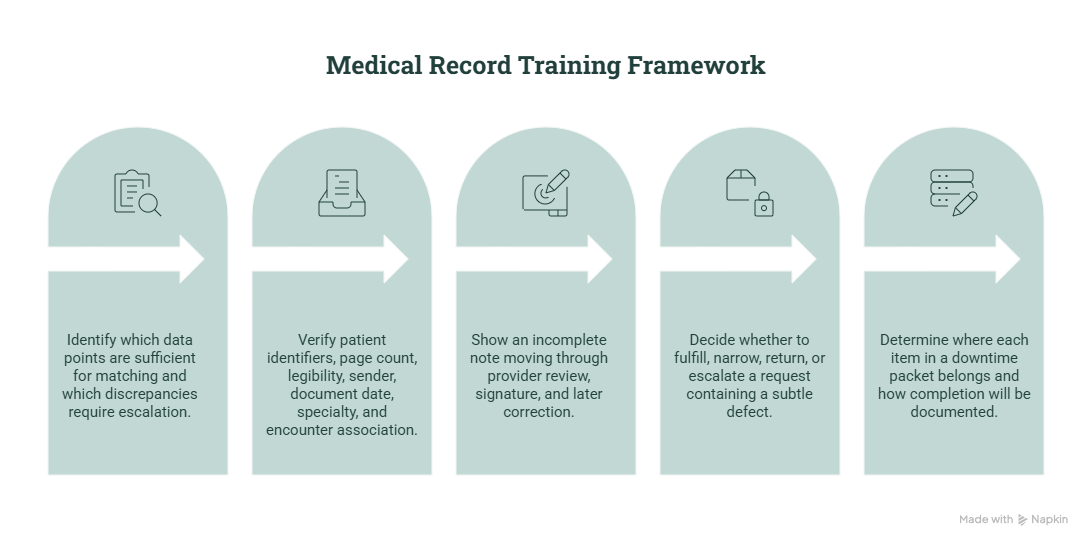
The video should begin with a realistic identity challenge: two patients with similar names and dates of birth, a returning patient using a new surname, or an individual whose demographic information conflicts with an existing chart. Viewers should pause and identify which data points are sufficient for matching and which discrepancies require escalation.
This chapter should connect registration behavior to scheduling conflict management, emergency appointment workflows, and daily office procedure checklists. Speed pressure should never push staff into selecting a questionable chart.
Chapter 2: Capture and classify the information
The next scene should follow an external report from receipt to final indexing. Viewers should verify patient identifiers, page count, legibility, sender, document date, specialty, and encounter association. The training should show how incorrect indexing can hide a clinically significant document even when the file exists in the EHR.
This chapter is particularly useful for teams using EMR shortcuts, because speed tools should support accuracy rather than bypass validation. It should also demonstrate how staff resolve common EMR issues and complete compliant patient record updates.
Chapter 3: Authenticate and amend documentation
The video should show an incomplete note moving through provider review, signature, and later correction. The original entry must remain visible in the audit history. The correction should be clearly labeled, dated, attributed, and connected to the content being corrected.
This scenario helps scribes apply essential documentation terminology while respecting the limits of their role. It also reinforces why certified medical scribes must understand authorship, attestation, accuracy, and provider authentication rather than treating note completion as a typing exercise.
Chapter 4: Process a record request safely
A strong video should include an authorization containing a subtle defect, such as an absent signature, unclear recipient, expired date, or broad request that conflicts with the stated purpose. Viewers should decide whether to fulfill, narrow, return, or escalate the request.
The demonstration should show secure delivery, request tracking, production review, and disclosure documentation. It should also cover how to communicate a delay without weakening privacy controls. Staff can apply techniques from difficult patient conversations, handling patient complaints, and empathy in healthcare administration.
Chapter 5: Reconcile downtime and external information
The video should end with a reconciliation exercise. Viewers receive a downtime packet containing a registration form, medication order, progress note, and test result. They must determine where each item belongs, whether it has already entered the EHR, who must review it, and how completion will be documented.
This chapter exposes a common operational blind spot: teams may restore the EHR successfully while leaving the patient record incomplete. Effective medical administrative workflows, organized office productivity systems, and disciplined time-management practices are essential when hundreds of paper records must be reconciled after an outage.
5. How to Build an Audit-Ready Medical Records Management Program
Audit readiness begins with observable controls. A policy alone does not prove that records are accurate, accessible, protected, and properly retained. Auditors and investigators look for evidence that the organization follows its stated process consistently.
Assign ownership at every stage
Each high-risk workflow needs an accountable owner. Registration leadership may own duplicate-prevention controls. Health information management may own amendments and release requests. Compliance may own access monitoring. Information technology may own backups, interfaces, and availability. Clinical leadership may own authentication and incomplete-note escalation.
Ownership should be documented in policies, job descriptions, escalation maps, and performance reports. Cross-functional teams can use collaboration tools, staff-scheduling systems, and medical admin time-tracking tools to manage backlogs without losing accountability.
Measure exceptions instead of relying on impressions
Useful records-management metrics include:
Duplicate record creation rate
Suspected overlay volume
Unindexed document backlog
Average time from receipt to final indexing
Incomplete note volume by department
Authentication turnaround time
Amendment frequency and reason
Record-request turnaround time
Returned authorizations by defect type
Misrouted disclosure incidents
Excessive-access findings
Downtime reconciliation completion rate
Archive retrieval success rate
Records eligible for disposition
Destruction certificates awaiting validation
The purpose of measurement is to expose where the process breaks under pressure. A department may appear efficient because it closes requests rapidly while repeatedly releasing excessive information. Another team may report a small backlog because unindexed documents remain in unmonitored inboxes. Metrics should therefore include volume, quality, timeliness, and unresolved risk.
Audit the complete workflow
Sampling only finalized records can miss upstream failures. A mature audit should examine registration searches, document queues, amendment histories, user access, request authorizations, transmission evidence, legal holds, and destruction logs. Teams can structure this work using a medical chart audit guide and connect findings to denial-management solutions, claims-management training, and CPT documentation training.
Train through scenarios and competency checks
Annual slide-based training rarely proves that staff can handle a complex record problem. Scenario-based learning is more effective because it requires the learner to recognize risk and choose an action.
Training scenarios should include similar patient names, incomplete authorizations, incorrect indexing, suspicious access, copied documentation, downtime recovery, legal holds, and legacy-system retrieval. Learners preparing for certification can strengthen related knowledge through an ACMSO study schedule, medical terminology memorization strategies, and realistic medical scribe questions.
Competency should be measured through observable tasks: correctly matching a patient, indexing a document, identifying an invalid authorization, explaining an amendment, reconciling downtime paperwork, or escalating a suspected overlay. Staff who cannot perform these tasks need targeted coaching before being given independent access to high-risk workflows.
6. Frequently Asked Questions About Medical Records Management
-
Medical records management focuses on controlling records throughout their lifecycle, including creation, classification, storage, access, disclosure, retention, and destruction. Health information management is a broader professional field that may also include coding, data quality, privacy, analytics, informatics, compliance, and information governance.
The two functions overlap heavily. Professionals studying EHR versus EMR terminology, healthcare CRM terms, and emerging medical administration technologies should understand that records may exist across multiple systems even when the EHR remains the primary clinical platform.
-
The organization or provider that creates and maintains the record generally acts as its custodian, while patients hold important rights concerning access, copies, corrections, and privacy under applicable laws. Exact ownership language and access rights can vary by jurisdiction.
Operationally, staff should avoid treating custodianship as unrestricted control. Patient requests must be managed through documented records-release procedures, privacy communication practices, and appropriate identity verification.
-
There is no universal retention period for every organization and record category. Requirements may differ by jurisdiction, patient age, facility type, provider type, payer contract, litigation status, and the nature of the document.
Organizations should maintain a written retention schedule reviewed by legal, compliance, clinical, records, and technology stakeholders. The schedule should distinguish clinical records, billing documentation, authorizations, audit logs, employee records, imaging, recordings, and temporary working documents. A legal hold must override routine destruction until formally released.
-
Finalized clinical information should generally be corrected through a traceable amendment, addendum, or correction process that preserves the original entry and records who made the change, when it was made, and why. Silent deletion can undermine integrity and create legal or compliance concerns.
Staff should follow approved EMR compliance training, scribe documentation terminology, and organizational amendment policies. Suspected wrong-patient documentation requires immediate escalation because the correction may affect two separate records.
-
The greatest operational risk is placing a complete and readable document into the wrong patient chart or wrong document category. Once indexed incorrectly, the document may influence the wrong patient’s care while remaining unavailable to the intended clinician.
A reliable scanning workflow verifies patient identity, page count, readability, document type, encounter, date, and routing destination. Post-scan quality checks should confirm that the electronic image matches the source before paper copies are destroyed according to policy.
-
Claims depend on documentation that supports the billed diagnosis, procedure, level of service, medical necessity, and provider participation requirements. Missing signatures, vague diagnoses, inconsistent dates, incomplete procedure details, and absent authorization documentation can delay or reduce payment.
Administrative teams should connect records management with EOB interpretation, superbill workflows, clearinghouse processes, and prior authorization management. Accurate records provide the evidence needed to submit, correct, appeal, and defend claims.
