

Medical Compliance Terms: Interactive Reference & Examples
Medical compliance failures rarely begin with dramatic misconduct. They usually start with a rushed identity check, excessive chart access, an undocumented correction, or a claim submitted before discrepancies are resolved. Staff who understand the medical administrative workflow, patient confidentiality, medical records management, medical coding errors, and HIPAA privacy terminology can recognize risk before it becomes a breach, repayment demand, audit finding, or patient complaint. This reference translates essential compliance language into practical actions for real medical-office situations.
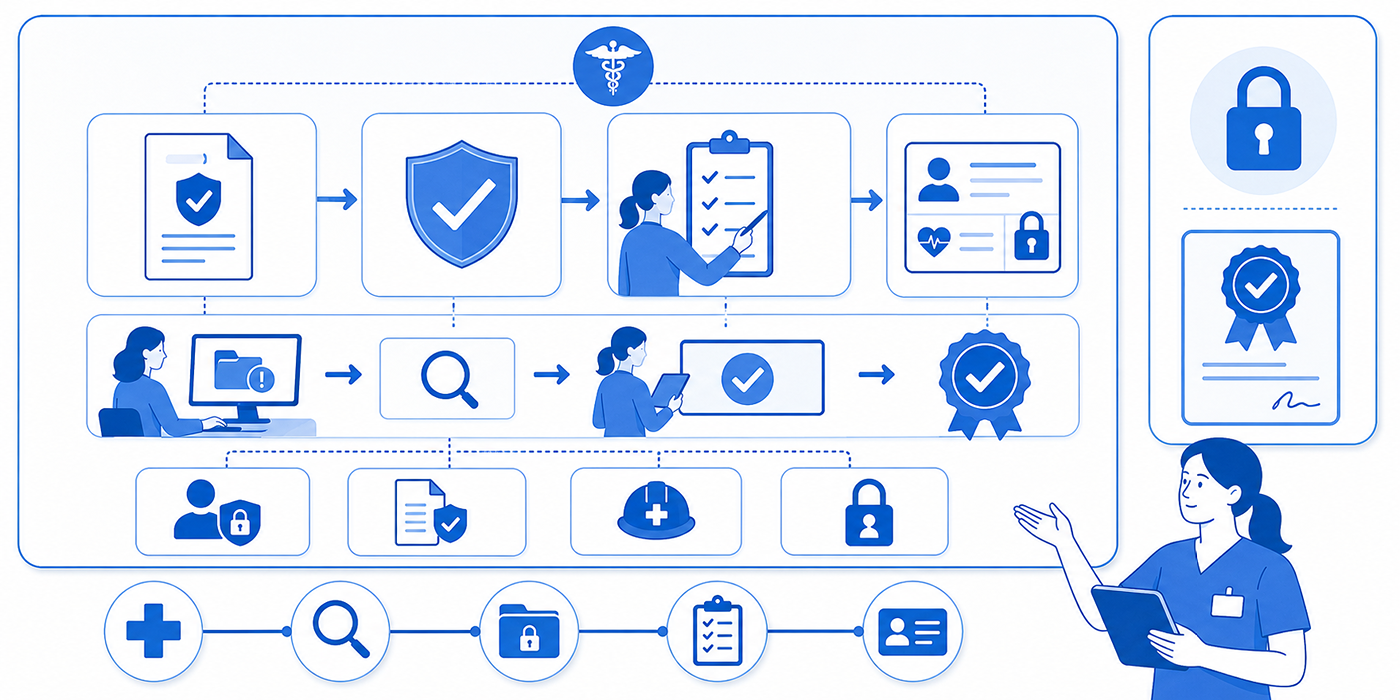
1. What Medical Compliance Means in Daily Healthcare Operations
Medical compliance is the organized process of meeting applicable legal, regulatory, contractual, ethical, and organizational requirements while delivering healthcare and managing patient information. It reaches far beyond annual HIPAA training. Compliance affects patient intake procedures, front-desk operations, EMR and charting practices, insurance verification, and patient communication.
A compliant employee asks operational questions before acting. Has the patient’s identity been confirmed using approved identifiers? Does the employee have a work-related reason to open this record? Does the documentation support the selected code? Has the disclosure recipient been verified? Does a vendor relationship require a business associate agreement? These questions turn broad regulations into measurable behavior.
The HIPAA Privacy Rule governs permitted uses and disclosures of protected health information, while the Security Rule requires administrative, physical, and technical safeguards for electronic protected health information. The Breach Notification Rule establishes notification duties following certain breaches of unsecured PHI. Together, these rules create a framework for controlling information use, securing electronic systems, and responding when protections fail.
A strong compliance system also covers billing integrity, referral relationships, employee screening, documentation quality, workplace safety, complaint handling, and record access. That is why legal responsibilities for CMAAs, risk management strategies, effective medical-office policies, medical chart audits, and clinical documentation improvement belong within the same operational structure.
The highest-risk offices often have written policies that employees cannot translate into action. A receptionist may recognize the term “minimum necessary” yet disclose an entire record when only an appointment date was requested. A biller may understand “medical necessity” while overlooking documentation that fails to support the billed service. A manager may require annual training but never test whether staff can respond to a misdirected fax, suspicious login, patient access request, or suspected overpayment.
Effective compliance therefore depends on competency, documentation, escalation, and monitoring. Staff must know the correct action, record what happened, route uncertainty to the right person, and preserve evidence that the organization responded appropriately. OIG describes a compliance program as a system of internal policies and procedures designed to help an organization follow the law, supported by structured elements such as written standards, oversight, training, communication, monitoring, enforcement, and corrective action.
The table below translates major federal healthcare compliance terms into the operational decisions medical administrative professionals face. It draws on HHS guidance concerning privacy, security, breach response, business associates, and patient access; OIG materials concerning compliance and fraud-and-abuse laws; CMS overpayment guidance; ONC information-blocking resources; and OSHA workplace-safety standards.
| # | Compliance Term | Operational Meaning | Common Failure Point | Practical Example |
|---|---|---|---|---|
| 1 | Protected Health Information | Individually identifiable health information protected under HIPAA when held or transmitted by a regulated entity. | Treating names, appointment details, billing data, or verbal information as harmless. | A receptionist lowers their voice and verifies the caller before discussing an upcoming procedure. |
| 2 | Electronic PHI | Protected health information created, received, maintained, or transmitted electronically. | Leaving records exposed through shared logins, unencrypted devices, or insecure messaging. | A clinic prohibits staff from sending chart screenshots through personal messaging accounts. |
| 3 | Covered Entity | A regulated health plan, healthcare clearinghouse, or qualifying healthcare provider. | Assuming every healthcare-related organization has identical HIPAA responsibilities. | A medical practice identifies which HIPAA duties apply to its clinical and billing operations. |
| 4 | Business Associate | A person or organization performing certain services involving PHI for a covered entity. | Giving a vendor PHI access before classifying the relationship. | A cloud scheduling vendor is reviewed before patient data is uploaded. |
| 5 | Business Associate Agreement | A contract defining permitted PHI uses, safeguards, reporting duties, and other HIPAA responsibilities. | Treating a standard service agreement as sufficient. | The practice executes an appropriate BAA before a billing company receives patient files. |
| 6 | Minimum Necessary | A requirement to limit many PHI uses, disclosures, and requests to information reasonably needed for the purpose. | Sending an entire chart when a limited document would satisfy the request. | An authorization specialist accesses the relevant order and notes instead of unrelated history. |
| 7 | Role-Based Access | System permissions aligned with an employee’s assigned responsibilities. | Giving all employees broad chart access for convenience. | A scheduler can view appointment information without accessing restricted clinical modules. |
| 8 | Authorization | A valid patient permission used for certain PHI uses or disclosures beyond otherwise permitted purposes. | Using an incomplete, expired, or overly broad form. | Staff confirm the recipient, purpose, information scope, signature, and validity before release. |
| 9 | Notice of Privacy Practices | A notice explaining privacy practices, patient rights, and organizational duties. | Providing the notice without maintaining the required acknowledgement process. | Registration staff document the patient’s acknowledgement or the reason it could not be obtained. |
| 10 | Privacy Incident | An event involving possible inappropriate access, use, or disclosure of PHI. | Employees independently deciding that a small mistake does not require reporting. | A misdirected email is immediately escalated for formal assessment. |
| 11 | Breach | An impermissible use or disclosure of unsecured PHI that meets the applicable breach standard after assessment. | Calling every incident a breach or dismissing every incident as harmless. | The privacy officer documents the facts, recipients, data involved, mitigation, and risk analysis. |
| 12 | Security Incident | An attempted or successful unauthorized access, use, disclosure, modification, or interference involving information systems. | Ignoring repeated login failures, malware warnings, or unusual account activity. | IT disables a compromised account and preserves logs for investigation. |
| 13 | Risk Analysis | A documented assessment of threats and vulnerabilities affecting the confidentiality, integrity, and availability of ePHI. | Using a generic checklist that omits actual systems, devices, vendors, and data flows. | The practice maps where ePHI is stored, transmitted, backed up, and remotely accessed. |
| 14 | Risk Management | The process of selecting, implementing, and monitoring controls that reduce identified risks. | Completing an assessment without assigning corrective actions. | High-risk unsupported software receives an owner, deadline, replacement plan, and interim controls. |
| 15 | Administrative Safeguards | Policies and management measures governing workforce conduct and security responsibilities. | Relying on technology while ignoring training, access approval, and termination procedures. | Access is reviewed when employees transfer roles or leave the organization. |
| 16 | Physical Safeguards | Controls protecting facilities, workstations, devices, and media. | Positioning screens where visitors can view records. | Registration monitors use privacy positioning and automatically lock when unattended. |
| 17 | Technical Safeguards | Technology controls protecting access to and transmission of ePHI. | Shared passwords, inactive audit logs, or poorly controlled remote access. | Each employee uses a unique account with appropriate authentication and logging. |
| 18 | Audit Trail | A system-generated history of record access, changes, and relevant user activity. | Collecting logs without reviewing unusual behavior. | Compliance investigates repeated access to records outside an employee’s assigned department. |
| 19 | Medical Necessity | The clinical justification supporting why a service or item was reasonable under applicable coverage rules. | Confusing physician preference, patient request, and coverage justification. | A claim is held when the documentation fails to support the ordered service. |
| 20 | Upcoding | Reporting a higher-paying code that the documented service does not support. | Selecting codes based on desired reimbursement. | A coder queries the provider rather than increasing the service level independently. |
| 21 | Unbundling | Separately billing services that applicable coding rules require to be reported together. | Assuming every documented component may be billed separately. | The coding team reviews bundling edits before claim submission. |
| 22 | False Claims Act | A federal law creating liability for knowingly submitting or causing false claims involving government funds. | Believing only the individual who presses “submit” can create exposure. | A manager stops claims after discovering a systematic documentation defect. |
| 23 | Anti-Kickback Statute | An intent-based criminal law addressing remuneration connected to federal healthcare program referrals or business. | Evaluating an arrangement solely by whether money changed hands. | Legal and compliance teams review free services offered by a referral source. |
| 24 | Stark Law | A physician self-referral law covering designated health services and certain financial relationships unless an exception applies. | Assuming a commercially reasonable arrangement automatically satisfies every requirement. | A physician compensation agreement is reviewed before related referrals begin. |
| 25 | Overpayment | Payment received beyond the amount properly due under applicable rules. | Correcting future claims while leaving previously identified excess payments unresolved. | Billing quantifies the affected claims and starts the approved refund process. |
| 26 | Exclusion Screening | Checking whether an individual or entity is excluded from participation in federally funded healthcare programs. | Screening clinicians while overlooking contractors, vendors, owners, or temporary workers. | HR and compliance verify exclusion status during onboarding and ongoing monitoring. |
| 27 | Corrective Action Plan | A documented response identifying the cause, remedy, owner, deadline, and validation method for a compliance problem. | Retraining employees without addressing system design or supervision failures. | A duplicate-billing problem triggers system edits, refunds, training, and follow-up auditing. |
| 28 | Sanction Policy | A documented framework for consistent disciplinary responses to policy violations. | Applying consequences differently according to seniority or revenue contribution. | Unauthorized celebrity-record access is investigated under the same approved policy used for all staff. |
| 29 | Information Blocking | Certain practices that interfere with the access, exchange, or use of electronic health information. | Delaying releases through blanket policies that lack a valid operational or legal basis. | A portal-release rule is reviewed when it systematically delays patient access. |
| 30 | 42 CFR Part 2 | Federal confidentiality requirements applying to certain substance use disorder patient records. | Handling specially protected records through ordinary release workflows without review. | A records specialist routes a substance-use-disorder disclosure request through the approved Part 2 process. |
2. Core Medical Compliance Terms and How They Work Together
PHI, ePHI, covered entities, and business associates: PHI can exist in electronic, paper, or oral form. ePHI refers to protected information handled electronically. A business associate performs certain functions or services involving PHI for a covered entity, while a workforce member operates within the covered entity’s organizational structure. HIPAA generally requires appropriate contracts with business associates so permitted uses, safeguards, reporting duties, and subcontractor responsibilities are defined. A vendor’s access and function must be examined before information is shared.
This classification directly affects EMR integration tools, patient communication applications, secure scheduling tools, healthcare CRM platforms, and telehealth platforms. A signed software contract cannot replace an appropriate privacy and security review. Staff should confirm what information the platform receives, where it is stored, who can access it, how incidents are reported, and how data is returned or destroyed when the relationship ends.
Minimum necessary, role-based access, and authorization: Minimum necessary controls reduce unnecessary exposure by limiting many uses, disclosures, and requests to the information reasonably needed. Role-based access applies the same discipline inside information systems by linking permissions to job responsibilities. Authorization becomes important when a planned use or disclosure requires specific patient permission. These concepts should be built into patient privacy communication, medical records release tools, patient portal management, virtual patient management, and record-update training.
The practical failure occurs when convenience overrides purpose. Employees may browse a family member’s record, open a familiar patient’s chart without an assignment, print more information than a recipient needs, or send a full chart when one report would satisfy the request. A compliant workflow requires staff to identify the purpose, verify the requester, determine the permitted basis, limit the information, select an approved transmission method, and document the disclosure when required.
Risk analysis, safeguards, and audit trails: The HIPAA Security Rule requires regulated entities to evaluate risks and vulnerabilities affecting ePHI and implement reasonable and appropriate safeguards. HHS describes risk analysis as the first step in the broader risk-management process. Administrative, physical, and technical protections work together; cybersecurity software cannot compensate for weak access termination, poor device handling, or untrained employees.
A realistic assessment should cover the systems described in EHR versus EMR guidance, common EMR software issues, medical-office collaboration tools, staff scheduling tools, and medical admin time-tracking tools. It should trace patient data across laptops, scanners, email, cloud storage, remote connections, backups, interfaces, mobile devices, printers, vendors, and archived systems.
Medical necessity, coding integrity, and claim accuracy: A documented diagnosis alone does not automatically support every service. The record must show what occurred, why it occurred, and how the submitted codes reflect the documented encounter. Upcoding, unbundling, duplicate billing, unsupported modifiers, mismatched units, copied documentation, and inaccurate dates can convert workflow weakness into repayment or enforcement risk.
That is why ICD-10 code knowledge, CPT code training, medical billing terminology, medical claims processing, and revenue cycle management must be coordinated. Coders should query ambiguous documentation instead of inferring unsupported detail, while billing staff should stop claims that contain known discrepancies.
False claims, kickbacks, self-referrals, overpayments, and exclusions: The False Claims Act can create liability when a person knowingly submits or causes the submission of a false claim to the government. The federal Anti-Kickback Statute is an intent-based criminal statute concerning remuneration tied to federal healthcare program referrals or business. The Stark Law covers certain physician referrals for designated health services involving financial relationships unless an exception applies.
These risks can enter through medical credentialing, prior authorization workflows, superbill preparation, clearinghouse submissions, and denials management. Employees should escalate suspicious compensation arrangements, referral incentives, systematic coding inflation, identified overpayments, and excluded-person concerns instead of trying to resolve legal questions independently.
CMS guidance states that applicable Medicare overpayments must be reported and returned within the governing timeframe after identification, subject to the relevant rules. OIG maintains the List of Excluded Individuals/Entities, and excluded individuals or entities generally cannot receive federal healthcare program payment for items or services they furnish, order, or prescribe.
3. Where Medical Compliance Breaks During Real Workflows
The first major danger point is identity and authority verification. A spouse requests results, an adult child asks for appointment details, an employer calls about a work note, or a third-party representative demands records immediately. Helpful staff can disclose information before confirming identity, authority, scope, and permitted purpose. Strong active-listening techniques, difficult-conversation procedures, de-escalation skills, appointment-conflict guidance, and patient complaint protocols help staff remain respectful without surrendering required controls.
The second breakdown occurs through documentation shortcuts. Copy-forward text can preserve outdated symptoms. Templates can create findings that were never assessed. Late entries may be added without proper identification. Staff may confuse a suspected condition with a confirmed diagnosis or convert a vague procedure description into a specific code. The resulting record can distort clinical decisions, billing, quality reporting, and future audits.
Medical scribes and administrative teams need consistent documentation terminology, specialty template guidance, medical terminology mastery, emergency-room scribing techniques, and HIPAA compliance training. Accuracy improves when unclear information remains flagged for provider clarification rather than being completed through guesswork.
The third breakdown involves technology and vendor assumptions. Employees may believe a familiar brand, encrypted website, or cloud platform is automatically suitable for PHI. HHS explains that a cloud service provider creating, receiving, maintaining, or transmitting ePHI for a regulated entity generally requires an appropriate business associate agreement along with compliance with applicable HIPAA requirements.
A safe technology workflow evaluates the platform, data involved, access model, contract, security controls, retention, incident duties, integration risks, and termination process. These reviews should accompany telehealth administration, AI and automation adoption, emerging medical technologies, predictive analytics, and healthcare portal use.
The fourth breakdown appears when employees fear escalation. A staff member discovers a duplicate claim, opens the wrong chart, receives an unusual vendor request, or notices a coworker accessing records without a clear purpose. Silence allows a manageable problem to grow. Effective programs provide confidential reporting channels, prohibit retaliation, establish escalation routes, and distinguish good-faith reporting from personal accusation. Employees should report facts, preserve relevant evidence, avoid independent investigations, and allow authorized personnel to assess the concern.
The fifth breakdown comes from conflicting access and privacy instincts. Some offices release information too freely, while others create unnecessary barriers to patient access. HIPAA gives individuals rights over their health information, including access to medical and billing records in a designated record set, subject to limited exceptions. Information-blocking rules also address certain practices that interfere with access, exchange, or use of electronic health information.
4. Practical Medical Compliance Examples and Correct Responses
Example 1: A lab result is emailed to the wrong patient. The employee should avoid deleting evidence, concealing the event, or deciding independently that the result was harmless. The correct response is immediate reporting through the privacy-incident process, preservation of relevant details, mitigation where appropriate, and documented assessment by authorized personnel. The Breach Notification Rule requires notification following qualifying breaches of unsecured PHI, while the organization must first evaluate the incident under applicable standards.
Prevention should connect patient intake accuracy, patient portal controls, privacy communication procedures, record-release technology, and daily office checklists. High-risk transmissions should require recipient verification, attachment confirmation, and a final pause before release.
Example 2: A manager tells a coder to choose a higher-paying code so the practice can “make up” for denied claims. The coder should stop the affected claim, document the instruction factually, and escalate it through the approved compliance route. Coding must follow the service documented in the record and applicable coding rules. Revenue pressure does not supply missing clinical support.
The control structure should combine CPT reference knowledge, ICD-10 understanding, claims-management training, coding-error scenarios, and denial-management procedures. Managers should measure clean-claim accuracy, query resolution, corrected-claim rates, and error recurrence rather than rewarding unsupported code intensity.
Example 3: A transcription, analytics, or AI vendor requests sample patient records for testing. Staff should pause the transfer and route the request for privacy, security, contractual, and operational review. The reviewer must determine what data the vendor needs, whether de-identification or synthetic data can satisfy the purpose, whether the vendor is functioning as a business associate, what agreement is required, and what safeguards govern storage, access, reuse, and deletion.
This process should be integrated into AI automation governance, future medical documentation planning, EMR integration reviews, telemedicine administration, and future-proofing CMAA skills. Informal testing with live records creates unnecessary exposure and weakens accountability.
Example 4: An employee loses a laptop containing access to patient systems. The incident requires immediate reporting, account protection, device-management actions, investigation, and assessment of the information involved. The organization should determine whether the device contained ePHI, whether data was encrypted, whether remote access remained active, when the device was last used, and whether logs show suspicious activity.
Preventive controls include unique credentials, multifactor authentication where appropriate, encryption, remote-device management, automatic lock settings, restricted local storage, prompt access termination, and a tested incident-response process. Those controls should reinforce EMR troubleshooting procedures, medical-office organization, collaboration-tool governance, remote patient-management practices, and medical records management.
Example 5: A patient requests records through the portal, but staff delay the request because the account has an unpaid balance. The request should be handled under the organization’s access policy and applicable law, with identity verification, scope confirmation, tracking, lawful fee review, and escalation of any proposed denial or delay. HHS states that individuals generally have the right to inspect and receive copies of medical and billing records held in covered designated record sets, subject to limited exceptions.
Staff should understand healthcare portal terminology, patient confidentiality rules, record-update compliance, effective patient communication, and complaint-handling obligations. Delays should be based on an applicable reason and documented process rather than inconvenience or punitive office policy.

5. How to Build a Compliance-Ready Medical Office System
Begin with clear ownership. Every major compliance function needs a responsible role, defined authority, escalation route, backup contact, and reporting timetable. Privacy, security, billing, credentialing, workplace safety, records access, and vendor oversight may involve different specialists, yet their responsibilities should connect. An incident involving a hacked billing vendor may require privacy, security, legal, revenue-cycle, leadership, and patient-communication decisions.
OIG’s compliance guidance emphasizes seven familiar program components: written policies and procedures, compliance leadership and oversight, training and education, effective communication channels, enforcement through incentives and disciplinary measures, risk assessment and auditing, and prompt response with corrective action. The organization should adapt these elements to its size, services, workforce, risks, and resources.
Written controls should connect medical-office policies, daily procedure checklists, front-desk workflows, emergency appointment management, and office inventory management. Each policy should identify who performs the task, which system or form is used, what evidence must be retained, where exceptions go, and how supervisors verify completion.
Next, build a living risk register. Record each identified risk, affected process, likely cause, existing control, severity, owner, corrective action, due date, and validation result. Generic entries such as “HIPAA risk” produce weak action. Specific entries such as “terminated employees retain portal access for up to 48 hours” can be measured and corrected.
Risk reviews should draw from medical chart audits, claims-processing errors, insurance verification problems, appointment scheduling conflicts, and common EMR failures. Complaint logs, corrected claims, access reports, security alerts, near misses, and employee questions can expose control weaknesses before regulators or payers find them.
Training should be role-based and scenario-tested. A receptionist needs disclosure verification, privacy-safe communication, screen positioning, and escalation practice. A biller needs coding support, overpayment handling, claim correction, and payer-rule awareness. A scribe needs documentation boundaries, terminology accuracy, correction standards, and appropriate chart access. A manager needs investigation discipline, non-retaliation responsibilities, consistent sanctions, and corrective-action design.
Training resources can combine CMAA terminology preparation, medical scribe terminology, HIPAA terms for scribes, patient communication scenarios, and risk-management training. A passing quiz provides limited assurance unless employees can apply the rule under realistic pressure.
Finally, measure evidence of control effectiveness. Useful indicators include unauthorized-access alerts reviewed, access removed on time, privacy incidents reported promptly, record requests completed within policy, unresolved coding queries, duplicate claims, refund aging, overdue corrective actions, exclusion checks completed, vendors reviewed, and repeated errors by process.
Metrics should lead to decisions. A rising denial rate may require revenue-cycle analysis, while repeated registration mismatches may require patient intake redesign. Persistent complaint themes may require de-escalation training, while broad chart access may require EMR access restructuring and stronger patient privacy controls.
6. Frequently Asked Questions About Medical Compliance Terms
-
A privacy incident is an event that may involve inappropriate PHI access, use, or disclosure. A breach is a legal determination reached after applying the relevant standard and completing the required assessment. Employees should report the incident immediately rather than label it themselves. The privacy or compliance team then evaluates the information involved, recipient, access likelihood, mitigation, and other relevant facts. Use the organization’s patient confidentiality process, privacy communication guidance, legal responsibility framework, and risk-management procedure.
-
HIPAA privacy protections can apply to PHI in electronic, paper, and oral forms. The Security Rule specifically focuses on ePHI and requires appropriate administrative, physical, and technical safeguards. A spoken conversation in a public area, printed schedule left at reception, photographed chart, or emailed attachment can therefore create different forms of compliance risk. Staff should connect EHR and EMR terminology, medical records management, front-desk safeguards, and HIPAA terminology.
-
The employee should close the record, avoid further access, and report the event through the approved privacy process. The report should state what was opened, why it happened, how long access lasted, what information was viewed, and whether anything was copied, changed, printed, or disclosed. Supervisors should review access logs and contributing workflow failures. Relevant controls include EMR compliance training, charting terminology, medical chart auditing, and medical-office risk management.
-
A software company may become a business associate when it performs qualifying functions or services for a covered entity and creates, receives, maintains, or transmits PHI in that role. Selling software alone does not automatically create the relationship when the vendor has no PHI access. The actual function and data flow determine the analysis. Review EMR integration tools, patient communication apps, telehealth platforms, and healthcare CRM systems before implementation.
-
Administrative employees can correct administrative fields within their authority and approved procedures. They should avoid changing a provider’s clinical meaning, adding unsupported findings, resolving contradictions through assumption, or selecting a diagnosis the provider did not document. Clinical ambiguity should move through an approved query or clarification process. Staff can strengthen accuracy through clinical documentation improvement, medical coding-error training, medical terminology mastery, and specialty documentation templates.
-
Fraud involves intentional deception or misrepresentation for an unauthorized benefit. Waste generally involves inefficient or excessive practices that create unnecessary cost. Abuse involves practices inconsistent with sound fiscal, business, or medical standards and can cause unnecessary costs or improper payment. An ordinary error lacks the same intentional element as fraud, yet unresolved errors can still cause overpayments, inaccurate claims, audits, and corrective-action obligations. CMS provides resources describing healthcare fraud, waste, and abuse risks.
Teams should apply claims-processing controls, billing terminology, denial-management methods, and revenue-cycle monitoring to detect and correct each category appropriately.
